From Surf Wiki (app.surf) — the open knowledge base
Daniel Ortega
Dictator of Nicaragua (1985–1990; since 2007)

Dictator of Nicaragua (1985–1990; since 2007)
| Field | Value | |
|---|---|---|
| name | Daniel Ortega | |
| alongside | Rosario Murillo since 18 February 2025 | |
| office | Co-President of Nicaragua | |
| image | Daniel Ortega (cropped).jpg | |
| caption | Ortega in 2014 | |
| predecessor | Enrique Bolaños | |
| 1blankname | Vice President | |
| 1namedata | Jaime Morales Carazo | |
| (2007–2012) | ||
| Omar Halleslevens | ||
| (2012–2017) | ||
| Rosario Murillo | ||
| (2017–2025) | ||
| party | FSLN (1958-present) | |
| predecessor3 | Himself | |
| (as Coordinator of the JNR) | ||
| successor3 | Violeta Chamorro | |
| office4 | Coordinator of the | |
| Junta of National Reconstruction | ||
| predecessor4 | Francisco Urcuyo | |
| (as Acting President) | ||
| vicepresident3 | Sergio Ramírez | |
| successor4 | Himself | |
| (as President) | ||
| birth_name | José Daniel Ortega Saavedra | |
| birth_date | ||
| birth_place | La Libertad, Chontales, Nicaragua | |
| spouse | ||
| children | 7 with Rosario Murillo, including Juan Carlos Ortega Murillo | |
| 1 with Leticia Herrera | ||
| relatives | Humberto Ortega (brother) | |
| Camilo Ortega (brother) | ||
| Xiomara Blandino (daughter-in-law) | ||
| term_start | 10 January 2007 | |
| term_start3 | 10 January 1985 | |
| term_end3 | 25 April 1990 | |
| term_start4 | 18 July 1979 | |
| term_end4 | 10 January 1985 | |
| signature | Daniel Ortega Signature.svg | |
| awards | Al-Gaddafi International Prize for Human Rights | |
| allegiance | Nicaragua | |
| branch | {{plainlist | |
| serviceyears | {{plainlist | |
| rank | {{plainlist | |
| battles | Nicaraguan Revolution | |
| office1 | First Gentleman of Nicaragua | |
| termstart1 | 18 February 2025 | |
| preceded1 | Lila T. Abaunza (2005, as First Lady) |
(2007–2012) Omar Halleslevens (2012–2017) Rosario Murillo (2017–2025) (as Coordinator of the JNR) Junta of National Reconstruction (as Acting President) (as President) 1 with Leticia Herrera Camilo Ortega (brother) Xiomara Blandino (daughter-in-law)
- FSLN
- Nicaraguan Army
- 1956-1990
- 1990-2007
- 2007–present
- Major (1959-1978)
- Commander-in-chief (1978-present) Serving with Rosario Murillo (as First Lady) José Daniel Ortega Saavedra ( , ; born 11 November 1945) is a Nicaraguan politician who has been the co-president of Nicaragua since 18 February 2025, alongside his wife Rosario Murillo. He was the president of Nicaragua from 1985 to 1990 and from 2007 to 2025. He previously led Nicaragua as the first coordinator of the Junta of National Reconstruction from 1979 to 1985. Ortega has been described as an authoritarian leader and has invited comparisons to Anastasio Somoza. Media and politicians in the international community have referred to him as a dictator.
Ortega came to prominence with the overthrow and exile of US-backed dictator Anastasio Somoza Debayle in 1979 during the Nicaraguan Revolution. As a leader in the Sandinista National Liberation Front (, FSLN) Ortega became leader of the ruling Junta of National Reconstruction. A Marxist–Leninist, Ortega pursued a program of nationalization, land reform, wealth redistribution, and literacy programs during his first period in office. Ortega's government was responsible for the forced displacement of 10,000 indigenous people. In 1984, Ortega won Nicaragua's presidential election with over 60% of the vote as the FSLN's candidate. During his first term, he implemented policies to achieve leftist reforms across Nicaragua. Throughout the 1980s, Ortega's government faced a rebellion by US-backed rebels, known as the Contras. After a presidency marred by conflict and economic collapse, Ortega was defeated in the 1990 Nicaraguan general election by Violeta Chamorro.
Ortega was an unsuccessful presidential candidate in 1996 and 2001 but won the 2006 Nicaraguan general election. In office, he allied with fellow Latin American socialists. In contrast to his previous political career, his second administration abandoned most of his earlier leftist principles, alienating many of his former revolutionary allies. Under his tenure, Nicaragua has experienced democratic backsliding. In June 2018, organizations such as Amnesty International and the Organization of American States reported that Ortega had engaged in a violent oppression campaign against anti-government protests. The violent crackdown and subsequent constriction of civil liberties have led to waves of emigration to neighboring Costa Rica, with more than 30,000 Nicaraguans filing for asylum in that country.
His government jailed many potential rival candidates in the 2021 Nicaraguan general election, including Cristiana Chamorro Barrios. Ortega's government also imprisoned other opponents, such as former allies Dora María Téllez and Hugo Torres Jiménez. In August 2021, Nicaragua cancelled the operating permits of six US and European NGOs. Many critics of the Ortega government, including opposition leaders, journalists and members of civil society, fled the country in mid-2021. In his fourth term, Ortega ordered the closure of several NGOs, universities, and newspapers, and resumed his repression of the Catholic Church after a brief rapprochement, imprisoning prelate Rolando José Álvarez Lagos.
Early life
Early childhood
Ortega was born in La Libertad in Chontales Department, into a working-class family. His parents, Daniel Ortega Cerda and Lidia Saavedra, were opposed to the regime of Anastasio Somoza Debayle. Ortega's mother was imprisoned by Somoza's National Guard for being in possession of "love letters", which police said were coded political missives. Ortega and his two brothers grew up to become revolutionaries. His late brother Humberto Ortega was a former general, military leader, and published writer, and the third brother Camilo Ortega died fighting the Somoza regime in 1978. They had a sister, Germania, who died.
Juigalpa and Managua
Seeking stable employment, the family migrated from La Libertad to the provincial capital of Juigalpa, and then to a middle-class neighborhood in Managua. In Managua, Ortega and his brother studied at the upper-middle class high school, the LaSalle Institute, where Ortega was classmates with Arnoldo Aleman, who would go on to be mayor of Managua (1990–1995) and later President of Nicaragua (1997–2002). Ortega's father Daniel Ortega Cedra detested US military intervention in Nicaragua and Washington's support for the Somoza government. He imparted this anti-American sentiment to his sons.
Early political activity
From an early age, Ortega opposed Nicaragua's president Anastasio Somoza Debayle, and became involved in the underground movement against his government. Ortega and his brother Humberto formed the Insurrectionist, or Tercerista (Third Way) faction, culminating in the Nicaraguan Revolution. After the overthrow and exile of Somoza Debayle's government, Ortega became leader of the ruling multi-partisan Junta of National Reconstruction.
Ortega was first arrested for political activities at the age of 15, and quickly joined the then-underground Sandinista National Liberation Front (FSLN) in 1963. In 1964, Ortega travelled to Guatemala, where the police arrested him and turned him over to the Nicaraguan National Guard. After his release from detainment, Ortega arranged the assassination of his torturer, Guardsman Gonzalo Lacayo, in August 1967.
Imprisonment
He was imprisoned in 1967 for taking part in armed robbery of a branch of the Bank of America. Ortega was released in late 1974, along with other Sandinista prisoners, in exchange for Somocista hostages. While imprisoned at the El Modelo jail, just outside Managua, Ortega wrote poems, one of which he titled "I Never Saw Managua When Miniskirts Were in Fashion". During his imprisonment, Ortega was tortured. While he was incarcerated at El Modelo, his mother helped stage protests and hunger strikes for political prisoners; this resulted in improving the treatment of incarcerated Sandinistas.
Exile in Cuba
Upon release in 1974, Ortega was exiled to Cuba. There he received training in guerrilla warfare from Fidel Castro's Marxist–Leninist government. He later returned secretly to Nicaragua.
Sectional division within the FSLN
In the late 1970s, divisions over the FSLN's campaign against Somoza led Ortega and his brother Humberto to form the Insurrectionist, or Tercerista (Third Way) faction. The Terceristas sought to combine the distinct guerrilla war strategies of the two other factions, Tomás Borge's Guerra Prolongada Popular (GPP, or Prolonged People's War), and Jaime Wheelock's Proletarian Tendency. The Ortega brothers forged alliances with a wide array of anti-Somoza forces, including Catholic and Protestant activists, and other non-Marxist civil society groups. The Terceristas became the most effective faction in wielding political and military strength, and their push for FSLN solidarity received the support of revolutionary leaders such as Fidel Castro.
Marriage and family
Ortega married Rosario Murillo in 1979 in a secret ceremony. They moved to Costa Rica with her three children from a previous marriage. Ortega remarried Murillo in 2005 in order to have the marriage recognized by the Catholic Church, as part of his effort to reconcile with the church. The couple has eight children, three of them together. Murillo serves as the Ortega government's spokeswoman and a government minister, among other positions. Ortega adopted stepdaughter Zoilamérica Ortega Murillo in 1986, through a court case. In 1998, she accused him of sexually abusing her as a child.
Sandinista revolution and first presidency (1979–1990)
When Somoza was overthrown by the FSLN in July 1979, Ortega became a member of the five-person Junta of National Reconstruction, which included Sandinista militant Moisés Hassan, novelist Sergio Ramírez, businessman Alfonso Robelo, and Violeta Barrios de Chamorro, the widow of a murdered journalist. In September 1979, United States President Carter hosted Ortega at the White House, and warned him against arming other Central American leftist guerrilla movements. At the time, Ortega spoke truthfully when he denied Sandinista involvement in neighboring countries. When Ortega questioned the Americans about CIA support for anti-Sandinista groups, Carter and Deputy Secretary of State Warren Christopher said the reports were false. After the meeting, Carter asked Congress for $75 million in aid to Nicaragua, contingent on the Sandinista government's promise not to aid other guerrillas.
The FSLN came to dominate the junta, Robelo and Chamorro resigned, and in 1981 Ortega became the coordinator of the Junta. As the only member of the FSLN National Directorate in the Junta, he was the effective leader of the country. After attaining power, the FSLN embarked upon an ambitious programme of social reform. They arranged to redistribute 5 e6acre of land to about 100,000 families; launched a literacy drive, and made health care improvements that ended polio through mass vaccinations, and reduced the frequency of other treatable diseases. The Sandinista nationalization efforts affected mostly banks and industries owned by the extended Somoza family. More than half of all farms, businesses, and industries remained in private hands. The revolutionary government wanted to preserve a mixed economy and support private sector investment. The Superior Council of Private Enterprise (COSEP) opposed the Sandinistas' economic reform. The main organization of Nicaraguan big business was composed of prosperous families from the Pacific coast cities, who dominated commerce and banking. Ortega took a very hard line against opposition to his policies: On 21 February 1981, the Sandinista army killed 7 Miskito Indians and wounded 17.
Ortega's administration forced displacement of many of the indigenous population: 10,000 individuals had been moved by 1982. Thousands of Indians fled to take refuge across the border in Honduras, and Ortega's government imprisoned 14,000 in Nicaragua. Anthropologist Gilles Bataillon termed this "politics of ethnocide" in Nicaragua. The Indians formed two rebel groups – the Misura and Misurasata. They were joined in the north by Nicaraguan Democratic Force (FDN) and in the south by former Sandinistas and peasantry who, under the leadership of Edén Pastora, were resisting forced collectivization.
In 1980 the Sandinista government launched the massive Nicaraguan Literacy Campaign and said the illiteracy rate fell from 50% to 13% in the span of five months. Robert F. Arnove said the figures were excessive because many "unteachable" illiterates were omitted from the statistics, and many people declared literate were found to be unable to read or write a simple sentence. Richard Kraft said that even if the figures were exaggerated, the "accomplishment is without precedent in educational history". In 1980, UNESCO awarded Nicaragua the Nadezhda K. Krupskaya prize in recognition of its efforts. The FSLN also focused on improving the Nicaraguan health system, particularly through vaccination campaigns and the construction of public hospitals. These actions reduced child mortality by half, to 40 deaths per thousand. By 1982, the World Health Organization deemed Nicaragua a model for primary health care. During this period, Nicaragua won the UNESCO prize for exceptional health progress.
In 1981, United States President Ronald Reagan accused the FSLN of joining with Soviet-backed Cuba in supporting Marxist revolutionary movements in other Latin American countries, such as El Salvador. People within the Reagan administration authorized the CIA to begin financing, arming and training rebels as anti-Sandinista guerrillas, some of whom were former officers from Somoza's National Guard. These were known collectively as the Contras. This resulted in one of the largest political scandals in US history, (the Iran–Contra affair). Oliver North and several members of the Reagan administration defied the Boland Amendment, selling arms to Iran and using the proceeds in order to secretly fund the Contras.
The Contra war claimed 30,000 lives in Nicaragua. The tactics used by the Sandinista government to fight the Contras have been widely condemned for their suppression of civil rights. On 15 March 1982, the junta declared a state of siege, which allowed it to close independent radio stations, suspend the right of association, and limit the freedom of trade unions. Nicaragua's Permanent Commission on Human Rights condemned Sandinista human rights violations, accusing them of killing and forcibly disappearing thousands of persons in the first few years of the war.

At the 1984 general election Ortega won the presidency with 67% of the vote and took office on 10 January 1985. In the early phases of the campaign, Ortega enjoyed many institutional advantages, and used the full power of the press, police, and Supreme Electoral Council against the fractured opposition. In the weeks before the November election, Ortega gave a U.N. speech denouncing talks held in Rio de Janeiro on electoral reform. But by 22 October, the Sandinistas signed an accord with opposition parties to reform electoral and campaign laws, making the process more fair and transparent. While campaigning, Ortega promoted the Sandinistas' achievements, and at a rally said that "Democracy is literacy, democracy is land reform, democracy is education and public health." International observers judged the election to be the first free election held in the country in more than half a century. A report by an Irish governmentary delegation stated: "The electoral process was carried out with total integrity. The seven parties participating in the elections represented a broad spectrum of political ideologies." The general counsel of New York's Human Rights Commission described the election as "free, fair and hotly contested". A study by the US Latin American Studies Association (LASA) concluded that the FSLN (Sandinista Front) "did little more to take advantage of its incumbency than incumbent parties everywhere (including the U.S.) routinely do". However, the Reagan administration described the elections as "a Soviet-style sham", and contemporary North-American press coverage tended to cast doubt on the election's legitimacy.

Thirty-three per cent of the Nicaraguan voters cast ballots for one of six opposition parties—three to the right of the Sandinistas, three to the left—which had campaigned with the aid of government funds and free TV and radio time. Two conservative parties captured a combined 23% of the vote. They held rallies across the country (a few of which were disrupted by FSLN supporters) and blasted the Sandinistas in harsh terms. Most foreign and independent observers noted this pluralism in debunking the Reagan administration charge—ubiquitous in the US media—that it was a "Soviet-style sham" election. Some opposition parties boycotted the election, allegedly under pressure from US embassy officials, and so it was denounced as being unfair by the Reagan administration. Reagan thus maintained that he was justified to continue supporting what he referred to as the Contras' "democratic resistance".
The illegal intervention of the Contras continued (albeit covertly) after Ortega's democratic election. Peace talks between five Central American heads of state in July 1987 led to the signing of the Central American Peace Accords, and the beginning of a roadmap to the end of the conflict. In 1988, the Contras first entered into peace talks with the Sandinista government, although the violence continued, as did their US support. Despite US opposition, disarmament of the Contras began in 1989.
In opposition (1990–2007)
In the 1990 presidential election, Ortega lost his reelection bid to Violeta Barrios de Chamorro, his former colleague in the junta. Chamorro was supported by the US and a 14-party anti-Sandinista alliance known as the National Opposition Union (Unión Nacional Oppositora, UNO), an alliance that ranged from conservatives and liberals to communists. She ran an effective campaign, presenting herself as the peace candidate and promising to end the US-funded Contra War if she won. Ortega campaigned on the slogan, "Everything Will Be Better", and promised that, with the Contra war over, he could focus on the nation's recovery. Contrary to what most observers expected, Chamorro shocked Ortega and won the election. Chamorro's UNO coalition garnered 54% of the vote, and won 51 of the 92 seats in the National Assembly. Immediately after the loss, the Sandinistas tried to maintain unity around their revolutionary posture. In Ortega's concession speech the following day he vowed to keep "ruling from below" a reference to the power that the FSLN still wielded in various sectors. He also stressed his belief that the Sandinistas had the goal of bringing "dignity" to Latin America, and not necessarily to hold on to government posts. In 1991, Ortega said elections were "an instrument to reaffirm" the FSLN's "political and ideological positions", and also "confront capitalism". However, the electoral loss led to pronounced divisions in the FSLN. Some members adopted more pragmatic positions, and sought to transform the FSLN into a modern social democratic party engaged in national reconciliation and class cooperation. Ortega and other party insiders found common ground with the radicals, who still promoted anti-imperialism and class conflict to achieve social change.
Possible explanations for his loss include that the Nicaraguan people were disenchanted with the Ortega government as well as the fact that already in November 1989, the White House had announced that the economic embargo against Nicaragua would continue unless Violeta Chamorro won. Also, there had been reports of intimidation from the side of the contras, with a Canadian observer mission stating that 42 people were killed by the contras in "election violence" in October 1989. This led many commentators to assume that Nicaraguans voted against the Sandinistas out of fear of a continuation of the contra war and economic deprivation.
From 19 to 21 July 1991, the FSLN held a National Congress to mend the rifts between members and form a new overarching political program. The effort failed to unite the party, and intense debates over the internal governance of the FSLN continued. The pragmatists, led by the former vice president Sergio Ramirez, formed the basis of a "renovating" faction, and supported collaboration with other political forces to preserve the rule of law in Nicaragua. Under the leadership of Ortega and Tomás Borge, the radicals regrouped into the "principled" faction, and branded themselves the Izquierda Democratica (ID), or Democratic Left (DL). The DL fought the Chamorro government with disruptive labor strikes and demonstrations, and renewed calls for the revolutionary reconstruction of Nicaraguan society. During the 20–23 May 1994, extraordinary congress, Ortega ran against a fellow National Directorate member, Henry Ruiz, for the position of party secretary-general. Ortega was elected with 287 to Ruiz's 147 votes, and the DL secured the most dominant role in the FSLN.
On 9 September 1994, Ortega gained more power after taking over Sergio Ramirez's seat in the Asamblea Sandinista (Sandinista Assembly). Ramirez had been chief of the FSLN's parliamentary caucus since 1990, but Ortega came to oppose his actions in the National Assembly, setting the stage for Ramirez's removal. Historic leaders, such as Ernesto Cardenal, a former minister of culture in the Sandinista government, rejected Ortega's consolidation of power: "My resignation from the FSLN has been caused by the kidnapping of the party carried out by Daniel Ortega and the group he heads." The party formally split on 8 January 1995, when Ramirez and a number of prominent Sandinista officials quit.
Ortega ran for election again, in October 1996 and November 2001, but lost on both occasions to Arnoldo Alemán and Enrique Bolaños, respectively. In these elections, a key issue was the allegation of corruption. In Ortega's last days as president, through a series of legislative acts known as "The Piñata", estates that had been seized by the Sandinista government (some valued at millions and even billions of US dollars) became the private property of various FSLN officials, including Ortega himself.
In the 1996 campaign, Ortega faced the Liberal Alliance (Alianza Liberal), headed by Arnoldo Aleman Lacayo, a former mayor of Managua. The Sandinistas softened their anti-imperialist rhetoric, with Ortega calling the US "our great neighbor", and vowing to cooperate "within a framework of respect, equality, and justice". The image change failed, as Aleman's Liberal Alliance came first with 51.03% of the vote, while Ortega's FSLN secured 37.75%.
Ortega's policies became more moderate during his time in opposition, and he gradually changed much of his former Marxist–Leninist stance in favor of an agenda of democratic socialism. His Roman Catholic faith has become more public in recent years as well, leading Ortega to embrace a variety of socially conservative policies; in 2006 the FSLN endorsed a strict law banning all abortions in Nicaragua. In the run-up to the 2006 elections, Ortega displayed his ties to the Catholic Church by renewing his marriage vows before Cardinal Miguel Obando y Bravo.
Ortega was instrumental in creating the controversial strategic pact between the FSLN and the Constitutional Liberal Party (Partido Liberal Constitucionalista, PLC). The controversial alliance of Nicaragua's two major parties is aimed at distributing power between the PLC and FSLN, and preventing other parties from rising. After sealing the agreement in January 2000, the two parties controlled the three key institutions of the state: the Comptroller General of the Republic, the Supreme Court, and the Supreme Electoral Council. "El Pacto", as it is known in Nicaragua, is said to have personally benefited former presidents Ortega and Alemán greatly, while constraining then-president Bolaños. One of the key accords of the pact was to lower the ratio necessary to win a presidential election in the first round from 45% to 35%, a change in electoral law that would become decisive in Ortega's favor in the 2006 elections.
At the Fourth Ordinary Congress of the FSLN, held 17–18 March 2002, Ortega eliminated the National Directorate (DN). Once the main collective leadership body of the party, with nine members, the DN no longer met routinely, and only three historic members remained. Instead, the body just supported decisions already made by the secretary-general. Ortega sidelined party officials and other members while empowering his own informal circle, known as the ring of iron.
2001 presidential election
Main article: 2001 Nicaraguan general election
In the November 2001 general elections, Ortega lost his third successive presidential election, this time to Enrique Bolaños of the Constitutionalist Liberal Party.
Under Ortega's direction, the FSLN formed the broad National Convergence (Convergencia Nacional) coalition in opposition to the PLC. Ortega abandoned the revolutionary tone of the past, and infused his campaign with religious imagery, giving thanks in speeches to "God and the Revolution" for the post-1990 democracy, and said a Sandinista victory would enable the Nicaraguan people to "pass through the sea and reach the Promised Land". The US opposed Ortega's candidacy from the beginning. The US ambassador even appeared with the PLC's Enrique Bolaños while distributing food aid. The 11 September 2001, terrorist attacks doomed Ortega's chances, as the threat of a US invasion became an issue. Bolanos convinced many Nicaraguans that the renewed US hostility towards terrorism would endanger their country if the openly anti-US Ortega prevailed. Bolanos ended up with 56.3% of the vote, and Ortega won 42.3%.
2006 presidential election
Main article: 2006 Nicaraguan general election
In 2006, Daniel Ortega was elected president with 38% of the vote. This occurred despite the fact that the breakaway Sandinista Renovation Movement (MRS) continued to oppose the FSLN, running former Mayor of Managua, Herty Lewites as its candidate for president. Ortega personally attacked Lewites' Jewish background, compared him to Judas, and warned he "could end up hanged." However, Lewites died several months before the elections.
Ortega emphasized peace and reconciliation in his campaign, and selected a former Contra leader, Jaime Morales Carazo, as his running mate. The FSLN also won 38 seats in the congressional elections, becoming the party with the largest representation in parliament. The split in the Constitutionalist Liberal Party helped allow the FSLN to become the largest party in Congress; however, the Sandinista vote had a minuscule split between the FSLN and MRS, and that the liberal party combined is larger than the Frente Faction. In 2010, several liberal congressmen accused the FSLN of attempting to buy votes to pass constitutional reforms that would allow Ortega to run for office for the 6th time since 1984.
Second presidency (2007–present)
Daniel Ortega, President of the Republic of Nicaragua President Ortega Mister President
According to Tim Rogers, writing in The Atlantic, during his second term as president, Ortega took "full control of all four branches of government, state institutions, the military, and police", and in the process dismantled "Nicaragua's institutional democracy". Frances Robles wrote that Ortega took control "every aspect of government ... the National Assembly, the Supreme Court, the armed forces, the judiciary, the police and the prosecutor's office". In its 2019 World Report, Human Rights Watch wrote that Ortega "aggressively dismantled all institutional checks on presidential power". Many journalists and governments criticize Ortega and label him a dictator.
2008 elections
In June 2008, the Nicaraguan Supreme Court disqualified the MRS and the Conservative Party from participation in municipal elections. In November 2008, the Supreme Electoral Council received national and international criticism following irregularities in municipal elections, but agreed to review results for Managua only, while the opposition demanded a nationwide review. For the first time since 1990, the Council decided not to allow national or international observers to witness the election. Instances of intimidation, violence, and harassment of opposition political party members and NGO representatives have been recorded. Official results show Sandinista candidates winning 94 of the 146 municipal mayoralties, compared to 46 for the main opposition Liberal Constitutional Party (PLC). The opposition claimed that marked ballots were dumped and destroyed, that party members were refused access to some of the vote counts and that tallies from many polling places were altered. As a result of the fraud allegations, the European Union suspended $70m of aid, and the US$64m.
With the late-2000s recession, Ortega in 2011 characterised capitalism as in its "death throes" and portrayed the Bolivarian Alternative for the People of Our America (ALBA) was the most advanced, most Christian and fairest project. He also said God was punishing the United States with the financial crisis for trying to impose its economic principles on poor countries. "It's incredible that in the most powerful country in the world, which spends billions of dollars on brutal wars ... people do not have enough money to stay in their homes."
Before the National Sandinista Council held in September 2009, Lenin Cerna, the secretary of the party organization, called for diversifying its political strategies. He declared the FSLN's future depended on implementing new plans, "so that the party can advance via new routes and in new ways, always under Ortega's leadership". Ortega gained power over the selection of candidates, allowing him to personally choose all candidates for public office.
During an interview with David Frost for the Al Jazeera English programme Frost Over the World in March 2009, Ortega suggested that he would like to change the constitution to allow him to run again for president. In Judicial Decision 504, issued on 19 October 2009, the Supreme Court of Justice of Nicaragua declared portions of Articles 147 and 178 of the Constitution of Nicaragua inapplicable; these provisions concerned the eligibility of candidates for president, vice-president, mayor, and vice-mayor—a decision that had the effect of allowing Ortega to run for reelection in 2011.
For this decision, the Sandinista magistrates formed the required quorum by excluding the opposition magistrates and replacing them with Sandinista substitutes, violating the Nicaraguan constitution. Opposing parties, the church and human rights groups in Nicaragua denounced the decision. Throughout 2010, court rulings gave Ortega greater power over judicial and civil service appointments.
While supporting abortion rights during his presidency during the 1980s, Ortega has since embraced the Catholic Church's position of strong opposition. While non-emergency abortions have long been illegal in Nicaragua, recently even abortions "in the case where the pregnancy endangers the mother's life", otherwise known as therapeutic abortions have been made illegal in the days before the 2006 election, with a six-year prison term in such cases, too—a move supported by Ortega.
2011 election
Main article: 2011 Nicaraguan general election
Ortega was re-elected president with a vote on 6 November and confirmation on 16 November 2011. During the election, the Supreme Electoral Council (CSE) blocked both domestic and international poll observers from multiple polling stations. According to the Supreme Electoral Council, Ortega defeated Fabio Gadea, with 63% of the vote.
.jpg)
;2014 amendments In January 2014 the National Assembly, dominated by the FSLN, approved constitutional amendments that abolished term limits for the presidency and allowed a president to run for an unlimited number of five-year terms. While the FSLN claimed the amendments would assure the stability Nicaragua needed to deal with long-term problems, the opposition claimed they were a threat to democracy. The constitutional reforms also gave Ortega the sole power to appoint military and police commanders.
2016 elections
Main article: 2016 Nicaraguan general election
As of 2016, Ortega's family owns three of the nine free-to-air television channels in Nicaragua, and controls a fourth (the public Channel 6). Four of the remaining five are controlled by Mexican mogul Ángel González, and are generally considered to be aligned with Ortega's ruling FSLN party. There are no government restrictions on Internet use; the Ortega administration attempted to gain complete control over online media in 2015, but failed due to opposition from civil society, political parties, and private organizations. In June 2016, the Nicaraguan supreme court ruled to oust Eduardo Montealegre, the leader of the main opposition party, leaving the main opposition coalition with no means of contesting the November 2016 national elections. In August 2016, Ortega chose his wife, Rosario Murillo, as his vice-presidential running-mate for re-election. According to The Washington Post, figures announced on 7 November 2016, put Daniel Ortega in line for his third consecutive term as president, also being his fourth term overall. The Supreme Electoral Council (CSE) reported Ortega and Murillo won 72.4% of the vote, with 68% turnout. The opposition coalition had called the election a "farce" and had called for the boycott of the election. International observers were not allowed to observe the vote. Nevertheless, according to the BBC, Ortega was the most popular candidate by far, possibly due to Nicaragua's stable economic growth and lack of violence compared to its neighbours El Salvador and Honduras in recent years.
;Economic situation during presidency According to Tim Rogers, until the 2018 unrest, as president Ortega presided over "the fastest-growing economy in Central America" and was a "poster child for foreign investment and citizen security in a region known for gangs and unrest". During this time the Ortega government formed an alliance with the Superior Council for Private Enterprise (COSEP), Nicaragua's council of business chambers. However the same unpopular decree which had the effect of "unilaterally overhauling the social-security tax system" (mentioned below) and precipitated the unrest in April 2018, also broke Ortega's arrangement with COSEP, and along with US sanctions, brought a sharp economic drop that as of mid-2020 is still "crippling" Nicaragua's economy.
Response to the COVID-19 pandemic
Main article: COVID-19 pandemic in Nicaragua
Ortega's government has been the target of criticism for its lack of a response to the pandemic.
On 14 March 2020, Ortega's government called a massive demonstration called "Love in the Time of COVID-19" as a show of support to him and his government. This occurred in the middle of the COVID-19 pandemic which had only recently been officially declared by the WHO.
According to CNN, as of mid-June 2020, Ortega had "refused to impose strict, preventive quarantine measures seen in neighboring countries" to fight the COVID-19 pandemic. "Public schools remain open, businesses continue to operate, festivals and cultural events are happening on an almost-weekly basis." The story stated that from mid-March to mid-June six politicians had died, and, according to witnesses, their remains disposed of at night in "express burials" (with police in attendance but "no Mass, no wake and no funeral arrangements", no photographs). The Ortega government said reports of "express burials" were "false news". According to AP News "the government threatened to ban" professional baseball players "who refuse to play baseball ... And everyone is warned to keep quiet." In hospitals "ruling-party activists ensure no information leaks out", and it quotes a doctor (anesthesiologist María Nela Escoto) complaining that in the public hospital where she works "everything is secret. They don't allow suggestions, and you can't question anything because they're watching. It's a very hostile environment." (At the start of the pandemic, Ortega was out of the public eye for "more than 40 days", and no explanation was given for his absence when he returned.)
2018–2022 Nicaraguan protests
Main article: 2018–2022 Nicaraguan protests
In April 2018, student protests over a nature reserve fire expanded to cover an unpopular decree that would have cut social security benefits and increased taxpayer contributions. The protesters were violently set upon by the state sponsored Sandinista Youth. Despite attempts by Ortega's government to hide the incident through censorship of all private-owned news outlets, photos and videos of the violence made their way to social media where they sparked outrage and urged more Nicaraguans to join in on the protests. Tensions escalated quickly, as police began using tear gas canisters and rubber bullets, and eventually live ammunition on unarmed protesters. Authorities were also seen arming Sandinista Youth members with weapons to serve as paramilitary forces. Dozens of student protesters were subsequently killed. Despite the withdrawal of the unpopular decree, the protests continue, with most protesters demanding Ortega's and his cabinet's resignations.
On 30 May 2018, Nicaragua's Mother's Day, over 300,000 people marched to honor the mothers of students killed in the preceding protests. Despite the attendance of children, mothers and retirees, and lack of any violence by marchers, marchers were attacked in an event dubbed the "Mother's Day Massacre". 16 were killed, and 88 injured, as "police sprayed the crowd with bullets, government sharpshooters positioned on the roof of the national baseball stadium went headhunting with sniper rifles".
In June 2018, Tim Rogers wrote in The Atlantic magazine:Over the past seven weeks, Ortega's police and paramilitaries have killed more than 120 people, mostly students and other young protesters who are demanding the president's ouster and a return to democracy, according to a human-rights group CENIDH, [Nicaraguan Center for Human Rights]. Police hunt students like enemy combatants. Sandinista Youth paramilitaries, armed and paid by Ortega's party, drive around in pickup trucks attacking protesters. Gangs of masked men loot and burn shops with impunity. Cops wear civilian clothing, and some paramilitaries dress in police uniforms. "This is starting to look more like Syria than Caracas," one Nicaraguan business leader told me.
By 3 December 22 people were dead and 565 imprisoned. Professionals involved in the protests (lawyers, engineering majors, radio broadcasters and merchants) had been reduced to lives of "ever-changing safe houses, encrypted messaging apps and pseudonyms", with the Ortega government allegedly "hunting us like deer", according to one dissident (Roberto Carlos Membreño Briceño). Human rights organization offices were raided, computers seized and observers expelled. Observers from the Organization of American States were expelled after releasing a critical investigative report of the government's response to the protests. The report found the government had progressed from "using tear gas to rubber bullets, then real bullets and finally military firepower like assault rifles and grenade launchers", based on an analysis of videos posted on social media. At least 1,400 people involved in the protests were hurt, although that the number was probably "far higher because most people were too afraid to go to public hospitals, where doctors were fired for treating wounded protesters". By July 2019 the international human rights organization Human Rights Watch called on the United States to impose sanctions on Ortega "and other top" Nicaraguan officials "implicated" in the crackdown on protests.
Term extension
On 20 November 2024, Ortega unveiled proposals to amend the Nicaraguan constitution in order to extend his term from five years to six and have his wife and vice president Rosario Murillo declared co-president. The measures passed in a first reading at the National Assembly on 22 November and passed in a second reading on 30 January 2025. The constitutional reform entered into force on 18 February 2025.
Foreign policy
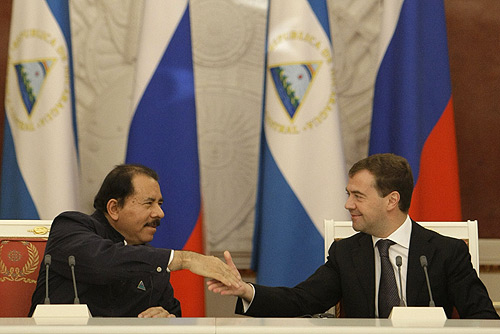
Soon after the 2006 election, Ortega paid an official visit to Iran and met Iranian President Mahmoud Ahmadinejad. Ortega told the press that the "revolutions of Iran and Nicaragua are almost twin revolutions ... since both revolutions are about justice, liberty, self-determination, and the struggle against imperialism".
On 6 March 2008, following the 2008 Andean diplomatic crisis, Ortega announced that Nicaragua was breaking diplomatic ties with Colombia "in solidarity with the Ecuadorian people". Ortega also stated, "We are not breaking relations with the Colombian people. We are breaking relations with the terrorist policy practiced by Álvaro Uribe's government". The relations were restored with the resolution at a Rio Group summit held in Santo Domingo, Dominican Republic, on 7 March 2008. At the summit Colombia's Álvaro Uribe, Ecuador's Rafael Correa, Venezuela's Hugo Chávez and Ortega publicly shook hands in a show of good-will. The handshakes, broadcast live throughout Latin America, appeared to signal that a week of military buildups and diplomatic repercussions was over. After the handshakes, Ortega said he would re-establish diplomatic ties with Colombia. Uribe then quipped that he would send him the bill for his ambassador's plane fare.
On 25 May 2008, Ortega, upon learning of the death of FARC guerrilla leader Manuel Marulanda in Colombia, expressed condolences to the family of Marulanda and solidarity with the FARC and called Marulanda an extraordinary fighter who battled against profound inequalities in Colombia. The declarations were protested by the Colombian government and criticized in the major Colombian media outlets.

On 2 September 2008, during ceremonies for the 29th anniversary of the founding of the Nicaraguan army, Ortega announced that "Nicaragua recognizes the independence of South Ossetia and Abkhazia and fully supports the Russian government's position". Ortega's decision made Nicaragua the second country (after Russia) to recognize the independence of Abkhazia and South Ossetia from Georgia.
雙邊會晤_(32074399712).jpg)
Under Ortega's leadership, Nicaragua joined the Bolivarian Alliance for the Americas.
When seeking office, Ortega threatened to cut diplomatic recognition with the Republic of China (Taiwan, formerly Nationalist China) in order to restore relations with the Mainland-based People's Republic of China (as in the period from 1985 to 1990) as the legal government of China. But he did not do so. In 2007 Ortega stated that Nicaragua did not accept the One China Policy of the PRC government and that Nicaragua reserved the right to maintain official diplomatic relations with the ROC. He reassured President Chen Shui Bian in 2007 that Nicaragua would not break diplomatic relations with the ROC. He explained that during the Reagan administration the United States imposed sanctions on Nicaragua. But cutting ties with Taipei was a sad and painful decision because of the friendship between Nicaragua and Taiwan's people and government. Ortega met with the ROC President Ma Ying-jeou in 2009 and both agreed to improve the diplomatic ties between both countries. However, with a trade show from China (PRC) in Managua in 2010, he is attempting a two-track policy to get benefits from both sides. In 2016 Nicaragua and China (ROC) signed an air services agreement and Ortega stated that Nicaragua's free trade deal with the ROC had benefited both nations. The ROC increased its investment in Nicaragua. In December 2021, Nicaragua once again switched recognition with the PRC.

In September 2010, after a US report listed Nicaragua as a "major" drug-trafficking centre, with Costa Rica and Honduras, Ortega urged the US Congress and Obama administration to allocate more resources to assist the fight against drug trafficking.
During the Libyan Civil War, Ortega was among the very few leaders who spoke out in clear defense of the embattled Muammar Gaddafi. During a telephone conversation between the two, Ortega told Gaddafi that he was "waging a great battle to defend his nation" and stated that "it's at difficult times that loyalty and resolve are put to the test."

Ortega has said that Assad's victory in the 2014 election is an important step to "attain peace in Syria and a clear cut evidence that the Syrian people trust their president as a national leader and support his policies which aim at maintaining Syria's sovereignty and unity".
Ortega attended the swearing-in ceremony of Nicolás Maduro for his second term on 10 January 2019.
In an interview with Max Blumenthal in August 2019, Ortega stated that he was open to the idea of Bernie Sanders (who had visited him in 1985) winning the US presidency in 2020 and that Sanders's message "goes in the right direction for the U.S. to become a pole of peace, development, and cooperation".
Environmental policy
In 2016, Daniel Ortega did not sign the Paris Agreement because he felt the deal did not do enough to protect the climate, although he later changed his mind. Moreover, Nicaragua rejected projects of mining of the Canadian group B2 Gold which could represent a threat to the environment. According to government estimates, Nicaragua has passed from 25% renewable electricity to 52% between 2007 and 2016.
International sanctions
United States
In November 2021, Joe Biden signed into law the "Reinforcing Nicaragua's Adherence to Conditions for Electoral Reform Act" (RENACER Act) which extended US sanctions against Nicaragua and gave Biden the power to exclude Nicaragua from the Dominican Republic-Central America Free Trade Agreement (CAFTA-DR) and to obstruct multilateral loans to Nicaragua. Venezuela and Russia condemned the new law.
Ukraine
In February 2021, Ukraine's parliament, the Verkhovna Rada, approved economic sanctions against Ortega and his government. The sanctions were in response to Ortega sending a delegation to Russian-occupied Crimea in November 2020.
Electoral history
1984 general election
Main article: 1984 Nicaraguan general election
1990 general election
Main article: 1990 Nicaraguan general election
1996 general election
Main article: 1996 Nicaraguan general election
2001 general election
Main article: 2001 Nicaraguan general election
2006 general election
Main article: 2006 Nicaraguan general election
2011 general election
Main article: 2011 Nicaraguan general election
2016 general election
Main article: 2016 Nicaraguan general election
2021 general election
Main article: 2021 Nicaraguan general election
Criticisms and concerns
Ortega's second presidency has been subject to much criticism and accusations of his becoming a strongman. The 2018 protests have been pointed to as being symbolic of these tensions. In 2018, Frances Robles wrote in The New York Times that the "many Ortega adult children manage everything from gasoline distribution to television stations" in Nicaragua.
In the months preceding the November 2021 Nicaraguan general election, Ortega's government arrested many prominent opposition members. As of 23 July 26 opposition leaders have been imprisoned.
On 24 March 2022, the ambassador Arturo McFields, condemned the Ortega government and requested the release of political prisoners, alluding that the government people were "tired of dictatorship" and that it was not easy to denounce it. As a result, he was dismissed.
The American lawyer Paul Reichler also left his position as representative due to "moral conscience", who felt that the president "was no longer the Daniel Ortega whom he respected so much and served with so much pride". Reichler found it inconceivable that someone like Ortega would have mercilessly suppressed peaceful demonstrations and imprisoned his former colleagues in inhumane conditions, and accused him of "murdering" a general by withholding medical treatment. Reichler had served as Nicaragua's international legal adviser before the International Court of Justice, when Managua sued the United States for financing the Contras, winning the case.
The Ortega administration also ordered the closure of the Nicaraguan Language Academy for failing to register as a "foreign agent" ratified by the Sandinista parliament with the favorable vote of 75 deputies of the ruling FSLN.
Sexual abuse allegations
In 1998, Daniel Ortega's adopted stepdaughter Zoilamérica Narváez released a 48-page report in which she alleged he had sexually abused her from 1979, when she was 12, until 1990. Ortega and his wife Murillo denied the allegation. The case could not proceed in Nicaraguan courts, which have been consistently allied with Ortega, because he had immunity from prosecution as a member of parliament, and the five-year statute of limitations for sexual abuse and rape charges had expired. Narváez's complaint to the Inter-American Human Rights Commission was ruled admissible on 15 October 2001. On 4 March 2002, the Nicaraguan government accepted the commission's recommendation of a "friendly agreement". Narváez withdrew the accusations in 2008. Following the 2016 election, Narváez renewed her accusations and said that she had become an outcast in her family.
A 2019 documentary film Exiliada was released which revolves around Zoilamérica Narváez and her sexual abuse allegations against Ortega.
There is also the case of Elvia Junieth who was allegedly abused by Ortega in 2005, and, according to the family, a girl was born from that relationship that Ortega did not recognize. Ernesto Moncada Lau, another of the assistants to the Sandinista president, appears on the birth certificate as the father of the minor. Her brother died in the Tipitapa Model prison in November 2021.
Foreign honours
- Abkhazia
- [[File:ABK Order of Honour and Glory 1st class ribbon 218.svg|70px]] Order of Honour and Glory, First Class
- Cuba
- [[File:Ribbon jose marti.png|70px]] Order of José Martí
- Peru
- [[File:PER Order of the Sun of Peru - Knight BAR.png|70px]] Order of the Sun of Peru
- Russia
- [[File:Orden of Friendship.png|70px]] Order of Friendship
- South Ossetia
- [[File:Лента Ордена Уацамонга.png|70px]] Uatsamonga Order
References
Citations
Sources
- , especially:
- |loc. cit.](sfnref)|ref=}}
References
- (2021-11-04). "Daniel Ortega, el alter ego de Somoza {{!}} Los dictadores comunistas del siglo XXI".
- (2023-08-30). "Daniel Ortega, convertido en dictador".
- Belli, Gioconda. (6 July 2021). "Daniel Ortega está destrozando el sueño nicaragüense".
- swissinfo.ch, S. W. I.. (2023-11-11). "Daniel Ortega, de guerrillero al presidente con más tiempo en el poder en Nicaragua".
- en, Por Fabián Medina SánchezSeguir. (2023-07-19). ""Daniel Ortega es un monstruo y un traidor": el duro análisis de una ex guerrillera a 44 años del triunfo de la revolución sandinista".
- en, Seguir. (2024-12-30). "Gabriel Boric denunció que el régimen de Ortega se consolida como una dictadura: "Hoy son más Somoza que otra cosa"".
- (2021-11-13). "Daniel Ortega supera a los Somoza, secuestra rivales y se aferra al poder".
- Moya, Marta. (2022-01-12). "Cómo Ortega se ha convertido en Somoza, el dictador al que ayudó a derrocar".
- (2021-12-21). "Daniel Ortega demostró ser en esencia "un dictador": expresidente de Costa Rica".
- (22 November 2024). "Nicaragua: Ortega and wife to assume absolute power after changes approved". The Guardian.
- Granger, Max. (25 August 2024). "Is Nicaragua's Dictatorship Nearing Its End?". [[Foreign Policy]].
- (10 September 2023). "Rare Look Inside Nicaragua dictatorship of Daniel Ortega". [[NPR]].
- (2016). "Ortega Saavedra, Daniel". Helicon.
- (8 November 2006). "Ortega wins Nicaraguan election". BBC News.
- (19 July 2018). "Profile: Nicaraguan President Daniel Ortega, from revolutionary leader to opposition hate figure". BBC News.
- Partlow, Joshua. (24 August 2018). "From rebel to strongman: How Daniel Ortega became the thing he fought against". The Washington Post.
- Webber, Jude. (22 August 2018). "A rebel no more, Daniel Ortega comes to resemble the dictator he replaced". [[The Irish Times]].
- Thaler, Kai M.. (2017). "Nicaragua: A Return to Caudillismo". Journal of Democracy.
- (2022). "Nicaragua: Doubling Down on Dictatorship". Journal of Democracy.
- (29 May 2018). "Shoot to kill: Nicaragua's strategy to repress protest". [[Amnesty International]].
- (13 June 2018). "IACHR Condemns Increased Violence in Nicaragua". Organization of American States.
- Moloney, Anastasia. (16 April 2019). "Nicaragua crisis forces 60,000 people to flee homes in past year - U.N.". Reuters.
- "Nicaragua Sees Democracy Crisis As President Ortega Jails Potential Election Rivals". NPR.
- Mannheim, Linda. (10 August 2021). "The Arrest of Dora María Téllez Marks a New Low for Nicaragua". The Nation.
- "Nicaragua cancels permits for US, European NGOs". Al Jazeera English.
- "Prominent Nicaraguan opposition leaders and journalists flee an escalating government crackdown". The Washington Post.
- (15 February 2022). "Daniel Ortega emprende una cruzada contra las universidades privadas de Nicaragua". ABC.
- (2 February 2022). "Daniel Ortega arremete contra las universidades rebeldes de Nicaragua". El Pais.
- (17 May 2022). "El régimen de Daniel Ortega ordenó el cierre de cuatro ONGs". [[Infobae]].
- Belli, Gioconda. (24 August 2018). "How Daniel Ortega Became a Tyrant - From Revolutionary to Strongman". Foreign Affairs.
- (25 August 2022). "Nicaraguan President Daniel Ortega goes after the Catholic Church in his latest effort to stop criticism of the government". NBC News.
- CNA. "European bishops call for release of Nicaraguan bishop due to stand trial for conspiracy". Catholic News Agency.
- "Ortega Saavedra, Daniel (1945–)".
- "La Jornada – Jueves, 5 de Mayo de 2005". lajornadanet.com.
- "Five facts about Nicaragua's Daniel Ortega". AlertNet.
- (10 May 2007). "Daniel Ortega Saavedra, candidato presidencial del FSLN". La Prensa.
- Vulliamy, Ed. (2 September 2001). "Nicaragua's Daniel Ortega; In the Lions' Den Again". [[The Observer]].
- (1987). "The Jaguar Smile. A Nicaraguan Journey". Picador.
- Diederich, Bernard. (1982). "Somoza and the Legacy of U.S. Involvement in Central America". Junction Books.
- "Hispanic Heritage in the Americas: Ortega, Daniel".
- (2000). "Ortega, Daniel". Elsevier Science & Technology.
- Perez, Andres. (1992). "The FSLN after the Debacle: The Struggle for the Definition of Sandinismo". [[University of Cambridge]].
- (28 September 2005). "Cardenal Obando caso a Daniel Ortega y poetisa Rosario Murillo". Cardinal Rating.
- (5 August 2007). "Iran and Nicaragua in barter deal". BBC News.
- "Nicaragua-Venezuela Talk Cooperation"&language=en). Prensa Latina.
- ''Envio'', March 2002, No 248 [http://www.envio.org.ni/articulo/1567 Case 12,230: ''Zoilamérica Narváez vs. the Nicaraguan State''] {{Webarchive. link. (21 June 2007)
- (28 May 1998). "Ortega faces sex abuse case from his stepdaughter". [[The Independent]].
- (4 November 2016). "As Nicaragua's first couple consolidates power, a daughter fears for her country". [[The Guardian]].
- (1993). "Encyclopædia Britannica".
- ''Mastering Modern World History'' by Norman Lowe, second edition
- Baumeister, Eduardo. "The politics of land reform" in {{harvnb. Close. Marti i Puig. McConnell. 2012, p. 250.
- (1983). "Report on the Situation of Human Rights of a Segment of the Nicaraguan Population of Miskito Origin". Organization of American States: Inter-American Commission on Human Rights.
- Bataillon, Gilles. (1983). "3. — Le Nicaragua". Journal de la société des américanistes.
- Hanemann, Ulrike. (March 2005). "Nicaragua's literacy campaign". UNESCO.
- Kinzer, Stephen. (23 March 1987). "Casualties in Nicaragua: Schools and Health Care". The New York Times.
- (27 July 2016). "La santé c'est d'abord un choix politique et gouvernemental". LeCourrier.
- Thomas Walker, ''Nicaragua: Living in the Shadow of the Eagle'', 4th Ed. (Westview Press, 2003)
- John Norton Moore, ''The Secret War in Central America'' (University Publications of America, 1987), p. 143
- Roger Miranda and William Ratliff, ''The Civil War in Nicaragua'' (Transaction, 1993), p. 193.
- McConnell, Shelley A. "The uncertain evolution of the electoral system", in {{harvnb. Close. Marti i Puig. McConnell. 2012, p. 127.
- (2014). "Canadian and American Press Coverage of the 1984 Nicaraguan Election". Canadian Journal of Latin American and Caribbean Studies / Revue canadienne des études latino-américaines et caraïbes.
- "The Sandinistas won't submit to free elections".
- "Remarks Following Discussions With President Jose Napoleon Duarte of El Salvador".
- (2 May 1985). "Reagan Puts Embargo On Nicaragua To 'Mend Their Ways'". Chicago Tribune.
- (October 1987). "Aid to the Nicaraguan Democratic Resistance". US Department of State Bulletin.
- "Nicaragua v United States of America - Military and Paramilitary Activities in and against Nicaragua - Judgment of 27 June 1986 - Merits - Judgments [1986] ICJ 1; ICJ Reports 1986, p 14; [1986] ICJ Rep 14 (27 June 1986)".
- (9 August 1989). "U.S. Endorses Contra Plan As Prod To Democracy in Nicaragua". The Washington Post.
- Anderson, Leslie E. and Lawrence C. Dodd, ''Learning Democracy: Citizen Engagement and Electoral Choice in Nicaragua, 1990–2001'', Chicago, University of Chicago Press, 2005, esp Chapter 3.
- Alma Guillermoprieto, ''The Heart That Bleeds: Latin America Now'', pp. 23–25
- Marti i Puig, Salvador. "The FSLN and Sandinismo", in {{harvnb. Close. Marti i Puig. McConnell. 2012, p. 30.
- [https://web.archive.org/web/20130117074255/http://www.highbeam.com/doc/1P2-1222025.html "Bush Vows to End Embargo if Chamorro Wins"], ''The Washington Post,'' 9 November 1989
- (1990). "Human Rights Watch World Report 1989". Human Rights Watch.
- "U.S. trying to disrupt election in Nicaragua, Canadians report".
- (1992). "Pens and Polls in Nicaragua: An Analysis of the 1990 Preelection Surveys". American Journal of Political Science.
- (2010). "The Adaptation of the FSLN: Daniel Ortega's Leadership and Democracy in Nicaragua". Latin American Politics and Society.
- Marti i Puig, Salvador. "The FSLN and Sandinismo", in {{harvnb. Close. Marti i Puig. McConnell. 2012, p. 35.
- Christian, Shirley. (8 June 1991). "Managua Journal; Victor's Lament: To the Losers Belong the Spoils – New York Times". The New York Times.
- (20 November 2006). "Nicaragua Eliminates Last Exception to Strict Anti-Abortion Law". The New York Times.
- "CIDOB".
- McConnell, Shelley A. "The uncertain evolution of the electoral system", in {{harvnb. Close. Marti i Puig. McConnell. 2012, p. 142.
- McConnell, Shelley A. "The uncertain evolution of the electoral system", in {{harvnb. Close. Marti i Puig. McConnell. 2012, p. 143.
- Uriarte, María José. (15 June 2010). "Ofertas de "cañonazos" en US$500 mil". La Prensa.
- (20 December 2018). "World Report 2019. Nicaragua Events of 2018 <!--". Human Rights Watch.
- "From rebel to strongman: How Daniel Ortega became the thing he fought against". The Washington Post.
- (7 November 2011). "Daniel Ortega: From revolutionary leader to opposition hate figure". BBC News.
- "Daniel Ortega".
- (11 September 2021). "Nicaragua: Daniel Ortega, from revolutionary to dictator". Deutsche Welle.
- (22 November 2024). "Nicaragua: Ortega and wife to assume absolute power after changes approved". The Guardian.
- Granger, Max. (25 August 2024). "Is Nicaragua's Dictatorship Nearing Its End?". [[Foreign Policy]].
- (10 September 2023). "Rare Look Inside Nicaragua dictatorship of Daniel Ortega". [[NPR]].
- "Informe No. 18/19 OAS.org". Organization of American States.
- (12 November 2008). "Review follows election fraud allegations in Nicaragua". CNN.
- (13 November 2008). "How to steal an election". The Economist.
- "Conozca como Daniel Ortega preparo el fraude electoral".
- Wood, Robert. (10 November 2008). "Irregularities in Nicaraguan Municipal Elections". U.S. Department of State.
- Aleman, Filadelfo. "Nicaraguan opposition demands election review". Miami Herald.
- (20 November 2008). "Voter fraud allegations directed at Nicaragua's Sandinistas".
- "Daily Times - Latest Pakistan News, World, Business, Sports, Lifestyle".
- (11 January 2008). "Ortega Says Capitalism In Its Death Throes".
- (10 October 2008). "Nicaragua's Ortega says crisis is God punishing U.S". Reuters.
- "Daniel Ortega". Al Jazeera English.
- "Global Legal Information Network".
- "Presidente de la CSJ de Nicaragua tilda de "ilegal" reelección de Ortega".
- Jarquin, Leyla. "Oposición toca a rebato".
- San Martin, Nieves. "Nicaraguga: La Iglesia, Contra La Reelección "Ilegal" de Ortega".
- "Núñez: "Reelección ilegal de Ortega aumenta persecución contra sociedad civil"".
- (2017). "Nicaragua: A Return to Caudillismo". Journal of Democracy.
- [https://news.bbc.co.uk/2/hi/americas/6161396.stm Nicaragua brings in abortion ban: Nicaraguan President Enrique Bolaños has signed into law a ban on all abortions, even in cases when a woman's life is judged to be at risk] 18 November 2006
- [http://upsidedownworld.org/main/content/view/472/1/ Abortion Outlawed in Nicaragua Ten Days Before Controversial Elections] {{Webarchive. link. (28 September 2007 27 October 2006)
- "Nicaragua electoral body confirms Ortega win – Americas". Al Jazeera English.
- (29 January 2014). "Nicaragua: Ortega allowed to run for third successive term". BBC News.
- (27 April 2016). "Nicaragua Country report/Freedom of the Press/2016". Freedom House.
- (26 June 2016). "Nicaragua suppresses opposition to ensure one-party election, critics say". The Guardian.
- (3 August 2016). "Nicaragua's President Picks Wife as Running Mate". [[NBC News]].
- (7 November 2016). "Nicaragua's Ortega re-elected president". BBC News.
- Gallón, Natalie. "Nicaragua's president Daniel Ortega hasn't been seen in a month". CNN.
- (1 June 2020). "Resisting Lockdown, Nicaragua Becomes a Place of Midnight Burials". The New York Times.
- (10 April 2020). "Nicaragua: Reckless COVID-19 Response". Human Rights Watch.
- (18 June 2020). "'There are two realities.' What is really happening in Nicaragua during the pandemic?". CNN.
- (6 July 2020). "During pandemic, Nicaraguan doctors face political pressure". Associated Press.
- (19 April 2018). "Peaceful Protests against Nicaraguan Social Security Reforms Violently Repressed". The Havana Times.
- (20 April 2018). "Nicaragua Roiled by Protests Over Social Security Benefits". The New York Times.
- (3 May 2018). "Facing censorship, Nicaraguan journalists and citizens turn to social media". ijnet.
- (24 July 2018). "Amidst unrest, Nicaraguan journalists use digital innovation to share information". ijnet.
- (2 May 2018). "In Nicaragua, the political battle is moving from the streets to the negotiating table". The Miami Herald.
- (4 May 2018). "As Nicaragua Death Toll Grows, Support for Ortega Slips". The New York Times.
- (31 May 2018). "Nicaragua Protests Grow Increasingly Violent, 100 Killed Since April". The New York Times.
- (1 June 2018). "Protests on Nicaragua's Mother's Day turn deadly". CNN.
- (30 May 2018). "Nicaragua: Violent attack on mass Mother's Day march in Managua". CNN.
- (31 May 2018). "Estados Unidos condena masacre del Día de las Madres y pide una investigación inmediata". La Prensa.
- (6 June 2018). "The Unraveling of Nicaragua". The Atlantic.
- (16 July 2019). "Nicaragua: US Should Sanction President Ortega". Human Rights Watch.
- (21 November 2024). "Nicaragua's Ortega proposes reform to make him and his wife 'copresidents'". Associated Press.
- (23 November 2024). "Nicaragua OKs reform to boost powers of president, wife". France 24.
- (31 January 2025). "Nicaragua makes Daniel Ortega and his wife Murillo 'copresidents,' fueling democratic rebuke". AP News.
- (26 February 2025). "Nicaragua's deepening repression: UN experts call for urgent global action".
- Hauser, Karim. (11 June 2007). "Nicaragua e Irán, 'unión invencible'". BBC World Service.
- "Nicaragua breaks diplomatic relations with Colombia - CNN.com".
- Mu, Xuequan. "Nicaragua breaks off relations with Colombian gov't". Xinhua News.
- (7 March 2008). "Colombia, Ecuador, Venezuela Agree to End Border Crisis". [[VOA]].
- (8 March 2008). "Leaders say Colombia crisis over". BBC News.
- Bridges, Tyler. (25 May 2008). "Colombian rebels' loss of leader ends an era". Miami Herald.
- (25 May 2008). "Ortega expresa condolencias a FARC por muerte líder".
- "Pésame de Ortega causa estupor • Archivo".
- (3 September 2008). "Nicaragua recognizes South Ossetia, Abkhazia". [[Reuters]].
- "Ma Ying-jeou shouldn't meet Daniel Ortega".
- Rogers, Tim. (14 January 2011). "Nicaragua seeks economic relations with China".
- "U.S. adds three nations to drug-traffic-hub list – Americas – MiamiHerald.com".
- "Field Listing :: Illicit drugs". CIA.
- "Live Blog – Libya Feb 22". Al Jazeera Blogs.
- Al Jazeera (24 February 2011). {{YouTube. u-HvdqjsqXM. ''Latin America divided over Gaddafi''
- Raghavan, Sudarsan. (23 February 2011). "Gaddafi vows to fight until 'the end'". The Washington Post.
- "syriatimes.sy - Nicaragua's Ortega Congratulates President Al-Assad on Winning Elections". syriatimes.sy.
- (10 January 2019). "Venezuela's Maduro begins second term". BBC News.
- "Daniel Ortega dice que le gustaría que Bernie Sanders ganara las elecciones presidenciales de 2020". Univision.
- (28 April 2017). "Le Salvador devient le premier pays au monde à interdire les mines de métaux". Le Monde.
- "Nicaragua Didn't Sign the Paris Agreement Because It Didn't Go Far Enough".
- (10 November 2021). "Biden enacts the RENACER Act". AL DÍA News.
- (11 November 2021). "Venezuela, Russia Condemn New US Aggressions Against Nicaragua". EntornoInteligente.
- (3 February 2021). "Ukraine Sanctions Nicaragua over its Consulate in Crimea - Confidencial".
- Shtepa, Hanna. (10 February 2021). "Ukraine imposes its first-ever sectoral sanctions".
- Partlow, Joshua. (24 August 2018). "From rebel to strongman: How Daniel Ortega became the thing he fought against". The Washington Post.
- (23 April 2018). "Nicaragua abandons social security changes after dozens killed in riots". The Guardian.
- (24 December 2018). "In Nicaragua, Ortega Was on the Ropes. Now, He Has Protesters on the Run.". [[The New York Times]].
- (6 July 2021). "Nicaragua opposition arrests climb to 26". France24.
- (6 July 2021). "More opposition leaders detained in Nicaragua crackdown". Al Jazeera English.
- Alandete, David. (23 March 2022). "El embajador de Nicaragua ante la OEA rompe con la dictadura durante una sesión en vivo". [[ABC (newspaper).
- (27 March 2022). "Nicaragua's lawyer before the International Court of Justice, Paul Reichler, resigned from his position due to "moral conscience"".
- Miranda, Wilfredo. (29 March 2022). "An important adviser to the Government of Nicaragua resigns: "He is no longer the Daniel Ortega whom I respected so much"".
- (31 May 2022). "El Parlamento sandinista ratifica el cierre de la Academia Nicaragüense de la Lengua pese a la repulsa internacional".
- {{in lang. es [http://www.jornada.unam.mx/2002/01/07/arts_41/41_zoilamerica.htm Testimony of Zoilamérica Narváez against her stepfather Daniel Ortega] {{webarchive. link. (26 October 2014 ; [http://www.therealnicaragua.com/Files/testimony_of_Zoilamerica_vs_Ortega.pdf Testimony of Zoilamérica Narváez against her stepfather Daniel Ortega (in English)] {{Webarchive). link. (28 October 2008)
- ''[[Time (magazine). Time]]'', 23 March 1998, [https://web.archive.org/web/20000816215922/http://www.time.com/time/magazine/1998/int/980323/latin_america.an_ugly_fa3.html An Ugly Family Affair: Charges of sexual abuse leveled against Sandinista leader Daniel Ortega swirl atop a power struggle]
- Anthony, Andrew. (7 November 2006). "From comandante to caudillo". The Guardian.
- (20 May 2013). "Nicaragua's President Accused of Sex Abuse by His Stepdaughter". [[The Daily Beast]].
- "Ortega faces sex abuse case from his stepdaughter". The Independent.
- Picq, Manuela. "Ignoring sexual violence in Nicaragua". Al Jazeera English.
- "Nicaragua 12.230 - Admissible".
- (2 November 2017). "Los motivos de la minga: 'Somos distintos porque queremos la vida'". Prensa rural.
- (7 May 2020). "Documental "Exiliada" ya puede verse en Nicaragua".
- "Joven supuestamente abusada: "Soy víctima de Daniel Ortega"".
- (26 October 2015). "Mi niña fue violada por Daniel Ortega".
- (11 November 2021). "Muere en cárcel de Nicaragua hombre que acusó a Ortega de violar a su hermana - SWI". Swissinfo.ch.
- (10 November 2021). "Nicaragua: fue hallado muerto en prisión el abogado que denunció que su hermana fue violada por Daniel Ortega cuando tenía 15 años". Infobae.
- (18 December 2008). "Даниэль Ортега Сааведра. Биографическая справка". RIA Novosti.
- (11 November 2015). "¡Comandante Daniel Ortega Saavedra; siempre Daniel". La Voz del Sandinismo.
- "Condecorados: Orden El Sol Del Perú". Ministerio de Relaciones Exteriores.
- "Указ Президента Российской Федерации от 20.10.2015 № 517 "О награждении государственными наградами Российской Федерации иностранных граждан"". Официальный интернет-портал правовой информации.
This article was imported from Wikipedia and is available under the Creative Commons Attribution-ShareAlike 4.0 License. Content has been adapted to SurfDoc format. Original contributors can be found on the article history page.
Ask Mako anything about Daniel Ortega — get instant answers, deeper analysis, and related topics.
Research with MakoFree with your Surf account
Create a free account to save articles, ask Mako questions, and organize your research.
Sign up freeThis content may have been generated or modified by AI. CloudSurf Software LLC is not responsible for the accuracy, completeness, or reliability of AI-generated content. Always verify important information from primary sources.
Report