From Surf Wiki (app.surf) — the open knowledge base
Dalit
Marginalized castes in India and South Asia
Marginalized castes in India and South Asia
| Field | Value | ||
|---|---|---|---|
| group | Dalit | ||
| image | [[File:Pulaya women.JPG | 200px | Two women from the Dalit community of Kerala]] |
| image_caption | Two Pulaya women from Kerala | ||
| region1 | India | ||
| pop1 | 201.4 million (2011) | ||
| region2 | Bangladesh | ||
| pop2 | 6.5 million (2010) | ||
| region3 | Nepal | ||
| pop3 | 5 million (2011) | ||
| region4 | Sri Lanka | ||
| pop4 | 5 million (2011) | ||
| region5 | Pakistan | ||
| pop5 | 3 million (2011) | ||
| region6 | United Kingdom | ||
| pop6 | 500,000 (2013) | ||
| region7 | Canada | ||
| pop7 | 250,000 (2013) | ||
| langs | South Asian languages | ||
| rels | |||
| related | Indo-Aryan, Dravidian, Munda |
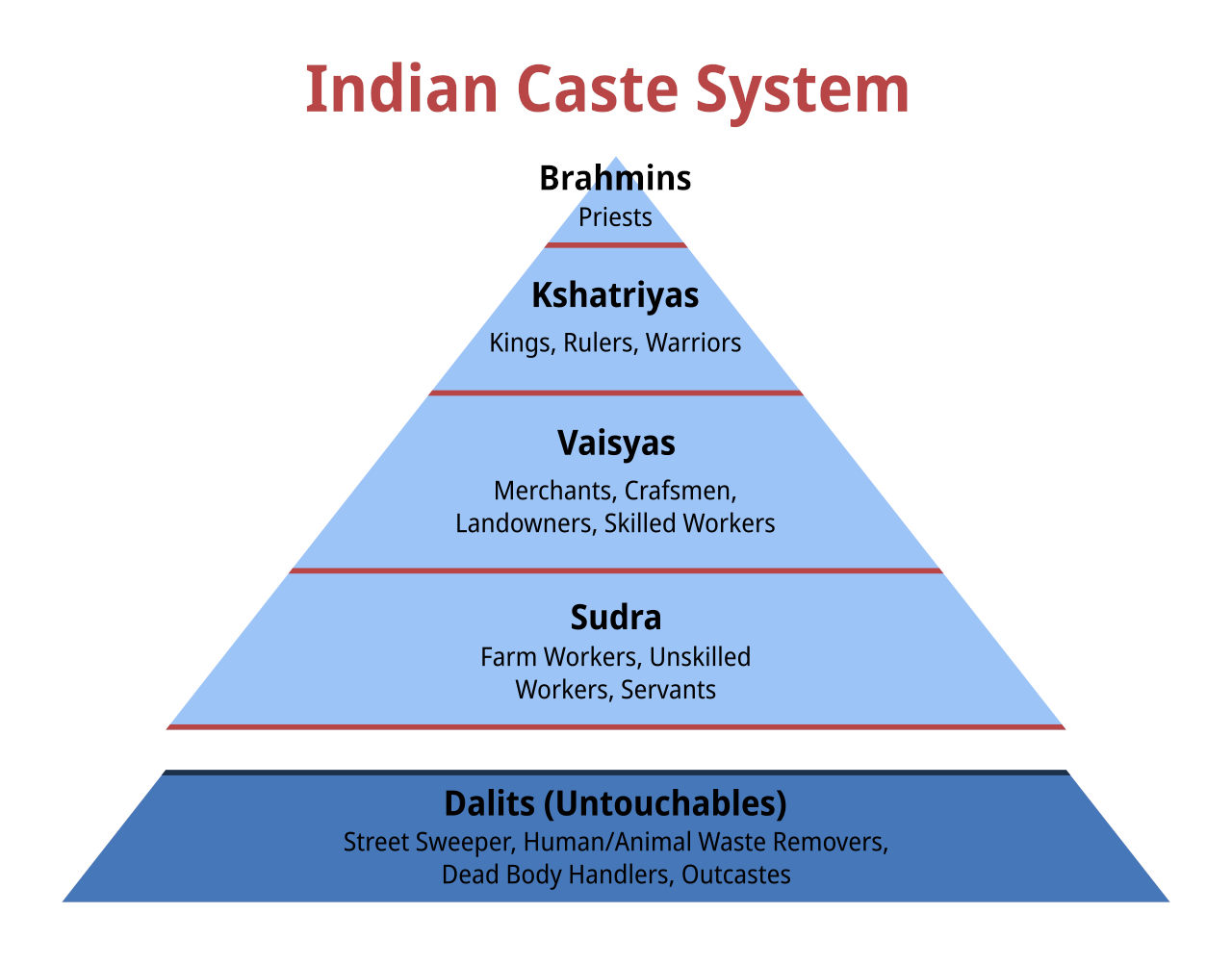
Representation of the varna system hierarchy, depicting Brahmins (priests) at the highest level and Dalits (historically marginalized as untouchables, considered outside the varna system) at the lowest stratum.]]
Dalit (, from meaning "broken/scattered"), also called Harijans () is a term used for untouchables and outcasts, who represent the lowest stratum of the castes in the Indian subcontinent. Dalits were excluded from the fourfold varna of the caste hierarchy in Hinduism and were seen as forming a fifth varna, also known by the name of Panchama.
Several scholars have drawn parallels between Dalits and the Burakumin of Japan, the Baekjeong of Korea and the peasant class of the medieval European feudal system. Dalits predominantly follow Hinduism with significant populations following Buddhism, Sikhism, Christianity, and Islam. The constitution of India includes Dalits as one of the Scheduled Castes; this gives Dalits the right to protection, affirmative action (known as reservation in India), and official development resources.
Terminology
The term Dalit is for those called the "untouchables" and others that were outside of the traditional Hindu caste hierarchy. Economist and reformer B. R. Ambedkar (1891–1956) said that untouchability came into Indian society around 400 CE, due to the struggle for supremacy between Buddhism and Brahmanism. Some Hindu priests befriended untouchables and were demoted to low-caste ranks. Eknath, who was an excommunicated Brahmin, fought for the rights of untouchables during the Bhakti period.
In the late 1880s, the Marathi word 'Dalit' was used by Jyotirao Phule for the outcasts and untouchables who were oppressed and broken in the Hindu society. Dalit is a vernacular form of the Sanskrit दलित (dalita). In Classical Sanskrit, this means "divided, split, broken, scattered". This word was repurposed in 19th-century Sanskrit to mean "(a person) not belonging to one of the four Varnas". It was perhaps first used in this sense by Pune-based social reformer Jyotirao Phule, in the context of the oppression faced by the erstwhile "untouchable" castes from other Hindus. The term Dalits was in use as a translation for the Indian census classification of Depressed Classes prior to 1935. It was popularised by Ambedkar, himself a Dalit, who included all depressed people irrespective of their caste into the definition of Dalits. It covered people who were excluded from the fourfold varna system of Hinduism and thought of themselves as forming a fifth varna, describing themselves as Panchama. In the 1970s its use was invigorated when it was adopted by the Dalit Panthers activist group.
Socio-legal scholar Oliver Mendelsohn and political economist Marika Vicziany wrote in 1998 that the term had become "intensely political ... While the use of the term might seem to express appropriate solidarity with the contemporary face of Untouchable politics, there remain major problems in adopting it as a generic term. Although the word is now quite widespread, it still has deep roots in a tradition of political radicalism inspired by the figure of B. R. Ambedkar." They went on to suggest that its use risked erroneously labelling the entire population of untouchables in India as being united by a radical politics. Anand Teltumbde also detects a trend towards denial of the politicised identity, for example among educated middle-class people who have converted to Buddhism and argue that, as Buddhists, they cannot be Dalits. This may be due to their improved circumstances giving rise to a desire not to be associated with what they perceive to be the demeaning Dalit masses.
James Lochtefeld, a professor of religion and Asian studies, said in 2002 that the "adoption and popularization of [the term Dalit] reflects their growing awareness of the situation, and their greater assertiveness in demanding their legal and constitutional rights".
Other terms
Official term
India's National Commission for Scheduled Castes considers official use of dalit as a label to be "unconstitutional" because modern legislation prefers Scheduled Castes; however, some sources say that Dalit has encompassed more communities than the official term of Scheduled Castes and is sometimes used to refer to all of India's oppressed peoples. A similar all-encompassing situation prevails in Nepal.
Scheduled Castes is the official term for Dalits in the opinion of India's National Commissions for Scheduled Castes (NCSC), who took legal advice that indicated modern legislation does not refer to Dalit and that therefore, it says, it is "unconstitutional" for official documents to do so. In 2004, the NCSC noted that some state governments used Dalits rather than Scheduled Castes in documentation and asked them to desist.
Some sources say that Dalit encompasses a broader range of communities than the official Scheduled Caste definition. It can include nomadic tribes and another official classification that also originated with the British Raj positive discrimination efforts in 1935, being the Scheduled Tribes. It is also sometimes used to refer to the entirety of India's oppressed peoples, which is the context that applies to its use in Nepalese society. An example of the limitations of the Scheduled Caste category is that, under Indian law, such people can only be followers of Buddhism, Hinduism or Sikhism, and the tribal communities often practise folk religions.
Harijan
The term Harijan, or 'children of God', was coined by Narsinh Mehta, a Gujarati poet-saint of the Bhakti tradition, to refer to all devotees of Krishna irrespective of caste, class, or sex. Mahatma Gandhi, an admirer of Mehta's work, first used the word in the context of identifying Dalits in 1933. Ambedkar disliked the name as it placed Dalits in relation to a greater Hindu nation rather than as in an independent community like Muslims. In addition, many Dalits found, and still find, the term patronizing and derogatory, with some even claiming that the term really refers to children of devadasis. When untouchability was outlawed after Indian independence, the use of the word Harijan to describe ex-untouchables became more common among other castes than within Dalits themselves.
Regional terms
In Southern India, Dalits are sometimes known as Adi Dravida, Adi Karnataka, and Adi Andhra, which literally mean First Dravidians, Kannadigas, and Andhras, respectively. These terms were first used in 1917 by Southern Dalit leaders, who believed that they were the indigenous inhabitants of India. The terms are used in the states of Tamil Nadu, Karnataka, and Andhra Pradesh/Telangana, respectively, as a generic term for anyone from a Dalit caste.
In Maharashtra, according to historian and women's studies academic Shailaja Paik, Dalit is a term mostly used by members of the Mahar caste, into which Ambedkar was born. Most other communities prefer to use their own caste name.
In Nepal, aside from Harijan and, most commonly, Dalit, terms such as Haris (among Muslims), Achhoot, outcastes and neech jati are used.
History
Gopal Baba Walangkar (c. 1840–1900) is generally considered to be the pioneer of the Dalit movement, seeking a society in which they were not discriminated against. Another pioneer was Harichand Thakur (c. 1812–1878) with his Matua organisation that involved the Namasudra (Chandala) community in the Bengal Presidency. Ambedkar himself believed Walangkar to be the progenitor. Another early social reformer who worked to improve conditions for Dalits was Jyotirao Phule (1827–1890).
The present system has its origins in the 1932 Poona Pact between Ambedkar and Mahatma Gandhi, when Ambedkar conceded his demand that the Dalits should have an electorate separate from the caste Hindus in return for Gandhi accepting measures along these lines. The notion of a separate electorate had been proposed in the Communal Award made by the British Raj authorities, and the outcome of the Pact – the Government of India Act 1935 – introduced the new term of Scheduled Castes, as a replacement for the term Depressed Classes, and also reserved seats for them in the legislatures.
Soon after its independence in 1947, India introduced a reservation system to enhance the ability of Dalits to have political representation and to obtain government jobs and education. The 1950 Constitution of India included measures to improve the socio-economic conditions of Dalits. Aside from banning untouchability, these included the reservation system, a means of positive discrimination that created the classification of Scheduled Castes as Dalits. Communities that were categorised as being one of those groups were guaranteed a percentage of the seats in the national and state legislatures, as well as in government jobs and places of education.
By 1995, of all federal government jobs in India – 10.1 per cent of Class I, 12.7 per cent of Class II, 16.2 per cent of Class III, and 27.2 per cent of Class IV jobs were held by Dalits. Of the most senior jobs in government agencies and government-controlled enterprises, only 1 per cent were held by Dalits, not much change in 40 years. In the 21st century, Dalits have been elected to India's highest judicial and political offices. In 1997, India elected its first Dalit President, K. R. Narayanan. Many social organisations have promoted better conditions for Dalits through education, healthcare and employment. Nonetheless, while caste-based discrimination was prohibited and untouchability abolished by the Constitution of India, such practices are still widespread. To prevent harassment, assault, discrimination and similar acts against these groups, the Government of India enacted the Prevention of Atrocities Act, also called the SC/ST Act, on 31 March 1995.
In accordance with the order of the Bombay High Court, the Information and Broadcasting Ministry (I&B Ministry) of the Government of India issued an advisory to all media channels in September 2018, asking them to use "Scheduled Castes" instead of the word "Dalit".
Demographics

Scheduled Caste communities exist across India and comprised 16.6% of the country's population, 2011 Census of India. Uttar Pradesh (21%), West Bengal (11%), Bihar (8%) and Tamil Nadu (7%) between them accounted for almost half the country's total Scheduled Caste population. They were most prevalent as a proportion of the states' population in Punjab, at about 32 per cent, while Mizoram had the lowest at approximately zero.
Similar groups are found throughout the rest of the Indian subcontinent; less than 2 per cent of Pakistan's population are Hindu and 70–75 per cent of those Hindus are Dalits, in Nepal, Bangladesh had 5 million Dalits in 2010 with the majority being landless and in chronic poverty, and Sri Lanka. They are also found as part of the Indian diaspora in many countries, including the United States, United Kingdom, Singapore, and the Caribbean. While discrimination against Dalits has declined in urban areas and in the public sphere, it still exists in rural areas and in the private sphere, in everyday matters such as access to eating places, schools, temples and water sources. Some Dalits successfully integrated into urban Indian society, where caste origins are less obvious. In rural India, however, caste origins are more readily apparent and Dalits often remain excluded from local religious life, though some qualitative evidence suggests that exclusion is diminishing.
India is home to over 200 million Dalits. According to Paul Diwakar, a Dalit activist from the National Campaign on Dalit Human Rights, "India has 600,000 villages and almost every village a small pocket on the outskirts is meant for Dalits."
Socioeconomic status and discrimination
Discrimination against Dalits has been observed across South Asia and among the South Asian diaspora. In 2001, the quality of life of the Dalit population in India was worse than that of the overall Indian population on metrics such as access to health care, life expectancy, education attainability, access to drinking water and housing. According to a 2007 report by Human Rights Watch (HRW), the treatment of Dalits has been like a "hidden apartheid" and that they "endure segregation in housing, schools, and access to public services". HRW noted that Manmohan Singh, then Prime Minister of India, saw a parallel between the apartheid system and untouchability. Eleanor Zelliot also notes Singh's 2006 comment but says that, despite the obvious similarities, race prejudice and the situation of Dalits "have a different basis and perhaps a different solution". Though the Indian Constitution abolished untouchability, the oppressed status of Dalits remains a reality. In rural India, stated Klaus Klostermaier in 2010, "they still live in secluded quarters, do the dirtiest work, and are not allowed to use the village well and other common facilities". In the same year, Zelliot noted that "In spite of much progress over the last sixty years, Dalits are still at the social and economic bottom of society."
According to the 2014 NCAER/University of Maryland survey, 27 per cent of the Indian population still practices untouchability; the figure may be higher because many people refuse to acknowledge doing so when questioned, although the methodology of the survey was also criticised for potentially inflating the figure. Across India, Untouchability was practised among 52 per cent of Brahmins, 33 per cent of Other Backward Classes and 24 per cent of non-Brahmin forward castes. Untouchability was also practised by people of minority religions – 23 per cent of Sikhs, 18 per cent of Muslims and 5 per cent of Christians. According to statewide data, Untouchability is most commonly practised in Madhya Pradesh (53 per cent), followed by Himachal Pradesh (50 per cent), Chhattisgarh (48 per cent), Rajasthan and Bihar (47 per cent), Uttar Pradesh (43 per cent), and Uttarakhand (40 per cent).
Examples of segregation have included the Madhya Pradesh village of Ghatwani, where the Scheduled Tribe population of Bhilala do not allow Dalit villagers to use the public borewell for fetching water and thus they are forced to drink dirty water. In metropolitan areas around New Delhi and Bangalore, Dalits and Muslims face discrimination from upper caste landlords when seeking places to rent. In Southern India public tea shops follow a two tumbler system where the owner maintains a second set of cups for serving tea to Dalits.
In 1855, Mutka Salve, a 14-year-old student of Dalit leader Savitribai Phule, wrote that during the rule of Baji Rao of the Maratha Empire, the Dalit castes were chased away from their lands to build large buildings. They were also forced to drink oil mixed with red lead causing them to die, and then they were buried in the foundations of buildings, thus wiping out generations of Dalits. Under the rule of Baji Rao, if a Dalit crossed in front of a gym, they would cut off his head and play "bat and ball" on the ground, with their swords as bats and his head as a ball. Under these 17th century kings, human sacrifice of untouchable persons was not unusual. They also created intricate rules and operations to ensure that they stayed untouchables. George Kunnath claims that there "is and has been an internal hierarchy between the various Dalit castes". According to Kunnath, the Dusadhs are considered the highest while the Musahars are considered the lowest within the Dalit groups.
Education
According to an analysis by The IndiaGoverns Research Institute, Dalits constituted nearly half of primary school drop-outs in Karnataka during the period 2012–14. A sample survey in 2014, conducted by Dalit Adhikar Abhiyan and funded by ActionAid, found that among state schools in Madhya Pradesh, 88 per cent discriminated against Dalit children. In 79 per cent of the schools studied Dalit children are forbidden from touching mid-day meals. They are required to sit separately at lunch in 35 per cent of schools and are required to eat with specially marked plates in 28 per cent.
There have been incidents and allegations of SC and ST teachers and professors being discriminated against and harassed by authorities, upper castes colleagues and upper caste students in different education institutes of India. In some cases, such as in Gujarat, state governments have argued that, far from being discriminatory, their rejection when applying for jobs in education has been because there are no suitably qualified candidates from those classifications.
Poverty
According to a 2014 report to the Ministry of Minority Affairs, 33.8 per cent of Scheduled Caste (SC) populations in rural India were living below the poverty line in 2011–12. In urban areas, 21.8 per cent of SC populations were below the poverty line. A 2012 survey by Mangalore University in Karnataka found that 93 per cent of Dalit families in the state of Karnataka live below the poverty line.
Some Dalits have achieved affluence, although most remain poor. Some Dalit intellectuals, such as Chandra Bhan Prasad, have argued that the living standards of many Dalits have improved since the economic system became more liberalised starting in 1991 and have supported their claims through large surveys. According to the Socio Economic and Caste Census 2011, nearly 79 per cent of Adivasi households and 73 per cent of Dalit households were the most deprived among rural households in India. While 45 per cent of SC households are landless and earn a living by manual casual labour, the figure is 30 per cent for Adivasis.
Occupations
In the past, they were believed to be so impure that upper-caste Hindus considered their presence to be polluting. The "impure status" was related to their historic hereditary occupations that caste Hindus considered to be "polluting" or debased, such as working with leather, disposing of dead animals, manual scavenging, or sanitation work, which in much of India means collection & disposal of faeces from latrines.
Forced by the circumstances of their birth and poverty, some Dalit communities in India continue to work as sanitation workers: manual scavengers, cleaners of drains and sewers, garbage collectors, and sweepers of roads. As of 2019, an estimated 40 to 60 per cent of the 6 million Dalit households are engaged in sanitation work. The most common Dalit caste performing sanitation work is Valmiki (also Balmiki) caste. Others work as landless laborers, marginalized farmers, or continue in their traditional roles such as leathercraft, tanning, cobbling, and the disposal of dead animals.
Healthcare and nutrition
Discrimination against Dalits exists in access to healthcare and nutrition. A sample survey of Dalits, conducted over several months in Madhya Pradesh and funded by ActionAid in 2014, found that health field workers did not visit 65 per cent of Dalit settlements. 47 per cent of Dalits were not allowed entry into ration shops, and 64 per cent were given fewer grains than non-Dalits. In Haryana state, 49 per cent of Dalit children under five years were underweight and malnourished while 80 per cent of those in the 6–59 months age group were anaemic in 2015.
Crime
Dalits comprise a slightly disproportionate number of India's prison inmates. While Dalits (including both SCs and STs) constitute 25 per cent of the Indian population, they account for 33.2 per cent of prisoners. About 24.5 per cent of death row inmates in India are from Scheduled Castes and Scheduled Tribes which is proportionate to their population. The percentage is highest in Maharashtra (50 per cent), Karnataka (36.4 per cent) and Madhya Pradesh (36 per cent). Dalits have been arrested on false pretexts. According to Human Rights Watch, politically motivated arrests of Dalit rights activists occur and those arrested can be detained for six months without charge.
Caste-related violence between Dalit and non-Dalits stems from ongoing prejudice by upper caste members. The Bhagana rape case, which arose out of a dispute of allocation of land, is an example of atrocities against Dalit girls and women. In August 2015, due to continued alleged discrimination from upper castes of the village, about 100 Dalit inhabitants converted to Islam in a ceremony at Jantar Mantar, New Delhi. Inter-caste marriage has been proposed as a remedy, but according to a 2014 survey of 42,000 households by the New Delhi-based National Council of Applied Economic Research (NCAER) and the University of Maryland, it was estimated that only 5 per cent of Indian marriages cross caste boundaries.
The latest data available from India's National Crime Records Bureau is from the year 2000. In that year a total of 25,455 crimes against Dalits were committed; 2 Dalits were assaulted every hour, and in each day 3 Dalit women were raped, 2 Dalits were murdered, and 2 Dalit homes were set on fire. Amnesty International documented a high number of sexual assaults against Dalit women, which were often committed by landlords, upper-caste villagers, and policemen, according to a study published in 2001. According to the research, only about 5% of assaults are recorded, and police dismiss at least 30% of rape reports as false. The study also discovered that police often seek bribes, threaten witnesses, and conceal evidence. Victims of rape have also been killed. There have been some reports of Dalits being forced to eat human faeces and drink urine by upper caste members in some villages. In one such instance, a 17-year-old girl was set on fire by Yadav (an OBC) youth, allegedly because she was allowed school-education. In September 2015, a 45-year-old Dalit woman was allegedly stripped naked and forced to drink urine by perpetrators in Madhya Pradesh. In some villages of India, there have been allegations that Dalit grooms riding horses for wedding ceremonies have been beaten up and ostracised by upper caste people. In August 2015, upper caste people burned houses and vehicles belonging to Dalit families and slaughtered their livestock in reaction to Dalits daring to hold a temple car procession at a village in Tamil Nadu. In August 2015, it was claimed that a Jat Khap Panchayat ordered the rape of two Dalit sisters because their brother eloped with a married Jat girl of the same village. In 2003, the higher caste Muslims in Bihar opposed the burials of lower caste Muslims in the same graveyard. A Dalit activist was killed in 2020 for social media posts criticising Brahmins. A Dalit was killed in 2019 for eating in front of upper-caste men.
Prevention of Atrocities Act
Main article: Scheduled Caste and Scheduled Tribe (Prevention of Atrocities) Act, 1989}}{{See also, Caste-related violence in India
The Government of India has attempted on several occasions to legislate specifically to address the issue of caste-related violence that affects SCs and STs. Aside from the Constitutional abolition of untouchability, there has been the Untouchability (Offences) Act of 1955, which was amended in the same year to become the Protection of Civil Rights Act. It was determined that neither of those Acts were effective, so the Scheduled Caste and Scheduled Tribe (Prevention of Atrocities) Act of 1989 (POA) came into force.
The POA designated specific crimes against SCs and STs as "atrocities" – a criminal act that has "the quality of being shockingly cruel and inhumane" – which should be prosecuted under its terms rather than existing criminal law. It created corresponding punishments. Its purpose was to curb and punish violence against Dalits, including humiliations such as the forced consumption of noxious substances. Other atrocities included forced labour, denial of access to water and other public amenities, and sexual abuse. The Act permitted Special Courts exclusively to try POA cases. The Act called on states with high levels of caste violence (said to be "atrocity-prone") to appoint qualified officers to monitor and maintain law and order.
In 2015, the Parliament of India passed the Scheduled Castes and Scheduled Tribes (Prevention of Atrocities) Amendment Act to address issues regarding the implementation of the POA, including instances where the police put procedural obstacles in the way of alleged victims or indeed outright colluded with the accused. It also extended the number of acts that were deemed to be atrocities. One of those remedies, in an attempt to address the slow process of cases, was to make it mandatory for states to set up the exclusive Special Courts that the POA had delineated. Progress in doing so, however, was reported in April 2017 to be unimpressive. P. L. Punia, a former chairman of the NCSC, said that the number of pending cases was high because most of the extant Special Courts were not exclusive but rather being used to process some non-POA cases, and because "The special prosecutors are not bothered and the cases filed under this Act are as neglected as the victims". While Dalit rights organisations were cautiously optimistic that the amended Act would improve the situation, legal experts were pessimistic.
Religion
Discrimination is illegal under Indian law by the Removal of Civil Disabilities Act (Act 21 of 1938), the Temple Entry Authorization and Indemnity Act 1939 (Act XXII of 1939) and Article 17 of the Constitution which outlawed Untouchability. After India's independence in 1947, secular nationalism based on a "composite culture" made all people equal citizens.
Hinduism
Most Dalits in India are Hindu. There have been incidents which showed that Dalits were restricted from entering temples by high-caste Hindus, and participation in religious processions.

In the 19th century, the Brahmo Samaj, Arya Samaj and the Ramakrishna Mission actively participated in the rights of Dalits. While Dalits had places to worship, the first upper-caste temple to openly welcome Dalits was the Laxminarayan Temple in Wardha in 1928. It was followed by the Temple Entry Proclamation issued by the last King of Travancore in the Indian state of Kerala in 1936.
In the 1930s, Gandhi and Ambedkar disagreed regarding the retention of the Varna system. Whilst Ambedkar wanted to see it destroyed, Gandhi thought that it could be modified by reinterpreting Hindu texts so that the untouchables were absorbed into the Shudra varna. It was this disagreement that led to the Poona Pact. Gandhi began the Harijan Yatra to help the Dalits, but ran into some opposition from Dalits that wanted a complete break from Hinduism.
The declaration by princely states of Kerala between 1936 and 1947 that temples were open to all Hindus went a long way towards ending untouchability there. However, educational opportunities for Dalits in Kerala remain limited.
Other Hindu groups attempted to reconcile with the Dalit community. Hindu temples are increasingly receptive to Dalit priests, a function formerly reserved for Brahmins. Brahmins such as Subramania Bharati passed Brahminhood onto a Dalit, while in Shivaji's Maratha Empire Dalit warriors joined his forces. However, in the 19th century, Dalits in the Mahar Regiment of British Bombay, defeated the oppressive rule of the Peshvas.
The fight for temple entry rights for Dalits continues to cause controversy. In a 2015 incident in Meerut, a Dalit belonging to the Valmiki caste was denied entry to a Hindu temple; he went on to convert to Islam. In September 2015, four Dalit women were fined by the upper-caste Hindus for entering a temple in Karnataka.
There have been allegations that Dalits in Nepal are denied entry to Hindu temples. In at least one case, Dalits were reportedly beaten by upper-caste people while attempting to enter a local temple.
Buddhism
In 1956, the Dalit jurist Bhimrao Ramji Ambedkar (1891–1956) launched the Dalit Buddhist movement, leading several mass conversions of Dalits from Hinduism to Buddhism. Ambedkar's Buddhism is a new kind of Buddhism that focuses on social and political engagement. About half a million Dalits joined Ambedkar in rejecting Hinduism and challenging its caste system. The movement is centered in Maharashtra, and according to the 2011 census, there were 6.5 million Marathi Buddhists (mainly Dalit Buddhists) in Maharashtra.
Another Dalit Buddhist leader and reformer was Pandit Iyothee Thass, founder of the Sakya Buddhist Society of Tamil Nadu. The Scheduled Castes Order (Amendment) Act, 1990 granted reservation to Dalit Buddhists and recognized their Scheduled Caste status.
Sikhism
Guru Nanak in Guru Granth Sahib calls for everyone to treat each other equally. Subsequent Sikh Gurus, all of whom came from the Khatri caste, also denounced the hierarchy of the caste system. Despite this, social stratification exists in the Sikh community. The bulk of the Sikhs of Punjab belong to the Jat caste; there are also two Dalit Sikh castes in the state, called the Mazhabis and the Ramdasias.
Surinder S. Jodhka says that, in practice, Sikhs belonging to the landowning dominant castes have not shed all their prejudices against the Dalit castes. While Dalits would be allowed entry into the village gurudwaras they would not be permitted to cook or serve langar (the communal meal). Therefore, wherever they could mobilise resources, the Sikh Dalits of Punjab have tried to construct their gurudwara and other local-level institutions to attain a certain degree of cultural autonomy. In 1953, Sikh leader Master Tara Singh succeeded in winning the demands from the government to include Sikh castes of the converted untouchables in the list of scheduled castes. In the Shiromani Gurdwara Prabandhak Committee (SGPC), 20 of the 140 seats are reserved for low-caste Sikhs.
Sikh women are required to have the surname "Kaur", and men, the surname "Singh", to eradicate caste identities and discrimination.
In 2003 the Talhan village Gurudwara endured a bitter dispute between Jat Sikhs and Chamars. The Chamars came out in force and confronted the Randhawa and Bains Jat Sikh landlords, who refused to give the Chamars a share on the governing committee of a shrine dedicated to Shaheed Baba Nihal Singh. The shrine earned 3–7 crore Indian Rupees, and the Jat Sikh landlord allegedly "gobbled up a substantial portion of the offerings". Though Dalits form more than 60 per cent of Talhan's 5,000-strong population, local traditions ensured that they were denied a place on the committee. The landlords, in league with radical Sikh organisations and the SGPC, attempted to keep out the Dalits by razing the shrine overnight and constructing a gurdwara on it, but the Dalit quest for a say in the governing committee did not end.
Chamars fought a four-year court battle with the landlords and their allies, including the Punjab Police. In that time Jats conducted several boycotts against the Chamars. The Jat Sikhs and their allies cut off the power supply to their homes. In addition, various scuffles and fights set Chamar youths armed with lathis, rocks, bricks, soda bottles and anything they could find fought Jat Sikh landlords, youths and the Punjab police. Dalit youngsters painted their homes and motorcycles with the slogan, Putt Chamar De (proud sons of Chamars) in retaliation to the Jat slogan, Putt Jattan De.
Jainism
Historically Jainism was practised by many communities across India. They are often conservative and are generally considered upper-caste.
In 1958, a Sthanakvasi Jain called Muni Sameer Muni came into contact with members of the Khatik community in the Udaipur region, who decided to adopt Jainism. Their centre, Ahimsa Nagar, located about four miles from Chittorgarh, was inaugurated by Mohanlal Sukhadia in 1966. Sameer Muni termed them Veerwaal, that is, belonging to Mahavira. A 22-year-old youth, Chandaram Meghwal, was initiated as a Jain monk in Ahore town in Jalore district in 2005. In 2010 a Mahar engineer called Vishal Damodar was initiated as a Jain monk by Acharya Navaratna Sagar Suriji at Samet Shikhar. Acharya Nanesh, the eighth Achayra of Sadhumargi Jain Shravak Sangha, had preached among the Balai community in 1963 near Ratlam. His followers are called Dharmapal. In 1984, some of the Bhangis of Jodhpur came under the influence of Acharya Shri Tulsi and adopted Jainism.
Christianity
Christian Dalits are found in India, Pakistan, Bangladesh, and Nepal.
Mass conversions of lower caste Hindus to Christianity took place in order to escape the discrimination. The main Dalit groups that participated in these conversions were the Chuhras of Punjab, Chamars of North India (Uttar Pradesh, Bihar and Madhya Pradesh), Vankars of Gujarat, and Pulayas of Kerala. The first people converted to Christianity by Jesuits of the Madura Mission were members of Nadars, Maravars, and Pallar. They believed that "Christianity is a true religion; a desire for protection from oppressors and, if possible, material aid; the desire for education for their children; and the knowledge that those who have become Christians had improved".
Christianity was thought to be egalitarian and could provide mobility away from the caste. Sometimes the only change seen was their religious identity. Even after conversion, in some cases, Dalits were discriminated against due to the "residual leftover" practice of caste discrimination from their previous traditions. This is attributed to the predominantly Hindu society they lived in. Discrimination against Dalit Christians also remained in interactions and mannerisms between castes; for example, during the earlier days, the 'lower caste Christians' had to [cover] their mouths when talking to a Syrian Christian. In many cases they were still referred to by their Hindu caste names: For example Pulayans in Kerala, Pariah in Tamil Nadu, and Madigas in Andhra Pradesh, by members of all religious backgrounds.
Even after conversion, to some extent segregation, restriction, hierarchy, and graded ritual purity remained. Data show that there is more discrimination and less class mobility among the people living in rural areas, where incidents of caste discrimination are higher among people from all religious backgrounds. In many cases, the churches referred to the Dalits as 'New Christians'. It is alleged to be a derogatory term which classifies the Dalit Christians to be looked down upon by other Christians. During the earlier days of Christianity, in some churches in south India, the Dalits had either separate seating or had to attend the mass outside.
Caste-based occupations held by Dalits also show a clear segregation which perpetuated even after becoming Christian. Occupational patterns (including manual scavenging) are prevalent among Dalit Christians in north-west India are said to be quite similar to those of Dalit Hindus. Occupational discrimination for Dalit Christians goes so far as to restrict not only employment but in some cases for clean sanitation and water.
Islam
Most of India's 140 million Muslims are descended from local converts. Many of them converted to Islam to escape Hindu upper-caste oppression. 75% of the present Indian Muslim population are Dalits.
Political involvement
Main article: Dalit Panthers
Dalit-led political parties include:
National Dalit-led political parties in India
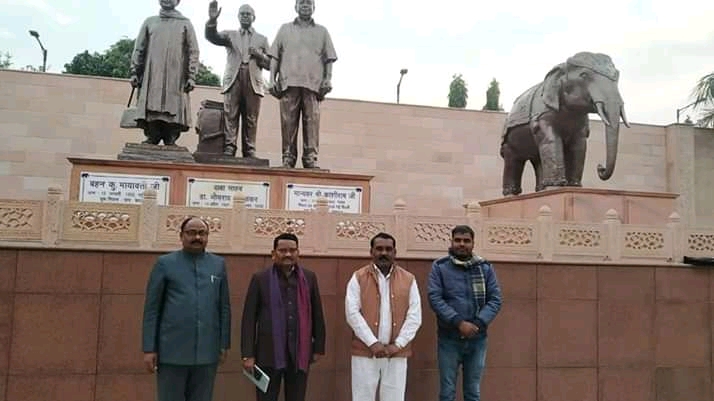
- Bahujan Samaj Party, a national political party as per Election Commission of India
- Azad Samaj Party
- Dalit League
Other recognized state political parties
- Azad Samaj Party
- Vanchit Bahujan Aaghadi, led by Prakash Yashwant Ambedkar, Ambedkar's grandson
- Republican Party of India factions, active in Maharashtra
- Viduthalai Chiruthaigal Katchi is the major Dalit party in Tamil Nadu
- Lok Janshakti Party, Bihar
Nepali Dalit-led parties
- Bahujan Shakti Party, Nepal
- Dalit Janajati Party, Nepal
Dalit-led political parties in Pakistan
- Dalit Sujag Tehreek, Pakistan
Other dalit groups
Main article: Bhim Sena, Bhim Army
Anti-Dalit prejudices exist in groups such as the extremist militia Ranvir Sena, largely run by upper-caste landlords in Bihar. They oppose equal treatment of Dalits and have resorted to violence. The Ranvir Sena is considered a terrorist organisation by the government of India. In 2015, Cobrapost exposed many leaders especially like C. P. Thakur alongside former PM Chandra Shekhar associated with Ranvir Sena in Bihar Dalit massacres while governments of Nitish Kumar (under pressure from BJP), Lalu Prasad Yadav and Rabri Devi did nothing to get justice for Dalits.
The rise of Hindutva's (Hindu nationalism) role in Indian politics has accompanied allegations that religious conversions of Dalits are due to allurements like education and jobs rather than faith. Critics argue that laws banning conversion and limiting social relief for converts mean that conversion impedes economic success. However, Bangaru Laxman, a Dalit politician, was a prominent member of the Hindutva movement.
Another political issue is Dalit affirmative-action quotas in government jobs and university admissions. About 8 per cent of the seats in the National and State Parliaments are reserved for Scheduled Caste and Tribe candidates.
Jagjivan Ram (1908–1986) was the first scheduled caste leader to emerge at the national level from Bihar. He was member of the Constituent assembly that drafted India's constitution. Ram also served in the interim national government of 1946 He served in the cabinets of Congress party Prime ministers Jawaharlal Nehru, Lal Bahadur Shastri and Indira Gandhi. His last position in government was as Deputy Prime Minister of India in the Janata Party government of 1977–1979,
In modern times several Bharatiya Janata Party leaders were Dalits, including Dinanath Bhaskar, Ramchandra Veerappa and Suraj Bhan.
In India's most populous state, Uttar Pradesh, Dalits have had a major political impact. The Dalit-led Bahujan Samaj Party (BSP) had previously run the government and that party's leader, Mayawati, served several times as chief minister. Regarding her election in 2007, some reports claimed her victory was due to her ability to win support from both 17 per cent of Muslims and nearly 17 per cent Brahmins alongside 80 per cent of Dalits. However, surveys of voters on the eve of elections, indicated that caste loyalties were not the voters' principal concern. Instead, inflation and other issues of social and economic development dictated the outcome. Mayawati's success in reaching across castes has led to speculation about her as a potential future Prime Minister of India.
Aside from Mayawati in Uttar Pradesh, Damodaram Sanjivayya was chief minister of Andhra Pradesh from 11 January 1960 to 12 March 1962, and Jitan Ram Manjhi was chief minister of Bihar for just under a year. In 1997, K. R. Narayanan, who was a Dalit, was elected as President of India. In 2017, Ramnath Kovind was elected as the President of India, becoming the second dalit president of the country.
Votebank
Main article: Caste politics
Votebank politics are common in India, usually based on religion or caste. Indeed, the term itself was coined by the Indian sociologist M. N. Srinivas. Dalits are often used as a votebank. There have been instances where it has been alleged that an election-winning party reneged on promises made to the Dalits made during the election campaign or have excluded them from party affairs.
Scheduled Castes and Scheduled Tribes Sub-Plan
The SC, ST Sub-Plan, or Indiramma Kalalu, is a budget allocation by the Government of Andhra Pradesh for the welfare of Dalits. The law was enacted in May 2013. SCs and STs have separate panels for spending. The plan was meant to prevent the government from diverting funds meant for SCs and STs to other programs, which was historically the case. , no equivalent national plan existed. Scheduled Castes Sub Plan and Tribal Sub-Plan funds are often diverted by state governments to other purposes.
While the Indian Constitution has provisions for the social and economic uplift of Dalits to support their upward social mobility, these concessions are limited to Hindus. Dalits who have converted to other religions have asked that benefits be extended to them.
Beyond the Indian subcontinent
United Kingdom
After World War II, immigration from the former British Empire was largely driven by labour shortages. Like the rest of the Indian subcontinent diaspora, Dalits immigrated and established their own communities.
A 2009 report alleged that caste discrimination is "rife" in the United Kingdom. The report alleged that casteism persists in the workplace and within the National Health Service and at doctor's offices.
Some claim that caste discrimination is non-existent. Some have rejected the government's right to interfere in the community. The Hindu Forum of Britain conducted their own research, concluding that caste discrimination was "not endemic in British society", reports to the contrary aimed to increase discrimination by legislating expression and behaviour and that barriers should instead be removed through education.
A 2010 study found that caste discrimination occurs in Britain at work and in service provision. While not ruling out the possibility of discrimination in education, no such incidents were uncovered. The report found favourable results from educational activities. However, non-legislative approaches were claimed to be less effective in the workplace and would not help when the authorities were discriminating. One criticism of discrimination law was the difficulty in obtaining proof of violations. Perceived benefits of legislation were that it provides redress, leads to greater understanding and reduces the social acceptance of such discrimination.
More recent studies in Britain were inconclusive and found that discrimination was "not religion specific and is subscribed to by members of any or no religion". Equalities Minister Helen Grant found insufficient evidence to justify specific legislation, while Shadow Equalities minister Kate Green said that the impact is on a relatively small number of people. Religious studies professor Gavin Flood of the Oxford Centre for Hindu Studies concluded that the Hindu community in Britain is particularly well integrated, loosening caste ties. Casteist beliefs were prevalent mainly among first-generation immigrants, with such prejudices declining with each successive generation due to greater assimilation.
From September 2013 to February 2014, Indian philosopher Meena Dhanda led a project on 'Caste in Britain' for the UK Equality and Human Rights Commission (EHRC), which focused on the proposed inclusion of a provision in the Equality Act 2010 to protect British citizens against caste discrimination. In 2018 the UK government decided not to include caste as a "protected characteristic" within the terms of the Act, and to rely instead on case law to identify tests for caste-based discrimination.
Supporters of anti-caste legislation include Lord Avebury and Lady Thornton.
Sikh diaspora in Britain

Sikhs in the United Kingdom are affected by caste. Gurdwaras such as those of the Ramgarhia Sikhs are organised along caste lines and most are controlled by a single caste. In most British towns and cities with a significant Sikh population, rival gurdwaras can be found with caste-specific management committees. The caste system and caste identity is entrenched and reinforced.
The few gurdwaras that accept inter-caste marriages do so reluctantly. Gurdwaras may insist on the presence of Singh and Kaur in the names of the bridegroom and bride, or deny them access to gurdwara-based religious services and community centres.
In the Caribbean
It is estimated that in 1883, about one-third of the immigrants who arrived in the Caribbean were Dalits. The shared experience of being exploited in a foreign land gradually broke down caste barriers in the Caribbean Hindu communities.
In Continental Europe
The Romani people, originating in northern India, are said to be of Dalit ancestry. Between 1001 and 1026, the Romani fought under their Hindu rulers to fight the Ghaznavids.
In the United States
Many Dalits first came to the United States to flee caste-based oppression in South Asia. After the Chinese Exclusion Act of 1882, the demand for labourers brought in many caste-diverse South Asian immigrants, many of whom were Dalit. After the 1965 Immigration and Naturalization Act, immigrants from India were primarily professionals and students, largely from upper caste or dominant caste families. However, from the 1990s onwards, many more of the skilled professionals arriving from India have been Dalit, due to multiple generations of affirmative action policies in India, as well as ongoing efforts of organised resistance against caste discrimination.
In 2018, Equality Labs released a report on "Caste in the United States". This report found that one in two Dalit Americans live in fear of their caste being "outed". In addition, 60% have experienced caste-based discriminatory jokes, and 25% have suffered verbal or physical assault because of their caste.
In late June 2020, the California Department of Fair Employment and Housing filed a lawsuit against Cisco Systems, alleging that a Dalit engineer at the company faced discrimination from two of his upper-caste supervisors for his Dalit background. The lawsuit claims that "higher caste supervisors and co-workers imported the discriminatory system's practices into their team and Cisco's workplace". In 2023, the California Civil Rights Department voluntarily dismissed its case alleging caste discrimination against two Cisco engineers, while still keeping alive its litigation against Cisco Systems. The CRD was later symbolically fined $2000 for their case against the two engineers and CISCO.
Literature
Main article: Dalit literature
Dalit literature encompasses writings by Dalits about their lived experiences, and it has emerged as a significant literary movement and forms a distinct part of Indian literature. It has formed an identity across various Indian languages, including Marathi, Bangla, Hindi, Kannada, Punjabi, Sindhi, Odia, Tamil, and others. The earliest identifiably Dalit writers were Madara Chennaiah, an 11th-century cobbler-saint who lived in the reign of Western Chalukyas and who is regarded by some scholars as the "father of Vachana poetry" and Dohara Kakkaiah, a Dalit by birth, six of whose confessional poems survive. The origins of modern Dalit writing can be traced back to the works of Marathi Dalit Bhakti poets and Tamil Siddhas, suggesting a long-standing tradition of marginalized voices. This literary movement gained momentum in the mid-20th century, challenging the prevailing portrayals of life in mainstream literature. The publication of Jyotirao Phule's Gulamgiri in 1873 marked a seminal moment in Dalit literature, shedding light on the plight of the Untouchables.
Dalit literature in India has flourished in various regional languages, reflecting the diverse experiences and struggles of Dalit communities across the country. In Maharashtra, Baburao Bagul's collection of stories, "Jevha Mi Jat Chorali" (When I had Concealed My Caste), published in 1963, marked a significant turning point, portraying the harsh realities of Dalit lives and garnering critical acclaim. Writers like Namdeo Dhasal and Daya Pawar further strengthened the Dalit movement in Maharashtra introducing the seminal "Dalit Panther" as part of the little magazine movement. Baburao Bagul, Bandhu Madhav and Shankar Rao Kharat, worked in the 1960s. Later the little magazine movement became popular. In Bengal, the Dalit literary movement began in 1992 after the suicide of Chuni Kotal, leading to the formation of the Bangla Dalit Sahitya Sanstha and the launch of the magazine "Chaturtha Duniya". Prominent Dalit authors in Bengal include Manoranjan Byapari, Jatin Bala, and Kalyani Charal. Tamil Nadu has a long history of Dalit literature, starting from the efforts of Parayars in the late 19th century. The Tamil Dalit literary movement gained momentum in the 1990s, influenced by the Mandal Commission report and Ambedkar centenary celebrations. Writers like Bama, Joseph Macwan, and Gogu Shyamala have made significant contributions to Tamil Dalit literature. In Telugu literature, Dalit voices gained prominence through the activism of leaders like Kathi Padma Rao and Bojja Tarakam, addressing issues of caste discrimination and social injustice. Gujarati Dalit literature emerged in the 1970s with magazines like Puma and Panther, inspired by the Dalit Panthers movement in Maharashtra. Writers such as Rameshchandra Parmar and Sahil Parmar played vital roles in its development. Odia Dalit literature has a rich history dating back to the fifteenth century, with significant contributions from Sudramuni Sarala Dasa and Bhima Bhoi. Writers like Basudeb Sunani and Pitambar Tarai have furthered the Dalit literary movement in Odisha. Additionally, Dalit literature encompasses various forms such as poetry, autobiographies, and oral history narratives, with notable works including "Karukku" by Bama and "The Weave of My Life" by Urmila Pawar. The Indian author Rajesh Talwar has written a play titled 'Gandhi, Ambedkar, and the Four-Legged Scorpion' in which the personal experiences of Ambedkar and the sufferings of the community have been highlighted.
In Sri Lanka, writers such as K. Daniel and Dominic Jeeva gained mainstream popularity.
In the film industry
Main article: Dalit music, Dalit Film and Cultural Festival
Until the 1980s, Dalits had little involvement in Bollywood or other film industries of India and the community were rarely depicted at the heart of storylines. Chirag Paswan (son of Dalit leader Ram Vilas Paswan) launched his career in Bollywood with his debut film Miley Naa Miley Hum in 2011. Despite political connections and the financial ability to struggle against ingrained prejudices, Chirag was not able to "bag" any other movie project in the following years. Chirag, in his early days, described Bollywood as his "childhood dream", but eventually entered politics instead. When the media tried to talk to him about "Caste in Bollywood", he refused to talk about the matter. A recent Hindi film to portray a Dalit character in the leading role, although it was not acted by a Dalit, was Eklavya: The Royal Guard (2007). The continued use of caste based references to Dalit sub-castes in South Indian films (typecast and pigeonholed in their main socio-economic sub-group) angers many Dalit fans.
A Brazilian telenovela India: A Love Story was broadcast in 2009 where the main female character Maya, who is of upper class, falls in love with a Dalit person.
Internal conflicts
Main article: Dalit feminism
Several Dalit groups are rivals and sometimes communal tensions are evident. A study found more than 900 Dalit sub-castes throughout India, with internal divisions. Emphasising any one caste threatens what is claimed to be an emerging Dalit identity and fostering rivalry among SCs.
A DLM (Dalit Liberation Movement) party leader said in the early 2000s that it is easier to organise Dalits on a caste basis than to fight caste prejudice itself.
Balmikis and Pasis in the 1990s boycotted the BSP, claiming it was a Jatav party.
Many converted Dalit Sikhs claim a superior status over the Hindu Raigars, Joatia Chamars and Ravidasis and sometimes refuse to intermarry with them. They are divided into gotras that regulate their marriage alliances. In Andhra Pradesh, Mala and Madiga were constantly in conflict with each other but as of 2015 Mala and Madiga students work for common dalit cause at university level.
Although the Khateek (butchers) are generally viewed as a higher caste than Bhangis, the latter refuses to offer cleaning services to Khateeks, believing that their profession renders them unclean. They also consider the Balai, Dholi and Mogya as unclean and do not associate with them.
Notable people
Main article: List of Dalits
References
Sources
References
- (2 May 2013). "Half of India's dalit population lives in 4 states".
- (19 January 2016). "The Dalits In Bangladesh".
- Pasic, Damir. "Nepal".
- Pasic, Damir. "Sri Lanka".
- "Experiences of caste prejudice in UK".
- "About". Dalit Freedom Network Canada.
- Bharatiya, Santosh. (2008). "Dalit And Minority Empowerment". Rajkamal Prakashan.
- (5 September 2018). "From Buddhist texts to East India Company to now, 'Dalit' has come a long way".
- (2014). "Working Skin: Making Leather, Making a Multicultural Japan". University of California Press.
- Sudrania, O. P.. (9 September 2012). "Castes in a Global Perspective – Is Caste Only a Hindu Problem? (Part 6)". The Chakra.
- Noble, Thomas. (2002). "The Foundations of Western Civilization". [[The Teaching Company]].
- (2011). "India Today: An Encyclopedia of Life in the Republic". [[ABC-CLIO]].
- (2010). "Dalits and Tribes of India". Mittal Publications.
- "Top RSS leader misquotes Ambedkar on untouchability". [[Hindustan Times]].
- "Eknath {{!}} Marathi Poet, Bhakti Movement & Maharashtra".
- Robinson, Rowena. (2003). "Christians of India". Sage Publications.
- "Dalit, n." OED Online. Oxford University Press, June 2016. Web. 23 August 2016.
- (1998). ["The Untouchables: Subordination, Poverty and the State in Modern India"]({{google books). Cambridge University Press.
- Katuwal, Shyam Bahadur. (2009). "Ethnographic Discourse of the Other: Conceptual and Methodological Issues". Cambridge Scholars Publishing.
- "Independent labour party: 19th July (1937) in Dalit History – Dr. Ambedkar took oath as the member of Bombay Legislative Council". Dr. Ambedkar Books.
- (2017). "Resistance in Everyday Life: Constructing Cultural Experiences". Springer.
- Teltumbde, Anand. (2016). "Dalits: Past, present and future". [[Routledge]].
- Lochtefeld, James G.. (2002). "The Illustrated Encyclopedia of Hinduism: A-M". The [[Rosen Publishing Group]].
- (2018-09-05). "Why Dalits want to hold on to Dalit, not Harijan, not SC".
- (2018-09-05). "What's in a name?: on the use of the term 'Dalit'". The Hindu.
- (18 January 2008). "Dalit word un-constitutional says SC". [[Express India]].
- Zelliot, Eleanor. (2010). "India's Dalits: Racism and Contemporary Change". Global Dialogue.
- Fuller, C. J.. (March 1976). "Kerala Christians and the Caste System". Man.
- "Tribal Religions". [[Library of Congress]] Country Studies.
- (2021). "Makers of Modern Dalit History". Penguin Random House India.
- (27 March 2017). "Stop calling Dalits 'Harijan': SC calls the term abusive, as we remain ignorant and insensitive". The News Minute.
- Omvedt, Gail. (2008). "Ambedkar: towards an enlightened India". [[Penguin Random House.
- Perez, Rosa Maria. (2004). "Kings and untouchables: a study of the caste system in western India". Chronicle Books.
- (1998). "The Untouchables: Subordination, Poverty and the State in Modern India". [[Cambridge University Press]].
- Paik, Shailaja. (September 2011). "Mahar–Dalit–Buddhist: The history and politics of naming in Maharashtra". Contributions to Indian Sociology.
- Teltumbde, Anand. (2016). "Dalits: Past, present and future". Routledge.
- (2024-11-24). "Jyotirao Phule {{!}} Biography, Social Reformer, & Facts {{!}} Britannica".
- (2018-04-11). "Mahatma Phule coined the term 'Dalit' – Know more about Maharashtrian reformer Jyotiba Phule on his Jayanti".
- Keane, David. (2007). "Religion, Human Rights and International Law: A Critical Examination of Islamic State Practices". [[Brill Publishers.
- Gould, William. (2011). "Religion and Conflict in Modern South Asia". [[Cambridge University Press]].
- Srivastava, B. N.. (2003). "Social Exclusion: Essays in Honour of Dr. Bindeshwar Pathak". Concept Publishing.
- "Historical Background Of Reservation In Educational Institutions In India".
- (2004). "Status of caste system in modern India". Ambedkar.org.
- (16 July 2009). "Profile: Mayawati Kumari". [[BBC News]].
- (2009). "Meira Kumar, a Dalit leader is the new Lok Sabha Speaker". NCHRO.
- (4 September 2018). "Stop using the term Dalit: I&B Ministry tells media".
- [http://www.censusindia.gov.in/2011-Documents/SCST%20Presentation%2028-10-2013.ppt Census of India 2011, Primary Census Abstract]{{PPTlink, Scheduled castes and scheduled tribes, Office of the Registrar General & Census Commissioner, Government of India (28 October 2013).
- (1 May 2013). "SCs, STs form 25% of population, says Census 2011 data". The Indian Express.
- Sivakumar, B.. (2 May 2013). "Half of India's dalit population lives in 4 states". The [[Times of India]].
- "Scheduled Caste Population in Punjab".
- Ghosh, Lipi. (29 November 2020). "Political Governance and Minority Rights: The South and South-East Asian Scenario". [[Taylor & Francis]].
- 978-0-215-54435-3. p. 93–.
- Bandarage, Asoka. (2008). "The Separatist Conflict in Sri Lanka: Terrorism, Ethnicity, Political Economy". [[Routledge]].
- Soundararajan, Thenmozhi. (20 August 2012). "Black Indians". Outlook India.
- Rath, Kayte. (5 March 2013). "Outlaw caste discrimination in UK, peers tell government". [[BBC News]].
- Lepoer, Barbara Leitch. "GPO for the Library of Congress". [[Library of Congress]].
- "Retention and Transculturation of Hinduism in the Caribbean". Guyana Journal.
- "The caste system".
- Dasgupta, Manas. (28 January 2010). "Untouchability still prevalent in rural Gujarat: survey". [[The Hindu]].
- (15 October 2006). "Hindus Support Dalit Candidates in Tamil Nadu". Indianchristians.in.
- Sengupta, Somini. (29 August 2008). "Crusader Sees Wealth as Cure for Caste Bias". [[The New York Times]].
- (1 October 2019). "India top court recalls controversial caste order". BBC News.
- (16 April 2020). "Under India's caste system, Dalits are considered untouchable. The coronavirus is intensifying that slur". CNN.
- Shankar, Deepa. (2007). "What is the progress in elementary education participation in India during the last two decades?". The World Bank.
- Singh, Darshan. (2009). "Development of Scheduled Castes in India – A Review". [[Journal of Rural Development]].
- (May 2008). "Changing Educational Inequalities in India in the Context of Affirmative Action". [[Demography (journal).
- (27 May 2002). "India: "Hidden Apartheid" of Discrimination Against Dalits". [[Human Rights Watch]].
- Klostermaier, Klaus. (2010). "A Survey of Hinduism: Third Edition". [[State University of New York Press]].
- Vij, Shivam. (1 December 2014). "Between the bathroom and the kitchen, there is caste". Scroll.
- Bhandare, Namita. (6 December 2014). "Casteism exists in India, let's not remain in denial". [[Hindustan Times]].
- Tharoor, Shashi. (8 December 2014). "Why Caste Won't Disappear From India". [[HuffPost]].
- Chishti, Seema. (29 November 2014). "Biggest caste survey: One in four Indians admit to practising untouchability". The Indian Express.
- (23 May 2015). "Dalits in MP village not allowed to use public borewell". [[Hindustan Times]].
- Chishti, Seema. (16 June 2015). "Study shows NCR homeowners turn away Dalits and Muslims". The Indian Express.
- (1 September 2015). "In 5 star Bengaluru hotel, Dalits show they have arrived". [[Hindustan Times]].
- (5 June 2015). "Contesting Power, Contesting Memories". Economic and Political Weekly.
- Kunnath, George. (2013). "Compliance or Defiance? The Case of Dalits and Mahadalits".
- (5 December 2014). "Half of school dropouts in K'taka are dalits". The [[Times of India]].
- Sarkar, Sravani. (5 December 2014). "Children bear the brunt of caste abuses in rural areas". [[Hindustan Times]].
- Lama, Prawesh. (7 December 2011). "Dalit professor 'harassed' for SC quota reforms thesis". India Today.
- (1 February 2013). "VHP, Bajrang Dal activists beat up a Dalit professor". [[The Hindu]].
- (15 April 2015). "Professor attempts suicide near Rajkot". The [[Times of India]].
- "dalit-headmistress-accuses-upper-caste-teachers-of-harassment".
- (28 March 2015). "Headmaster booked for abusing dalit teacher". Business Standard.
- (24 March 2013). "Dalit professor alleges harassment by colleague, students". [[The Hindu]].
- Rana, Niyati. (25 April 2015). "Prejudice reserved". Ahmedabad Mirror.
- (7 November 2014). "Dalits in India are poorer than Muslims: Government report".
- Mukunth, Vasudevan. (2 December 2014). "Who among India's young are likely to become modern slaves?".
- (28 October 2012). "93% dalit families still live below poverty line, says survey". The [[Times of India]].
- Sengupta, Somini. (29 August 2008). "Crusader Sees Wealth as Cure for Caste Bias". The New York Times.
- Wax, Emily. (31 August 2008). "In an Indian Village, Signs of the Loosening Grip of Caste". The Washington Post.
- (6 July 2015). "Landlessness is higher among Dalits but more adivasis are 'deprived'". [[The Indian Express]].
- Lochtefeld, James G.. (2002). "The Illustrated Encyclopedia of Hinduism: N-Z". The [[Rosen Publishing Group]].
- PRIA (2019): [https://pria.org/knowledge_resource/1560777260_Occasional%20Paper%204%20(2019)%20(Lived%20Realities%20of%20Women%20Sanitation%20Workers%20i....pdf Lived Realities of Women Sanitation Workers in India: Insights from a Participatory Research Conducted in Three Cities of India]. Participatory Research in Asia, New Delhi, India
- "Dalits in India".
- Sur, Priyali. (2020-04-16). "Under India's caste system, Dalits are considered untouchable. The coronavirus is intensifying that slur".
- (2025-01-07). "Chamar Studio: Empowering Dalit Artisans".
- (2023-12-20). "In pictures: The many lives of India's Dalits".
- Saini, Manvir. (29 July 2015). "49% of Haryana's dalit kids are malnourished: Report". The [[Times of India]].
- Arunachalam, Pon Vasanth. (3 November 2014). "Prejudice Blamed For Dalit Prisoners". The New Indian Express.
- Arunachalam, Pon Vasanth. (3 November 2014). "Skew in Dalit Jail Inmate Ratio: NCRB". The New Indian Express.
- Sen, Jahnavi. (6 May 2016). "Three-Quarters of Death Row Prisoners are from Lower Castes or Religious Minorities". The Wire.
- (4 April 2018). "Withdraw false cases, release arrested Dalits: Congress on police action".
- "India: Dalit rights activists detained". [[United Nations High Commissioner for Refugees]].
- Wax, Emily. (21 June 2007). "A 'Broken People' in Booming India". [[The Washington Post]].
- Dubey, Priyanka. (10 September 2014). "A Portrait of the Indian as a Young Dalit Girl". [[Yahoo! News]]/Grist Media.
- Saini, Manvir. (9 August 2015). "Dalits from Bhagana convert to Islam". The [[Times of India]].
- Guha, Ramachandra. (26 October 2014). "They were rivals, but with the same mission". [[Hindustan Times]].
- S., Rukmini. (13 November 2014). "5% of Indian marriages are inter-caste: survey". [[The Hindu]].
- (2 June 2003). "India's "Untouchables" Face Violence, Discrimination".
- (9 May 2001). "Sex hell of Dalit women exposed". [[The Guardian]].
- (19 September 2014). "Dalit tortured, forced to eat human excreta".
- (14 January 2010). "Upper caste youths force Dalit to eat excreta in Tamil Nadu".
- "Man tortured, made to drink urine by cops". The [[Times of India]].
- (25 April 2015). "Dalit youth assaulted, forced to eat human faeces in UP".
- Srivastava, Piyush. (2015-03-06). "Dalit girl set on fire for pursuing education in UP".
- Nair, Nithya. (2 September 2015). "Dalit woman allegedly stripped in Madhya Pradesh, forced to consumed urine". India.com.
- (19 June 2014). "Families of 2 dalit grooms ostracized for riding horse as marriage ritual".
- (9 June 2014). "Dalit groom beaten up in M.P. village for riding a horse". [[The Hindu]].
- Dhar, Aarti. (14 July 2014). "Dalit wedding fetes face feudal rage in Rajasthan". [[The Hindu]].
- (18 August 2015). "Temple procession row: TN police nab 75 for torching Dalit houses". [[The Indian Express]].
- Sivaraman, R.. (17 August 2015). "70 held for burning Dalit houses in Villupuram". [[The Hindu]].
- (1 September 2015). "Jat leaders in UP village deny ordering rape of Dalit sisters". [[Hindustan Times]].
- Basu, Indrani. (8 September 2015). "9 Things You Need To Know About The Khap 'Rape Order' in India". [[HuffPost]].
- Bahuguna, Ankush. (28 August 2015). "A Khap Panchayat in UP Wants Two Dalit Sisters Raped Because Their Brother Eloped with a Married Woman".
- Sahay, Anand Mohan. "Backward Muslims protest denial of burial". [[Rediff.com]].
- (28 September 2020). "'Anti-Brahmin' posts on social media: 5 more held for murder of Dalit lawyer in Kutch". [[The Indian Express]].
- (19 May 2019). "The Indian Dalit man killed for eating in front of upper-caste men". [[BBC News]].
- Sampath, G.. (23 August 2015). "Children of a different law". [[The Hindu]].
- (24 April 2016). "Centre notifies rules for amended SC/ST Act". [[The Hindu]].
- Ramachandran, Smriti Kak. (16 April 2017). "States lag in setting up courts to address SC, ST grievances". [[Hindustan Times]].
- "Fighting caste discrimination is about changing attitude, than law".
- S. Gurusamy. ''[https://books.google.com/books?id=nqmcDwAAQBAJ&pg=PA104 Dalit Empowerment in India]''. MJP Publisher; 11 June 2019. GGKEY:SW8XELLJGLC. p. 104–.
- (1 November 2019). "Dalits and Their Religious Identity in India: A Critical Look at Existing Practices". Contemporary Voice of Dalit.
- Kumar, Anuj. (1 November 2019). "Dalit women not allowed to enter temple". [[The Hindu]].
- Sura, Ajay. (8 January 2020). "Not allowed to enter temple, dalit minister tells Himachal Pradesh assembly".
- Arulselvan, S.. (2 April 2016). "Resisting ritual repression and reclaiming social positions by Dalits in Tamilnadu: a critical discourse analysis of media text". Media Asia.
- Chandran, Rina. (6 March 2020). "Denied in life, India's lower-caste Dalits fight for land in death". [[Reuters]].
- (2007-01-23). "First temple to allow Dalits entry". The Times of India.
- Nath, Suryakant. (2013). "Gandhi's Harijan Padyatra in Orissa in 1934: Claims over a Contested Social Space". Proceedings of the Indian History Congress.
- Rushdi, Aaliya. "In Kerala, Dalit students facing difficulties to get educated".
- Pansare, Govind. (28 August 2015). "How history has systematically distorted the figure of Shivaji: Excerpt from Govind Pansare's book".
- Chari, Mridula. (3 January 2016). "Why lakhs of Indians celebrate the British victory over the Maratha Peshwas every New Year".
- (4 June 2007). "Temples of Unmodern India". [[The Times of India]].
- Ali, Mohammad. (14 March 2015). "Denied temple access, Dalit converts to Islam". [[The Hindu]].
- T., Sathish G.. (7 September 2015). "Dalits fume over fine on their women for entering temple in Karnataka".
- Jha, Hari Bansh. (October 2005). "Nepal's Downtrodden". Hinduism Today.
- (27 February 2014). "Dalits 'barred' from entering temple". The Kathmandu Post.
- (18 September 2006). "Nepal: Dalits beaten up for entering temple". Rediff.com.
- Gary Tartakov. (2003). "Religious Conversion in India: Modes, Motivations, and Meanings". [[Oxford University Press]].
- Christopher Queen. (2015). "A Companion to Buddhist Philosophy". [[John Wiley & Sons]].
- Skaria, A. (2015). "Ambedkar, Marx and the Buddhist Question". [[Taylor & Francis]].
- Omvedt, Gail. (2003). "Buddhism in India: Challenging Brahmanism and Caste". [[SAGE Publishing.
- "Census GIS Household".
- Teltumbde, Anand. (2016). "Dalits: Past, Present and Future". [[Taylor & Francis]].
- (2017). "The Oxford Handbook of Secularism". [[Oxford University Press]].
- (1994). "The construction of religious boundaries: culture, identity, and diversity in the Sikh tradition". [[Oxford University Press]].
- (23 December 2013). "Akali Dal demands inclusion of Jat Sikhs in OBC list". News East West.
- McLeod, W. H.. (2009). "The A to Z of Sikhism". [[Scarecrow Press]].
- (17 May 2002). "Caste and Untouchability in Rural Punjab". Economic and Political Weekly.
- "Punjabi".
- Cole, Owen. (2010). "Sikhism - An Introduction: Teach Yourself". John Murray Press.
- Singh, Vikram Jit. (18 February 2006). "Talhan scores for Dalit rights". Tehelka.
- Chapple, Christopher Key. (2006). ["Jainism and Ecology: Nonviolence in the Web of Life"]({{google books). Motilal Banarsidass.
- Nathuram Chandalia, Mewad men Veerwal Pravriti, pp. 220–21
- वीरवाल जैन समाज के गुरु की पुण्यतिथि मार्च में, Bhaskar News Network. 31 December 2013
- "Latest Udaipur News 31/12/2013: वीरवाल जैन समाज के गुरु की पुण्यतिथि मार्च में – www.bhaskar.com". bhaskar.com.
- (18 October 2013). "dharm ke naam par desh tak bant gae: pahaadiya".
- (1 February 2005). "Dalit youth turns Jain monk".
- (June 2010). "Dalit Engineer Becomes a Jain Monk". Ahimsa Times.
- link. (12 October 2013 Vinay N. Joshi on 14 June 2010,)
- [http://navbharattimes.indiatimes.com/mumbai/other-news/--/articleshow/6589054.cms 'दाता' के दातार बन गए तारणहार, नवभारत टाइम्स], 20 September 2010
- Shyamlal. (1997). ["From Higher Caste to Lower Caste: The Processes of Asprashyeekaran and the Myth of Sanskritization"]({{google books). Rawat Publications.
- Shyamlal. (1992). "Jain Movement and Socio-Religious Transformation of the 'Bhangis' of Jodhpur, Rajasthan". Indian Journal of Social Work.
- (2009). "Ethnographic Discourse of the Other: Conceptual and methodological issues". Cambridge Scholars.
- Sobin, George. (2012). "Dalit Christians in India".
- Mosse, David. (September 1996). "[no title cited]". The Journal of the Royal Anthropological Institute.
- (1908). "The Report of Conference Held at Madras".
- Dumont, Louis. (1980). "Homo Hierarchicus: The caste system and its implications". [[University of Chicago Press]].
- Louis, Prakash. (2007). "Caste-based discrimination and atrocities on Dalit Christians and the need for reservations". Indian Institute of Dalit Studies.
- (14 September 2010). "Indian Dalits find no refuge from caste in Christianity". BBC News.
- Dogar, Vidya Sagar. (2000). "Rural Christian Community in North West India".
- Jose, Kananaikil. 1990. ''Scheduled Castes Converts and Social Disabilities: A survey of Tamil Nadu''{{full citation needed. (August 2020)
- Soutik Biswas. (10 May 2016). "Why are many Indian Muslims seen as untouchable?". [[BBC News]].
- (20 June 2002). "Dalit Muslims". [[Outlook (Indian magazine).
- (25 October 2021). "Recognized National Parties".
- "Non-Dalits flock to RPI".
- (1974). "Dalit Panthers: Another View". Economic and Political Weekly.
- Madhavan, Narayanan. (2016-06-05). "How Muhammad Ali inspired India's Dalits".
- (4 April 2014). "Madras HC orders ECI to consider VCK's request for star symbol". India TV News.
- "How the VCK Emerged as More Than 'Just a Dalit Party' in the Tamil Nadu Elections".
- Varghese, Anil. (17 September 2015). "Nepal Dalit leader says Modi's stress on consensus has meant dilution in draft constitution".
- (4 September 2015). "10 parties register amendment proposals".
- (3 June 2012). "Ranvir Sena banned and declared as a Terrorist Group". Daily News and Analysis.
- Venkat, Vidya. (18 August 2015). "Cobrapost film on Bihar Dalit massacres 'exposes' BJP links".
- (27 August 2015). "Nitish, Lalu and BJP in the dock again over Dalit massacres in Bihar". Tehelka.
- Verma, R.K., 1991. Caste and Bihar Politics. Economic and Political Weekly, pp.1142–1144.
- (2001). "The success of India's democracy". [[Cambridge University Press]].
- (2002). "Indian prime ministership: a comprehensive study". Concept.
- (1986). "Indian Democracy at the Crossroads I". Mittal Publications.
- (1994). "The Politics of India since Independence (The new Cambridge history of India.)". [[Cambridge University Press]].
- (2002). "Indian prime ministership: a comprehensive study". Concept.
- (2003). "320 Million Judges". Abhinav Publications.
- (20 March 2014). "Niece vs aunt in battle for Jagjivan Ram legacy". [[The Indian Express]].
- (1994). "Caste and Communal Mobilisation in the Electoral Politics of Uttar Pradesh". Indian Political Science Association.
- Raina, J. N.. (30 May 2007). "Can Maya recreate another 'rainbow' in Delhi?". World Institute For Asian Studies.
- (16 February 2012). "17% of BSP votes came from Brahmins, according to a survey by the Centre for the Study of Developing Societies".
- Vij, Shivam. (21 May 2009). "UP's Dalits Remind Mayawati: Democracy is a Beautiful".
- (14 March 2007). "Mayawati bets on Brahmin-Dalit card for U.P. polls". [[The Hindu]].
- Sengupta, Somini. (12 May 2007). "Brahmin Vote Helps Party of Low Caste Win in India". [[The New York Times]].
- (11 May 2007). "The victory of caste arithmetic". Rediff.co.in.
- (28 March 2007). "Why Mayawati is wooing the Brahmins". Rediff News.
- Beckett, Paul. (11 August 2008). "Mayawati Plans to Seek India's Premier Post". [[The Wall Street Journal]].
- (20 June 2017). "KR Narayanan to RN Kovind — A tale of two Dalit Presidents". DNA India.
- Harshe, Rajen. (2008). "Globalization and the Politics of Identity in India". [[Pearson Education]] India.
- Mishra, Mayank. (23 April 2014). "Deciphering the 'Dalit vote bank'". Business Standard.
- (17 December 2014). "All players eye Dalit vote bank". The Tribune.
- Kumar, Sanjay. (20 March 2014). "The BJP's Dalit game plan".
- (4 January 2015). "KCR has betrayed Dalits: TDP". [[The Hindu]].
- (19 January 2015). "CPI(M) accused of sidelining Dalits". [[The Hindu]].
- (29 August 2013). "Central legislation of SC/ST sub-plan may be a reality soon". The New Indian Express.
- "Why They Remain on the Margins. Adivasis and Dalits have been deprived of a staggering Rs 5 lakh crore over three decades by successive governments.".
- Sikand, Yoginder. "The 'Dalit Muslims' and the All-India Backward Muslim Morcha". indianet.nl.
- (2002). "A Short history of immigration". [[BBC News]].
- Jones, Sam. (11 November 2009). "Asian caste discrimination rife in UK, says report". [[The Guardian]].
- Cohen, Nick. (24 August 2009). "The secret scandal of Britain's caste system". [[The Guardian]].
- Nelson, Dean. (31 March 2010). "India clashes with Britain over Equality Bill racism law". [[The Daily Telegraph]].
- (12 March 2009). "Does the caste system still linger in the UK?". [[BBC News]].
- Suroor, Hasan. (4 September 2010). "Caste discrimination – U.K. Dalits win the argument, nearly". [[The Hindu]].
- Government Equalities Office. (1 December 2010). "Caste Discrimination and Harassment in Great Britain". Home Office, UK Government.
- Datani, Pratik. (13 August 2013). "Caste Discrimination Reforms in Britain". [[HuffPost]].
- Flood, Gavin. "Briefing on Caste Legislation".
- "Dr Meena Dhanda – University of Wolverhampton".
- Pimenta, T., [https://www.shrm.org/resourcesandtools/legal-and-compliance/employment-law/pages/global-uk-caste-discrimination.aspx UK: Government Decides Against Writing Caste into the Equality Act 2010] {{Webarchive. link. (29 September 2022 , ''Boyes Turner'', accessed 29 September 2022)
- Jones, Sam. (30 November 2012). "Campaigners urge government to tackle caste discrimination in UK". The Guardian.
- (1 February 2012). ["The South Asian Religious Diaspora in Britain, Canada, and the United States"]({{google books). [[State University of New York Press]].
- Singh, Ramindar. (10 January 2012). "Multiculturalism: The Rise of Mixed-marriage Britain, Islam and Pluralism". Newageislam.com.
- (9 August 2018). "Language Conflict and Language Rights: Ethnolinguistic Perspectives on Human Conflict". Cambridge University Press.
- (3 December 2012). "European Roma descended from Indian 'untouchables', genetic study shows". [[The Daily Telegraph]].
- Lerche, Jens. (2008). "Transnational Advocacy Networks and Affirmative Action for Dalits in India". Development and Change.
- (2018). "Caste in the United States. A Survey of Caste among South Asian Americans". Equality Labs, USA..
- (2019-03-04). "The US isn't safe from the trauma of caste bias".
- (October 2025). "Case to Watch: Cisco lawsuit tests anti-bias laws' application to Indian caste system".
- (20 June 2024). ""U.S. court penalises California State department in caste discrimination lawsuit"". [[The Hindu]].
- "Meena Kandasamy: Brief Introduction to Dalit Literature".
- "Dohaara Kakkayya (ಡೋಹಾರ ಕಕ್ಕಯ್ಯ)".
- (25 Jan 2013). "Mainstreaming the subaltern". Frontline.
- Gundappa, Dr.. (2019). "Emergence of Dalit Literature in India". Shodhmanthan.
- M.S., Thimmanaik. (2019). "Dalit Literature and Culture in Marginalized Society". Shodhmanthan.
- 0-313-28778-3. ''Page 368''.
- [https://books.google.com/books?id=kLn11KD4ea0C&dq=%22Baburao+Bagul%22+Awards&pg=PA409 Mother 1970] ''Indian short stories, 1900–2000'', by [[E. V. Ramakrishnan]]. [[Sahitya Akademi]]. ''Page 217'', ''Page 409'' (Biography).
- 81-260-1194-7. ''Page 1823''.
- (23 Jan 2003). "Of art, identity, and politics". [[The Hindu]].
- [http://www.cscsarchive.org/MediaArchive/clippings.nsf/(docid)/D851E94A922C228E6525694200313C9C Dalit literature is not down and out any more]{{dead link. (September 2017)
- Mishra, Jugal Kishore. "A Critical study of Dalit Literature in India".
- Taneja, Nidhima. (2022-04-30). "Meet Chuni Kotal, the Dalit Advasi woman from Bengal who battled stigma in Indian education".
- admin. (9 August 2016). "A Brief Introductory Overview of Bengali Dalit Literature – Y – The ILF Samanvay Blog".
- (2020-10-09). "Introduction". Institut Français de Pondichéry.
- Mangalam, B.. (2007-01-01). "Tamil Dalit literature: an overview". Language Forum.
- Geetha, Krishnamurthy Alamelu. (2011-08-01). "From Panchamars to Dalit". Prose Studies.
- Bharathi, Thummapudi. (2008). "A history of Telugu Dalit literature". Kalpaz Publications.
- Purushotham, K. (2010). "Evolution of Telugu Dalit Literature". Economic and Political Weekly.
- "Dalit Theatre in Gujarati: Trends, Patterns, Differences".
- rti_admin. (2012-01-31). "Gujarati Dalit Literature: An Overview".
- (2018-02-25). "Tale of Dalit Sahitya in Gujarati literature". The Times of India.
- Malik, Suratha Kumar. (2021). "Genesis, Historicity and Persistence of Dalit Protest Literature and Movements in Odisha". Contemporary Voice of Dalit.
- Kumar, Raj. (21 September 2023). "Dalit Literatures in India".
- "Amazon.com: Books".
- "Lesson – 4: P10144 – The Novels of K. Daniel".
- Ghosh, Avijit. (6 April 2008). "Dalits strive to make it in Hindi, Bhojpuri films". [[The Times of India]].
- (4 May 2013). "Dalit Representation in Bollywood". Mainstream Weekly.
- (21 September 2011). "Dalits in Bollywood: A skewed equation nobody is willing to talk about".
- Dhaliwal, Nirpal. (16 December 2010). "How Bollywood is starting to deal with India's caste system". [[The Guardian]].
- Naig, Udhav. (27 July 2015). "Caste references polarise Tamil film fans".
- Grudgings, Stuart. (18 August 2009). "India is cool in Brazil thanks to hot 'novela'". [[Reuters]].
- (28 June 2016). "Road to India—A Brazilian Love Story: BRICS, Migration, and Cultural Flows in Brazil's Caminho das Indias". International Journal of Communication.
- Shinde, Prem K.. "Dalits and Human Rights: Dalits: security and rights implications".
- Jeremiah, Anderson H. M.. (14 May 2013). ["Community and Worldview Among Paraiyars of South India: 'Lived' Religion"]({{google books). A&C Black.
- Henry, Nikhila. (6 September 2015). "The rising rage against in-campus policing". [[The Hindu]].
- Shyamlal. (1 January 1992). ["The Bhangi: A Sweeper Caste, Its Socio-economic Portraits: with Special Reference to Jodhpur City"]({{google books). Popular Prakashan.
This article was imported from Wikipedia and is available under the Creative Commons Attribution-ShareAlike 4.0 License. Content has been adapted to SurfDoc format. Original contributors can be found on the article history page.
Ask Mako anything about Dalit — get instant answers, deeper analysis, and related topics.
Research with MakoFree with your Surf account
Create a free account to save articles, ask Mako questions, and organize your research.
Sign up freeThis content may have been generated or modified by AI. CloudSurf Software LLC is not responsible for the accuracy, completeness, or reliability of AI-generated content. Always verify important information from primary sources.
Report