From Surf Wiki (app.surf) — the open knowledge base
Dala'il al-Khayrat
Collection of Islamic prayers
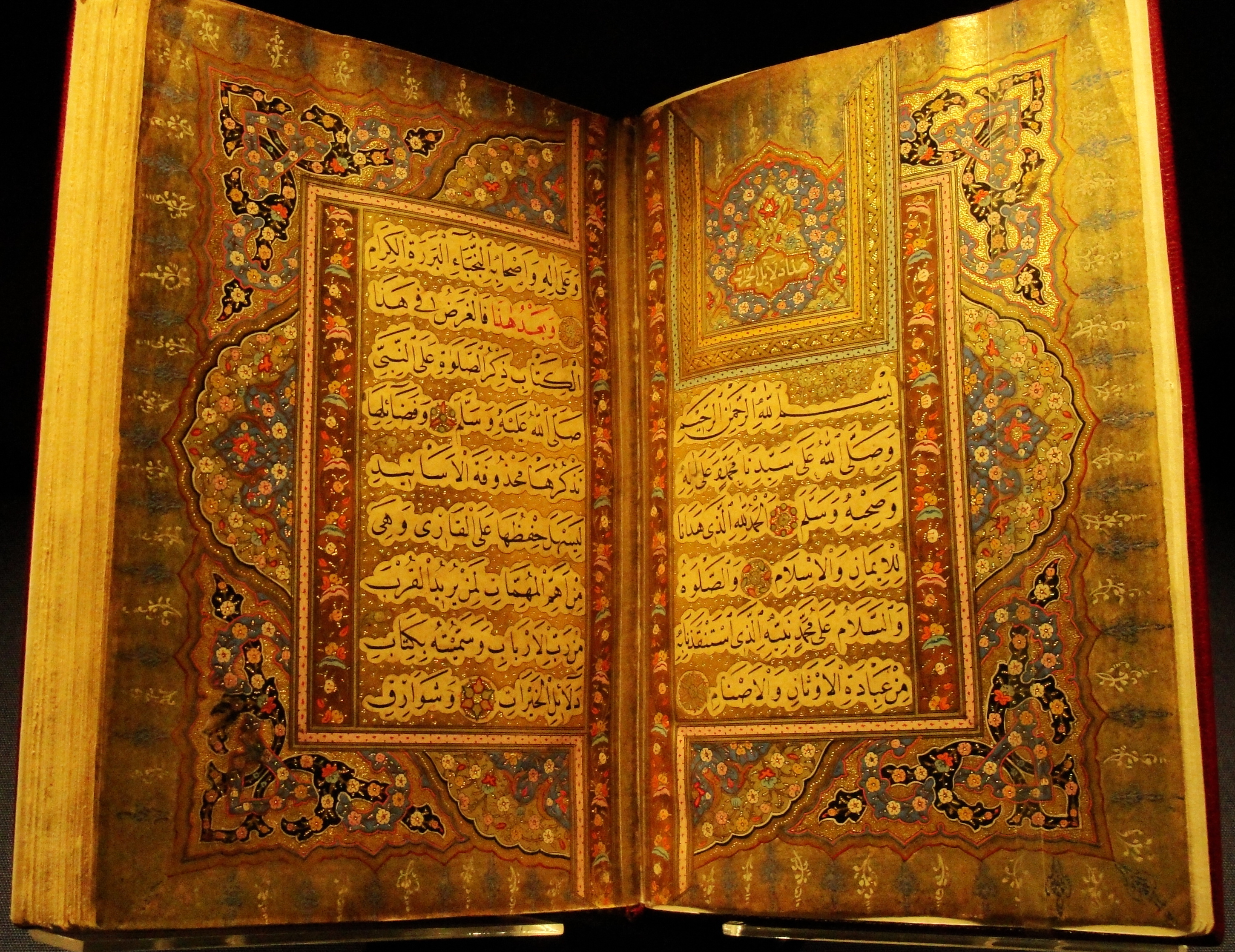
Collection of Islamic prayers

Dalāil al-khayrāt wa-shawāriq al-anwār fī dhikr al-ṣalāt alá al-Nabī al-mukhtār (), usually shortened to Dala'il al-Khayrat, is a famous collection of prayers for the Islamic prophet Muhammad, which was written by the Moroccan Shadhili scholar Muhammad al-Jazuli (died 1465 AD). It is popular in parts of the Islamic world amongst traditional Muslims—specifically North Africa, the Levant, Turkey, the Caucasus and South Asia—and is divided into sections for daily recitation.
Background
Moroccan hadith scholar Abdullah al-Talidi wrote of the Dala'il al-Khayrat: "Millions of Muslims from East to West tried it and found its good, its blessing, and its benefit for centuries and over generations, and witnessed its unbelievable spiritual blessings and light. Muslims avidly recited it, alone and in groups, in homes and mosques, utterly spending themselves in the Blessings on the Most Beloved and praising him".
The Dala'il al-Khayrat is the first major book in Islamic history which compiled litanies of peace and blessings upon Muhammad. It is also the most popular and most universally acclaimed collection of litanies asking God to bless him. Among some Sunni religious orders, most notably the Shadhili order, its recitation is a daily practice. In others however, its recitation is a purely voluntary daily practice. The work begins with the ninety nine names of God, and then a collection of 201 names of Muhammad.
The legend behind the origin of the Dala'il al-Khayrat claims that al-Jazuli once awoke late for his morning prayers and began to look in vain for pure water to perform ritual ablutions. In the midst of his search al-Jazuli encountered a young girl who was aware of al-Jazuli's famed religiosity and was bewildered on why al-Jazuli could not find pure water. The girl then spat into a well which miraculously overflowed with pure sweet water for al-Jazuli to perform ablutions. Consequent to performing prayer, al-Jazuli inquired to the means by which the girl achieved such a high spiritual station. The girl replied it was simply by "Making constant prayer for God to bless the best of creation by the number of breaths and heartbeats." Al-Jazuli then resolved to write a work collecting litanies of prayers asking God to bless and show mercy and kindness to Muhammad.
Al-Jazuli then moved east to Medina where he would recite the whole of the Dala'il al-Khayrat twice daily at Muhammad's grave in al-Masjid an-Nabawi. The Dala'il Khayrat has since been seen as a testament of love and passionate longing for Muhammad.
Many of exegesis were written on the Dala'il Khayrat - most notably by the scholar Yusuf an-Nabhani in his work Afdal al-Salawat, Mohammed al-Mahdi al-Fasi's Matali‘ Al Masarrat Bi Jalaa’ Dala’il Al Khayrat (مطالع المسرات بجلاء دلائل الخيرات) and Abd al-Majid al-Sharnubi al-Azhari's Sharh Dala'il Khayrat. A classic Ottoman era work by Kara Davud is popular in Turkish, titled Tevfîk-i Muvaffık il-Hayrât li-Neyl'il-berekât fî Hidmet-i Menbâ'üs-sa'adât (), in short known as "Kara Davud". In 2023, Shaykh Muhammad al-Yaqoubi undertook the task of publishing the most authentic edition and English translation of the Dala'il al-Khayrat, following extensive research into its chains of transmission and the consultation of numerous manuscripts, through his London-based publishing house, Signatora.
Manuscripts
| Institution | Inventory number | Origin | Date | Size | Notes | |||
|---|---|---|---|---|---|---|---|---|
| Walters Art Museum | W.583 | Ottoman Empire | 17th century | |||||
| National Library of Israel | Yahuda Ms.Ar.862 | North Africa | 17th century | title=Eid al-Adha | url=https://web.nli.org.il/sites/nli/english/digitallibrary/gallery/islam-collection/pages/id-al-adha--2012.aspx | access-date=2020-11-28 | website=web.nli.org.il}} | |
| Khalili Collection of Hajj and the Arts of Pilgrimage | MSS 97 | Turkey | late 17th or 18th century | 52 folios | ||||
| National Library of Israel | Yahuda Ms.Ar.864 | Ottoman Empire | 1734 | |||||
| Chester Beatty Library, Dublin | CBL Ar 5459 | Probably Morocco | 18th century | |||||
| Los Angeles County Museum of Art | M.85.237.51 | Turkey | 1751-1752 | |||||
| National Library of Israel | Yahuda Ms.Ar.863 | India | Late 18th century | |||||
| National Library of Israel | Yahuda Ms.Ar.47 | Ottoman Empire | 1795 | |||||
| Khalili Collection of Hajj and the Arts of Pilgrimage | MSS 1278 | India | late 18th – early 19th century | 2 detached pages | ||||
| Museum of Islamic Art, Qatar | MS.427.2007 | Istanbul | 19th century | |||||
| Khalili Collection of Hajj and the Arts of Pilgrimage | MSS 1283 | India, or possibly Mecca by Indian artists | 1801-2 | 101 folios | ||||
| National Library of Israel | Yahuda Ms.Ar.852 | Kashmir | Early 19th century | |||||
| Bayerische Staatsbibliothek, Munich | BSB Cod.arab. 2646 | 1830 | 99 folios | |||||
| Khalili Collection of Hajj and the Arts of Pilgrimage | MSS 1138 | Morocco | 1838 | 223 folios | ||||
| Bayerische Staatsbibliothek, Munich | BSB Cod.turc. 553 | Istanbul | 1845 | 221 folios | ||||
| Khalili Collection of Hajj and the Arts of Pilgrimage | MSS 276 | Turkey, probably Istanbul | 1848-9 | 84 folios | ||||
| Bayerische Staatsbibliothek, Munich | BSB Cod.arab. 2673 | Istanbul? | 1857 | 90 folios | ||||
| National Library of Israel | Yahuda Ms.Ar.38 | Ottoman Empire | 1862 | |||||
| Khalili Collection of Hajj and the Arts of Pilgrimage | MSS 1245 | North Africa or Mecca | 1873 | 89 folios | ||||
| Allama Iqbal Library, University of Kashmir | Saudi Arabia | 1885 | 187 folios | |||||
| Weltmuseum Wien, Vienna Austria | 140430 | Afghanistan | 18th century, |
Gallery
File:Khalili Collection Hajj and Arts of Pilgrimage mss 0276 fol 5b-6a.jpg|Khalili Collections MSS 0276 File:Khalili Collection Hajj and Arts of Pilgrimage mss 1138 fol 71b-72a.jpg|Khalili Collections MSS 1138 showing the names "Allah" and "Mohammed" File:Kaba and Mosque (cropped).jpg|The National Library of Israel Jerusalem Israel Ms. Yah. Ar. 47 showing illustrations of the Great Mosque of Mecca and the Prophet's Mosque. File:Al-Hajj Hafiz Muhammad Nuri, Turkey, 1801 - The Dala'il al-Khayrat of al-Juzuli - Google Art Project.jpg|The Museum of Islamic Art, Qatar, MS.427.2007 showing illustrations of the Great Mosque of Mecca and the Prophet's Mosque. File:Manuscript of the Dala'il al-khayrat of al-Jazuli LACMA M.85.237.51 (2 of 3).jpg|Los Angeles County Museum of Art M.85.237.51
References
- Read/Download Dalail ul Khairat Shareef (Urdu)
- Dala'il al-Khayrat (Audio).
- English translation of Dala'il al-Khayrat
- The Story of Dala’il al-Khayrat (by Sheikh Nuh Ha Mim Keller)
- An Appreciation by Siddiq Osman Noormuhammad
- Read online
- Read online in Arabic with English translation and transliteration
References
- "The Story of Dala'il al-Khayrat".
- "Dala'il Khayrat: An Appreciation by Siddiq Osman Noormuhammad (IQRA.net)".
- "Şerh-i Delâilü'l-hayrât".
- "Collection of Prayers for the Prophet Muhammad".
- "Eid al-Adha".
- "Dala'il al-Khayrat of al-Jazuli".
- (2021). "Dala'il al-Khayrat ('The Guide to Happiness') - Discover Islamic Art - Virtual Museum".
- "Manuscript of the Dala'il al-khayrat of al-Jazuli (Devotional Manual) {{!}} LACMA Collections".
- "The Masjid al-Haram at Mecca and the Prophet's Mosque at Medina".
- "Ottoman copy of the Dalâ'il Al-Khayrât, MS.427.2007".
- "The Dala'il al-Khayrat of al-Jazuli and Other Prayers".
- (August 1830). "Dalāʾil al-ḫairāt".
- "An Exceptional Copy of al-Jazuli's Dala'il al-Khayrat".
- "Prayer Book of Düzdidil Kadın".
- "A Lavishly Illuminated Copy of al-Jazuli's Dala'il al-Khayrat".
- "Dalāʾil al-Ḫairāt".
- Nassar, Nahla. (2020). "The ''Dala'il al-khayrat'' of al-Jazuli".
- "Manifestations of Goodness". US Library of Congress.
This article was imported from Wikipedia and is available under the Creative Commons Attribution-ShareAlike 4.0 License. Content has been adapted to SurfDoc format. Original contributors can be found on the article history page.
Ask Mako anything about Dala'il al-Khayrat — get instant answers, deeper analysis, and related topics.
Research with MakoFree with your Surf account
Create a free account to save articles, ask Mako questions, and organize your research.
Sign up freeThis content may have been generated or modified by AI. CloudSurf Software LLC is not responsible for the accuracy, completeness, or reliability of AI-generated content. Always verify important information from primary sources.
Report