From Surf Wiki (app.surf) — the open knowledge base
Dahiya doctrine
Israeli strategy of destroying civilian buildings

Israeli strategy of destroying civilian buildings
The Dahiya doctrine, also spelled Dahya or Dahieh, is an Israeli military strategy involving the large-scale destruction of civilian infrastructure, or domicide, to pressure hostile governments. The doctrine was outlined by former Israel Defense Forces (IDF) Chief of General Staff Gadi Eizenkot. Israel colonel Gabi Siboni wrote that Israel "should target economic interests and the centers of civilian power that support the organization". The logic is to cause difficulties for the civilian population so much that they will then turn against the militants, forcing the enemy to sue for peace.
Etymology
The doctrine is named after the Dahieh neighborhood (also transliterated as Dahiyeh and Dahiya) of Beirut, where Hezbollah had its headquarters during the 2006 Lebanon War, and which was heavily damaged by the IDF.
History
2006 Lebanon War
The first public announcement of the doctrine was made in an interview with general Gadi Eizenkot, commander of the IDF's northern front, published by Yedioth Ahronoth in October 2008:
In 2010, Eizenkot formulated his views in writing as follows:
According to analyst Gabi Siboni at the Israeli Institute for National Security Studies:
Noting that Dahya was the Shia quarter in Beirut that was razed by the Israeli Air Force during the 2006 Lebanon War, Israeli journalist Yaron London wrote in 2008 that the doctrine "will become entrenched in our security discourse".
Gaza
2008–2009
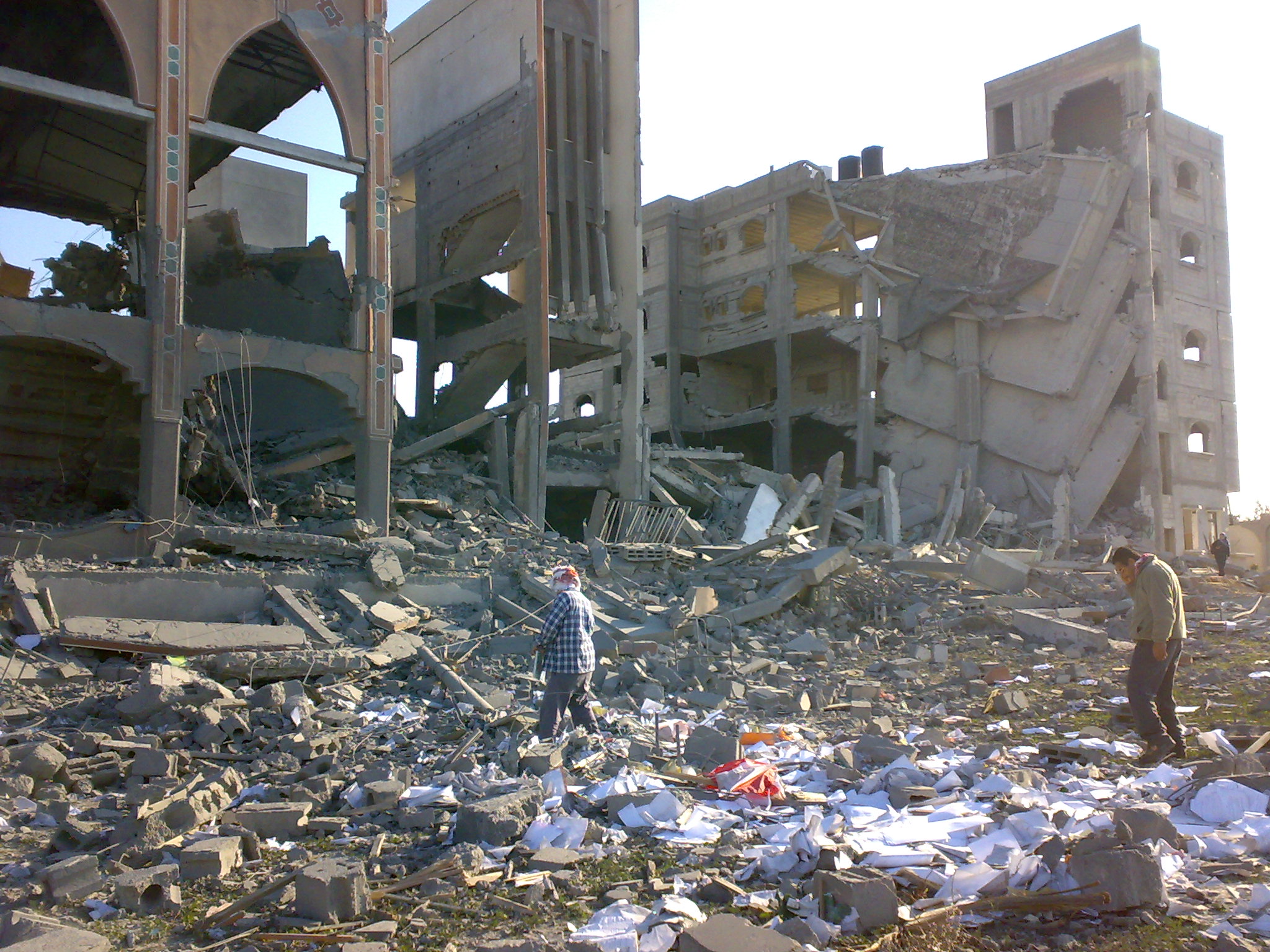
Some analysts have argued that Israel implemented such a strategy during the 2008–09 Gaza War, with the Goldstone Report concluding that the Israeli strategy was "designed to punish, humiliate and terrorize a civilian population".
The 2009 United Nations Fact Finding Mission on the Gaza Conflict makes several references to the Dahya doctrine, calling it a concept which requires the application of "widespread destruction as a means of deterrence" and which involves "the application of disproportionate force and the causing of great damage and destruction to civilian property and infrastructure, and suffering to civilian populations". It concluded that the doctrine had been put into practice during the conflict. However, in a 1 April 2011 op-ed, one of the lead authors of the report, Judge Richard Goldstone, stated that some of his conclusions may have been different had the Israeli government cooperated with his team during the investigation. Goldstone's three co-authors—Hina Jilani, Christine Chinkin, and Desmond Travers—were strongly critical of Goldstone's statement, releasing a statement standing by the report, claiming that in response to the pressure to change their conclusions "had we given in to pressures from any quarter to sanitise our conclusions, we would be doing a serious injustice to the hundreds of innocent civilians killed during the Gaza conflict, the thousands injured, and the hundreds of thousands whose lives continue to be deeply affected by the conflict and the blockade".
The doctrine is defined in a 2009 report by the Public Committee Against Torture in Israel as follows: "The military approach expressed in the Dahiye Doctrine deals with asymmetrical combat against an enemy that is not a regular army and is embedded within civilian population; its objective is to avoid a protracted guerilla war. According to this approach Israel has to employ tremendous force disproportionate to the magnitude of the enemy's actions." The report further argues that the doctrine was fully implemented during Operation Cast Lead.
2023–present

Commentators for The Guardian, The Washington Post, and Mondoweiss have noted that the attacks of the Israeli Defense Forces on the civilian infrastructure of the Gaza Strip during the Gaza war may constitute an extension of the doctrine.
Writing in The Guardian, Paul Rogers of Bradford University argues that Israel's goal in the 2023 war is to "corral the Palestinians into a small zone in the southwest of Gaza where they can be more easily controlled", and that the long-term goal is to make clear that Israel "will not stand for any opposition".
Sources reportedly told +972 Magazine that bombing of non military targets was to “lead civilians to put pressure on Hamas".
Criticism
Counterproductive
Paul Rogers argues that in their using the Dahiya doctrine in the Israel–Hamas war, Israel will fail in its goal of eradicating Hamas, which will come back in a different form, unless "some way is found to begin the very difficult task of bringing the communities together."
Violation of international law
Richard Falk wrote that under the doctrine, "the civilian infrastructure of adversaries such as Hamas or Hezbollah are treated as permissible military targets, which is not only an overt violation of the most elementary norms of the law of war and of universal morality, but an avowal of a doctrine of violence that needs to be called by its proper name: state terrorism."
References
References
- "From War to Deterrence? Israel-Hezbollah Conflict Since 2006".
- (2011). "A High Price".
- "Israel's Dahiya doctrine intentionally violates International Humanitarian Law".
- Rogers, Paul. (2023-12-05). "Israel's use of disproportionate force is a long-established tactic – with a clear aim". The Guardian.
- Malekafzali, Séamus. (2024-09-25). "Beirut Suburbs or "Hezbollah Stronghold"? U.S. Media Parrots Israeli Propaganda to Justify Bombing Civilians".
- Amos Harel. (5 October 2008). "ANALYSIS / IDF plans to use disproportionate force in next war". Haaretz.
- link. (5 October 2008)
- Hirst, David. (30 March 2010). "Beware of Small States: Lebanon, Battleground of the Middle East". Nation Books.
- (3 October 2008). "Israel warns Hizbullah war would invite destruction". Yedioth Ahronoth.
- (3 October 2008). "[I Have Tremendous Power, I Will Make No Excuses]". Yediot Ahronot.
- (June 2010). "A changing threat? The response in the northern theater". Army and Strategy.
- (2 October 2008). "Disproportionate Force: Israel's Concept of Response in Light of the Second Lebanon War". INSS.
- Caverley, Jonathan D.. (1 May 2014). "Democratic Militarism: Voting, Wealth, and War". Cambridge University Press.
- London, Yaron. (10 June 2008). "The Dahya Strategy". Ynet News.
- (September 2010). "Deterrence in the Twenty-first Century: Proceedings".
- "Media Summary: Report of the United Nations Fact Finding Mission on the Gaza Conflict".
- United Nations General Assembly, [http://www2.ohchr.org/english/bodies/hrcouncil/docs/12session/A-HRC-12-48.pdf "Report of the United Nations Fact-Finding Mission on the Gaza Conflict"], 25 September 2010
- Goldstone, Richard. (2 April 2011). "Reconsidering the Goldstone Report on Israel and war crimes". [[The Washington Post]].
- (11 April 2011). "UN Gaza report co-authors round on Goldstone". The Guardian.
- [http://www.stoptorture.org.il/files/no%20second%20thoughts_ENG_WEB.pdf "No Second Thoughts"] {{webarchive. link. (15 February 2010 The Public Committee Against Torture in Israel, pp. 20–21)
- Tharoor, Ishaan. (2023-11-10). "Analysis {{!}} The punishing military doctrine that Israel may be following in Gaza". Washington Post.
- (December 2023). "Israel's Gaza onslaught is the next stage of the Dahiya Doctrine".
- Rogers, Paul. (2023-12-05). "Israel's use of disproportionate force is a long-established tactic – with a clear aim". The Guardian.
- Reiff, Ben. (2023-11-30). "'A mass assassination factory': Inside Israel's calculated bombing of Gaza".
- Richard Falk. (7 January 2011). "Israel's Violence Against Separation Wall Protests: Along the Road of State Terrorism". Citizen Pilgrimage blog <!--.
This article was imported from Wikipedia and is available under the Creative Commons Attribution-ShareAlike 4.0 License. Content has been adapted to SurfDoc format. Original contributors can be found on the article history page.
Ask Mako anything about Dahiya doctrine — get instant answers, deeper analysis, and related topics.
Research with MakoFree with your Surf account
Create a free account to save articles, ask Mako questions, and organize your research.
Sign up freeThis content may have been generated or modified by AI. CloudSurf Software LLC is not responsible for the accuracy, completeness, or reliability of AI-generated content. Always verify important information from primary sources.
Report