From Surf Wiki (app.surf) — the open knowledge base
Dagome iudex
Early historical document relating to Poland

Early historical document relating to Poland
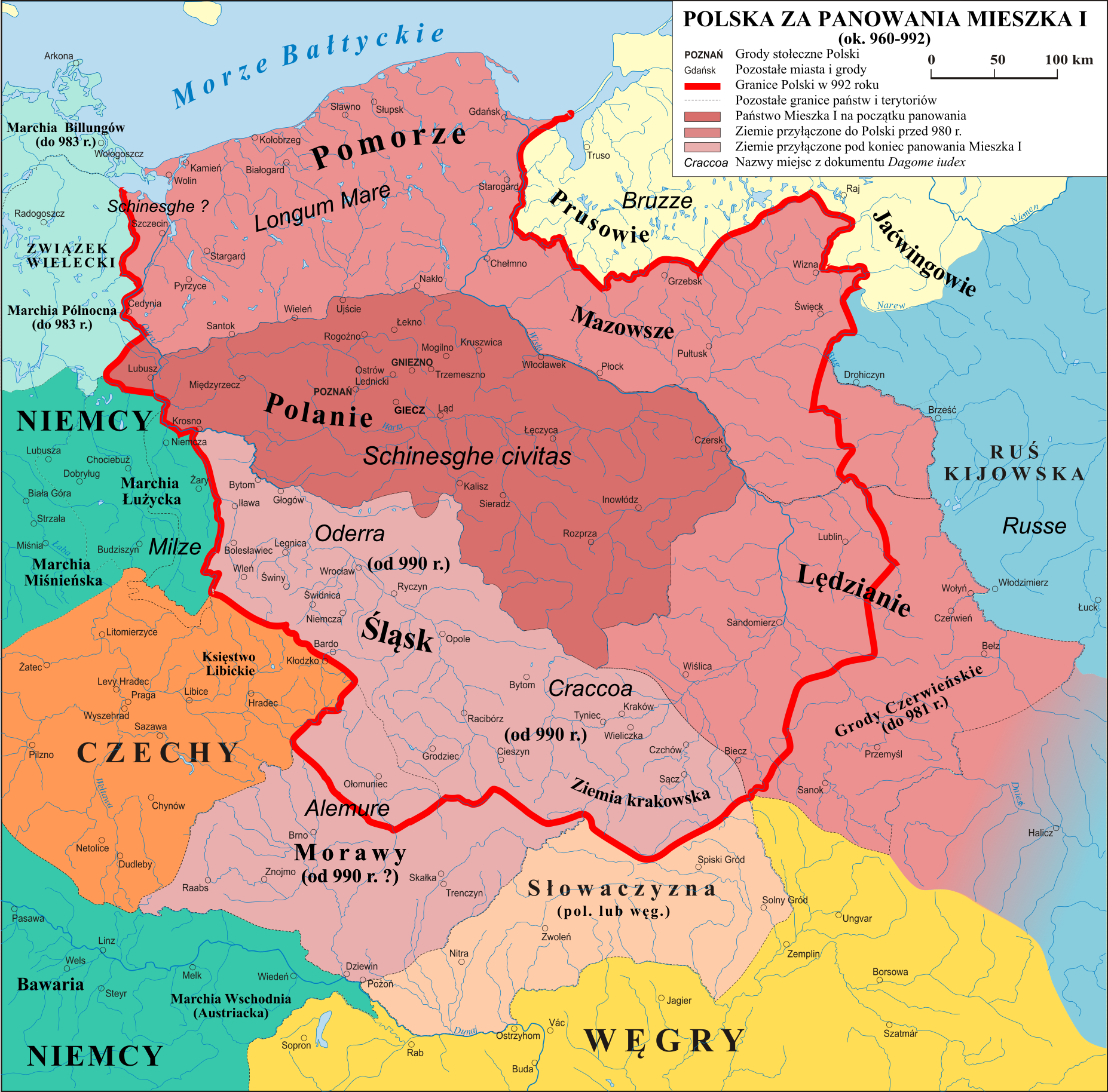
Dagome iudex is one of the earliest historical documents relating to Poland. Although Poland is not mentioned by name, it refers to Dagome and Ote (Mieszko I and his wife, Oda von Haldensleben) and their sons in 991, placing their land (called "Civitas Schinesghe") under the protection of the Apostolic See. The document's name derives from its opening words.
History
- In English translation:
: "Also in another volume from the times of Pope John XV, Dagome, lord, and Ote, lady, and their sons Misico and Lambert (I do not know of which nation those people are, but I think they are Sardinians, for those are ruled by four judges) were supposed to give to Saint Peter one state in whole which is called Schinesghe, with all its lands in borders which run along the long sea, along Prussia to the place called Rus, thence to Kraków and from said Kraków to the River Oder, straight to a place called Alemure, and from said Alemure to the land of Milczanie, and from the borders of that people to the Oder and from that, going along the River Oder, ending at the earlier mentioned city of Schinesghe."
Notes
Notes based on interpretations by the Polish historian Gerard Labuda:
a. When Lusatia came in sight of medieval writers, the lived only in Lower Lusatia, the Milceni in Upper Lusatia. Later on, the term Lusatia (Lausitz, Lužice) was spread to the south. Therefore, nowaday's term Lusatian Mountains does not totally fit with the history of settlement.
b. "Dagome" is commonly identified as Mieszko I. However, the question remains open whether this was a misspelling or his Christian name. If the latter, it might correspond to the names "Dago", "Dagon" or "Dagobert".
c. In classical Latin, the term iudex was used to refer to "a person who is ordered to do some work on behalf of others" and was identical in meaning to the Byzantine archont. However, in medieval Latin iudex could also mean a sovereign ruler. Princes of Slavic tribes were sometimes referred to as iudices. Nevertheless, some historians claim that this was a misspelling of the Latin dux ("duke" or "prince").
d. Literally, "lady-senator". Cf. "senate".
e. It is unclear why Bolesław I the Brave, Mieszko's eldest son and his successor, is not mentioned while the children from Mieszko's marriage to Ote are.
f. Scribe's note, only in the Vatican copy; the four is written non-classical as iiii.
g. The origin of the name Schinesghe is unclear. Some historians argue that it is a corruption of "Gniezno", then Poland's capital. Others identify it with the town of Szczecin.
h. "Long sea": Some historians identify it with the Baltic Sea, others with the province of Pomerania (the Baltic coast), a part of Poland ca. 990.
i. Alemure might be the city of Olomouc, in Moravia. However, this is uncertain.
References
References
- George J. Lerski. (1996). "Historical Dictionary of Poland, 966-1945". Greenwood Press.
- Przemyslaw Wiszewski. (2010). "Domus Bolezlai: Values and social identity in dynastic traditions of medieval Poland (c.966-1138)". BRILL.
This article was imported from Wikipedia and is available under the Creative Commons Attribution-ShareAlike 4.0 License. Content has been adapted to SurfDoc format. Original contributors can be found on the article history page.
Ask Mako anything about Dagome iudex — get instant answers, deeper analysis, and related topics.
Research with MakoFree with your Surf account
Create a free account to save articles, ask Mako questions, and organize your research.
Sign up freeThis content may have been generated or modified by AI. CloudSurf Software LLC is not responsible for the accuracy, completeness, or reliability of AI-generated content. Always verify important information from primary sources.
Report