From Surf Wiki (app.surf) — the open knowledge base
Da Vinci Systems
Defunct American digital cinema company

Defunct American digital cinema company
| Field | Value |
|---|---|
| name | da Vinci Systems |
| logo | Da Vinci Systems wordmark.svg |
| type | Private |
| industry | Digital cinema |
| founded | 1984 |
| founder | |
| defunct | |
| fate | Acquired; merged into Blackmagic Design |
| hq_location_city | Coral Springs, Florida |
| owners | Dynatech (1986–2000) |
| Acterna (2000–2005) | |
| JDSU (2005–2009) | |
| website |
Acterna (2000–2005) JDSU (2005–2009)
da Vinci Systems was an American digital cinema technology company based in Coral Springs, Florida. It was founded in 1984 as a spinoff of Video Tape Associates (VTA), a production and post-production facility that had begun developing in-house post-production systems in 1982. The company became known for its color correction and color grading systems, as well as digital mastering and film restoration technologies. Its products were used widely in television and film post-production.
In 1986, the company was acquired by Dynatech, following a corporate merger, Dynatech was renamed Acterna, which continued to hold da Vinci Systems. In 2005, Acterna was acquired by JDS Uniphase, which inherited da Vinci Systems as part of the transaction. In 2009, the financially troubled JDSU sold the company to Blackmagic Design, which merged it into its operations. Blackmagic Design has continued development of da Vinci's flagship software under the name DaVinci Resolve.
Company history
In 1982, Video Tape Associates (VTA), a Hollywood, Florida-based production/post-production facility, began developing the Wiz for internal use and introduced it to the public the following year. The Wiz controlled early telecines such as the RCA FR-35 and the Bosch FDL 60 and offered basic primary and secondary color correction. The Wiz served as a major inspiration/prototype for what would become the da Vinci Classic.
In 1984, VTA Technologies, the research and development division of VTA Post, broke away from its parent company to become da Vinci Systems, Inc. One of its four founders was Bob Hemsky. The da Vinci was the only film-to-tape or tape-to-tape color correction system on the market that offered the capability to create a basic rectangular window shape isolating a secondary color correction. In 1986, da Vinci was acquired by Dynatech Corporation and managed within their Utah Scientific business. Two years later, da Vinci Systems, LLC became its own entity as one of roughly eight video manufacturing companies within the Dynatech Video Group. In 1998, da Vinci Academy was formed to provide training to the growing number of aspiring colorists. The following year, da Vinci acquired Nevada-based Sierra Design Labs, at that time a worldwide leader in HDTV storage and workstation interface solutions.
In 2000, da Vinci's parent company, Dynatech, became Acterna after a merger with Wavetek, Wandel & Goltermann and TTC. Acterna then acquired Singaporean company Nirvana Digital to add the Revival film restoration system to its production line. In 2004, da Vinci had offices in Coral Springs, Los Angeles, New York, London, Paris, Germany, and Singapore. On August 3, 2005, JDS Uniphase acquired Acterna, including da Vinci systems, for $450 million and 200 million shares of JDSU common stock.
Product history
da Vinci Classic (1984-1990)
The da Vinci, now known as the da Vinci Classic, was launched in 1984 and manufactured until 1990. At the time of its introduction, it was the only film-to-tape or tape-to-tape color correction system available that offered the capability to correct secondary colors by isolating them. The analog grading system became the most popular color corrector for telecines like the Fernseh FL 60 and Rank Cintel Mark 3. The Classic had a customized external control panel with primary and secondary processing and an internal NTSC encoder. It operated on a Motorola 68000 Multibus 1 system computer. Early models had knob-only color correction controls; trackball control was introduced later.
da Vinci Renaissance (1990-1993)
The da Vinci Renaissance, manufactured between 1990 and 1993, was similar to the Classic but ran on a Motorola 68020 system rather than a 68000. Kilvectors secondary color processing, which would become an industry standard function for secondary color isolation, later became available on the system. Options for 525 and 625 resolutions were available. The system was often used with FDL 60, FDL 90, MK3, or URSA telecines.
da Vinci's Leonardo (1990)
In 1990, da Vinci released a low-cost color corrector for smaller facilities. To reduce the cost, they used a flat plate control panel and limited its capabilities to scene-by-scene control of a telecine. The Leonardo did not offer da Vinci color processing and only one unit was sold in its short time on the market.
da Vinci Renaissance 888 (1991-1998)
In 1991, the da Vinci Renaissance 888 was introduced; it was manufactured until 1998. The 888 operated without a GUI and was the first product ever to include digital 888 signal processing throughout. Power Windows, which enabled area isolation using soft edges and shapes; Custom Curves, a color correction tool using curves; and YSFX, which allowed independently adjustable luminance and chrominance ratios, were all included features. The 888 was used with FDL 60, FDL 90, Quadra, MK3, and URSA telecines.
Time Logic Controller (1994)
In 1994, da Vinci Systems acquired the Time Logic Controller (TLC) product line from Time Logic. TLC was an edit controller for telecines, vision mixers, and video tape recorders. It provided accurate 2:3 editing when transferring a 24 frames per second film into a 30 frames per second video environment. TLC 1 was released by Time Logic in early 1994 and TLC 2 was released by da Vinci later that year.
888 da Vinci User Interface (1995)
In 1995, the 888 da Vinci User Interface (DUI) was introduced. It had similar color processing to the 888 but had a new Windows-style user interface, an internal TLC controller, and EDWIN. The telecine interface card controlled the telecine's internal color corrector. The 888 DUI came in two configurations: the first used a SGI Indy workstation and the second used SGI O2.
The da Vinci Lite, a scaled-down version of the 888 DUI, was released later that year. It was largely unsuccessful due to lack of marketing.
da Vinci 2K (1998)
The da Vinci 2K, which began production in 1998, was an enhanced version of previous color correction systems. With an improved color processing quality and performance, it could support high-definition, standard-definition, and 2K formats. It operated with a 4:2:2, 4:4:4, or 8:4:4 input. da Vinci 2K also included features such as PowerTiers, Defocus (using defocus aberration); and Colorist Toolbox. In 2001, PowerGrades, color presets, and the Gallery, an integrated reference store, were available as additions. It also allowed for real-time filesharing. Seabiscuit and Star Wars: Episode I – The Phantom Menace were both graded on the 2K. In 2001, the 2K won the Philo T. Farnsworth Award at the Primetime Engineering Emmy Awards.
The 2K Plus was introduced in 2002. Upgrades included four PowerVectors, Defocus Plus, Colorist Plus, and redesigned primaries, secondaries, and keys. In 2006, ColorTrace was offered for 2K Plus to track color grades when the edit decision list (EDL) is revised.
Nucleas (2003)
Nucleas was launched in 2003, providing server-to-server software interface to existing 2k Plus systems to work from data disks and storage networks. HIPPI and HSDL (High Speed Data Link, which transferred 2K and higher resolution images over HD-SDI links) interfaces and data waveforms were also available.
Resolve (2004)
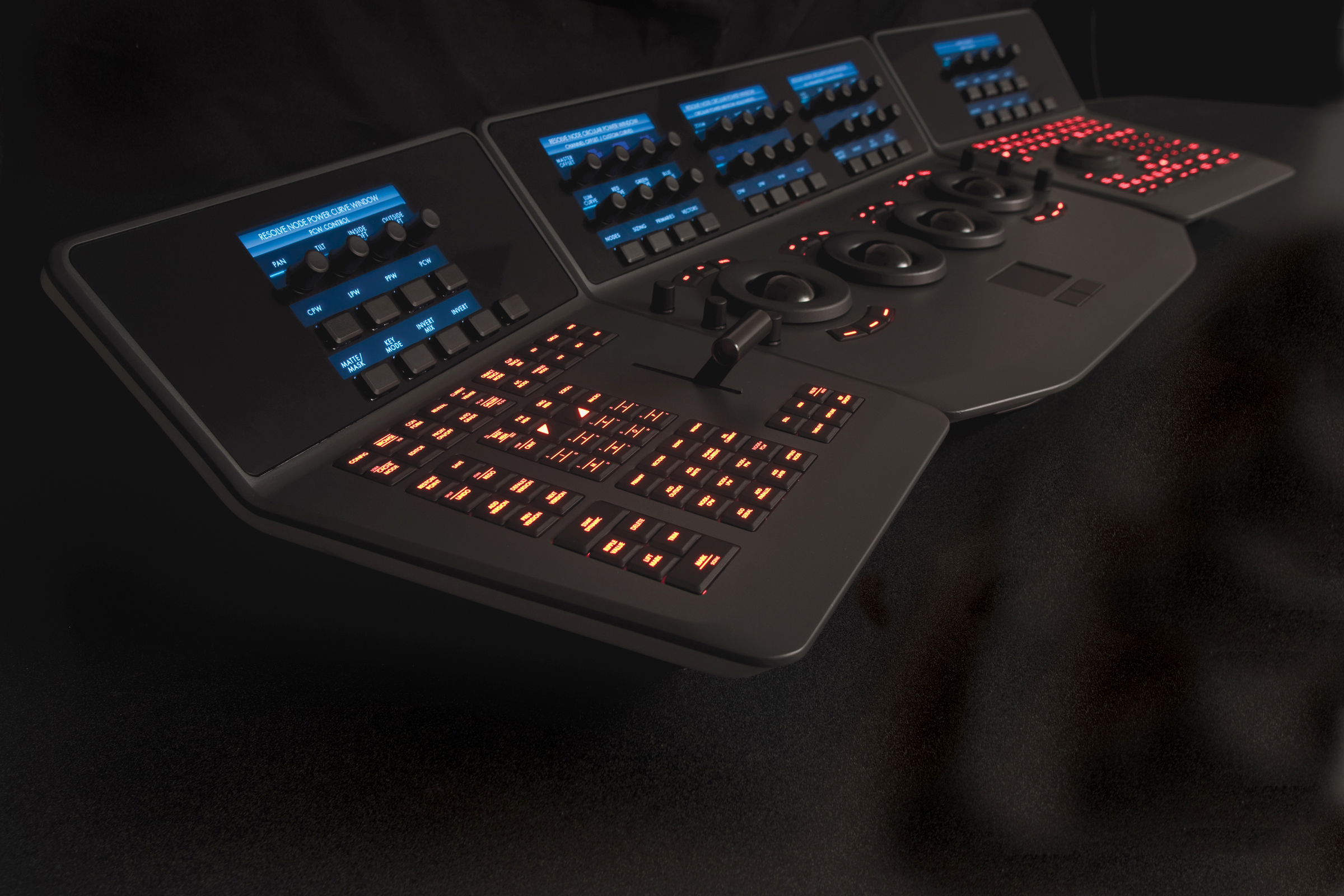
Main article: DaVinci Resolve
In 2004, da Vinci released Resolve, a software-based, resolution-independent color grading system that used multiple parallel processing engines within normal PC computer infrastructure for real-time 2K resolution color grading. This system was the first to implement InfiniBand topology.
In 2007, da Vinci released the Resolve R-3D which was focused on nonlinear grading in 3D. Some of the early films graded on the R-3RD include Quantum of Solace, U2 3D, and Meet the Robinsons. In 2008, Impresario, a new control panel for Resolve, was launched at NAB 2008 and demonstrated at NAB 2009. Resolve v6.2, released in 2009, allowed syncing two Resolve systems for shared work; when any changes are made on one, they immediately appeared on the other.
Splice (2004)
Like the da Vinci Nucleas, Splice was a server-to-server system that enabled 2K systems to work nonlinearly. It was promoted for use with SANs and as a life-extender for the 2K and 2K Plus.
References
References
- Wilson, Tim. "DaVinci – Rebuilding the Brand for the 21st Century". Creative COW.
- Shaw, Kevin. (n.d.). "History For Colorists". Final Color.
- Jayawardana, Ruwini. (August 16, 2010). "HD for a finer vision". Daily News.
- Cristy, Matt. (February 3, 1997). "Firm seeking $1.5M helping hand". Jacksonville Business Journal.
- Soule, Alexander. (August 7, 2000). "Dynatech tests out a new name: Acterna". The Business Journals.
- (March 20, 2013). "GDC Technology Limited". U.S. Securities and Exchange Commission.
- Desowitz, Bill. (April 15, 2004). "da Vinci and SGI to Deliver Integrated Digital Mastering Solutions at NAB2004". Animation World Network.
- Seymour, Mike. (September 7, 2009). "BlackMagic Design Buys daVinci – Confirmed". FX Guide.
- (December 1, 2009). "Through A Lens (Really) Clearly...". International Cinematographers Guild Magazine.
- Ochiva, Dan. (August 16, 2011). "Company 3 Settles In". NYC Production & Post News.
- Dager, Nick. (April 30, 2009). "ShoWest 2009: The Report". Digital Cinema Report.
- (December 1, 2002). "Shaw Brothers Remastering Center". TV Technology.
- Shaw, Kevin. (2005). "A History of da Vinci Products". Final Color.
- (November 27, 2007). "Maximum Throughput and da Vinci Systems Partner to Deliver Virtual Telecine". TV Technology.
- Dager, Nick. (May 12, 2008). "CinePostproduction Installs BrightDrive Recording System". Digital Cinema Report.
- Kaufman, Debra. (2003). "A Digital Finish for Seabiscuit".
- Eagles, Warren. (November 21, 2010). "The Last DaVinci 2K Goes Into the BFA". iColorist.
- (2021). "Engineering Emmy Award Winners". Television Academy.
- (2005). "Da Vinci 2K Plus and 2K Elite Series". The ASC.
- (2005). "POSTWORKS FURTHER COMMITS TO DA VINCI TECHNOLOGY". Post Magazine.
- (August 3, 2005). "JDSU closes Acterna acquisition". Lightwave.
- Goldman, Matthew. (February 15, 2012). "NAB 2004". Creative Planet Network.
- Dager, Nick. (July 15, 2015). "Sex&Drugs&Rock&Roll Posted at Technicolor PostWorks". Digital Cinema Report.
- Dager, Nick. (February 10, 2015). "Modern VideoFilm's Transatlantic Effort for Grand Budapest Hotel". Digital Cinema Report.
- Dager, Nick. (December 8, 2008). "At the C.O.R.E.". Digital Cinema Report.
- Dager, Nick. (November 19, 2008). "Not a Bad Start". Digital Cinema Report.
- Dager, Nick. (May 13, 2008). "NAB 2008: The Report Part 2". Digital Cinema Report.
- Dager, Nick. (March 22, 2009). "NAB 2009: Preview – Part One". Digital Cinema Report.
- Dager, Nick. (July 12, 2009). "Da Vinci Resolve now has added Support for Red and 3D Files". Digital Cinema Report.
- Kaufman, Debra. (February 12, 2009). "3 Kings". Hollywood Reporter.
- (June 16, 2009). "Filmworkers Club upgrades da Vinci Splice systems". TV Technology.
- (August 13, 2007). "FILMWORKERS CLUB/ASTRO LABS BUILDING 'DI' PIPELINE". Post Magazine.
This article was imported from Wikipedia and is available under the Creative Commons Attribution-ShareAlike 4.0 License. Content has been adapted to SurfDoc format. Original contributors can be found on the article history page.
Ask Mako anything about Da Vinci Systems — get instant answers, deeper analysis, and related topics.
Research with MakoFree with your Surf account
Create a free account to save articles, ask Mako questions, and organize your research.
Sign up freeThis content may have been generated or modified by AI. CloudSurf Software LLC is not responsible for the accuracy, completeness, or reliability of AI-generated content. Always verify important information from primary sources.
Report