From Surf Wiki (app.surf) — the open knowledge base
Cyclops (play)
Ancient Greek satyr play by Euripides

Ancient Greek satyr play by Euripides
| Field | Value |
|---|---|
| image | Polyphemos reclining and holding a drinking bowl.jpg |
| caption | Late Classical terracotta figure depicting Polyphemos reclining while drinking a bowl of wine. |
| writer | Euripides |
| chorus | Satyrs |
| characters | Silenus |
| Odysseus | |
| The Cyclops | |
| mute | Companions of Odysseus |
| place | Athens |
| orig_lang | Ancient Greek |
| genre | Satyr play |
Odysseus The Cyclops
Cyclops () is an ancient Greek satyr play by Euripides, based closely on an episode from the Odyssey.{{cite book
Plot
The play is set in Sicily at Mount Aetna. It begins with an opening monologue by Silenus, who tells the tale of how he and the satyrs (who are his offspring and followers) have been abused by the giant Cyclops (named by him as Polyphemus (l. 25)). The satyrs are now enslaved to work for the Cyclops, and shepherd his flock (ll. 1-85). Odysseus, who has lost his way on the voyage home from the Trojan War, arrives with his hungry sailors. They meet Silenus and offer to trade wine for food. Being a servant of Dionysus, Silenus cannot resist obtaining the wine despite the fact that the food is not his to trade. But the Cyclops soon arrives and Silenus is quick to accuse Odysseus of stealing the food (ll. 86-275).
Odysseus has a lively debate with the Cyclops, arguing against his brutality, and in favor of morality, law, justice and hospitality, while the Cyclops argues in support of personal advantage and pleasure. The Cyclops considers the idea of social justice a fraud created by the weak as protection against the mighty; he is basically an atheist (ἀνόσιος, anosios, impious), and claims that the only thing worthy of worship is wealth. After this debate, the Cyclops brings Odysseus and his crew inside his cave and eats two of them. Odysseus manages to sneak out, stunned by what he has witnessed. In revenge, he plans a scheme to get the Cyclops drunk and blind him with a burning stake after the giant has passed out from inebriation (ll. 276-515).
The Cyclops and Silenus drink together, with Silenus attempting to hoard the wineskin for himself. When the Cyclops is drunk, he says he sees the gods, and begins to call Silenus his Ganymede (the beautiful prince whom Zeus made his immortal cup bearer and lover). The Cyclops then steals Silenus away into his cave, explaining that he takes "more pleasure in boys than in women" ("τοῖς παιδικοῖσι μᾶλλον ἢ τοῖς θήλεσιν", tois paidikoisi māllon ē tois thēlesin [l. 584]). Odysseus now decides to execute the next phase of his plan. The satyrs initially agreed to help, but later offer a variety of absurd excuses when the time for action comes. The annoyed Odysseus gets his crew to help instead and they blind the Cyclops (ll. 516-660).
As Odysseus had told the Cyclops earlier that his name was "Nobody" (οὔτις, outis), when the Cyclops screams who was responsible for blinding him, it sounds like he is saying that nothing is wrong ("Nobody blinded me", Οὖτίς με τυφλοῖ βλέφαρον, Outis me tuphloi blepharon [l. 673]), and the satyrs mock him over this. Once Odysseus and his men have escaped the cave, he reveals his true name and sets off, taking the willing satyrs with him. Meanwhile the Cyclops rushes to the mountain peak to try and sink the departing ship with boulders (ll. 661-707).[[File:Odysseus (Rom).jpg|thumb|upright=0.5|left|Odysseus offering wine to Polyphemus]]
Analysis
Euripides is not the only ancient dramatist who wrote a Cyclops satyr play. Aristias of the early fifth century did also. But Cyclops is apparently the only play by Euripides with a particular Homeric foundation. Euripides' play combines the myth of Dionysus's capture by pirates with the episode in Homer's Odyssey of Odysseus' encounter with the cyclops Polyphemus. In this scenario Euripides inserts Silenus and the satyrs, comic characters.
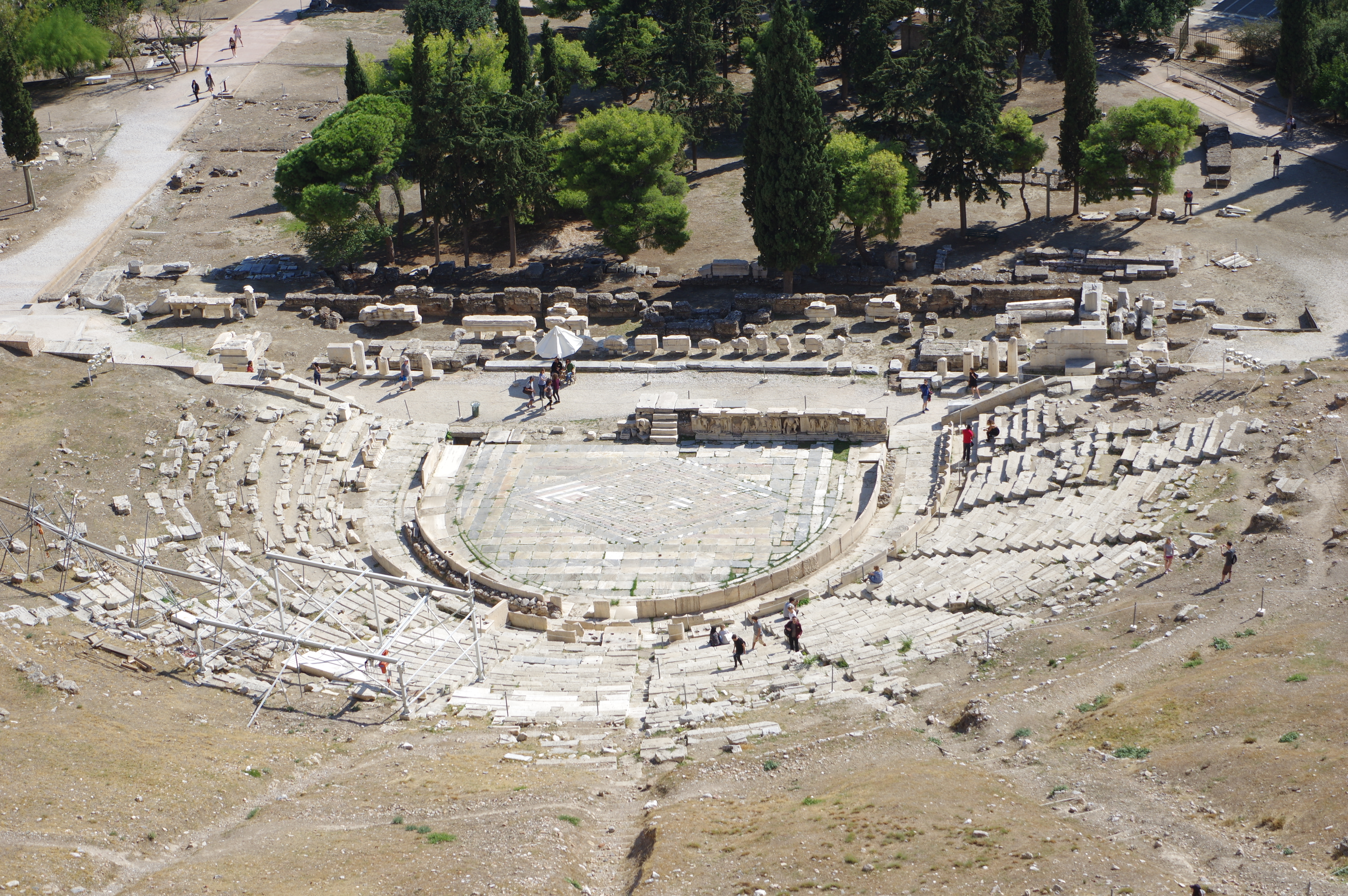
Both the Homeric episode and Euripides' Cyclops are based on the blinding of the Cyclops. It was almost certainly known by Euripides' audience that a particular Alcander had stuck a stick into the eye of Lycurgus the Spartan lawgiver. On one level of Euripides' play Alcibiades thrusts a stake into the eye of "a gross caricature of a Spartan", expressing "a shift of political alliances ostensibly achieved by Alcibiades". Like Sophocles' Philoctetes, Euripides' Cyclops made an appeal on behalf of Alcibiades that he be allowed to return from exile. Euripides also encouraged his audience to consider the recent Athenian enterprise against Sicily, which was undertaken for greed against an intractable and difficult enemy when Athens could barely provide money or men and which did not go well.
The Homeric Polyphemus is brutish and alien to Odysseus and his crew. Euripides' Polyphemus is sophisticated and intellectually analogous to sophists of the fifth century.{{cite book
Gluttonous ingestion is a theme and "[t]he imagery of grotesque ingestion surfaces almost immediately in the play". Euripides' Cyclops has been described as "a figure of proto-Rabelaisian excess" and linked to ideas contained in the work of Mikhail Bakhtin. Polyphemus "likes to talk, he likes to eat, [...] to talk about eating, or to try to eat those who talk to him". The Cyclops and the satyrs continually refer to the Cyclops' belly and the satisfaction thereof. Interaction between Odysseus and the Cyclops is based on food and exchange.
In the play the Cyclops suggests that people are the source of morality and not the gods. He says that he sacrifices only to his belly, the greatest of divinities. Such impiety was of substantial interest to Athenians in the fifth century. Euripides often dealt with "the consequences of impiety". One facet of Greek religion was "to honor and placate the gods because they are powerful". The Athenians judicially punished philosophers and sophists. Euripides himself may have left Athens in "self-imposed exile".{{cite book
The location of the cyclopes in the Odyssey is not specified, but Euripides' Cyclops is set in Sicily, possibly following Epicharmus, portrayed as barbarous and desolate and hostile.O'Sullivan, Patrick. "Cyclops". McClure, Laura. A Companion to Euripides. John Wiley & Sons, 2017. . page 315. This was not an accurate representation of Sicily. But the point is that the place is "completely non-Bacchic" and "non-Dionysiac". This is mentioned by every character in the play.
_02.jpg)
In Cyclops the chorus "claim to know an incantation of Orpheus that will bring down a form of fiery destruction upon their enemy". When the satyrs identify the Cyclops as a "son of Earth" and present their firebrand as igniting the Cyclops' skull rather than his eye they mimic a traditional Orphic incantation and Zeus's punishment of the Titans, the "sons of Earth" and primordial enemies of the Orphic Dionysus. The central focus of Orphism is the suffering and death of the god Dionysus at the hands of the Titans, which forms the basis of Orphism's central myth. In the play the satyrs are devotees of Dionysus and on the island of Sicily, known to be "a center of Orphic cult".
Cyclops has been both lauded and scorned, with hostile commentators criticising its simplicity of plot and characterisation.{{cite book
Translations
- Percy Bysshe Shelley, 1819 (published 1824) – verse (full text at Google Books or )
- Edward P. Coleridge, 1891 – prose (full text from MIT Classics)
- Arthur S. Way, 1912 – verse
- J. T. Sheppard, 1923 – verse
- William Arrowsmith, 1956 - verse
- Roger Lancelyn Green, 1957 – verse
- David Kovacs, 1994 – prose (full text on Tufts Perseus)
- Heather McHugh and David Konstan, 2001 – verse
- George Theodoridis, 2008 – prose (full text at Bacchicstage Wordpress)
- Patrick O'Sullivan and Christopher Collard, 2013 (full text on Academia.edu)
- Brian Vinero, 2013: rhymed verse
References
References
- (1997). "The Cambridge Companion to Greek Tragedy". Cambridge University Press.
- Storey, Ian C., and Allan, Arlene. A Guide to Ancient Greek Drama. Somerset: John Wiley & Sons, Incorporated, 2014. p. 171.
- Torrance, Isabelle. (2013). "Metapoetry in Euripides". Oxford University Press.
- Dougherty, Carol. "The Double Vision of Euripides' ''Cyclops'': An Ethnographic ''Odyssey'' on the Satyr Stage". ''Comparative Drama''. Vol. 33, No. 3 (Fall 1999), pp. 313-338
- [[Homer]], ''[[Odyssey]]'' [http://data.perseus.org/citations/urn:cts:greekLit:tlg0012.tlg002.perseus-eng1:9.318-9.359 9.331-333].
- Storey, Ian C., and Allan, Arlene. A Guide to Ancient Greek Drama. Somerset: John Wiley & Sons, Incorporated, 2014. p. 170.
- Tarnopolsky, Christina. "The Event of Genre: Reading Plato's Republic through the Lens of Satyr-Play." Theory & Event 17, no. 1 (2014): N_A.
- O'Sullivan, Patrick. "Cyclops". McClure, Laura. ''A Companion to Euripides''. John Wiley & Sons, 2017. {{ISBN. 9781119257509.
- Torrance, Isabelle. (2013). "Metapoetry in Euripides". Oxford University Press.
- Torrance, Isabelle. (2013). "Metapoetry in Euripides". Oxford University Press.
- Torrance, Isabelle. (2013). "Metapoetry in Euripides". Oxford University Press.
- Torrance, Isabelle. (2013). "Metapoetry in Euripides". Oxford University Press.
- Torrance, Isabelle. (2013). "Metapoetry in Euripides". Oxford University Press.
- Vickers, Michael. Sophocles and Alcibiades : Athenian Politics in Ancient Greek Literature. Stocksfield [U.K.]: Acumen, 2008. p.85
- Vickers, Michael. Sophocles and Alcibiades : Athenian Politics in Ancient Greek Literature. Stocksfield [U.K.]: Acumen, 2008. pp.84-85
- Vickers, Michael. Sophocles and Alcibiades : Athenian Politics in Ancient Greek Literature. Stocksfield [U.K.]: Acumen, 2008. p.84
- Vickers, Michael. (2014). "Sophocles and Alcibiades: Athenian Politics in Ancient Greek Literature". Routledge.
- Torrance, Isabelle. (2013). "Metapoetry in Euripides". Oxford University Press.
- Raeburn, D. (2016), Greek Tragedies As Plays for Performance, John Wiley & Sons, Incorporated, Newark. p.138
- Worman, Nancy. "Odysseus, ingestive rhetoric, and Euripides' Cyclops." Helios, vol. 29, no. 2, 2002, p. 101+. Gale Academic OneFile, https://link.gale.com/apps/doc/A95966820/AONE?u=tou&sid=AONE&xid=5ad4a560. Accessed 8 Sept. 2020.
- Worman, Nancy. "Odysseus, ingestive rhetoric, and Euripides' Cyclops." Helios, vol. 29, no. 2, 2002, p. 101+. Gale Academic OneFile, https://link.gale.com/apps/doc/A95966820/AONE?u=tou&sid=AONE&xid=5ad4a560. Accessed 4 Sept. 2020.
- Worman, Nancy. "Odysseus, ingestive rhetoric, and Euripides' Cyclops." Helios, vol. 29, no. 2, 2002, p. 101+. Gale Academic OneFile, https://link.gale.com/apps/doc/A95966820/AONE?u=tou&sid=AONE&xid=5ad4a560. Accessed 5 Sept. 2020.
- McClure, LK (ed.) 2017, A Companion to Euripides, John Wiley & Sons, Incorporated, Somerset. pp. 521-22
- McClure, LK (ed.) 2017, A Companion to Euripides, John Wiley & Sons, Incorporated, Somerset. p. 522
- O'Sullivan, Patrick. "Cyclops". McClure, Laura. ''A Companion to Euripides''. John Wiley & Sons, 2017. {{ISBN. 9781119257509. page 314.
- Olson, S. Douglas. "Dionysus and the Pirates in Euripides' 'Cyclops'." Hermes 116, no. 4 (1988): 502-04. Accessed September 7, 2020. http://www.jstor.org/stable/4476660.
- Slenders, Willeon. (2015). "A Companion to Sophocles". Wiley.
- Riggs, David. (2014). "The World of Christopher Marlowe". Henry Holt and Company.
- Shaw, Carl A.. (2014). "Satyric Play: The Evolution of Greek Comedy and Satyr Drama". Oxford University Press.
- Antonopoulos, Andreas P.. (2021). "Reconstructing Satyr Drama". De Gruyter.
- Kerényi, Károly. (2016). "The Gods of The Greeks". Hauraki Publishing.
- [[Christopher A. Faraone. Faraone, Christopher A.]] "Mystery Cults and Incantations: Evidence for Orphic Charms in Euripides' Cyclops 646-48?" Rheinisches Museum Für Philologie 151, no. 2 (2008): p.127
- Faraone, Christopher A. "Mystery Cults and Incantations: Evidence for Orphic Charms in Euripides' Cyclops 646-48?" Rheinisches Museum Für Philologie 151, no. 2 (2008): p.140
- Faraone, Christopher A. "Mystery Cults and Incantations: Evidence for Orphic Charms in Euripides' Cyclops 646-48?" Rheinisches Museum Für Philologie 151, no. 2 (2008): p.142
- Arnott, Peter D. "The Overworked Playwright A Study in Euripides' Cyclops." Greece and Rome 8, no. 2 (1961): 164-69.
- "Cyclops, adapted from Euripides".
This article was imported from Wikipedia and is available under the Creative Commons Attribution-ShareAlike 4.0 License. Content has been adapted to SurfDoc format. Original contributors can be found on the article history page.
Ask Mako anything about Cyclops (play) — get instant answers, deeper analysis, and related topics.
Research with MakoFree with your Surf account
Create a free account to save articles, ask Mako questions, and organize your research.
Sign up freeThis content may have been generated or modified by AI. CloudSurf Software LLC is not responsible for the accuracy, completeness, or reliability of AI-generated content. Always verify important information from primary sources.
Report