From Surf Wiki (app.surf) — the open knowledge base
Cyclone Xynthia
2010 violent European windstorm
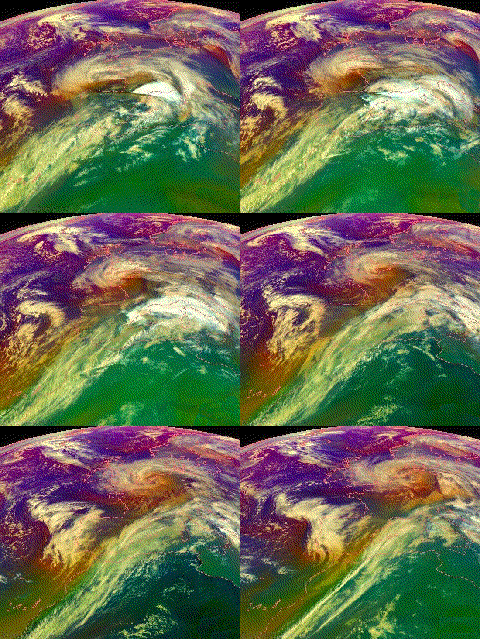
2010 violent European windstorm
| Field | Value |
|---|---|
| name | Cyclone Xynthia |
| image | Xynthia 2010-02-28 0603Z.jpg |
| formed | 26 February 2010 |
| dissipated | 7 Μarch 2010 |
Cyclone Xynthia was an exceptionally violent European windstorm which crossed Western Europe between 27 February and 1 March 2010. It reached a minimum pressure of 967 mb on 27 February. In France—where it was described by the civil defence as the most violent since Lothar and Martin in December 1999—at least 51 people were killed, with 12 more said to be missing. A further six people were killed in Germany, three in Spain, one in Portugal, one in Belgium and another one in England. Most of the deaths in France occurred when a powerful storm surge topped by battering waves up to 7.5 m high, hitting at high tide, smashed through the sea wall off the coastal town of L'Aiguillon-sur-Mer. A mobile home park built close to the sea wall was particularly hard-hit. The sea wall was about two hundred years old, built in the time of Napoleon; critics said that situating a mobile home park so close to the sea wall showed poor coastal development practices. The storm cut power to over a million homes in France and a million customers in Portugal lost power.
Effects
One million homes were left without power in western France. In the Hautes-Pyrénées, falling trees damaged vehicles, the roofs of houses and barns were blown away, and rocks were falling onto the road. In the département of Vendée, cities like La Faute-sur-Mer, L'Aiguillon-sur-Mer, and La Tranche-sur-Mer were flooded with water levels reaching up to 1.5 m. Flooding affected parts of the Charente-Maritime département (Suburbs of La Rochelle, cities of Fouras, Marennes, Châtelaillon as well as Ré and Oléron Island) where high speed wind was registered (160 km/h).
Flooded railway tracks led to railway delays in France and the rail services in northern Spain were also severely affected. 70 flights from Paris-Charles de Gaulle Airport were cancelled by Air France.
The storm also caused damage in Portugal and Spain. The strongest wind gust recorded in Portugal was 166 km/h while in Spain a gust of 228 km/h was recorded. In France a 241 km/h wind gust was recorded at the Pic du Midi.
The storm may have been exacerbated by the spread of volcanic ash from the Soufrière Hills volcano. A cloud of ash from the volcano was dragged over the United Kingdom, forming a visible haze to the north-west of Xynthia on visible satellite imagery.
On 11 March 2010, catastrophe risk modeling firm EQECAT estimated wind losses for affected countries excluding Portugal and Spain as follows: Mean damage: €1.3 billion (approximately US$1.8 billion); Mean insured gross loss: €994 million (approximately US$1.4 billion). One year after the event, the insurance industry loss aggregator PERILS AG published its final loss estimate for Xynthia of €1.32bn, excluding the French indemnified losses.
Response

Météo-France issued its second highest warning (orange) for 27 February and early 28 February for Andorra, Ain, Ariège, Cantal, Finistère, Haute-Garonne, Gironde, Isère, Loire, Haute-Loire and Hautes-Pyrénées. It issued its highest warning level (red) for the Charente-Maritime, Vendée, Deux-Sèvres and Vienne.
Helicopters were sent to rescue people on their roofs following flooding in Charente-Maritime and Vendée, France. An emergency meeting was held on 28 February by French Prime Minister François Fillon following the effects in France.
The Portuguese Institute of Meteorology issued red warnings for the northern parts of the country for winds up to 150 km/h, the rest of the country being with orange warnings for wind gusts up to 120 km/h.
Aftermath
The French Government declared the 2010 floods a "catastrophe". A historical study of coastal surges in France conducted after the storm indicated that there had been no previous coastal surge in France with such a high death toll.
In response to the coastal flooding brought by Xynthia, the French Government announced on 8 April 2010 that it had decided to destroy 1,510 houses in the affected areas of which 823 were in the Vendée and 595 were in Charente-Maritime. The government promised to fully compensate all home-owners, based on the value of the real estate prior to the storm, with the ministry of finance stating that they would pay €250,000 per house. In Vendée of the 823 homes designated by the French state to be destroyed, nearly 700 homeowners accepted the compensation terms by the state with demolition taking place in March 2011. In 2011 there remained 79 people who decided to fight the destruction of their homes via the legal system.
The French Government produced a document called Rapid inundation plan: coastal floods, flash floods and dike failures -"Plan submersions rapides: submersions marines, crues soudaines et ruptures de digues" in February 2011. This plan details the policy response brought about not only as a result of Xynthia in February 2010, but also severe June 2010 flash flooding in the Var Department in southern France that led to the deaths of 25 people.
Observed wind gusts
Wind gusts recorded during Xynthia storm in France and Switzerland:
| Country | Location | Speed | Comments | km/h | kn | mph |
|---|---|---|---|---|---|---|
| France | Pic du Midi de Bigorre | 238 km/h | at 2877 m | |||
| France | Puy de Dôme | 209 km/h | at 1415 m | |||
| France | Le Markstein | 172 km/h | at 1184 m | |||
| France | Scillé | 161 km/h | plain maximum value for the storm | |||
| France | Île de Ré | 160 km/h | ||||
| France | Paris (Tour Eiffel) | 155 km/h | ||||
| France | Chouilly | 148 km/h | ||||
| France | Luchon | 147 km/h | ||||
| France | Celles-sur-Ource | 144 km/h | ||||
| France | Saint Agnant, Pointe de Chassiron (Ile d'Oléron) | 140 km/h | ||||
| France | Sainte-Gemme-la-Plaine, Brindas, Chastreix | 138 km/h | ||||
| France | Royan | 137 km/h | ||||
| France | Metz | 136 km/h | ||||
| France | Châteauroux, Blois, La Rochelle | 132 km/h | 1999 records beaten for Châteauroux and Blois | |||
| France | La Roche-sur-Yon, Fontenay-le-Comte | 131 km/h | ||||
| France | Cap-Ferret, Cap-Ferret | 130 km/h | ||||
| France | Nangis | 128 km/h | ||||
| France | Niort | 127 km/h | ||||
| France | Roissy-en-France | 126 km/h | ||||
| France | Bourges | 125 km/h | ||||
| France | Poitiers | 123 km/h | ||||
| France | Paris (Montsouris) | 122 km/h | ||||
| France | Lyon | 105 km/h | ||||
| Switzerland | Les Diablerets | 148.3 km/h | at 2966 m | |||
| Switzerland | Altdorf | 147.2 km/h | at 449 m high | |||
| Switzerland | Evionnaz | 124.9 km/h | at 480 m high | |||
| Switzerland | La Dole | 121.1 km/h | at 1677 m | |||
| Switzerland | Piz Corvatsch | 119.9 km/h | at 3451 m | |||
| Switzerland | Quarten, Moléson | 115.6 km/h | respectively at 420 and 2002 m | |||
| Switzerland | Oron-la-Ville | 112 km/h | at 830 m high | |||
| Switzerland | Le Bouveret | 108.7 km/h | at 375 m high | |||
| Switzerland | Aigle | 105.1 km/h | at 381 m high | |||
| Switzerland | Glaris | 101.9 km/h | at 1478 m |
Highest wind gust per country
| Country | Gust | Location |
|---|---|---|
| Austria | 166 km/h | Zugspitze |
| Belgium | 136 km/h | Stavelot |
| Czechia | 165 km/h | Plešivec |
| Denmark | 146 km/h | Nordborg |
| France | 238 km/h | Pic du Midi de Bigorre |
| Germany | 180 km/h | Brocken |
| Italy | 172 km/h | Adamello |
| Liechtenstein | 155 km/h | Eschen |
| Luxembourg | 144 km/h | Wincrange |
| Netherlands | 116 km/h | Vaalserberg |
| Poland | 176 km/h | Śnieżka |
| Sweden | 145 km/h | Karlskrona |
| Switzerland | 164 km/h | Säntis |
| United Kingdom | 119 km/h | Bruray |
Notes
References
References
- International News, ClaimsJournal.com. (3 March 2010). "AIR Estimates Windstorm Xynthia Insured Losses at $2 to $4.1 Billion". Wells Publishing, Inc.
- Europe, CNN. (28 February 2010). "Storm batters Europe, at least 55 dead". Cable News Network.
- CAT Updates, RMS. "Storm Xynthia". RMS.com.
- English.news.cn, Xinhuanet. (3 March 2010). "Violent winter storm kills 62 in western Europe". Xinhua News Agency.
- Staff (1 March 2010) [http://news.bbc.co.uk/2/hi/europe/8544002.stm "Weak sea walls blamed for France storm disaster "] ''BBC News''
- (28 February 2010). "Au moins 40 morts après le passage de la tempête Xynthia". lemonde.fr.
- (28 February 2010). "Rescapés des eaux". sudouest.com.
- (28 February 2010). "Un cataclysme en Oléron". sudouest.com.
- (28 February 2010). "La tempête Xynthia des 27-28 février 2010". meteofrance.com.
- (28 February 2010). "At least 50 dead in western Europe storms". [[BBC News]].
- (1 March 2010). "Intensidade de vento no Continente". www.meteo.pt.
- (28 February 2010). "Estación C072-Orduña Información del dato validado". euskalmet.euskadi.net.
- (June 2010). "Volcanoes, dust, and storms". [[The Geological Society]].
- (11 March 2010). "EQECAT Estimates Losses for Wind Storm Xynthia".
- (April 2011). "Inside Newsletter". PERILS AG.
- Lumbroso, D. M.. (2011). "A comparison of the causes, effects and aftermaths of the coastal flooding of England in 1953 and France in 2010". Natural Hazards and Earth System Sciences.
- [http://france.meteofrance.com/france/actu/bilan/archives/2010/bilanxynthia?page_id=12002 Météo France]
This article was imported from Wikipedia and is available under the Creative Commons Attribution-ShareAlike 4.0 License. Content has been adapted to SurfDoc format. Original contributors can be found on the article history page.
Ask Mako anything about Cyclone Xynthia — get instant answers, deeper analysis, and related topics.
Research with MakoFree with your Surf account
Create a free account to save articles, ask Mako questions, and organize your research.
Sign up freeThis content may have been generated or modified by AI. CloudSurf Software LLC is not responsible for the accuracy, completeness, or reliability of AI-generated content. Always verify important information from primary sources.
Report