From Surf Wiki (app.surf) — the open knowledge base
Customs and traditions of the Royal Navy
none
none
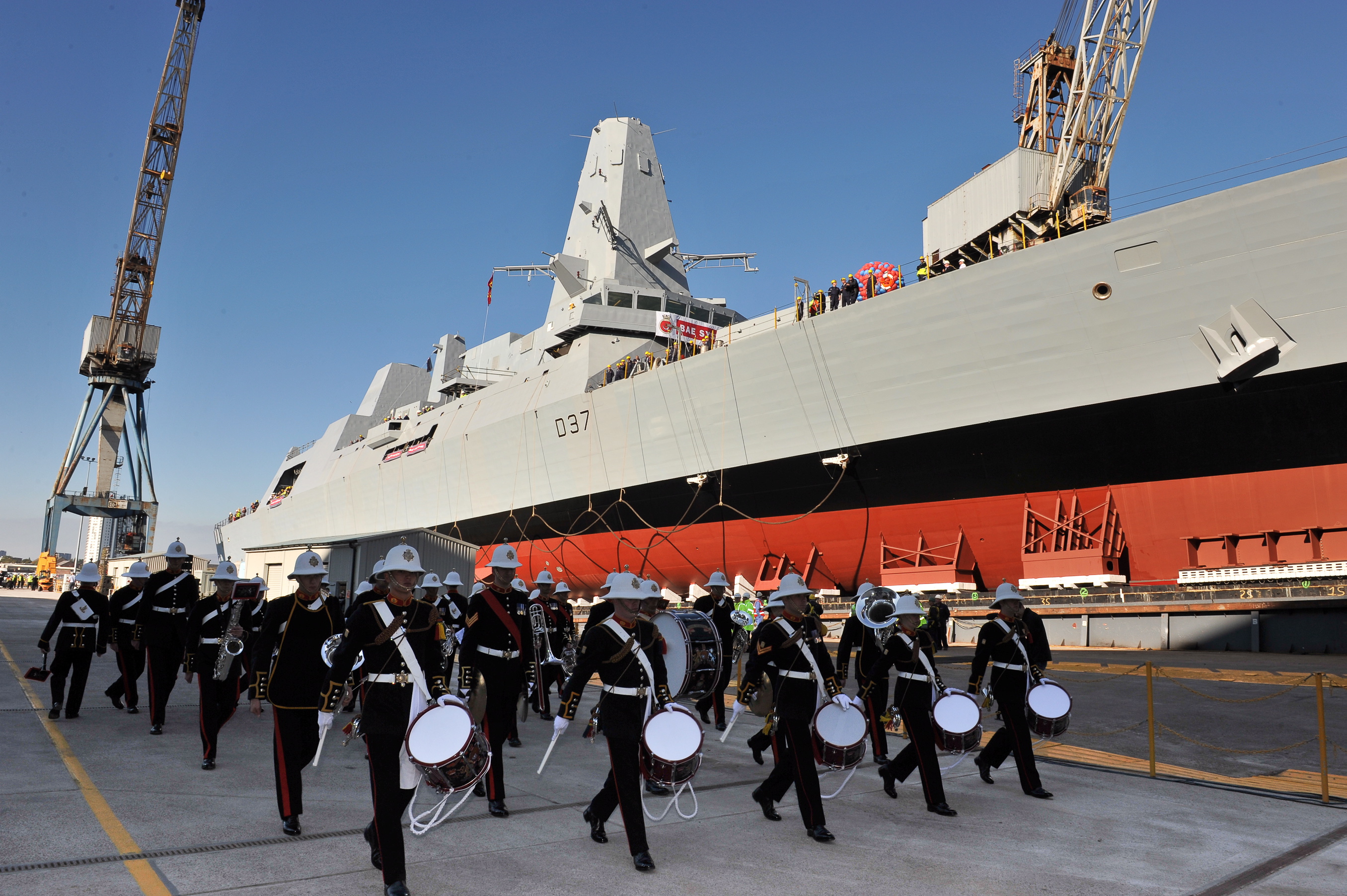
There are many customs and traditions associated with the Royal Navy of the United Kingdom. Many of these traditions have carried on to other Commonwealth navies, such as Canada, India, Australia and New Zealand. These include formal customs such as separate crests associated with ships, ensigns and fleet reviews. There are also several less formal customs and traditions, including Naval slang commonly referred to as Jackspeak and the traditional games of Uckers and Euchre.
Heraldry
Ensigns
Main article: British Naval ensigns
Commissioned ships and submarines wear the White Ensign at the stern whilst alongside during daylight hours and at the main-mast whilst under way. When alongside, the Union Jack is flown from the jackstaff at the bow, but can be flown under way on only special circumstances, i.e. when dressed with masthead flags (when it is flown at the jackstaff), to signal a court-martial is in progress (when it is flown from the starboard yardarm), or to indicate the presence of an Admiral of the Fleet, including the Lord High Admiral or the Monarch (when it is flown from the highest hoist).
Ships badges
The Royal Navy assigns badges to every ship, submarine, squadron and shore establishment. Before the age of steam ships, ships were identified by their figurehead. With the removal of the figurehead, ships’ badges and mottos were created to graphically represent the ships. The official process for creating the badge was initiated by Charles ffoulkes after World War I who was appointed as the Admiralty Advisor on Heraldry. Soon after his appointment the Ships' Badges Committee was established. This was amalgamated in 1983 with the Ships' Names Committee (founded in 1913) to create the Ships' Names and Badges Committee. The Naval Crown adorns the top of all the badges. The frame is gold rope. Originally, different classes of ships had different shapes, but currently all ships and submarines have a circular design. Shore establishments have an offset square design.
Ship names
The names of ships are considered by the Ships' Names and Badges Committee. The committee passes their recommendations for approval by the Navy Board and then the Minister of Defence. The chosen names are then formally approved by the monarch.
Ceremonial
The Royal Navy uses a number of unique ceremonies which often have their origins in the days of sail.
Colours
This is the formal ceremony of raising or lowering of a ship's ensign and jack when in port or at anchor. All shore establishments fly only the White Ensign. The lowering ceremony is referred to as "Sunset" or "Evening Colours" if sunset occurs after 2100. It may be accompanied by the "Sunset" bugle call. Ships at sea fly the White Ensign continuously.
Divisions

A formal parade of a ship's or shore establishment's company. At the Britannia Royal Naval College, the "Lord High Admiral's Divisions" is a parade held in the presence of the monarch or his representative.
Pipe the side
A ceremonial greeting by a guard of honour on the arrival of a flag officer or the commander of another ship, members of the royal family or foreign officers in uniform. The actual piping is done using a boatswain's call and consists of a low note, rising to high and falling to low again, lasting for twelve seconds on a single breath.
Pipe the still
A signal made boatswain's call which brings a ship's company to attention, especially for the "Colours" ceremony or when saluting a passing warship. A second call of "carry on!" returns the company to their duties.
Fleet reviews
Main article: Fleet Review
The Fleet Review is an irregular tradition of assembling the fleet before the monarch. For example, at the most recent Review on 28 June 2005 to mark the bi-centenary of the Battle of Trafalgar, 167 ships of the RN, and 30 other nations, were present. The fleet review in 2005 showed the marked contrast between the size of the Navy in 2005 compared to the last review in 1977. In total the Royal Navy had 67 ships on display, with the largest ship present being the French carrier Charles De Gaulle.
Service nicknames
Nicknames for the service include The Andrew or Andrew Miller (of uncertain origin, possibly after a zealous press ganger) and the Senior Service. It is also referred to as the Grey Funnel Line: ship owning companies, or lines, painted their steamships' funnels in distinctive colours such as Cunard's red and black or the eponymous Blue Funnel Line, while the Royal Navy's funnels are plain grey.
Toasts
The Toasts of the Royal Navy are a set of traditional drinking toasts.
| Day | Toast | url=https://www.tintrousers.com/royal-naval-toasts | title=RN Toasts – Tin Trousers | publisher=Tin Trousers | access-date=2022-05-04}} |
|---|---|---|---|---|---|
| Sunday | "Absent friends" | "Absent friends and those at sea" | |||
| Monday | "Our ships at sea" | "Our native land. King and country" | |||
| Tuesday | "Our sailors" (before 2013, "Our men") | "Our mothers. Health and wealth" | |||
| Wednesday | "Ourselves" (usually with the informal reply "for nobody else will concern themselves with our well-being!") | "Ourselves. Our Swords. Old Ships" | |||
| Thursday | "A bloody war or a sickly season" | "The King" | |||
| Friday | "A willing foe and sea-room" | "Fox hunting and old port. Ships at sea" | |||
| Saturday | "Our families" (before 2013, "Our wives and sweethearts," usually with the reply "May they never meet!") | (no alternative) |
In June 2013 the Tuesday and Saturday toasts were officially changed under orders from the Second Sea Lord, Vice-Admiral David Steel, to reflect the fact that women had been at sea in the Royal Navy for nearly two decades. Officially the Tuesday toast is now "our sailors" and the Saturday toast is "our families".
While most of these toasts are self-explanatory, "a bloody war or a sickly season" refers to the desire and likelihood of being promoted when many people die: during war or sickness. In addition, when referring to "Old Ships" (alternate toast for Wednesday), "ships" is referring to 'shipmates'.
On completion of the daily toast, it was often customary to conclude with the following tribute. "But the standing toast, that pleased the most was, to the wind that blows the ship that goes, and the lass that loves a sailor" – Charles Dibdin (1740–1814).
The toasts are typically given by the youngest officer present at the mess dinner. By tradition, these toasts are proposed immediately after the loyal toast, on the relevant day of the week. The Navy makes the loyal toast seated. This was a special dispensation granted by William IV, who had narrowly missed cracking his head several times on low deckheads when serving in the Royal Navy.
Affiliation
Ships will engage in a number of affiliations. It is often misunderstood that ships are named after places when normally they are associated with the local lord e.g. the Duke of Marlborough. There were, however, a number of vessels named after places during World War II after schools, cadet units and charities. At one time every Sea Cadet unit in the UK had an affiliated ship (with the exception of Kettering, which is affiliated with 800 Naval Air Squadron; Yeovilton, now disbanded; and Yeovil unit which, owing to its location on RNAS Yeovilton (HMS Heron), is affiliated with 848 Helicopter Squadron). However, now that Sea Cadet units outnumber Royal Navy vessels, this is no longer possible.
Uckers and Euchre
Uckers is a two or four player board game similar to Ludo that is traditionally played in the Royal Navy. It is fiercely competitive and rules differ between ships and stations (and between other services).
Euchre, pronounced you-ker, is a card game also played on board ships, in naval establishments and also in pubs in Cornwall and Devon. It is similar to Trumps, and equally competitive. Euchre involves nominated partners, is played with only the nine card and higher, apart from the two of spades – called the "Benny" – (making 25 cards in all) and uses the eight and seven cards as a score board. The winner is the first team to score 15.
Songs and marches
There are several songs that are commonly associated with the Royal Navy including "Heart of Oak" (the official quick march) and "Rule, Britannia!".
Notes
References
References
- "Use of the Union Jack at Sea". Flags of the World.
- (5 September 2014). "Warships". UK Parliament.
- (April 2017). "BRd2". [[Royal Navy]].
- Jolly, Rick. (2011). "Jackspeak: A Guide to British Naval Slang and Usage". Conway – Bloomsbury Publishing.
- Jolly 2014, p. 140
- Jolly 2014, p. 336
- (2005-06-26). "French top gun at Fleet Review". [[The Times]].
- (1964). "Admiralty Manual of Seamanship". HMSO.
- "FAQs;Royal Navy's nickname". National Maritime Museum.
- Jolly, Rick. (December 2000). "Jackspeak". Maritime Books Dec 2000.
- "Naval Slang". Royal Navy.
- "Why the Royal Navy? | Unique Traditions, Customs and Culture".
- "RN Toasts – Tin Trousers". Tin Trousers.
- (22 June 2013). "Navy bans historic toast to the 'wives and sweethearts'". [[The Times]].
- Gibowicz, Charles J.. (September 2007). "Mess Night Traditions". AuthorHouse.
- A. Metaxas, "Metaxas' Personal Authoritative Manual on Naval Traditions"
- Gilje, Paul A.. (2016-02-15). "To Swear like a Sailor". Cambridge University Press.
- (28 September 2011). "The joy of 'Jackspeak'".
- David, George. (2019-10-04). "Naval board game uckers still rules the waves". The News (Portsmouth).
This article was imported from Wikipedia and is available under the Creative Commons Attribution-ShareAlike 4.0 License. Content has been adapted to SurfDoc format. Original contributors can be found on the article history page.
Ask Mako anything about Customs and traditions of the Royal Navy — get instant answers, deeper analysis, and related topics.
Research with MakoFree with your Surf account
Create a free account to save articles, ask Mako questions, and organize your research.
Sign up freeThis content may have been generated or modified by AI. CloudSurf Software LLC is not responsible for the accuracy, completeness, or reliability of AI-generated content. Always verify important information from primary sources.
Report