From Surf Wiki (app.surf) — the open knowledge base
Currency union
Agreement involving states sharing a single currency
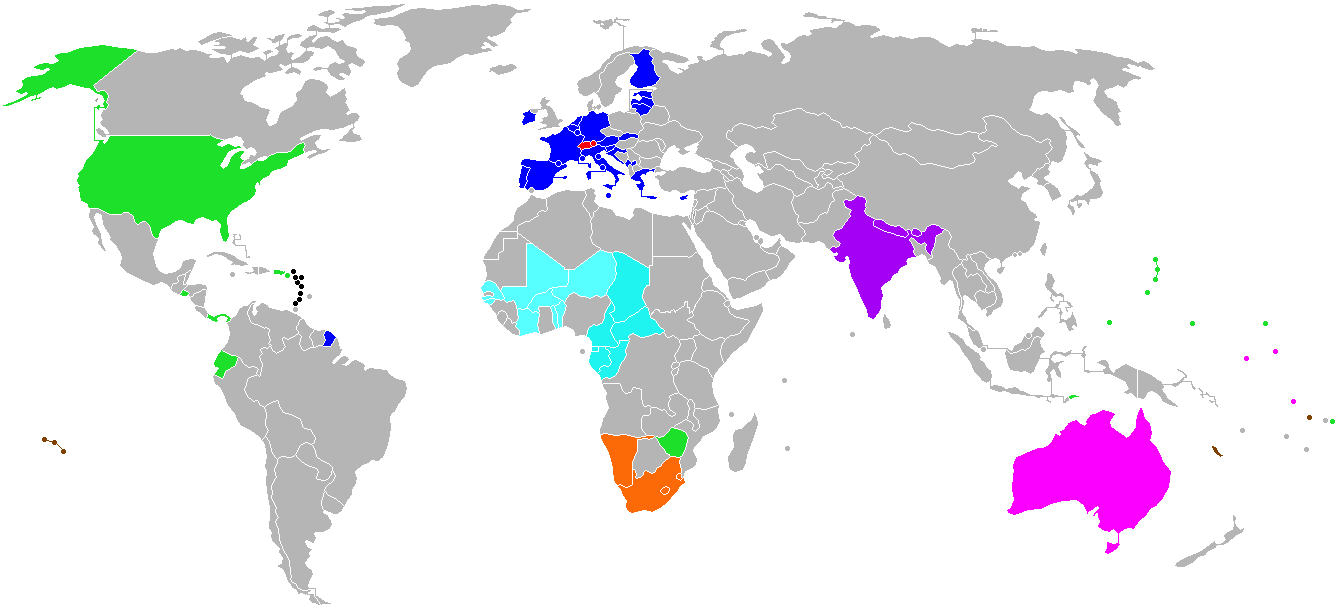
Agreement involving states sharing a single currency
]] A currency union (also known as monetary union) is an intergovernmental agreement that involves two or more states sharing the same currency. These states may not necessarily have any further integration (such as an economic and monetary union, which would have, in addition, a customs union and a single market).
There are three types of currency unions:
- Informal – unilateral adoption of a foreign currency.
- Formal – adoption of foreign currency by virtue of bilateral or multilateral agreement with the monetary authority, sometimes supplemented by issue of local currency in currency peg regime.
- Formal with common policy – establishment by multiple countries of a common monetary policy and monetary authority for their common currency.
The theory of the optimal currency area addresses the question of how to determine what geographical regions should share a currency in order to maximize economic efficiency.
Convergence and divergence
Convergence in terms of macroeconomics means that countries have a similar economic behaviour (similar inflation rates and economic growth). It is easier to form a currency union for countries with more convergence as these countries have the same or at least very similar goals. The European Monetary Union (EMU) is a contemporary model for forming currency unions. Membership in the EMU requires that countries follow a strictly defined set of criteria (the member states are required to have a specific rate of inflation, government deficit, government debt, long-term interest rates and exchange rate). Many other unions have adopted the view that convergence is necessary, so they now follow similar rules to aim the same direction.
Divergence is the exact opposite of convergence. Countries with different goals are very difficult to integrate in a single currency union. Their economic behaviour is completely different, which may lead to disagreements. Divergence is therefore not optimal for forming a currency union.
History
The first currency unions were established in the 19th century. The German Zollverein came into existence in 1834, and by 1866, it included most of the German states. The fragmented states of the German Confederation agreed on common policies to increase trade and political unity.
The Latin Monetary Union, comprising France, Belgium, Italy, Switzerland, and Greece, existed between 1865 and 1927, with coinage made of gold and silver. Coins of each country were legal tender and freely interchangeable across the area. The union's success made other states join informally.
The Scandinavian Monetary Union, comprising Sweden, Denmark, and Norway, existed between 1873 and 1905 and used a currency based on gold. The system was dissolved by Sweden in 1924.
A currency union among the British colonies and protectorates in Southeast Asia, namely the Federation of Malaya, North Borneo, Sarawak, Singapore and Brunei was established in 1952. The Malaya and British Borneo dollar, the common currency for circulation was issued by the Board of Commissioners of Currency, Malaya and British Borneo from 1953 until 1967. Following the cessation of the common currency arrangement, Malaysia (the combination of Federation of Malaya, North Borneo, Sarawak), Singapore and Brunei began issuing their own currencies. Contemporarily, a currency reunion of these countries might still be feasible based on the findings of economic convergence.{{cite web |access-date = 5 July 2021 |url-status = dead |archive-url = https://web.archive.org/web/20110722233307/http://moneymuseum.bnm.gov.my/index.php?ch=8&pg=14&ac=38 |archive-date = 22 July 2011
List of currency unions
Existing
| Currency | Union | Users | Est. | Status | Population |
|---|---|---|---|---|---|
| CFA franc | Issued by the (French) Overseas Issuing Institute between 1945 and 1962 then by the Central Bank of West African States and the Bank of Central African States | West African CFA franc users: | |||
| 1945 | Formal, common policy | 151,978,440 | |||
| CFP franc | Issued by the (French) Overseas Issuing Institute | French Polynesia | |||
| 1945 | Formal, common policy | 552,537 | |||
| Eastern Caribbean dollar | Eastern Caribbean Currency Union of the Eastern Caribbean Central Bank (ECCB) and the OECS. | Anguilla | |||
| 1965 | Formal, common policy | ||||
| de facto EMU for CSME members | 625,000 | ||||
| Euro | International status and usage of the euro | European Union Eurozone: | |||
| 1999/2002 | Formal, common policy and EMU for EU members | ||||
| Formal for Monaco and Akrotiri and Dhekelia (which form part of the EU's customs territory) | |||||
| Informal for Kosovo, Montenegro | |||||
| Formal for Andorra and San Marino (which are in customs union with the EU's customs territory) | 351,379,988 | ||||
| Singapore dollar | |||||
| Managed together by the Monetary Authority of Singapore | Brunei | ||||
| 1967 | Formal; currencies mutually exchangeable | 5,137,000 | |||
| Australian dollar | Australia | ||||
| 1966 | Informal | 24,557,000 | |||
| Pound sterling | Sterling area (former) | United Kingdom | |||
| 1939 | Semi-formal. UK banknotes are legal tender in locations outside the UK. Local currencies are pegged to the GBP but not necessarily accepted in the UK: Guernsey pound, Manx pound, Jersey pound and Alderney pound, Falkland Islands pound, Gibraltar pound, Saint Helena pound | 62,321,000 | |||
| Indian rupee | India | ||||
| 1974 | Informal | ||||
| 1,352,000,000 | |||||
| New Zealand dollar | New Zealand | ||||
| 1967 | Informal | 4,411,000 | |||
| Israeli new sheqel | Israel | ||||
| 1927/1986 | Informal | 11,738,000 | |||
| Jordanian dinar | Jordan | ||||
| Informal | 8,922,000 | ||||
| Egyptian pound | Egypt | ||||
| Informal | 109,450,000 | ||||
| Russian ruble | Russia | ||||
| 2008 | Informal | 142,177,000 | |||
| South African rand | Multilateral Monetary Area | Lesotho | |||
| 1974 | Formal | ||||
| de facto customs and monetary union for the SACU member countries | 52,924,669 | ||||
| Swiss franc | Liechtenstein | ||||
| 1920 | Informal | ||||
| de facto economic and monetary union—1924 creation of a customs union, then members of the European Free Trade Association (a common market), and now also part of the European Single Market. | 8,547,015 | ||||
| Turkish lira | Turkey | ||||
| 1983 | Informal | 75,081,100 | |||
| United States dollar | United States | ||||
| 1904 | |||||
| Formal for insular areas and sovereign status with Compact of Free Association, informal for other areas | 339,300,000 |
Note: Every customs and monetary union and economic and monetary union also has a currency union.
Zimbabwe is theoretically in a currency union with four blocs as the South African rand, Botswana pula, British pound and US dollar freely circulate. The US Dollar was, until 2016, official tender.
Additionally, the autonomous and dependent territories, such as some of the EU member state special territories, are sometimes treated as separate customs territory from their mainland state or have varying arrangements of formal or de facto customs union, common market and currency union (or combinations thereof) with the mainland and in regards to third countries through the trade pacts signed by the mainland state.
Currency union in Europe
The European currency union is a part of the Economic and Monetary Union of the European Union (EMU). EMU was formed during the second half of the 20th century after historic agreements, such as Treaty of Paris (1951), Maastricht Treaty (1992). In 2002, the euro, a single European currency, was adopted by 12 member states. Currently, the Eurozone has 21 member states. The other members of the European Union are required to adopt the euro as their currency (except for Denmark, which has been given the right to opt out), but there has not been a specific date set. The main independent institution responsible for stability of the euro is the European Central Bank (ECB). The Eurosystem groups together the ECB and the national central banks (NCBs) of the Member States whose currency is the euro. The European System of Central Banks (ESCB) is made up of the ECB and the national central banks of all Member States of the European Union (EU), regardless of whether or not they have adopted the euro. The Governing Board consists of the Executive Committee of the ECB and the governors of individual national banks, and determines the monetary policy, as well as short-term monetary objectives, key interest rates and the extent of monetary reserves.
Planned
| Community | Currency | Region | Target date | Notes | ||||||||||||||||
|---|---|---|---|---|---|---|---|---|---|---|---|---|---|---|---|---|---|---|---|---|
| East African Community East African Community | East African shilling | Africa | last1=Asongu | first1=Simplice | last2=Nwachukwu | first2=Jacinta | last3=Tchamyou | first3=Vanessa | date=2016-08-01 | title=A Literature Survey on Proposed African Monetary Unions | journal=Journal of Economic Surveys | volume=31 | issue=3 | language=en | pages=878–902 | doi=10.1111/joes.12174 | s2cid=38454408 | issn=1467-6419 | url=http://www.afridev.org/RePEc/agd/agd-wpaper/A-Literature-Survey-on-Proposed-African-Monetary-Unions.pdf}} 2031 | |
| West African Monetary Zone | Eco | Africa | 2027 | Inside Economic Community of West African States, planned to eventually merge with West African franc | ||||||||||||||||
| ASEAN+3 | Asian Monetary Unit | Asia | ? | a free trade agreements matrix partially established | ||||||||||||||||
| GCC Flag.svg Cooperation Council for the Arab States of the Gulf | Khaleeji | Arabian Peninsula | ? | Oman and the United Arab Emirates do not intend to adopt the currency at first but will do at a later date. | ||||||||||||||||
| Flag of the African Union.svg African Economic Community | Afro or Afriq | Africa | 2028 | Planned for 2028 or later | ||||||||||||||||
| Brazil, Argentina and possibly other countries | Sur | Latin America | ? | As Financial Times reports, Brazil and Argentina will announce in January 2023 that they are starting preparatory work on a common currency "Sur" (South). The initiative would later be extended to invite other Latin American nations. |
Disbanded
- between Bahrain Bahrain and Abu Dhabi Abu Dhabi using the Bahraini dinar
- between Bahrain Bahrain, Kuwait Kuwait, Flag of The Imamate of Oman.svg Oman, Qatar Qatar and the Trucial States Trucial States, using the Gulf rupee from 1959 until 1966
- between Flag of Aden (1937–1963).svg Aden, South Arabia, Bahrain Bahrain, Flag of Kenya (1921–1963).svg Kenya, Kuwait Kuwait, Flag of The Imamate of Oman.svg Oman, Qatar Qatar, British Somaliland British Somaliland, Trucial States the Trucial States, Flag of the Uganda Protectorate.svg Uganda, Flag of Zanzibar Under British Rule.svg Zanzibar and British India British India (later independent India India) using the Indian rupee until 1974
- between Belgium Belgium and the Luxembourg Grand-Duchy of Luxemburg (Belgium-Luxembourg Economic Union) using the Belgian/Luxembourgish franc from 1921 to the Euro
- between British India British India and the Straits Settlements Straits Settlements (1837–1867) using the Indian rupee
- between Czech Republic Czech Republic and Slovakia Slovakia (briefly from January 1, 1993 to February 8, 1993) using the Czechoslovak koruna
- between Ethiopia Ethiopia and Eritrea Eritrea using the Ethiopian birr
- between France France, Monaco Monaco, and Andorra Andorra using the French franc
- between Austria-Hungary Austria-Hungary and Liechtenstein Liechtenstein using the Austro-Hungarian krone
- between the Eastern Caribbean, Flag of Jamaica (1957–1962).svg Jamaica, Flag of Barbados (1870–1966).svg Barbados, Flag of Trinidad and Tobago (1958–1962).svg Trinidad and Tobago and British Guiana British Guiana using the British West Indies dollar
- between the Eastern Caribbean, Flag of Barbados (1870–1966).svg Barbados, Flag of Trinidad and Tobago (1958–1962).svg Trinidad and Tobago and British Guiana British Guiana using the Eastern Caribbean dollar
- between Italy Italy, Holy See Vatican City, and San Marino San Marino using the Italian lira
- between Jamaica Jamaica and the Cayman Islands Cayman Islands using the Jamaican pound and later Jamaican dollar
- between Flag of Kenya (1921–1963).svg Kenya, Flag of the Uganda Protectorate.svg Uganda, and Flag of Zanzibar Under British Rule.svg Zanzibar using the East African rupee
- between Flag of Kenya (1921–1963).svg Kenya, Flag of the Uganda Protectorate.svg Uganda, and Flag of Zanzibar Under British Rule.svg Zanzibar (and later Tanganyika) using the East African florin
- between Kenya Kenya, Tanganyika and Zanzibar Zanzibar (later merged as Tanzania Tanzania), Uganda Uganda, South Arabia South Arabia, British Somaliland British Somaliland and Flag of the Kingdom of Italy.svg Italian Somaliland using the East African shilling
- Latin Monetary Union (1865–1927), initially between French Third Republic France, Belgium Belgium, Kingdom of Italy Italy and Switzerland Switzerland, and later involving Kingdom of Greece Greece, Kingdom of Romania Romania, Spain and other countries.
- between Liberia Liberia and the United States United States using the United States dollar
- between Mauritius Mauritius and Seychelles Seychelles using the Mauritian rupee
- between Flag of Nigeria (1914–1952).svg Nigeria, Flag of The Gambia (1889–1965).svg the Gambia, Flag of Sierra Leone (1916–1961).svg Sierra Leone, Gold Coast the Gold Coast and Liberia Liberia using the British West African pound
- between Kingdom of Prussia Prussia and the North German states (1838–1857) using the North German thaler
- between Russian Federation Russia and the Flag of the CIS (UEFA Euro 1992).svg former Soviet republics (1991–1993) using the Soviet ruble
- between Armenia Armenia and Artsakh Artsakh using the Armenian dram
- between Qatar Qatar and all the emirates of the UAE United Arab Emirates, except Abu Dhabi using the Qatari and Dubai riyal
- between Saudi Arabia Saudi Arabia and Qatar Qatar using the Saudi riyal
- between Flag of the Territory of Papua.svg Western Samoa and New Zealand New Zealand using the New Zealand pound
- Scandinavian Monetary Union (1870s until 1924), between Denmark Denmark, Norway Norway and Sweden Sweden
- between the Solomon Islands Solomon Islands, Papua New Guinea Papua New Guinea and Australia Australia using the Australian dollar
- between Australia Australia, Flag of the Territory of Papua.svg Papua, Flag of the Territory of New Guinea.svg New Guinea, Civil Ensign of Australia.svg Nauru, Flag of the Solomon Islands (1956–1966).svg the Solomon Islands, and Flag of the Gilbert and Ellice Islands (1937–1976).svg the Gilbert and Ellice Islands using the Australian pound
- between Flag of Bavaria (striped).svg Bavaria, Banner of Baden (3^2).svg Baden, Flagge Königreich Württemberg.svg Württemberg, Flag of the Free City of Frankfurt.svg Frankfurt, and Flag of Hohenzollern-Hechingen and Sigmaringen.png Hohenzollern using the South German guilder
- between Spain Spain and Andorra Andorra using the Spanish peseta
- between Trinidad and Tobago Trinidad and Tobago and Grenada Grenada using the Trinidad and Tobago dollar
- between Brunei Brunei, Malaysia Malaysia, and Singapore Singapore (1953–1967) using the Malaya and British Borneo dollar
- between Flag of Cambodia under French protection.svg Cambodia, Flag of French Laos.svg Laos, Flag of France.svg Guangzhouwan, First flag of the Nguyen Dynasty.svg Annam, Flag of Colonial Annam.svg Tonkin, and Flag of Republic of Cochinchina.svg Cochinchina (later State of Vietnam Vietnam) between 1885 and 1952 using the French Indochinese piastre
- between South Africa, South West Africa South West Africa, and Flag of the United Kingdom.svg Bechuanaland (later independent Botswana Botswana) using the South African rand
- between Egypt Egypt, Flag of Anglo-Egyptian Sudan.svg Anglo-Egyptian Sudan, and Ensign of the Palestine Mandate (1927–1948).svg Mandatory Palestine (until 1926) using the Egyptian pound
- between West Germany West Germany and DDR East Germany between 1 July 1990 and 3 October 1990, as part of a temporary, so-called "Monetary, Economic and Social Union" prior to German reunification.
- between what ultimately became the Republic of Ireland Republic of Ireland and the United Kingdom United Kingdom, between 1928 and 1979. The Irish Pound was held at exactly the same value as Sterling for this period, although it was not accepted for payments in the UK.
- Yen Bloc (between 1905 and 1945), between the Empire of Japan Empire of Japan, the Korean Empire Korean Empire, Manchukuo Manchukuo, Mengjiang Mengjiang, the Wang Jingwei regime Wang Jingwei regime, and Japanese-occupied Southeast Asia prior to and during World War II.
Never materialized
- proposed Pan-American monetary union – abandoned in the form proposed by Argentina
- proposed monetary union between the United Kingdom United Kingdom and Norway Norway using the pound sterling during the late 1940s and early 1950s
- proposed gold-backed, pan-African monetary union put forward by Muammar Gaddafi prior to his death
References
References
- "World Bank".
- "The Optimum Currency Area Theory and the EMU".
- "Currency unions: key variables, definitions, measurement, and statistical improvement".
- (10 December 2001). "History of currency unions".
- (2020). "Economic Feasibility of Malaysia and Singapore-Brunei Monetary Reunion: A Scrutiny during Major Financial Crises". Applied Economics Journal.
- [[Anguilla]] and [[Montserrat]] are members of OECS currency union, but not of the CSME.
- To all intents and purposes a monetary union. They are the last two nations whose dollars have remained at par and mutually interchangeable since the days when the [[Spanish Dollar]] was the united currency of large areas of the [[New World]] and [[Southeast Asia]].
- alongside the [[Bhutanese ngultrum. ngultrum]]
- Not official, but freely used as a tender in Nepal, due to primarily the economic flux with India and also the instability caused by that country's civil war.
- Zacharia, Janine. (2010-05-31). "Palestinian officials think about replacing Israeli shekel with Palestine pound". The Washington Post and Times-Herald.
- Cobham, David. (2004-09-15). "The Economics of Palestine: Economic Policy and Institutional Reform for a Viable Palestine State". Routledge.
- "Compact- Title 02 Article 05".
- (2009-01-29). "Zimbabwe abandons its currency".
- EU [[Overseas Countries and Territories. Overseas countries]] and some other territories participate partially in the EU single market per [http://eur-lex.europa.eu/en/treaties/dat/12002E/htm/C_2002325EN.003301.html part four of the Treaty Establishing the European Community] {{Webarchive. link. (2013-11-16 ; Some EU Outermost regions and other territories use the [[Euro]] of the currency union, others are part of the [[European Union Customs Union). customs union]]; some participate in both unions and some in neither.
[[Territories of the United States]], [[Australian External Territories]] and [[Realm of New Zealand]] territories share the currency and mostly also the [[single market. market]] of their respective mainland state, but are generally not part of its [[customs territory]]. - "European Union".
- (2016-08-01). "A Literature Survey on Proposed African Monetary Unions". Journal of Economic Surveys.
- (2024-03-04). "Public Notice: Information About East Africa Currency Should Be Disregarded". Bank of Tanzania.
- (30 November 2001). "A common currency at a later stage of Africa's economic integration".
- (2023-01-22). "Brazil and Argentina to begin preparations for common currency, Financial Times reports". Reuters.
- Bolton, Sally. (10 December 2001). "A history of currency unions". guardian.co.uk.
- Not currently on any political agenda, based mostly off conspiracy theories.
This article was imported from Wikipedia and is available under the Creative Commons Attribution-ShareAlike 4.0 License. Content has been adapted to SurfDoc format. Original contributors can be found on the article history page.
Ask Mako anything about Currency union — get instant answers, deeper analysis, and related topics.
Research with MakoFree with your Surf account
Create a free account to save articles, ask Mako questions, and organize your research.
Sign up freeThis content may have been generated or modified by AI. CloudSurf Software LLC is not responsible for the accuracy, completeness, or reliability of AI-generated content. Always verify important information from primary sources.
Report