From Surf Wiki (app.surf) — the open knowledge base
Currarino syndrome
| Field | Value |
|---|---|
| name | Currarino syndrome |
| image | Atresia.jpg |
| caption | An X-ray showing Imperforate anus |
| synonyms | Currarino triad |
| Currarino syndrome is an inherited congenital disorder where either the sacrum (the fused vertebrae forming the back of the pelvis) is not formed properly, or there is a mass in the presacral space in front of the sacrum, and there are malformations of the anus or rectum. It occurs in approximately 1 in 100,000 people.
Anterior sacral meningocele is the most common presacral mass in patients with Currarino syndrome, occurring in 60% of cases. Its presence may significantly affect the surgical management of these patients. Other potential presacral masses include presacral teratoma and enteric cyst. Presacral teratoma usually is considered to be a variant of sacrococcygeal teratoma. However, the presacral teratoma that is characteristic of the Currarino syndrome may be a distinct kind.
Genetics
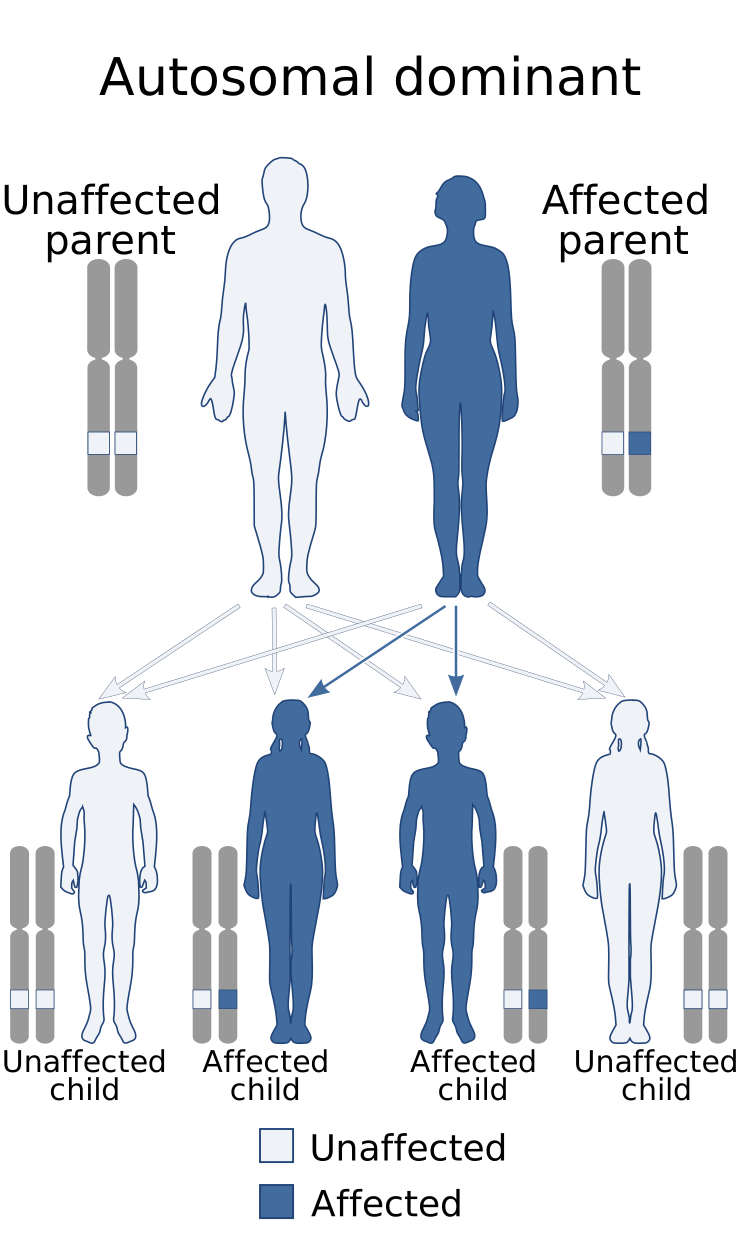
The disorder is an autosomal dominant genetic trait caused by a mutation in the HLXB9 homeobox gene. In 2000 the first large series of Currarino cases was genetically screened for HLXB9 mutations, and it was shown that the gene is specifically causative for the syndrome, but not for other forms of sacral agenesis. The study was published in the American Journal of Human Genetics.
Diagnosis
Diagnosis of Currarino syndrome is usually clinical, detecting all three elements of the triad. However, genetic testing is often used as the confirmation of diagnosis and genetic analysis of patient's family members.
Treatment
Surgery of an anterior myelomeningocele is only indicated in the rare case in which the space-occupying aspect is expected to cause constipation or problems during pregnancy or delivery. Fistulas between the spinal canal and colon have to be operated on directly.
Early diagnosis and multidisciplinary assessment is recommended to plan adequate treatment.
By accurate evaluation, the correct surgical management, including neurosurgery, can be performed in a single-stage approach.
The management of Currarino syndrome is similar to the usual management of anorectal malformation (ARM) regarding the surgical approach and probably the prognosis, which mainly depends on degree of associated sacral dysplasia.
References
References
- Weber, Stefanie. (2014). "German approach of coding rare diseases with ICD-10-GM and Orpha numbers in routine settings". Orphanet Journal of Rare Diseases.
- Emans, Pieter J.. (2006-05-01). "The Currarino Triad: Neurosurgical Considerations". Neurosurgery.
- Samuel, M.. (December 2000). "Currarino triad—Diagnostic dilemma and a combined surgical approach". Journal of Pediatric Surgery.
- (June 2007). "Hereditary sacrococcygeal teratoma--not the same as its sporadic counterpart!". Eur J Pediatr Surg.
- Ashcraft KW. (October 1974). "Hereditary presacral teratoma". J. Pediatr. Surg..
- Belloni, E. (January 2000). "Involvement of the HLXB9 homeobox gene in Currarino syndrome.". American Journal of Human Genetics.
- AbouZeid, Amr Abdelhamid. (August 2017). "The Currarino triad: What pediatric surgeons need to know". Journal of Pediatric Surgery.
- Garcia-Barceló, Mercè. (2006-01-01). "Population Differences in the Polyalanine Domain and 6 New Mutations in HLXB9 in Patients with Currarino Syndrome". Clinical Chemistry.
- Emans PJ, van Aalst J, van Heurn EL, Marcelis C, Kootstra G, Beets-Tan RG, Vles JS, Beuls EA. (2006). "The Currarino triad: neurosurgical considerations". Neurosurgery.
- Samuel M, Hosie G, Holmes K. (Dec 2000). "Currarino triad--diagnostic dilemma and a combined surgical approach". J Pediatr Surg.
- Crétolle C, Zérah M, Jaubert F, Sarnacki S, Révillon Y, Lyonnet S, Nihoul-Fékété C. (2006). "New clinical and therapeutic perspectives in Currarino syndrome (study of 29 cases)". J Pediatr Surg.
- AbouZeid AA, Mohammad SA, Abolfotoh M, Radwan AB, Ismail MME, Hassan TA. (2017). "The Currarino triad: What pediatric surgeons need to know". J Pediatr Surg.
This article was imported from Wikipedia and is available under the Creative Commons Attribution-ShareAlike 4.0 License. Content has been adapted to SurfDoc format. Original contributors can be found on the article history page.
Ask Mako anything about Currarino syndrome — get instant answers, deeper analysis, and related topics.
Research with MakoFree with your Surf account
Create a free account to save articles, ask Mako questions, and organize your research.
Sign up freeThis content may have been generated or modified by AI. CloudSurf Software LLC is not responsible for the accuracy, completeness, or reliability of AI-generated content. Always verify important information from primary sources.
Report