From Surf Wiki (app.surf) — the open knowledge base
Curling (metalworking)
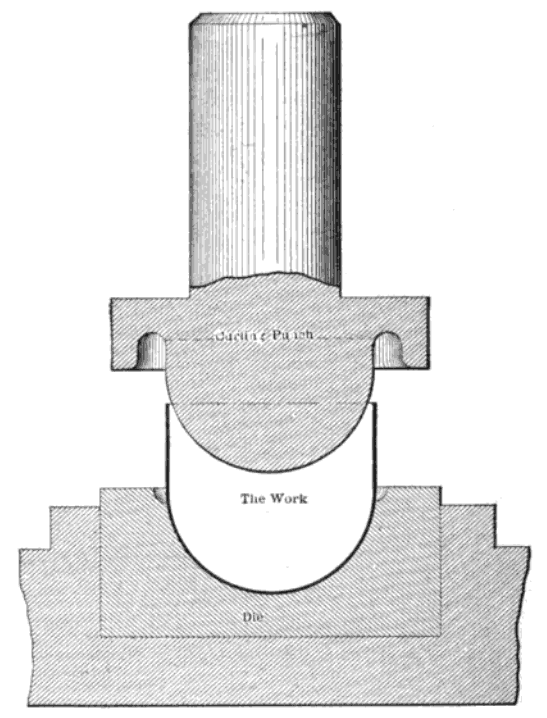

Curling is a sheet metal forming process used to form the edges into a hollow ring. Curling can be performed to eliminate sharp edges and increase the moment of inertia near the curled end. Other parts are curled to perform their primary function, such as door hinges.
Operation
In the curling operation, the flare, or burr, should always be turned away from the die. This will help prolong the life of the die by avoiding unnecessary damage due to scratching. The stroke of the die must be as long as the curl. Curling is often performed as part of a high production, multiple operation progressive forming.
Tooling
The curling die is designed to curl a material of specific thickness. Dies are generally made of hardened tool steel because of the amount of wear caused by the operation. Their smooth, rounded cavities are often lapped and polished to help curl the material uniformly.
References
References
- Boljanovic, Vukota. (2004). "Sheet metal forming processes and die design". Industrial Press.
This article was imported from Wikipedia and is available under the Creative Commons Attribution-ShareAlike 4.0 License. Content has been adapted to SurfDoc format. Original contributors can be found on the article history page.
Ask Mako anything about Curling (metalworking) — get instant answers, deeper analysis, and related topics.
Research with MakoFree with your Surf account
Create a free account to save articles, ask Mako questions, and organize your research.
Sign up freeThis content may have been generated or modified by AI. CloudSurf Software LLC is not responsible for the accuracy, completeness, or reliability of AI-generated content. Always verify important information from primary sources.
Report