From Surf Wiki (app.surf) — the open knowledge base
Cultural festival (Japan)
Annual event held by most schools in Japan
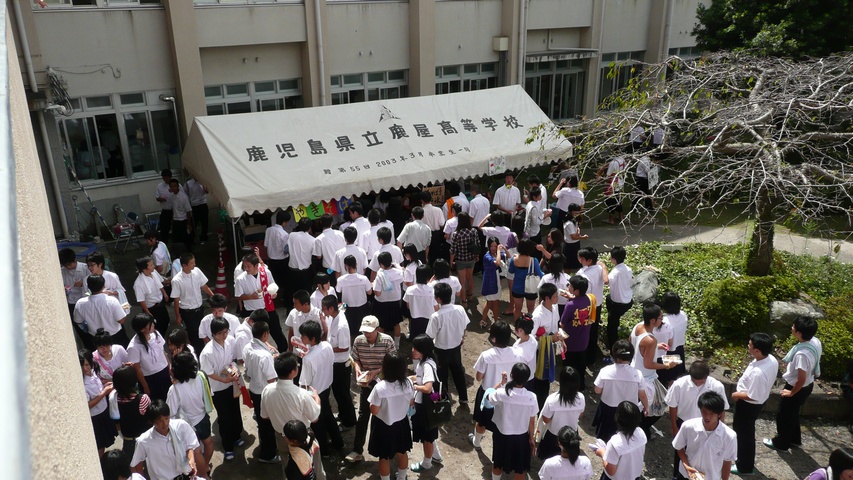
Annual event held by most schools in Japan
Cultural festivals in Japan are annual open day events held by most schools, from nursery schools to universities at which their students display their artistic achievements. People who want to enter the school themselves or who are interested in the school may come to see what the schoolwork and atmosphere are like. Parents may also want to see what kind of work their children have been doing. The festivals are usually open to the public, especially at high schools and universities.
Definition
According to the curriculum guidelines of the Ministry of Education, Culture, Sports, Science and Technology, cultural festivals are part of special activities and are defined as "events which aim to use the results of everyday learning to heighten motivation".
The cultural festivals are parts of regular lessons in elementary schools, junior high schools, and high schools, so the students are obligated to attend for graduation. In universities, the cultural festivals are placed as extracurricular activity, so attendance is not required.
Traditionally, most schools hold festivals on or around Culture Day (November 3), a Japanese national holiday. Normally it is held on a Saturday or Sunday; sometimes even both.
Name
"Cultural festival" (bunkasai) and "university festival" (daigaku-sai) are common nouns in Japanese, so particular names of cultural festivals depend on each school. For example, the festival at the University of Tokyo, Komaba Campus is named Komaba-sai.
Names
| School | English name | Japanese name |
|---|---|---|
| Nursery school | Daily life exhibition | Seikatsu-happyō-kai (生活発表会) |
| Kindergarten | Daily life exhibition | Seikatsu-happyō-kai (生活発表会) |
| Elementary school | Literary arts exhibition | |
| Learning exhibition | Gakugei-kai (学芸会) | |
| Gakushū-happyō-kai (学習発表会) | ||
| Junior high school | Cultural festival | Bunka-sai (文化祭) |
| High school | Cultural festival | Bunka-sai (文化祭) |
| University | University festival | Daigaku-sai (大学祭), Gakuen-sai (学園祭) |
Variations
The school festivals of junior high schools and high schools may also sometimes be called , , or .
Function
Festivals are held to display the students' learning, but many people visit a festival as a recreational diversion. Alumni often take the opportunity to visit schools they once attended. Food is served, and often classrooms or gymnasiums are transformed into temporary restaurants or cafés. Dances, concerts and plays may be performed by individual volunteers or by various school clubs, such as the dance club, the literature club, the orchestra club, the band club, and the drama club.
Cultural festivals are intended to be a fun event, but are also the only opportunity each year for students to see what life is like in other schools. They are also intended to enrich people's lives by increasing social interaction and fostering community ties.
References
References
- Rohlen, Thomas P.. (1983). "Japan's High Schools". University of California Press.
- [http://www.mext.go.jp/b_menu/shuppan/sonota/990301b/990301k.htm 小学校学習指導要領 第4章 特別活動(Curriculum guideline of Elementary School Chapter 4: Special activity)] {{webarchive. link. (2010-10-08 {{in lang). ja
- [http://www.mext.go.jp/b_menu/shuppan/sonota/990301c/990301k.htm 中学校学習指導要領 第4章 特別活動(Curriculum guideline of Lower Secondary School Chapter 4: Special activity)] {{webarchive. link. (2011-05-20 {{in lang). ja
- [http://www.mext.go.jp/b_menu/shuppan/sonota/990301d/990301z.htm 高等学校学習指導要領 第4章 特別活動(Curriculum guideline of High school Chapter 4: Special activity)] {{webarchive. link. (2010-07-10 {{in lang). ja
- "School life 学校生活". [[University College London]].
- "Komaba Festival - Student Support - The University of Tokyo, Komaba".
This article was imported from Wikipedia and is available under the Creative Commons Attribution-ShareAlike 4.0 License. Content has been adapted to SurfDoc format. Original contributors can be found on the article history page.
Ask Mako anything about Cultural festival (Japan) — get instant answers, deeper analysis, and related topics.
Research with MakoFree with your Surf account
Create a free account to save articles, ask Mako questions, and organize your research.
Sign up freeThis content may have been generated or modified by AI. CloudSurf Software LLC is not responsible for the accuracy, completeness, or reliability of AI-generated content. Always verify important information from primary sources.
Report