From Surf Wiki (app.surf) — the open knowledge base
Cuboctahedron
Polyhedron with 8 triangles and 6 squares
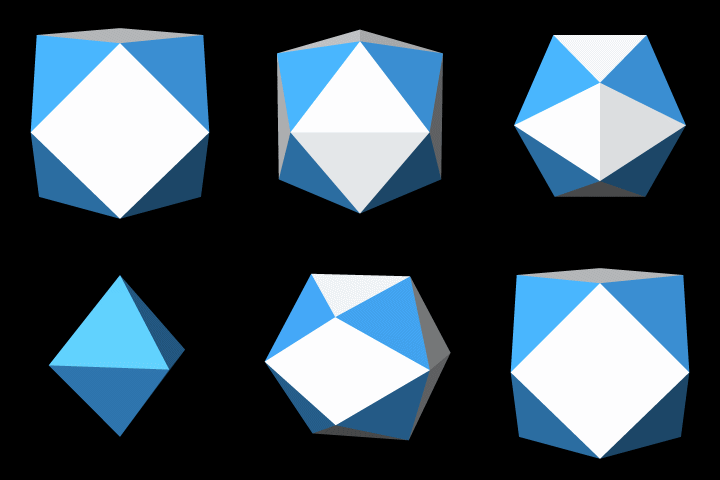
Polyhedron with 8 triangles and 6 squares
| Field | Value |
|---|---|
| name | Cuboctahedron |
| image | Cuboctahedron (green).png |
| type | Archimedean solid |
| faces | 14 |
| edges | 24 |
| vertices | 12 |
| vertex_config | 3.4.3.4 |
| coxeter | |
| schläfli | r{4,3} |
| conway | aC |
| symmetry | Octahedral \mathrm{O}_\mathrm{h} |
| dual | Rhombic dodecahedron |
| angle | approximately 125° |
| properties | convex, |
| vector equilibrium, | |
| Rupert property | |
| vertex_figure | Polyhedron 6-8 vertfig.svg |
| net | Polyhedron 6-8 net.svg |
vector equilibrium, Rupert property A cuboctahedron, rectified cube, or rectified octahedron is a polyhedron with 8 triangular faces and 6 square faces. A cuboctahedron has 12 identical vertices, with 2 triangles and 2 squares meeting at each, and 24 identical edges, each separating a triangle from a square. As such, it is a quasiregular polyhedron, i.e., an Archimedean solid that is not only vertex-transitive but also edge-transitive. It is radially equilateral. Its dual polyhedron is the rhombic dodecahedron.
Construction
The cuboctahedron can be constructed in many ways:
- Its construction can be started by attaching two regular triangular cupolas base-to-base. This is similar to one of the Johnson solids, triangular orthobicupola. The difference is that the triangular orthobicupola is constructed with one of the cupolas twisted so that similar polygonal faces are adjacent, whereas the cuboctahedron is not. As a result, the cuboctahedron may also called the triangular gyrobicupola.{{multiref | |
- Its construction can be started from a cube or a regular octahedron, marking the midpoints of their edges, and cutting off all the vertices at those points. This process is known as rectification, making the cuboctahedron being named the rectified cube and rectified octahedron.
- An alternative construction is by cutting off all vertices (truncation) of a regular tetrahedron and beveling the edges. This process is termed cantellation, lending the cuboctahedron an alternate name of cantellated tetrahedron. From all of these constructions, the cuboctahedron has 14 faces: 8 equilateral triangles and 6 squares. It also has 24 edges and 12 vertices.
The Cartesian coordinates for the vertices of a cuboctahedron with edge length \sqrt{2} centered at the origin are the permutations of (0, \pm 1, \pm 1)
Properties
Measurement and other metric properties
The surface area of a cuboctahedron A can be determined by summing all the area of its polygonal faces. The volume of a cuboctahedron V can be determined by slicing it off into two regular triangular cupolas, summing up their volume. Given that the edge length a , its surface area and volume are: \begin{align} A &= \left(6+2\sqrt{3}\right)a^2 &&\approx 9.464a^2 \ V &= \frac{5 \sqrt{2}}{3} a^3 &&\approx 2.357a^3. \end{align}
The dihedral angle of a cuboctahedron can be calculated with the angle of triangular cupolas. The dihedral angle of a triangular cupola between square-to-triangle is approximately 125°, that between square-to-hexagon is 54.7°, and that between triangle-to-hexagon is 70.5°. Therefore, the dihedral angle of a cuboctahedron between square-to-triangle, on the edge where the base of two triangular cupolas are attached is 54.7° + 70.5° approximately 125°. Therefore, the dihedral angle of a cuboctahedron between square-to-triangle is approximately 125°. The exact angle is \arccos(-1/\sqrt{3}).
Buckminster Fuller found that the cuboctahedron is the only polyhedron in which the distance between its center to the vertex is the same as the length of its edges. In other words, it has the same length vectors in three-dimensional space, known as vector equilibrium. The rigid struts and the flexible vertices of a cuboctahedron may also be transformed progressively into a regular icosahedron, regular octahedron, regular tetrahedron. Fuller named this the jitterbug transformation.
A cuboctahedron has the Rupert property, meaning there is a polyhedron of the same or larger size that can pass through its hole.
Symmetry and classification
The cuboctahedron is an Archimedean solid, meaning it is a highly symmetric and semi-regular polyhedron, and two or more different regular polygonal faces meet in a vertex. The cuboctahedron has two symmetries, resulting from the constructions as has mentioned above: the same symmetry as the regular octahedron or cube, the octahedral symmetry \mathrm{O}\mathrm{h} , and the same symmetry as the regular tetrahedron, tetrahedral symmetry \mathrm{T}\mathrm{d} .{{multiref | |. For octahedral symmetry, see p. 378, Figure 10.13. For tetrahedral symmetry, see p. 380, Figure 10.15.
Radial equilateral symmetry
In a cuboctahedron, the long radius (center to vertex) is the same as the edge length; thus its long diameter (vertex to opposite vertex) is 2 edge lengths. Its center is like the apical vertex of a canonical pyramid: one edge length away from all the other vertices. (In the case of the cuboctahedron, the center is in fact the apex of 6 square and 8 triangular pyramids). This radial equilateral symmetry is a property of only a few uniform polytopes, including the two-dimensional hexagon, the three-dimensional cuboctahedron, and the four-dimensional 24-cell and 8-cell (tesseract). Radially equilateral polytopes are those that can be constructed, with their long radii, from equilateral triangles which meet at the center of the polytope, each contributing two radii and an edge. Therefore, all the interior elements which meet at the center of these polytopes have equilateral triangle inward faces, as in the dissection of the cuboctahedron into 6 square pyramids and 8 tetrahedra.
Each of these radially equilateral polytopes also occurs as cells of a characteristic space-filling tessellation: the tiling of regular hexagons, the rectified cubic honeycomb (of alternating cuboctahedra and octahedra), the 24-cell honeycomb and the tesseractic honeycomb, respectively. Each tessellation has a dual tessellation; the cell centers in a tessellation are cell vertices in its dual tessellation. The densest known regular sphere-packing in two, three and four dimensions uses the cell centers of one of these tessellations as sphere centers.
Because it is radially equilateral, the cuboctahedron's center is one edge length distant from the 12 vertices.
Configuration matrix
The cuboctahedron can be represented as a configuration matrix with elements grouped by symmetry transitivity classes. A configuration matrix is a matrix in which the rows and columns correspond to the elements of a polyhedron as in the vertices, edges, and faces. The diagonal of a matrix denotes the number of each element that appears in a polyhedron, whereas the non-diagonal of a matrix denotes the number of the column's elements that occur in or at the row's element.
The cuboctahedron has 1 transitivity class of 12 vertices, 1 class of 24 edges, and 2 classes of faces: 8 triangular and 6 square; each element in a matrix's diagonal. The 24 edges can be seen in 4 central hexagons.
With octahedral symmetry (orbifold 432), the squares have the 4-fold symmetry, triangles the 3-fold symmetry, and vertices the 2-fold symmetry. With tetrahedral symmetry (orbifold 332) the 24 vertices split into 2 edge classes, and the 8 triangles split into 2 face classes. The square symmetry is reduced to 2-fold.
| f2 (Z4) | 4 | 4 | * | 6 |
|---|
|[[File:Cuboctahedron-tetrahedral colored.svg|240px]] |
| f3 (Z2) | 4 | 2 | 2 | * | * | 6 |
|---|
|}
Graph
The skeleton of a cuboctahedron may be represented as the graph, one of the Archimedean graphs. It has 12 vertices and 24 edges. It is quartic graph, which is four vertices connecting each vertex.
It has Hamiltonian paths. One example is shown below mapped onto a 16-gon perimeter, elements colored by transitivity positions.
The graph of a cuboctahedron may be constructed as the line graph of the cubical graph, making it becomes the locally linear graph.
The 24 edges can be partitioned into 2 sets isomorphic to tetrahedral symmetry. The edges can also be partitioned into 4 hexagonal cycles, representing centrosymmetry, with only opposite vertices and edges in the same transitivity class.
| e1 | 2 | 24 |
|---|
|[[File:Cuboctahedron-graph-tetrahedral-colored.svg|160px]] |
| e2 | 2 | * | 12 |
|---|
|[[File:Cuboctahedral_graph-ortho-4color.svg|160px]] |
| e3 | 0 | 1 | 1 | * | * | 8 |
|---|
|[[File:Cuboctahedral graph-circulant.svg|160px]] |}
Related polyhedra and honeycomb
The cuboctahedron shares its skeleton with the two nonconvex uniform polyhedra, the cubohemioctahedron and octahemioctahedron. These polyhedrons are constructed from the skeleton of a cuboctahedron in which the four hexagonal planes bisect its diagonal, intersecting its interior. Adding six squares or eight equilateral triangles results in the cubohemicotahedron or octahemioctahedron, respectively.{{multiref | |
The cuboctahedron 2-covers the tetrahemihexahedron, which accordingly has the same abstract vertex figure (two triangles and two squares: 3 \cdot 4 \cdot 3 \cdot 4 ) and half the vertices, edges, and faces. (The actual vertex figure of the tetrahemihexahedron is 3 \cdot 4 \cdot \frac{3}{2} \cdot 4 , with the \frac{a}{2} factor due to the cross.)

The cuboctahedron can be dissected into 6 square pyramids and 8 tetrahedra meeting at a central point. This dissection is expressed in the tetrahedral-octahedral honeycomb where pairs of square pyramids are combined into octahedra.
Appearance
The cuboctahedron was probably known to Plato: Heron's Definitiones quotes Archimedes as saying that Plato knew of a solid made of 8 triangles and 6 squares.
References
Footnotes
Works cited
- {{cite book
- {{cite journal
- {{cite journal
- {{cite book
- {{cite book | title-link = Regular Polytopes (book)
- {{citation
- {{cite book
- {{cite journal
- {{cite book | editor-last = Bezdek | editor-first = Andras
- {{cite journal
- {{cite book | contribution-url = https://books.google.com/books?id=ILnBkuSxXGEC
- {{cite book | editor-last1 = Reedijk | editor-first1 = J. | editor-last2 = Poeppelmmeier | editor-first2 = K.
- {{cite book | editor-last1 = Novikov | editor-first1 = S. | editor-last2 = Krichever | editor-first2 = I. | editor-last3 = Ogievetsky | editor-first3 = O. | editor-last4 = Shlosman | editor-first4 = S.
- {{cite book
- {{cite book
- {{cite book
- {{cite journal
- {{cite book
- {{cite journal
- {{cite book
References
- "Co".
- https://www.weddslist.com/rmdb/1graph.php?gr=cuboct
This article was imported from Wikipedia and is available under the Creative Commons Attribution-ShareAlike 4.0 License. Content has been adapted to SurfDoc format. Original contributors can be found on the article history page.
Ask Mako anything about Cuboctahedron — get instant answers, deeper analysis, and related topics.
Research with MakoFree with your Surf account
Create a free account to save articles, ask Mako questions, and organize your research.
Sign up freeThis content may have been generated or modified by AI. CloudSurf Software LLC is not responsible for the accuracy, completeness, or reliability of AI-generated content. Always verify important information from primary sources.
Report