From Surf Wiki (app.surf) — the open knowledge base
Crystal Palace, London
Residential area in London, England

Residential area in London, England
| Field | Value |
|---|---|
| official_name | Crystal Palace |
| os_grid_reference | TQ341708 |
| london_borough | Croydon |
| london_borough1 | Bromley |
| london_borough2 | Lewisham |
| london_borough3 | Lambeth |
| london_borough4 | Southwark |
| map_type | Greater London |
| coordinates | |
| population | 12,255 |
| population_ref | (2011 Census. Bromley Ward) |
| constituency_westminster | Streatham and Croydon North |
| constituency_westminster1 | Dulwich and West Norwood |
| constituency_westminster2 | Lewisham West and Penge |
| region | London |
| country | England |
| post_town | LONDON |
| dial_code | 020 |
| postcode_area | SE |
| postcode_district | SE19, SE20, SE26 |
| static_image_name | Upper Norwood Town Centre - 1.jpg |
| static_image_alt | Photo showing road junction at the end of Crystal Palace Parade. |
| static_image_caption | View of Crystal Palace from the park. Four London boroughs—Bromley, Croydon, Lambeth, and Southwark—meet at this junction. |
Crystal Palace is an area in South London, named after the Crystal Palace Exhibition building which stood in the area from 1854, until it was destroyed by a fire in 1936. About 7 miles southeast of Charing Cross, it includes one of the highest points in London, at 367 ft, offering views over the capital.
The area has no defined boundaries and straddles five London boroughs and three postal districts, although there is a Crystal Palace electoral ward and Crystal Palace Park in the London Borough of Bromley. It forms a part of the greater area known as Upper Norwood, and is contiguous with the areas of Anerley, Dulwich Wood, Gipsy Hill, Penge, South Norwood and Sydenham. The area is represented by four parliamentary constituencies, four London Assembly constituencies and fourteen local councillors.
Until development began in the 19th century, and before the arrival of the Crystal Palace, the area was known as Sydenham Hill. The Norwood Ridge and an historic oak tree were used to mark parish boundaries. After the Crystal Palace burned down in 1936, the site of the building and its grounds became Crystal Palace Park, the location of the National Sports Centre which contains an athletics track, stadium and other sports facilities. Crystal Palace Park has also been used as the setting for a number of concerts and films, such as The Italian Job and The Pleasure Garden and contains the Crystal Palace Park Concert Platform, in place since 1997.
Two television transmitter masts make the district a landmark location, visible from many parts of Greater London. Local landmarks include the Crystal Palace Triangle, a shopping district made up of three streets forming a triangle; Westow Park, a smaller park that lies off the triangle southwest of Crystal Palace Park; and the Stambourne Woodland Walk.
Crystal Palace was named in the Sunday Times newspaper's top ten list of "the best places to live in London" of 2016. In April 2022 Crystal Palace was named the best place to live in London by the Sunday Times, being characterised by a bohemian fusion of urban vibes and village-feel.
History
The ridge and the historic oak tree known as the Vicar's Oak (at the crossroads of the A212 Church Road and A214 Westow Hill) were used to mark parish boundaries. This has led to the Crystal Palace area straddling the boundaries of five London Boroughs; Bromley, Croydon, Lambeth, Southwark and Lewisham. The area also straddles three postcode districts: , , and . The ancient boundary between Surrey and Kent passes through the area, and until 1889 included parts of both counties. From 1889 to 1965 the area was on the south-eastern boundary of the County of London.
For centuries the area was covered by the Great North Wood, an extensive area of natural oak forest that formed a wilderness close to the southern edge of the then expanding city of London. The forest was a popular area for Londoners' recreation right up to the 19th century, when it began to be built over. It also became a home for some Romani people, with local street names and pubs recording the link, and the area still retains vestiges of woodland.
A pneumatic railway was briefly trialled in the area in 1864. Once the railways arrived, Crystal Palace was eventually served by two railway stations, the high level and low level stations, built to handle the large volume of passengers visiting the exhibition building. After the Palace was destroyed by fire, and with railway travel declining, passenger numbers fell and the high level station was closed in 1954 and demolished seven years later. Rail services gradually declined, and for a period in the 1960s and 1970s, there were plans to construct an urban motorway through the area as part of the London Ringways plan. With rising passenger numbers, additional London Overground services began stopping at the station and a major station redevelopment occurred.
The Crystal Palace
Main article: The Crystal Palace
The Crystal Palace, designed by Joseph Paxton, was a remarkable construction of prefabricated parts. It was a cast-iron and glass building originally erected in Hyde Park to house the Great Exhibition of 1851. Following the success of the exhibition, the Palace was moved and reconstructed in 1854 in a modified and enlarged form in the grounds of the Penge Place estate at Sydenham Hill. The buildings housed the Crystal Palace School of Art, Science, and Literature and Crystal Palace School of Engineering. It attracted visitors for over seven decades.
Sydenham Hill is one of the highest locations in London; 109 metres (357 ft) above sea level (spot height on Ordnance Survey Map); and the size of the Palace and prominence of the site made it easy to identify from much of London. This led to the residential area around the building becoming known as Crystal Palace instead of Sydenham Hill. The Palace was destroyed by fire on 30 November 1936 and the site of the building and its grounds is now known as Crystal Palace Park.
Landmarks
Crystal Palace Triangle

The area is formed by Westow Street, Westow Hill and Church Road, and has a number of restaurants and several independent shops, as well as an indoor secondhand market and a farmer's market on Haynes Lane. The triangle also contains a range of vintage furniture and clothing stores, as well as galleries, arts and crafts shops and other businesses. There was an ongoing campaign to turn a former bingo hall (at 25 Church Road) back into a cinema, after it had been purchased by the Kingsway International Christian Centre. The cinema had opened as "The Rialto" in 1928, later being renamed "The Picture Palace", only to close in 1968 and become a bingo hall. In 2018 after considerable restoration and renovation, Everyman Cinemas re-opened 25 Church Road as their 25th nationwide cinema location.

Transmitters
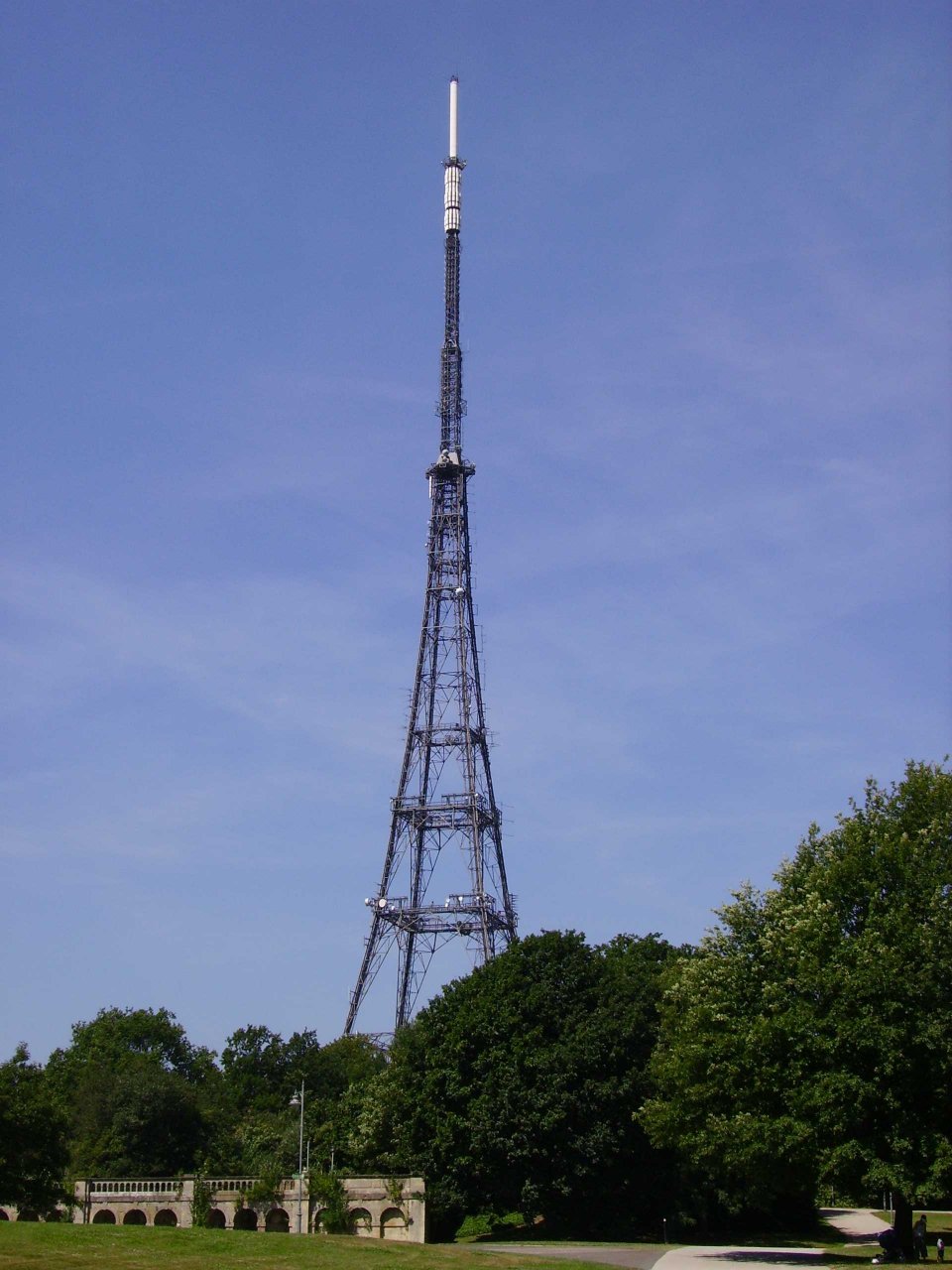
Television transmission has been taking place from Crystal Palace since at least the 1930s and two TV transmitter towers — Crystal Palace Transmitter – 640 ft tall — and Croydon Transmitter – 500 ft tall — stand on the hill at Upper Norwood, making the district a landmark location visible from many parts of London. The towers may appear similar in height and design, but the Crystal Palace mast, constructed in 1956, is on a slightly higher elevation. The current Croydon tower was built in 1962.
Crystal Palace Park

Main article: Crystal Palace Park
Crystal Palace Park is a large Victorian pleasure ground occupying much of the land within Crystal Palace and is one of the major London public parks. The park was maintained by the LCC and later the GLC, but with the abolition of the GLC in 1986, control of the entire park was given to the London Borough of Bromley. From 15 September 2023 responsibility for the park's management has been handed to the Crystal Palace Park Trust. Crystal Palace railway station is located by the park, as is the National Sports Centre. The park was formerly used for sports such as cricket, football and motor racing, and has been a venue for concerts often performed at the site of the Crystal Palace Park Concert Platform. In recent years the park has played host to organised music events such as Wireless Festival and South Facing Festival. It is also home to the famous Crystal Palace Dinosaur sculptures.
The park is situated halfway along Norwood Ridge at one of its highest points. This ridge offers views northwards to central London, east to the Queen Elizabeth II Bridge and Greenwich, and southward to Croydon and the North Downs. It is also one of the starting points for the Green Chain Walk, linking to places such as Chislehurst, Erith, the Thames Barrier and Thamesmead. Section 3 of the Capital Ring walk round London goes through the park.

Westow Park
A smaller park occupying 2.73 ha is to the southwest of the triangle on Church Road. Westow Park hosts the annual Crystal Palace Overground festival, a free community festival held over four days in the summer.

Stambourne Woods
To the south of the triangle is a small area of woodland occupying 1.92 ha, containing the Stambourne Woodland Walk. It was opened in 1984 and covers an area between developments on Stambourne Way and Fox Hill. The land originally formed the gardens of Victorian villas built on the hill overlooking Croydon, but fell into disrepair. In 1962, the Croydon Council approved terms for buying the land from the Church Commissioners and other local freeholders, allowing the construction of a link. Paths and benches were installed but much of the vegetation was left undisturbed, creating a woodland pathway.
Saint Constantine and Helen Greek Orthodox Church
At 69 Westow Street is an ornate Greek Orthodox Church which serves the Greek Cypriot and Orthodox community in the surrounding area. Built in 1878, and formerly an Anglican church (St. Andrew's), the walls are now dressed in ornate Byzantine-style art.

Geography
Crystal Palace is about 7 mi southeast of Charing Cross on Norwood Ridge and includes one of the highest points of London at 112 metres above the mean sea level (OS map reference TQ337707). The soil in the area has been classified as typically "Slowly permeable, seasonally wet, slightly acid but base-rich loamy and clayey soils", with impeded drainage, moderate fertility and a loamy profile. The nearest Met Office climate station is based in Greenwich Park.
|Jan record high C = 18.5 |Feb record high C = 19.7 |Mar record high C = 25.3 |Apr record high C = 29.8 |May record high C = 32.8 |Jun record high C = 35.6 |Jul record high C = 36.5 |Aug record high C = 38.5 |Sep record high C = 35.4 |Oct record high C = 29.9 |Nov record high C = 21.1 |Dec record high C = 17.7 |year record high C = 38.5 |Jan record low C = -10.0 |Feb record low C = -9.0 |Mar record low C = -8.0 |Apr record low C = -2.0 |May record low C = -1.0 |Jun record low C = 5.0 |Jul record low C = 7.0 |Aug record low C = 6.0 |Sep record low C = 3.0 |Oct record low C = -4.0 |Nov record low C = -5.0 |Dec record low C = -7.0 |year record low C = -10.0 | archive-url = https://web.archive.org/web/20121027145637/http://www.metoffice.gov.uk/climate/uk/averages/19812010/sites/greenwich.html | url-status = dead | archive-date = 27 October 2012 | access-date = 10 April 2013}} except for humidity and snow data which are from NOAA
Local government
Crystal Palace is on the boundary of four London boroughs – Bromley, Croydon, Lambeth and Southwark. A fifth borough – Lewisham – is nearby. As a result, the area is served by a diverse range of local government bodies and Members of Parliament (MPs).
| Colour | Party |
|---|---|
| Conservative | |
| Labour | |
| Liberal Democrats |
Local authorities
Several local authority councillors in the area were elected on 5 May 2022. All seats bar 1 are held by Labour party candidates. The elected officials by ward for Crystal Palace local authorities in October 2023 were:
| Local Authority | Ward | Elected Councillors | |||||
|---|---|---|---|---|---|---|---|
| Bromley | Crystal Palace & Anerley | Ruth McGregor | |||||
| title=Your Councillors by Ward | url=https://cds.bromley.gov.uk/mgMemberIndex.aspx?FN=WARD&VW=LIST&PIC=0 | website=Bromley Council Website | publisher=London Borough of Bromley | access-date=13 October 2023}} | |||
| Croydon | Crystal Palace and Upper Norwood | Claire Bonham | |||||
| Nina Degrads | |||||||
| title=Your Councillors by Ward | url=https://democracy.croydon.gov.uk/mgMemberIndex.aspx?FN=WARD&VW=LIST&PIC=0 | website=Croydon Council Website | publisher=London Borough of Croydon | access-date=13 October 2023}} | |||
| Lambeth | Gipsy Hill | Christine Banton | |||||
| title=Find Councillor | url=https://moderngov.lambeth.gov.uk/mgFindMember.aspx?XXR=0&AC=WARD&WID=353&sPC=Enter%20postcode | website=Lambeth Council Website | publisher=London Borough of Lambeth | access-date=13 October 2023}} | |||
| Southwark | Dulwich Wood | Andy Simmons | |||||
| title=Your Councillors by Ward | url=https://moderngov.southwark.gov.uk/mgMemberIndex.aspx?FN=WARD&VW=LIST&PIC=0 | website=Southwark Council Website | publisher=London Borough of Southwark | access-date=13 October 2023}} | |||
| Lewisham | Sydenham | Chris Best | |||||
| Liam Curran | |||||||
| title=Councillors by Ward | url=https://councilmeetings.lewisham.gov.uk/mgMemberIndex.aspx?FN=WARD&VW=LIST&PIC=0 | website=Lewisham Council Website | publisher=London Borough of Lewisham | access-date=13 October 2023}} |
London Assembly
The area is represented by four constituencies in the London Assembly. Their elected assembly members in 2024 were:
| London Assembly Constituency | Elected Member | |||
|---|---|---|---|---|
| Croydon and Sutton | Neil Garratt | |||
| Bexley and Bromley | Thomas Turrell | |||
| Greenwich and Lewisham | Len Duvall | |||
| Lambeth and Southwark | Marina Ahmad |
Westminster Parliament
The area is represented by four constituencies in the Westminster Parliament. In July 2024, their elected MPs were:
| Constituency | MP | |||
|---|---|---|---|---|
| Beckenham and Penge | Liam Conlon | |||
| Croydon North | Steve Reed | |||
| Dulwich and West Norwood | Helen Hayes | |||
| Lewisham West and East Dulwich | Ellie Reeves |
Media
Films
The Italian Job has a scene filmed at the athletics track in the Crystal Palace sports centre, in which Michael Caine says, "You were only supposed to blow the bloody doors off!" The Pleasure Garden was also filmed in the park and Our Mother's House has a scene featuring Dirk Bogarde with several children on the park's boating lake.
The park features prominently as the setting of an outdoor rave in the music video for The Chemical Brothers' number 1 single "Setting Sun".

Literature
Arthur Conan Doyle was active in the area between 1891 and 1894. Although he lived in nearby South Norwood, he visited the Crystal Palace and Upper Norwood area regularly in connection with the Upper Norwood Literary and Scientific Society. The Foresters Hall on Westow Street was then known as the Welcome Hall (or just Welcome), and it was in that hall in May 1892 that Arthur Conan Doyle was elected President of the society. He was re-elected to the post in 1893 and resigned in 1894. Each occasion was held in the same hall.
The writer Deborah Crombie sets her 2013 mystery, The Sound of Broken Glass, in the Crystal Palace area of London.
Sports
Cricket
Main article: Crystal Palace Cricket Club
The Crystal Palace Cricket Club was founded in 1857 and played their matches inside the grounds of The Crystal Palace at the Crystal Palace Park Cricket Ground, which later became the home of the London County Cricket Club formed by the Crystal Palace Company with the help of W.G. Grace.
Football
Main article: Crystal Palace F.C.
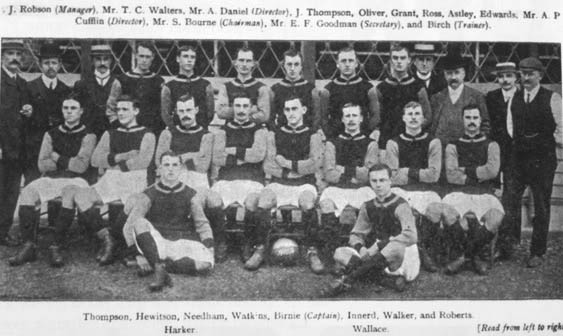
An amateur football team formed of players from the Crystal Palace Cricket Club played on the cricket ground between 1862 and 1864. They moved to a ground behind the Crooked Billet, Penge for a few years, but then came back to Crystal Palace Park for a short spell before disbanding around 1876. The professional Crystal Palace football club was founded in 1905 and played its home games at the sports stadium situated in Crystal Palace Park, which was built in 1895 to host the FA Cup Final. However, in 1915 the club was forced to leave due to the First World War and played at nearby Herne Hill Velodrome and the Nest, before moving to its current home at Selhurst Park in 1924. The club competes in the Premier League, the top–tier of English football.
FA Cup Final
The FA Cup Final was hosted at the Palace sports stadium between 1895 and 1914.
Rugby
The historical grounds also hosted the first England Rugby Union match against New Zealand in 1905, which New Zealand won by 15–0.
National Sports Centre
Main article: Crystal Palace National Sports Centre
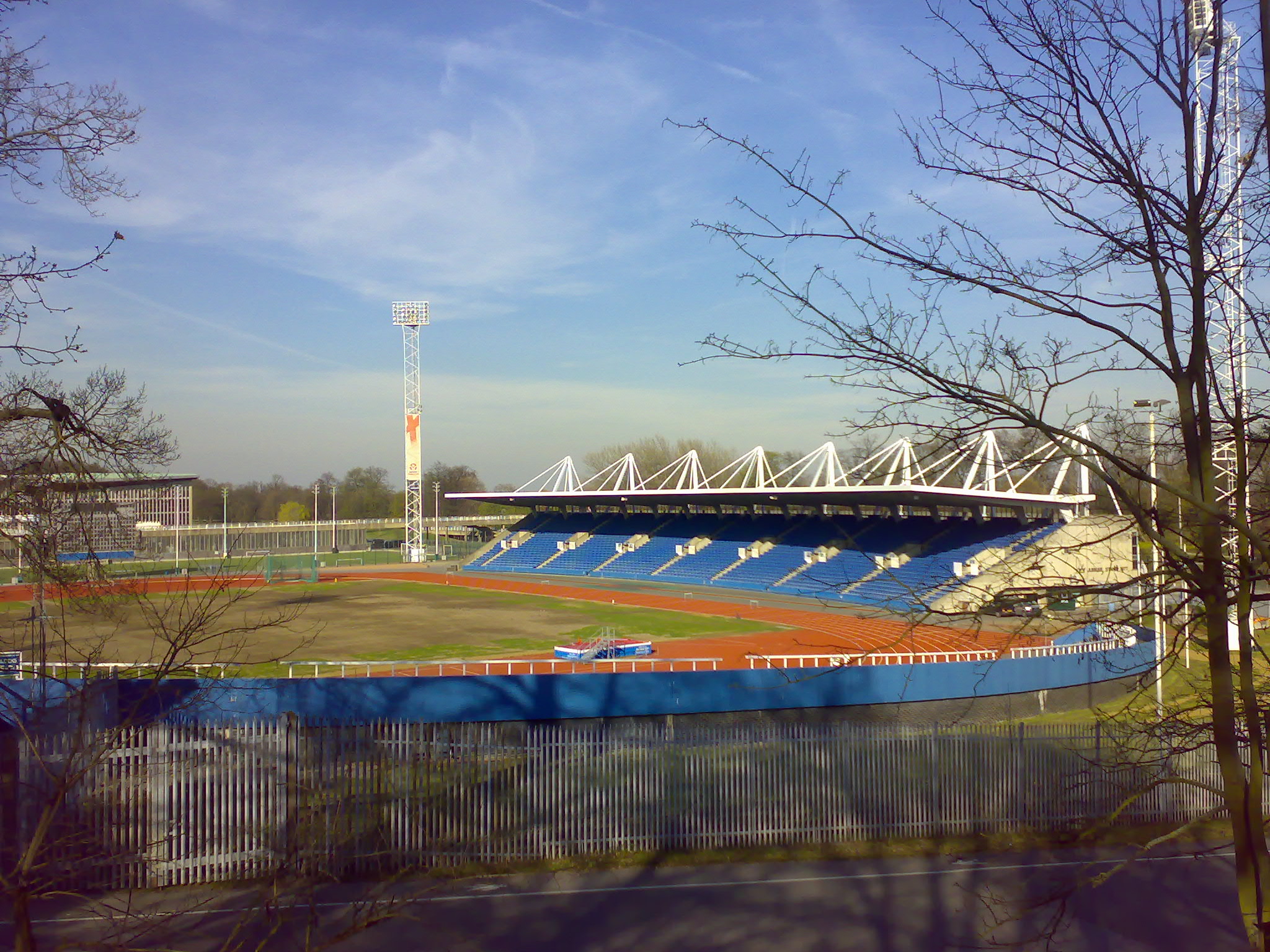
In 1964, a 15,500 seater athletics stadium and sports centre was built on the former site of the football stadium in Crystal Palace Park. The athletics stadium was known as the National Sports Centre and between 1999 and 2012 hosted the London Athletics Grand Prix among other international athletics meetings. The Crystal Palace triathletes club is also based here. Since the London 2012 Olympics, the status of the stadium and aquatics centre as the main facilities for their sports in London has been superseded by the London Aquatics Centre and Olympic Stadium. This led to Crystal Palace F.C. submitting plans to rebuild the stadium as a 40,000 capacity football venue, although the club has since shelved these plans, to concentrate on redeveloping their home at Selhurst Park.
Motor Racing
Main article: Crystal Palace circuit
A motor racing circuit was opened around the Park in 1927 and the remains of the track now make up some of the access roads around the park. The track was extended to 2 mi in 1936, before being taken over by the Ministry of Defence at the start of World War II. Race meetings resumed in 1953, and the circuit hosted a range of international racing events, continuing until the last races in 1974. For three years, from 1997, parts of the circuit were used for a once-a-year sprint time trial similar to a hillclimb before stopping due to development work. The event resumed in 2010 and continued until 2019.
Education

Crystal Palace contains three primary schools, Paxton Primary School, Rockmount Primary School and All Saints C of E Primary School, and one secondary school, Harris City Academy. Crystal Palace Park also contains a branch of Capel Manor College, offering courses in Animal Care, Arboriculture and Countryside, Horticulture and Landscaping and Garden Design along with other short courses.
In 2013, due to a shortage of primary school places in both Crystal Palace and London, proposals to open a new primary school by September 2015 were put forward, with plans submitted to the Department for Education in January 2014. The proposals were approved as part of wave 6 of the Free Schools Programme and the school is scheduled to open in September 2015. As of October 2014, the school is considering three possible building configurations – with the Greater London Authority running a public consultation on each option – all of which would involve demolishing one of the seated stands around the athletics track at the National Sports Centre.
Transport
Roads
The area is served by the A212, A214, A234 and A2199 roads. The roads that make up the triangle (Westow Hill, Westow Street and Church Road) form part of a one-way system and are in a 24-hour controlled parking and loading zone. There is a coach park inside Crystal Palace Park.
The area would have been affected by the cancelled London Ringways motorway plans, as one of the radial routes connecting the South Cross Route to Ringway 2 (the South Cross Route to Parkway D Radial) would have run through a part of Crystal Palace Park, following the railway line.
Cycle routes
London Cycle Network routes 23 and 27 travel through Crystal Palace. Route 27 runs from Anerley Hill through part of Crystal Palace Park towards Bromley and route 23 runs through the Crystal Palace triangle to connect to Borough and Croydon.
Transport for London have proposed to build Quietway route 7 that runs from Crystal Palace to Elephant and Castle. The route was subject to consultation processes in the London Boroughs of Lambeth and Southwark in 2016, with construction to begin in 2017.
Rail

Crystal Palace is accessible by rail from Crystal Palace railway station, where Southern trains run between Victoria on the Crystal Palace Line and London Bridge on the Brighton Main Line, and where London Overground trains run to Highbury & Islington on the East London Line. In addition, Southern services run to Beckenham Junction, Sutton and Epsom Downs. Crystal Palace railway station is one of the few stations to border two zones, Zones 3 and 4. The South Gate of the Park is accessible by rail via Penge West, which is served by Southern trains from London Bridge and London Overground services.
Crystal Palace used to have a second railway station, the Crystal Palace (High Level) railway station. The station was built to serve passengers visiting the Crystal Palace, but after the fire in 1936, traffic on the branch line declined. In World War II, the line serving the station was temporarily closed due to bomb damage. Repairs were made and the line was reopened, but the requirement for reconstruction and the decline in traffic led to a decision to close the station and branch line in 1954, followed by the demolition of the station in 1961. Despite the demolition, a Grade II listed subway remains under Crystal Palace Parade. The Crystal Palace pneumatic railway was also built in Crystal Palace c.1864.

The low level station remain open, although passenger numbers at that station also fell after the fire of 1936 and many services were diverted to serve London–Croydon routes instead of the Victoria–London Bridge route. Rail travel was in decline across the UK in the 1960s and 1970s when the Beeching Axe was imposed. In the 1970s, two outer platforms used by terminating trains were abandoned and the third rail was removed.
More recently rail travel at the station has seen a resurgence and new services have started running. Passenger numbers increased each year between 2004 and 2013. Since May 2010, the station has served the East London Line branch of the London Overground, connecting with the Central London and East End of London. In 2011 services were extended to Highbury and Islington. The station underwent redevelopment in 2012, which brought the original Victorian booking hall back into use, created a new cafe in the station building and provided wheelchair access through the installation of three lifts; this work was completed by the end of March 2013.
Tram
Tram services from Surrey used to operate up Anerley Hill to the Crystal Palace Parade until the 1930s. More recently there have been proposals to connect Tramlink to Crystal Palace, with mayoral candidates citing the desirability of the initiative.

Bus
The area is served by multiple bus routes, many of which terminate at Crystal Palace Bus Station situated on the Parade. These services include routes N2, 3/N3, N63, 122, N137, 157, 202, 227, 249, 322, 358, 363, 410, 417, 432 and 450.
Air
The nearest major international airports are Heathrow and Gatwick. London City Airport and Biggin Hill Airport are also nearby.
Notable people

Marie Stopes, early promoter of sex education and contraception, was raised in a house on Cintra Park shortly after her birth in Edinburgh in 1880.
Joseph Paxton, designer of the Crystal Palace itself and instrumental in having the building reassembled on Sydenham Hill following the success of the Great Exhibition of 1851, lived in a house called "Rockhills" at the top of Westwood Hill.
Benjamin Waterhouse Hawkins, artist and sculptor who created the Crystal Palace Dinosaurs in the park, lived in Belvedere Road between 1856 and 1872.
Jim Bob, Carter USM frontman, currently lives in Crystal Palace.
The African-American Shakespearean actor Ira Aldridge lived in Hamlet Road.

The French novelist Émile Zola lived in what is now the Queen's Hotel on Church Road between October 1898 and June 1899. Zola fled to England after being convicted of criminal libel in France on 23 February 1898, a direct consequence of the publication of his open letter J'Accuse…!.
Francis Pettit Smith, one of the inventors of the screw propeller and a contributor to the construction of the SS Archimedes, lived in the area between 1864 and 1870.
British rapper Speech Debelle was born in Crystal Palace. She left the area because of "traffic and parking problems".
Camille Pissarro, Danish-French Impressionist and Neo-Impressionist painter, stayed in Crystal Palace between 1870 and 1871.
Comedy scriptwriter John Sullivan of Only Fools and Horses fame wrote the pilot episode of his debut sitcom Citizen Smith at his in-laws' house in Crystal Palace.
A fuller list of notable people can be found on the same section of the Upper Norwood page.
Nearest places
- Anerley
- Beckenham
- Catford
- Dulwich and Dulwich Wood
- Elmers End
- Forest Hill
- Gipsy Hill
- Penge
- South Norwood
- Sydenham
- Upper Norwood
- West Norwood
References
Citations
Bibliography
- Beryl D. Cheeseman, Treetops & Terraces, Theban Publishing, 1991.
- Beryl D. Cheeseman, Upper Norwood Triangle Memories, Theban Publishing, 2007.
- John Coulter, Norwood: A Second Selection (Britain in Old Photographs), The History Press, 2012.
- John Coulter, Norwood Past, Historical Publications, 1996.
- John Coulter, Norwood Pubs (Images of England), Tempus Publishing, 2006 (reprinted by The History Press).
- David R. Johnson, Around Crystal Palace & Penge (Britain in Old Photographs), Sutton Publishing, 2004 (reprinted by The History Press).
- Ian Leith, Delamotte's Crystal Palace: A Victorian Pleasure Dome Revealed, English Heritage, 2005 (reprinted by The Crystal Palace Foundation, 2013).
- J. R. Piggott, Palace of the People: The Crystal Palace at Sydenham 1854-1936, Hurst & Company, 2004.
- Nicholas Reed, Crystal Palace and the Norwoods (Images of England), Tempus Publishing, 1995 (reprinted by The History Press).
- C. J. Schuler, The Wood that Built London: A Human History of the Great North Wood, Sandstone Press, 2021.
- Alan R. Warwick, The Phoenix Suburb: A South London Social History, The Blue Boar Press/Norwood Society, 1972 (reprinted 1991 & 2008).
References
- "Bromley Ward population 2011". Office for National Statistics.
- Mills, Anthony David (2001). ''Dictionary of London Place Names''. [[Oxford University Press]]. {{ISBN. 0-19-280106-6
- Ordnance Survey. (1862). "Spot Height in feet, TQ337707". Ordnance Survey.
- (21 March 2016). "Best places to live in London". Evening Standard.
- "Crystal Palace named best place to live in London 2022 list". Sunday Times.
- (13 June 2022). "Londoners split over Crystal Palace and whether it's great or 'dead'".
- (1956). "Norwood: Introduction". Institute of Historical Research.
- Hughes, Pete. (28 May 2012). "Crystal Palace Triangle: How life in the three London boroughs compares.". Croydon Advertiser.
- "Upper Norwood Triangle Conservation Area Appraisal and Management Plan". Croydon Borough Council.
- Ordnance Survey. (1933). "1933 Ordnance Survey Map". Ordnance Survey.
- Potter, Russell. (29 January 2007). "The Crystal Palace".
- "Haynes Lane Market". London and Partners.
- Bloss, Andrew. (17 May 2013). "New farmers market comes to Crystal Palace". Streatham Guardian.
- (27 May 2010). "Introducing the East London Line: Crystal Palace". Londonist.
- Green, Jerry. (21 March 2014). "New Bid to Use Former Cinema for Church Services 'Dual purpose' application expected".
- (26 November 2010). "Church's silence on bingo club's future". Croydon Advertiser.
- (27 May 2011). "Cinema protest at disused site". Croydon Advertiser.
- (14 Nov 2018). "Crystal Palace Opening is Everyman's Triumphant 25th".
- (September 1935). "Television for Millions". Popular Mechanics.
- "Crystal Palace Transmitter". SkyscraperPage.com.
- "About Crystal Palace Park — History of the park". London Borough of Bromley.
- "Historic Handover". Crystal Palace Park Trust Website.
- Williams, David. (17 May 2013). "Motor to the Palace for action-packed vintage racing". London Evening Standard.
- (27 March 2012). "The 70s Crystal Palace Garden Parties". Mish Mash Vintage.
- (April 2010). "Capital Ring, Section 3, Grove Park to Crystal Palace". Walk London.
- "Westow Park". Croydon Council.
- Fowler, Joshua. (20 May 2013). "Crystal Palace Overground Festival announces Acorn Group sponsorship". Bromley Times.
- "Stambourne Woodland Walk History". Croydon Council.
- "Archdiocese of Thyateira and Great Britain".
- "UK climate — Averages — Crystal Palace National Sports CentreUK climate — Averages — Crystal Palace National Sports Centre". Met Office.
- "Soilscapes". Cranfield University.
- "London, Greater London: Average conditions". [[BBC Weather]].
- "August 2003 — Hot spell". [[Met Office]].
- "Monthly temperature records by country". Met Office.
- "NOAA".
- "London boroughs map and profiles". London Councils.
- "Your Councillors by Ward". London Borough of Bromley.
- "Your Councillors by Ward". London Borough of Croydon.
- "Find Councillor". London Borough of Lambeth.
- "Your Councillors by Ward". London Borough of Southwark.
- "Councillors by Ward". London Borough of Lewisham.
- "The film — locations — UK locations". The Italian Job.com.
- "A south London past – musings on Crystal Palace". Ivory Bunker.
- The Norwood Author — Arthur Conan Doyle & The Norwood Years (1891–1894) by Alistair Duncan {{ISBN. 978-1-904312-69-7
- Joh Tipping. (22 February 2013). "Book review: 'The Sound of Broken Glass' by Deborah Crombie". The Dallas Morning News.
- "Welcome to the CPT website". Crystal Palace Triathletes.
- (20 January 2011). "Crystal Palace unveil plans for National Sports Centre". BBC Sport - Football.
- (20 April 2018). "Crystal Palace plan for Selhurst Park expansion given the go-ahead by Croydon Council". Croydon Advertiser.
- "Motorsport at the Palace".
- "Living in Crystal Palace". Foxtons.
- "Crystal Palace Park centre". Capel Manor College.
- "WANTED: More primary school places for Crystal Palace". Crystal Palace Primary School.
- Davis, Anna. (24 June 2013). "London primary schools places crisis". London Evening Standard.
- "Our Project Timeline". Crystal Palace Primary School.
- (10 June 2014). "Location". Crystal Palace Primary School Limited.
- "Crystal Palace National Sports Centre Development Options: Public Consultation". Greater London Authority.
- "Open Cycle Map". OpenCycleMap.
- "Quietways – The First Seven Routes".
- (August 2024). "Quietway 7 – Elephant and Castle to Crystal Palace".
- "Proposed changes to Quietway 7 cycle route -Elephant & Castle to Crystal Palace- West Dulwich and Gipsy Hill – Series 1".
- "National Rail Enquiries". National Rail.
- "London's Rail and Tube Services". Transport for London.
- "Site Name: Crystal Palace High Level Station subway". Subterranea Britannica.
- "Estimates of station usage". Office of Rail Regulation.
- (28 February 2011). "East London Line reaches Highbury and Islington". Railway Gazette International.
- "Crystal Palace refurbishment complete". Transport for London.
- Mike Didymus. (31 August 2010). "Ken Livingstone looks to China to regenerate Croydon". This is Local London.
- Truman, Peter. (6 January 2009). "Renewed hope for Crystal Palace tram". Streatham Guardian.
- "Buses from Crystal Palace". Transport for London.
- (29 July 2010). "Blue Plaque for Marie Stopes". English Heritage.
- "Plaques of London-Rockhills". Plaques of London.
- "Blue Plaques in Bromley". London Borough of Bromley.
- Blundy, Rachel. (10 June 2012). "Carter USM frontman to open Crystal Palace festival". Your Local Guardian.
- "Aldridge, Ira (1807–1867)". English Heritage.
- "Zola, Emile (1840–1902)". English Heritage.
- "Smith, Sir Francis Pettit (1808–1874)". English Heritage.
- Watts, Matt. (15 September 2009). "Mercury winner, Speech Debelle, to quit south London over traffic congestion". Croydon Guardian.
- Reed, Nicholas. (1995). "Camille Pissarro at Crystal Palace". Lilburne Press.
- "Camille Pissarro (1830–1903) impressionist painter stayed on this site 1870–71". Open Plaques.
- Coveney, Michael. (2011-04-24). "John Sullivan obituary". The Guardian.
This article was imported from Wikipedia and is available under the Creative Commons Attribution-ShareAlike 4.0 License. Content has been adapted to SurfDoc format. Original contributors can be found on the article history page.
Ask Mako anything about Crystal Palace, London — get instant answers, deeper analysis, and related topics.
Research with MakoFree with your Surf account
Create a free account to save articles, ask Mako questions, and organize your research.
Sign up freeThis content may have been generated or modified by AI. CloudSurf Software LLC is not responsible for the accuracy, completeness, or reliability of AI-generated content. Always verify important information from primary sources.
Report