From Surf Wiki (app.surf) — the open knowledge base
Cryptoclidus
Extinct genus of reptiles

Extinct genus of reptiles
- C. richardsoni Lydekker, 1889
- Plesiosaurus eurymerus Phillips, 1871
Cryptoclidus ( ) is a genus of plesiosaur reptile from the Middle Jurassic period of England, France, and Cuba.
Discovery
Cryptoclidus was a plesiosaur whose specimens include adult and juvenile skeletons, and remains which have been found in various degrees of preservation in England, Northern France, Russia, and South America. Its name, meaning "hidden clavicles", refer to its small, practically invisible clavicles buried in its front limb girdle.
The type species was initially described as Plesiosaurus eurymerus. The specific name "wide femur" refers to the forelimb, which was mistaken for a hindlimb at the time. It was moved to its own genus Cryptoclidus by Seeley (1892).
Fossils of Cryptoclidus have been found in the Oxford Clay of Cambridgeshire, England. The dubious species Cryptoclidus beaugrandi is known from Kimmeridgian-age deposits in Boulogne-sur-Mer, France. Cryptoclidus vignalensis, which is now considered undiagnostic, hails from the Jagua Formation of western Cuba.
In 2016, there was a report about a fragmentary Cryptoclidus postcranial skeleton from the Callovian deposits of Nikitino village in Spassky District, Ryazan Oblast, Russia, but later Zverkov et al. defined it as an intedermitate cryptoclidid.
Description
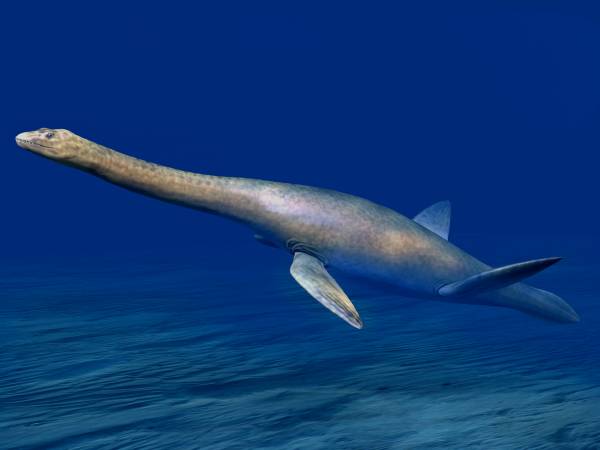
Cryptoclidus was a medium-sized plesiosaur, with the largest individuals measuring up to 4 m long and weighing about 737 -. The fragile build of the head and teeth preclude any grappling with prey, and suggest a diet of small, soft-bodied animals such as squid and shoaling fish. Cryptoclidus may have used its long, intermeshing teeth to strain small prey from the water, or perhaps sift through sediment for buried animals.
The size and shape of the nares and nasal openings have led Brown and Cruickshank (1994) to argue that they were used to sample seawater for smells and chemical traces.
Classification


The cladogram below follows the topology from Benson et al. (2012) analysis.
References
References
- Brown, David S., and Arthur RI Cruickshank. {{usurped
- Seeley, Harry G.. (1892). "The nature of the shoulder girdle and clavicular arch in sauropterygia". Proceedings of the Royal Society of London.
- [https://web.archive.org/web/20220515175404/http://www.fossilworks.org/cgi-bin/bridge.pl?a=collectionSearch&taxon_no=36466&max_interval=Jurassic&country=France&is_real_user=1&basic=yes&type=view&match_subgenera=1 Bologne-sur-Mer] at [[Fossilworks]].org
- (1996). "Synopsis of Late Jurassic Marine Reptiles from Cuba". American Museum Novitates.
- De la Torre, R., and A. A. Cuervo. (1939). Dos nuevas especies de ichthyosaurios del Jurisico de Vinales. ''Universidad de La Habana, Depto. Geol. y Paleont.'' pp. 1-9.
- Shmakov A. S.. (2016). "О находке остатков плезиозавра (Reptilia, Plesiosauria) в келловее Никитино (Спасский район, Рязанская область) [On a plesiosaur (Reptilia, Plesiosauria) finding in Callovian of Nikitino (Spassky District, Ryazan Oblast)]". М.: ПИН РАН.
- Zverkov N. G., Shmakov A. S., Arkhangelsky M. S.. (2017). "Jurassic marine reptiles of Moscow and surroundings (in "Jurassic deposits and fauna of the southern part of the Moscow Syneclyse")". GEOS.
- Brown, D. S.. (1981). "The English Upper Jurassic Plesiosauridea (Reptilia) and a review of the phylogeny and classification of the Plesiosauria". Bulletin of the British Museum of Natural History.
- Motani, R.. (2002). "Swimming speed estimation of extinct marine reptiles: energetic approach revisited". Paleobiology.
- (1999). "The Marshall Illustrated Encyclopedia of Dinosaurs and Prehistoric Animals". Marshall Editions.
- Brown and Cruickshank, 1994
- (2022). "Historically transposed flipper pairs in a mounted plesiosaurian skeleton". PalZ.
- (2012). "High Diversity, Low Disparity and Small Body Size in Plesiosaurs (Reptilia, Sauropterygia) from the Triassic–Jurassic Boundary". PLOS ONE.
This article was imported from Wikipedia and is available under the Creative Commons Attribution-ShareAlike 4.0 License. Content has been adapted to SurfDoc format. Original contributors can be found on the article history page.
Ask Mako anything about Cryptoclidus — get instant answers, deeper analysis, and related topics.
Research with MakoFree with your Surf account
Create a free account to save articles, ask Mako questions, and organize your research.
Sign up freeThis content may have been generated or modified by AI. CloudSurf Software LLC is not responsible for the accuracy, completeness, or reliability of AI-generated content. Always verify important information from primary sources.
Report