From Surf Wiki (app.surf) — the open knowledge base
Cryolite
Halide mineral

Halide mineral
| Field | Value |
|---|---|
| name | Cryolite |
| category | Halide mineral |
| boxwidth | 24 |
| image | 816- Ivigtut - cryolite.jpg |
| imagesize | 260px |
| caption | Cryolite from Ivittuut, Greenland |
| formula | Na3AlF6 |
| molweight | 209.9 g mol−1 |
| IMAsymbol | Crl |
| strunz | 3.CB.15 |
| dana | 11.6.1.1 |
| system | Monoclinic |
| class | Prismatic (2/m) |
| (same H-M symbol) | |
| symmetry | P21/n |
| unit cell | a = 7.7564(3) Å, |
| b = 5.5959(2) Å, | |
| c = 5.4024(2) Å; β = 90.18°; Z = 2 | |
| color | Colorless to white, also brownish, reddish and rarely black |
| habit | Usually massive, coarsely granular. The rare crystals are equant and pseudocubic |
| twinning | Very common, often repeated or polysynthetic with simultaneous occurrence of several twin laws |
| cleavage | None observed |
| fracture | Uneven |
| tenacity | Brittle |
| mohs | 2.5 to 3 |
| luster | Vitreous to greasy, pearly on {001} |
| refractive | nα = 1.3385–1.339, nβ = 1.3389–1.339, nγ = 1.3396–1.34 |
| opticalprop | Biaxial (+) |
| birefringence | δ = 0.001 |
| dispersion | r |
| 2V | 43° |
| streak | White |
| gravity | 2.95 to 3.0. |
| melt | 1012 °C |
| solubility | Soluble in AlCl3 solution, soluble in H2SO4 with the evolution of HF, which is poisonous. Insoluble in water. |
| diaphaneity | Transparent to translucent |
| other | Weakly thermoluminescent. Small clear fragments become nearly invisible when placed in water, since its refractive index is close to that of water. May fluoresce intense yellow under SWUV, with yellow phosphorescence, and pale yellow phosphorescence under LWUV. Not radioactive. |
| references |
(same H-M symbol) b = 5.5959(2) Å, c = 5.4024(2) Å; β = 90.18°; Z = 2 Cryolite (Na3AlF6, sodium hexafluoroaluminate) is a rare mineral identified with the once-large deposit at Ivittuut on the southwest coast of Greenland, mined commercially until 1987.
It is used in the reduction ("smelting") of aluminium, in pest control, and as a dye.
History
Cryolite was first described in 1798 by Danish veterinarian and physician (1740–1801), from rock samples obtained from local Inuit who used the mineral for washing their hides; the actual source of the ore was later discovered in 1806 by the explorer Karl Ludwig Giesecke. who found the deposit at Ivigtut (old spelling) and nearby Arsuk Fjord, Southwest Greenland, where it was extracted by Øresund Chemical Industries.The Brazilian statesman and scientist José Bonifácio de Andrada e Silva also analyzed cryolite:
- Cryolite (Chryolit) is discussed on pp. 37–38. From p. 38: "Dieses sonderbare Fossil besteht aus Thonerde, Fluẞspathsäure und ein klein wenig Kali. Er kommt vor in Grönland, … " (This strange mineral consists of alumina, hydrofluoric acid and a very little potassium carbonate. It occurs in Greenland, … )
- Reprinted in French:
- Reprinted in English: See "Chryolite" on pp. 212–213. The name is derived from the Greek words cryos (), and lithos ().
The Pennsylvania Salt Manufacturing Company used large amounts of cryolite to make caustic soda and fluorine compounds, including hydrofluoric acid at its Natrona, Pennsylvania, works, and at its integrated chemical plant in Cornwells Heights, Pennsylvania, during the 19th and 20th centuries.
It was historically used as an ore of aluminium and later in the electrolytic processing of the aluminium-rich oxide ore bauxite (itself a combination of aluminium oxide minerals such as gibbsite, boehmite and diaspore). The difficulty of separating aluminium from oxygen in the oxide ores was overcome by the use of cryolite as a flux to dissolve the oxide mineral(s).
Pure cryolite itself melts at 1012 °C (1285 K), and it can dissolve the aluminium oxides sufficiently well to allow easy extraction of the aluminium by electrolysis. Substantial energy is still needed for both heating the materials and the electrolysis, but it is much more energy-efficient than melting the oxides themselves. As natural cryolite is now too rare to be used for this purpose, synthetic sodium aluminium fluoride is produced from the common mineral fluorite.
In 1940 before entering World War II, the United States became involved with protecting the world's largest cryolite mine in Ivittuut, Greenland from falling into Nazi Germany's control.
In 1987 the main mining in Ivittuut was closed. According to economist Arindam Banerjee, exploitation of cryolite in Greenland contributed nearly 54 billion euros to Danish economy, though this claim has been strongly disputed.
Source locations
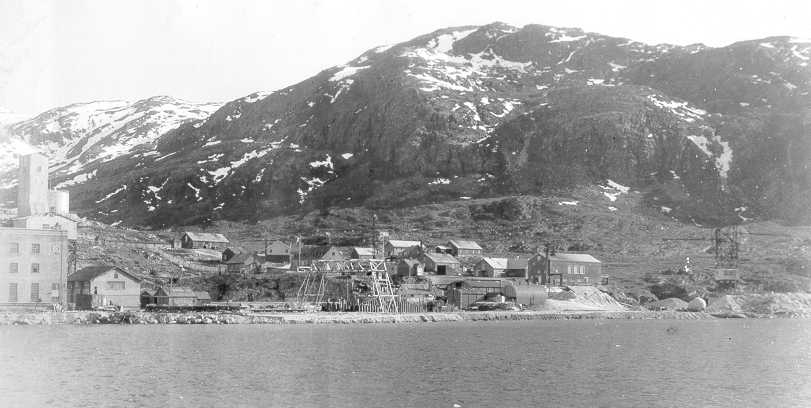
Besides Ivittuut, on the southwest coast of Greenland where cryolite was once found in commercial quantities, small deposits of cryolite have also been reported in some areas of Spain, at the foot of Pikes Peak in Colorado, Francon Quarry near Montreal in Quebec, Canada and also in Miass, Russia.
Uses
Molten cryolite is used as a solvent for aluminium oxide (Al2O3) in the Hall–Héroult process, used in the refining of aluminium. It decreases the melting point of aluminium oxide from 2000–2500 °C to 900–1000 °C, and increases its conductivity thus making the extraction of aluminium more economical.
Cryolite is used as an insecticide and a pesticide. It is also used to give fireworks a yellow color. It is used in glass manufacturing as a "powerful opaliser."
Physical properties

Cryolite occurs as glassy, colorless, white-reddish to gray-black prismatic monoclinic crystals. It has a Mohs hardness of 2.5 to 3 and a specific gravity of about 2.95 to 3.0. It is translucent to transparent with a very low refractive index of about 1.34, which is very close to that of water; thus if immersed in water, cryolite becomes essentially invisible.
References
References
- Warr, L.N.. (2021). "IMA–CNMNC approved mineral symbols". Mineralogical Magazine.
- ''CRC Handbook of Chemistry and Physics'', 83rd Ed., p. 4–84.
- (1997). "Dana's new mineralogy : the system of mineralogy of James Dwight Dana and Edward Salisbury Dana.". Wiley.
- (3 October 2010). "Cryolite: Cryolite mineral information and data".
- "Cryolite Mineral Data".
- "Cryolite".
- (1985). "Manual of mineralogy : (after James D. Dana)". Wiley.
- (15 January 2021). "Eclipse Metals buys unique historical cryolite mine in Greenland".
- Abildgaard. (1799). "Norwegische Titanerze und andre neue Fossilien". Allgemeines Journal der Chemie.
- Abildgaard, P. C.. (1800). "Om Norske Titanertser og om en nye Steenart fra Grönland, som bestaaer af Flusspatsyre og Alunjord". Det Kongelige Danske Videnskabers-Selskabs (The Royal Danish Scientific Society).
- (1903). "The Mineral Collector". Mineral Collector Company.
- (1926). "Engineering and Mining Journal-press". McGraw-Hill Publishing Company.
- Albert Huntington Chester, ''A Dictionary of the Names of Minerals Including Their History and Etymology'' (New York, New York: John Wiley & Sons, 1896), [https://books.google.com/books?id=IiwFAAAAMAAJ&pg=PA68 p. 68.]
- Magazine, Smithsonian. "How This Abandoned Mining Town in Greenland Helped Win World War II".
- Sandré, Tanguy. (3 March 2025). "Cryolite: le Danemark censure son histoire coloniale". Mediapart.
- Kajkus, Ines. (2025-02-10). "Vrede kilder beskylder DR for at manipulere seerne i sprængfarlig dokumentar: »Grebet ud af den blå luft«".
- "Cryolite (Sodium Aluminum Fluoride)".
- "Cryolite {{!}} mineral".
- (11 November 2010). "Properties of Low-Temperature Melting Electrolytes for the Aluminum Electrolysis Process: A Review". Journal of Chemical & Engineering Data.
- (2003). "Handbook of Aluminum: Volume 2: Alloy production and materials manufacturing. vol. 2". Marcel Dekker, Inc..
- (2000). "Efficacy of cryolite against major lepidopteran pests of cauliflower". Plant Protection Bulletin.
- Helmenstine, Anne Marie. "How Firework Colors Work and the Chemicals That Make Vivid Colors".
- (1924). "The Chemical Calculation of Glass Compositions, p. 713 (March, 1925)". "Glass" (Industry Periodical).
This article was imported from Wikipedia and is available under the Creative Commons Attribution-ShareAlike 4.0 License. Content has been adapted to SurfDoc format. Original contributors can be found on the article history page.
Ask Mako anything about Cryolite — get instant answers, deeper analysis, and related topics.
Research with MakoFree with your Surf account
Create a free account to save articles, ask Mako questions, and organize your research.
Sign up freeThis content may have been generated or modified by AI. CloudSurf Software LLC is not responsible for the accuracy, completeness, or reliability of AI-generated content. Always verify important information from primary sources.
Report