From Surf Wiki (app.surf) — the open knowledge base
Crushing (execution)
Execution technique

Execution technique
Death by crushing or pressing is a method of execution that has a history during which the techniques used varied greatly from place to place, generally involving placing heavy weights upon a person with the intent to kill.
Crushing by elephant
Main article: Execution by elephant
A common method of death throughout South and Southeast Asia for over 4,000 years was crushing by elephants. The Sasanians, Romans, and Carthaginians also used this method on occasion.
Ancient Rome
In ancient Roman legend, Tarpeia was a Vestal Virgin who betrayed the city of Rome to the Sabines in exchange for what she thought would be a reward of jewellery. She was instead crushed to death and her body cast from the Tarpeian Rock, which now bears her name.
Crushing in pre-Columbian America
Crushing is also reported from pre-Columbian America, notably in the Aztec Empire.
Crushing under Mongol rule
Due to religious beliefs, it was at times viewed as better to execute prisoners without the shedding of blood. The means with which it could occur would vary.
Crushing under common law
Main article: Peine forte et dure
Peine forte et dure (Law French for "forceful and hard punishment") was a method of torture formerly used in the common law legal system, in which a defendant who refused to plead ("stood mute") would be subjected to having heavier and heavier stones placed upon his or her chest until a plea was entered, or, as the weight of the stones on the chest became too great for the condemned to breathe, fatal suffocation occurred.
The common law courts originally took a very limited view of their own jurisdiction. They considered themselves to lack jurisdiction over a defendant until he had voluntarily submitted to it by entering a plea seeking judgment from the court. Since a criminal justice system that tried and punished only those who volunteered for trial and punishment was practically unworkable, this was the means chosen to coerce them.
Many defendants charged with capital offences nonetheless refused to plead, since thereby they would escape forfeiture of property and their heirs would still inherit their estate; but if defendants pleaded guilty and were executed their heirs would inherit nothing, their property escheating to the Crown. Peine forte et dure was abolished in Great Britain in 1772, and the last known use of the practice was in 1741. In 1772 refusing to plead was deemed to be equivalent to pleading guilty. This was changed in 1827 to being deemed a plea of not guilty. Today in all common-law jurisdictions standing mute is treated by the courts as equivalent to a plea of not guilty.
The elaborate procedure was recorded by a 15th-century witness in an oft-quoted description: "he will lie upon his back, with his head covered and his feet, and one arm will be drawn to one quarter of the house with a cord, and the other arm to another quarter, and in the same manner it will be done with his legs; and let there be laid upon his body iron and stone, as much as he can bear, or more ..."
"Pressing to death" might take several days, and not necessarily with a continued increase in the load. The Frenchman Guy Miege, who from 1668 taught languages in London says the following about the English practice:
The most famous case in the United Kingdom was that of Roman Catholic martyr St Margaret Clitherow, who, in order to avoid a trial in which her own children would be obliged to give evidence, was pressed to death on March 25, 1586, after refusing to plead to the charge of having harboured Catholic priests in her house. She died within fifteen minutes under a weight of at least 700 lb. Several hardened criminals, including William Spigott (1721) and Edward Burnworth, lasted half an hour under 400 lb before pleading to the indictment. Others, such as Major Strangways (1658) and John Weekes (1731), refused to plead, even under 400 lb, and were killed when bystanders, out of mercy, sat on them.
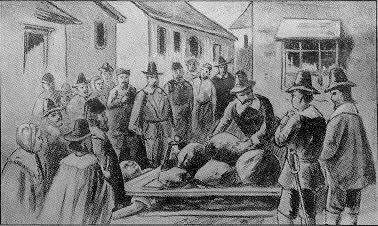
The only death by peine forte et dure in American history was that of Giles Corey, who was pressed to death on September 19, 1692, during the Salem witch trials, after he refused to enter a plea in the judicial proceeding. According to legend, his last words as he was being crushed were "More weight", and he was thought to be dead as the weight was applied.
In popular culture
Peine forte et dure is referred to in Arthur Miller's political drama The Crucible (1953), where Giles Corey is pressed to death after refusing to plead "aye or nay" to the charge of witchcraft. In the 1996 film version of this play, the screenplay also written by Arthur Miller, Corey is crushed to death for refusing to reveal the name of a source of information.
In the 2017 BBC One series Gunpowder the public execution by crushing of the fictional Lady Dorothy Dibdale (based on Margaret Clitherow) is shown in graphic detail.
References
References
- Sanders, H.. (1904). "Roman historical sources and institutions". Macmillan.
- Summerson, Henry (1983). "The Early Development of Peine Forte et Dure."
- ''Law, Litigants, and the Legal Profession: Papers Presented to the Fourth British Legal History Conference at the University of Birmingham 10–13 July 1979'' ed E. W. Ives & A. H. Manchester, 116-125. Royal Historical Society Studies in History Series 36. London: Humanities Press.
- (10 July 2018). "How the Mongols Executed Enemies with No Blood Spilled…".
- (27 November 2022). "Dining with the Mongols — One of the Cruelest Ways to die".
- Sir [[Sir Frederick Pollock, 1st Baronet. Frederick Pollock]] and [[Frederic William Maitland]], ''[[The History of English Law]]'', v. 2, pp. 650–651 (Cambridge; 1968; {{ISBN. 0-521-07062-7)
- See generally, [[William Blackstone]], ''[[Commentaries on the Laws of England]]'' (1769), vol. 4, pp. *319-324
- "Drug Control and Asset Seizures: a review of the history of forfeiture in England and colonial America".
- (11 May 1851). "Tait's Edinburgh Magazine". W. Tait.
- Francoeur, A.. (11 May 2010). "The enterprising and tenacious Guy Miège: four dictionaries from 1677 to 1688".
- Miege, G.:"[https://books.google.com/books?id=b3gZAAAAYAAJ&q=editions:Pu8Sknlj31oC The present state of Great-Britain and Ireland]" London 1715, p.294
- "Mackenzie, The Practise of Peine Forte et Dure in 16th and 17th Century England".
- (31 October 2017). "The bloody truth – why BBC's Gunpowder had to be so violent".
This article was imported from Wikipedia and is available under the Creative Commons Attribution-ShareAlike 4.0 License. Content has been adapted to SurfDoc format. Original contributors can be found on the article history page.
Ask Mako anything about Crushing (execution) — get instant answers, deeper analysis, and related topics.
Research with MakoFree with your Surf account
Create a free account to save articles, ask Mako questions, and organize your research.
Sign up freeThis content may have been generated or modified by AI. CloudSurf Software LLC is not responsible for the accuracy, completeness, or reliability of AI-generated content. Always verify important information from primary sources.
Report