From Surf Wiki (app.surf) — the open knowledge base
Cruciate ligament of atlas
Ligament forming part of theatlanto-axial joint
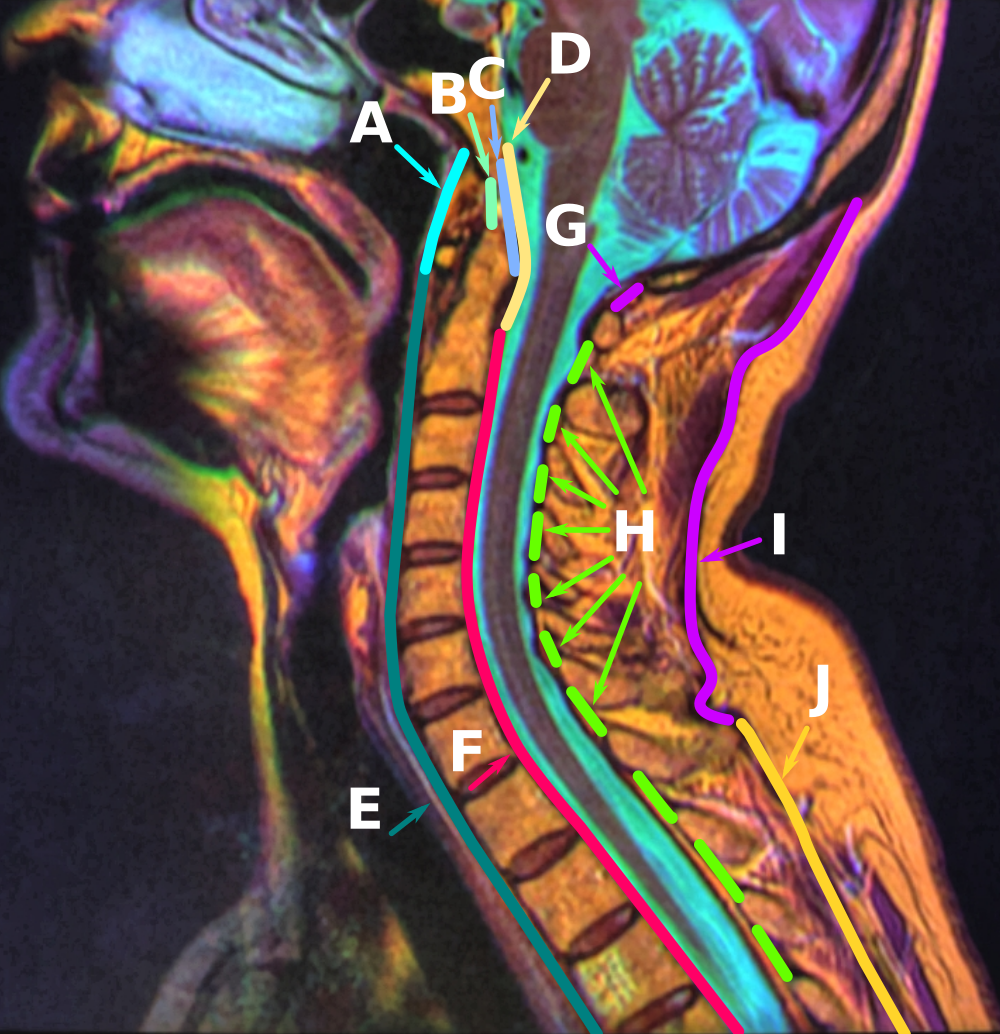
Ligament forming part of theatlanto-axial joint
| Field | Value |
|---|---|
| Name | Cruciate ligament of atlas |
| Latin | ligamentum cruciforme atlantis |
| Image | Gray307.png |
| Caption | Membrana tectoria, transverse, and alar ligaments. ("Transverse ligament" and "vertical portion" visible intersecting at center.) |
| From | medial tubercles of atlas bone (C1), anterior side of foramen magnum of occipital bone of skull, body of axis bone (C2) |
| System | skeletal |
The cruciate ligament of the atlas (cruciform ligament) is a cross-shaped (thus the name) ligament in the neck forming part of the atlanto-axial joint. It consists of the transverse ligament of atlas, a superior longitudinal band, and an inferior longitudinal band.
The cruciate ligament of the atlas prevents abnormal movement of the atlanto-axial joint.
It may be torn, such as by fractures of the atlas bone.
Structure
The cruciate ligament of the atlas consists of the transverse ligament of the atlas, a superior longitudinal band, and an inferior longitudinal band. The superior longitudinal band connects the transverse ligament to the anterior side of the foramen magnum (near the basilar part) in the occipital bone of the skull. The inferior longitudinal band connects the transverse ligament to the body of the axis bone (C2).
Variation
The inferior longitudinal band may be absent in some people; the rest of the ligament is invariably present.
Gerber's ligament
In about half of individuals, an additional band - Gerber's ligament - arises at the junction of the transverse ligament and superior band, and is situated deep to the superior band.
Function
The cruciate ligament of the atlas prevents abnormal movements of the atlanto-axial joint. The longitudinal bands prevent hyperflexion and hyperextension of the occipital bone, and hold the transverse ligament of the atlas in a normal position.
Clinical significance
Any part of the cruciate ligament of the atlas may tear, which is a significant injury. This may be caused by fractures of the atlas bone. Ligament tears may be imaged with radiography, a CT scan, or magnetic resonance imaging.
Ossification
Very rarely, the cruciate ligament of the atlas may ossify. This may lead to cervical myelopathy, that is, damage to the spinal cord.
Etymology
The terms "cruciform" and "cruciate" refer to the cross shape of the ligament. Both terms are frequently used, although the term "cruciate" may be confusing due to confusion with the anterior cruciate ligament and the posterior cruciate ligament of the knee.
References
References
- Cramer, Gregory D.. (2014). "Clinical anatomy of the spine, spinal cord, and ANS". [[Elsevier Health Sciences]], [[Mosby (publisher).
- Federative Committee on Anatomical Terminology. (1998). "Terminologia anatomica: international anatomical terminology". Thieme.
- (2019-01-04). "Clinical Anatomy of the Ligaments of the Craniocervical Junction". [[Cambridge Scholars Publishing]].
- (April 2019). "Gerber's Ligament—A Forgotten Structure of the Craniocervical Junction". World Neurosurgery.
- (2019). "Ossification of the Cruciform Ligament of Atlas; a Rare Cause of Cervical Myelopathy: Case Report and Review of Literature". Asian Journal of Neurosurgery.
This article was imported from Wikipedia and is available under the Creative Commons Attribution-ShareAlike 4.0 License. Content has been adapted to SurfDoc format. Original contributors can be found on the article history page.
Ask Mako anything about Cruciate ligament of atlas — get instant answers, deeper analysis, and related topics.
Research with MakoFree with your Surf account
Create a free account to save articles, ask Mako questions, and organize your research.
Sign up freeThis content may have been generated or modified by AI. CloudSurf Software LLC is not responsible for the accuracy, completeness, or reliability of AI-generated content. Always verify important information from primary sources.
Report