From Surf Wiki (app.surf) — the open knowledge base
Crotyl group
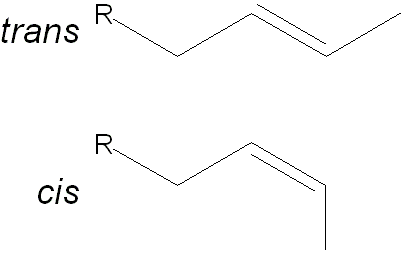
A crotyl group is an organic functional group with the formula . Systematically, it is called a but-2-en-1-yl group and exhibits geometric isomerism, being either cis (Z) or trans (E). There are many simple compounds in which the crotyl group forms base carbon chain: crotyl alcohol, crotonaldehyde, crotonic acid, and crotyl acrylate are examples.
Synthesis of {{chem name|crotylates}}
(crotyl anions) can be synthesised from 2-butene (either isomer): this reaction must be performed in the presence of organometallic reagents, as a base, usually alkyl lithium, or any alkylates of s-block metals, in a solvent, typically THF, and at low temperatures, generally below -20 °C. The negative charge is delocalised over three of the carbon atoms of the group and there is resonance between the two possible delocalised forms (one for each terminal carbon).
Crotylation reactions
Crotylation readily occurs with alkoxy boronates to form .
are useful reagents in the formation of crotyl alcohols. They react with the acidic protons of aldehydes to form alcohols. The mechanism involves a six-membered ring involving the carbonyl oxygen and boron in a chair-like structure. Such reactions are highly diastereoselective.
References
References
- {{Cite Merriam-Webster. crotyl
This article was imported from Wikipedia and is available under the Creative Commons Attribution-ShareAlike 4.0 License. Content has been adapted to SurfDoc format. Original contributors can be found on the article history page.
Ask Mako anything about Crotyl group — get instant answers, deeper analysis, and related topics.
Research with MakoFree with your Surf account
Create a free account to save articles, ask Mako questions, and organize your research.
Sign up freeThis content may have been generated or modified by AI. CloudSurf Software LLC is not responsible for the accuracy, completeness, or reliability of AI-generated content. Always verify important information from primary sources.
Report