From Surf Wiki (app.surf) — the open knowledge base
Crotonaldehyde
Crotonic aldehyde β-Methacrolein β-Methyl acrolein 2-butenal Propylene aldehyde soluble in chloroform miscible in benzene |NFPA-H = 4 |NFPA-F = 3 |NFPA-R = 2 |NFPA-S = - 1375 ppm (rat, 30 min) 519 ppm (mouse, 2 hr) 1500 ppm (rat, 30 min)
cis-3-hexenal
(E,E)-2,4-Decadienal
Crotonaldehyde is a chemical compound with the formula CH3CH=CHCHO. The compound is usually sold as a mixture of the E- and Z-isomers, which differ with respect to the relative position of the methyl and formyl groups. The E-isomer is more common. This lachrymatory liquid is moderately soluble in water and miscible in organic solvents. As an unsaturated aldehyde, crotonaldehyde is a versatile intermediate in organic synthesis. It occurs in a variety of foodstuffs, e.g. soybean oils.
Production and reactivity
Crotonaldehyde is produced by the aldol condensation of acetaldehyde: :2 CH3CHO → CH3CH=CHCHO + H2O
Crotonaldehyde is a multifunctional molecule that exhibits diverse reactivity. It is a prochiral dienophile. It is a Michael acceptor. Addition of methylmagnesium chloride produces 3-penten-2-ol.
Uses
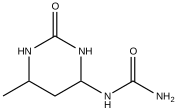
It is a precursor to many fine chemicals. A prominent industrial example is the crossed aldol condensation with diethyl ketone to give trimethylcyclohexenone, this can be easily converted to trimethylhydroquinone, which is a precursor to the vitamin E. Other derivatives include crotonic acid, 3-methoxybutanol and the food preservative Sorbic acid. Condensation with two equivalents of urea gives a pyrimidine derivative that is employed as a controlled-release fertilizer.
Safety
Crotonaldehyde is a potent irritant even at the ppm levels. It is not very toxic, with an of 174 mg/kg (rats, oral).
References
References
- ''[[Merck Index]]'', 11th Edition, '''2599'''
- {{PGCH. 0157
- {{IDLH. 123739. Crotonaldehyde
- R. P. Schulz. (2005). "Crotonaldehyde and Crotonic Acid".
- Longley Jr., R. I... (1954). "3,4-Dihydro-2-methoxy-4-methyl-2H-pyran". Org. Synth..
- Coburn, E. R.. (1947). "3-Penten-2-ol". Org. Synth..
- (2009). "Fertilizers, 2. Types".
- (6 December 2022). "100 Years of Vitamin E: From Discovery to Commercialization". European Journal of Organic Chemistry.
This article was imported from Wikipedia and is available under the Creative Commons Attribution-ShareAlike 4.0 License. Content has been adapted to SurfDoc format. Original contributors can be found on the article history page.
Ask Mako anything about Crotonaldehyde — get instant answers, deeper analysis, and related topics.
Research with MakoFree with your Surf account
Create a free account to save articles, ask Mako questions, and organize your research.
Sign up freeThis content may have been generated or modified by AI. CloudSurf Software LLC is not responsible for the accuracy, completeness, or reliability of AI-generated content. Always verify important information from primary sources.
Report