From Surf Wiki (app.surf) — the open knowledge base
Crotalus
Genus of snakes
Genus of snakes
|Crotalus Linnaeus, 1758 |Crotalophorus Houttuyn, 1764 |Caudisona Laurenti, 1768 |Crotalinus Rafinesque, 1815 |Crotalurus Rafinesque, 1820 |Crotulurus Rafinesque, 1820 |Uropsophus Wagler, 1830 |Urocrotalon Fitzinger, 1843 |Aploaspis Cope, 1867 |Aechmophrys Coues In Wheeler, 1875 |Haploaspis Cope, 1883 |Paracrotalus Reuss, 1930
Crotalus is a genus of pit vipers, commonly known as rattlesnakes or rattlers, in the family Viperidae. The genus is found only in the Americas from southern Canada to northern Argentina. The generic name Crotalus is derived from the Greek word κρόταλον krótalοn, which means "rattle" or "castanet", and refers to the rattle on the end of the tail, which makes this group (genera Crotalus and Sistrurus) so distinctive. As of July 2023, 44 to 53 species are recognized as valid.
Description
Members of the genus Crotalus range in size from only 50–70 cm (C. intermedius, C. pricei), to over 150 cm (eastern and western diamondback rattlesnakes). In general, adult males are slightly larger than females. Compared to most snakes, they are heavy-bodied, although some African vipers are much thicker. Most forms are easily recognized by the characteristic rattle on the end of their tails, although a few island populations form exceptions to this rule: C. catalinensis has lost its rattle entirely, Crotalus lorenzoensis usually has no rattle, and both Crotalus ruber lucasensis and Crotalus estebanensis exhibit a tendency for rattle loss. The rattle may also be lacking in any species due to a congenital abnormality.
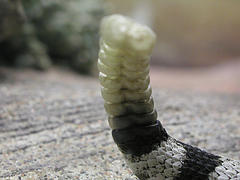
The rattle consists of a series of loosely interlocking hollow shells, each of which was at one point the scale covering the tip of the tail. In most other snakes, the tail tip, or terminal spine, is cone-shaped, hardly any thicker than the rest of the skin, and is shed along with it at each successive molt. In this case, the end scale, or "button", is much thicker and shaped like a bulb, with one or two annular constrictions to prevent it from falling off. Before each molt, a new button will have developed inside the last one and before the skin is shed off its body, the tip of the new button shrinks, then loosening the shell of the previous one. This process continues so the succession of molts produces an appendage consisting of a number of interlocking segments that make an audible noise when vibrated. Since younger specimens may shed several times in a year at a frequency that depends on their environment and how much they eat, every time adding a new segment to the rattle, the number of segments is a function of more than solely the age of the snake. In theory, the rattle could become very long indeed, but in practice, the older segments tend to wear out and fall off. How quickly this happens depends on the snake's environment, but end segments tend to break off after the rattle becomes about six or seven segments long; nonetheless, finding specimens with as many as a dozen segments is not uncommonand in captive specimens, as many as 29 segments have been documented.
Distribution and habitat
The genus Crotalus is found in the Americas from southern Canada to central Argentina.
Behavior
No species of Crotalus is considered aggressive; when threatened, most retreat quickly, but most species defend themselves readily when cornered.
There is no consensus in the available literature about how far rattlesnakes can strike, with estimates ranging from one-third to the entire body length of the rattlesnake. Strike distance depends not just on the snake's size, but also on many other factors, including its species, the position of its body, and its degree of agitation. This is compounded by a further lack of consensus as to the location on the anchor coil of the snake from where a strike should be measured. They rarely strike further than half of their body length, and almost never more than three-fourths, but trusting such values is unwise if only because it is not feasible to accurately judge the length of a coiled snake.
Feeding
The diets of species of Crotalus generally consist of vertebrates, although many invertebrate species are also consumed. Smaller species feed mainly on lizards, while larger species start by feeding on lizards as juveniles and then switch to preying mainly on mammals as adults. Prey items more frequently taken include rabbits, ground squirrels such as prairie dogs, tree squirrels, chipmunks, gophers, and rats and mice, while those less frequently taken include birds, snakes, and amphibians. Cannibalism has been reported in a number of different species. Individuals that feed on rodents usually release their prey after a strike to avoid their teeth, and these snakes evidently can discriminate between trails left by prey that has or has not been envenomated.
Predators
For all species of Crotalus, the most significant threats come from people, but they also face many natural enemies. These include other snakes, such as kingsnakes (Lampropeltis), coachwhips (Masticophis), indigo snakes (Drymarchon), and racers (Coluber); birds, such as hawks, eagles, owls, roadrunners, and ravens; and mammals, such as cats, coyotes, foxes, wildcats, badgers, skunks, and pigs. Certain species of birds frequently prey on these snakes, but this is not without risk. Two cases were reported in which dead hawks found near venomous snakes had suffered hemorrhage and gangrenous necrosis due to snakebite.
Reproduction
The genus Crotalus is ovoviviparous, giving birth to live young. The basic lifecycle of many Nearctic species has been known for quite some time. Females at an age of 26 months undergo vitellogenesis as they enter their third hibernation, mate the following spring, and give birth later in September or October.
Several variations to this basic cycle occur. In North America, the females of some species store sperm in their oviducts for at least eight months, and the males (all species of which undergo spermatogenesis during the summer) store sperm in the vas deferens for at least a year. Thus, species that store sperm for a shorter duration mate in the spring and store sperm in the vas deferens, while those that do so for a longer duration mate in the fall and store sperm in the oviduct over the winter, after which fertilization occurs the following spring. In addition, species that occur further north, where weather is colder during much of the year and the feeding and growing season is short, may reproduce only every other year or less. Those found in central and southern Mexico or the tropics have reproductive cycles that correspond mostly with the rainy season.
Venom
Two main hemotoxic effects are caused by rattlesnake venom. First, zinc-containing metalloproteases act upon capillary endothelial cells to inhibit platelet aggregation and hemorrhage. Second, the platelet antagonist crotalin creates a severe bleeding effect as it binds to the surface proteins, blocking aggregation.
Neurotoxic effects may also be caused by rattlesnake venom. These effects vary by species, and within species by population.
Species
| Image | Species | Taxon author | Subsp.* | Common name | Geographic range | |
|---|---|---|---|---|---|---|
| [[File:Crotalus adamanteus 25.jpg | 190px]] | C. adamanteus | Palisot de Beauvois, 1799 | 0 | Eastern diamondback rattlesnake | The southeastern United States from southeastern North Carolina, south along the coastal plain through peninsular Florida to the Florida Keys, and west along the Gulf Coast through southern Mississippi to southeastern Louisiana |
| C. angelensis | Klauber, 1963 | 0 | Angel de la Guarda Island speckled rattlesnake | Isla Ángel de la Guarda in the Gulf of California, Mexico | ||
| [[File:Crotalus aquilus.jpg | 190px]] | C. aquilus | Klauber, 1952 | 0 | Querétaro dusky rattlesnake | The highlands of central Mexico: Guanajuato, Hidalgo State of Mexico, Michoacán, and San Luis Potosí |
| [[File:Crotalus armstrongi in Morelia zoo.jpg | 251x251px]] | C. armstrongi | Campbell, 1979 | 0 | Western dusky rattlesnake | Mexico: Jalisco and Nayarit |
| [[File:Crotalus atrox USFWS.jpg | 190px]] | C. atrox | Baird & Girard, 1853 | 0 | Western diamondback rattlesnake | The Southwestern United States from central Arkansas and southeastern California, south into Mexico as far as northern Sinaloa, Hidalgo, and northern Veracruz, disjunct populations in southern Veracruz and southeastern Oaxaca |
| [[File:Crotalus basiliscus.jpg | 190px]] | C. basiliscus | (Cope, 1864) | 0 | Mexican west coast rattlesnake | Western Mexico from southern Sonora to Michoacán |
| C. campbelli | Bryson, Linkem, Dorcas, Lathrop, Jones, Alvarado-Diaz, Grünwald & Murphy, 2014 | 0 | Campbell's rattlesnake | Mexico: western Jalisco, northwestern Colima | ||
| [[File:Gfp-santa-cataline-island-rattlesnake.jpg | 190px]] | C. catalinensis | Cliff, 1954 | 0 | Santa Catalina rattlesnake | Isla Santa Catalina in the Gulf of California (western Mexico) |
| [[File:Crotalus cerastes mesquite springs CA-2.jpg | 190px]] | C. cerastes | Hallowell, 1854 | 3 | Sidewinder, | The southwestern United States in the desert region of eastern California, southern Nevada, extreme southwestern Utah, and western Arizona, northwestern Mexico in western Sonora and eastern Baja California |
| [[File:Arizona Black Rattlesnake.jpg | 190px]] | C. cerberus | (Coues, 1875) | 0 | Arizona black rattlesnake | Central Arizona to western New Mexico |
| [[File:Crotalus oreganus concolor 01.jpg | 190px]] | C. concolor | (Woodbury, 1929) | 0 | Midget faded rattlesnake | basins of the Colorado and Green Rivers in the United States |
| [[File:Gfp-northwestern-neotropical-rattlesnake.jpg | 190px]] | C. culminatus | Klauber, 1952 | 0 | Northwestern neotropical rattlesnake | Mexico in southwestern Michoacán, southern and western Morelos, Guerrero, and southwestern Oaxaca, probably in extreme western Puebla and possibly in the Mexican Federal District |
| [[File:Cascabelle.JPG | 190px]] | C. durissus | Linnaeus, 1758 | 7 | South American rattlesnake | All South American countries except Chile and Ecuador (although the various populations are disjunct), some islands in the Caribbean |
| C. ehecatl | Carbajal-Marquez, Cedeno-Vazquez, Martinez-Arce, Neri-Castro, & Machkour-M'rabet, 2020 | 0 | Tehuantepec Isthmus Neotropical rattlesnake | Mexico: (Chiapas, Oaxaca) | ||
| [[File:Crotalus enyo.JPG | 190px]] | C. enyo | (Cope, 1861) | 2 | Baja California rattlesnake | Western Mexico on the Baja California Peninsula from around Río San Telmo on the west coast and from opposite Isla Ángel de la Guarda on the Gulf Coast, south to Cabo San Lucas, on the following islands in the Gulf of California: San Marcos, Carmen, San José, San Francisco, Partida del Sur, Espírita Santo, and Cerralvo, off the Pacific coast on Isla Santa Margarita |
| C. ericsmithi | Campbell & Flores-Villela, 2008 | 0 | Guerreran long-tailed rattlesnake | Western Mexico: Guerrero | ||
| C. estebanensis | Klauber, 1949 | 0 | San Esteban Island rattlesnake | Mexico: Isla San Esteban (Gulf of California) | ||
| [[File:Crotalus viridis helleri.jpg | 190px]] | C. helleri | (Meek, 1905) | 0 | Southern Pacific rattlesnake | SW California, Baja California, Mexico |
| [[File:ZollmanTimberRattlesnake.jpg | 190px]] | C. horridusT | Linnaeus, 1758 | 0 | Timber rattlesnake | The eastern United States from southern Minnesota and southern Maine, south to east Texas and north Florida, in southern Canada in southern Ontario |
| [[File:Mexican Smallhead Rattlesnake imported from iNaturalist photo 46759429 on 5 February 2022.png | 190px]] | C. intermedius | Troschel, 1865 | 2 | Mexican small-headed rattlesnake | Central and southern Mexico, in southeastern Hidalgo, southern Tlaxcala, northeastern and south-central Puebla, west-central Veracruz, Oaxaca and Guerrero |
| C. lannomi | W. Tanner, 1966 | 0 | Autlán rattlesnake | Western Mexico in Jalisco | ||
| [[File:Crotalus lepidus lepidus 1.jpg | 190px]] | C. lepidus | (Kennicott, 1861) | 2 | Rock rattlesnake | The southwestern United States in Arizona, southern New Mexico, and southwestern Texas, south into north-central Mexico |
| C. lorenzoensis | Radcliffe & Maslin, 1975 | 0 | San Lorenzo Island red diamond rattlesnake | Mexico, San Lorenzo Island in the Gulf of California | ||
| [[File:Rattlesnake (Marshal Hedin).jpg | 190px]] | C. lutosus | (Klauber, 1930) | 0 | Great Basin rattlesnake | Great Basin between the Rocky Mountains and the Sierra Nevada |
| C. mictlantecuhtli | Carbajal-Marquez, Cedeno-Vazquez, Martinez-Arce, Neri-Castro, & Machkour-M'rabet, 2020 | 0 | Veracruz Neotropical rattlesnake | Mexico: (Veracruz) | ||
| [[File:Speckled Rattlesnake (Crotalus mitchellii) (21705787199).jpg | 190px]] | C. mitchellii | (Cope, 1861) | 1 | Speckled rattlesnake | Mexico: most of Baja California Sur and on a number of islands in the Gulf of California and on Isla Santa Margarita off the Pacific coast of Baja California Sur |
| [[File:Northern black-tailed rattlesnake.jpg | 190px]] | C. molossus | Baird & Girard, 1853 | 3 | Black-tailed rattlesnake | The southwestern United States (Arizona, south-western New Mexico), and Mexico from Sonora and western Chihuahua as far south as Oaxaca, in the Gulf of California on San Esteban Island and Tiburón Island |
| [[File:Crotalus morulus, Tamaulipan Rock Rattlesnake, Tamailipas.jpg | 190px]] | C. morulus | Klauber, 1952 | 0 | Tamaulipan rock rattlesnake | Mexico (Sierra Madre Oriental: Tamaulipas, Nuevo León, Coahuila) |
| [[File:Crotalus oreganus.jpg | 190px]] | C. oreganus | Holbrook, 1840 | 0 | Western rattlesnake | Southwestern Canada (southern British Columbia), south through the northwestern half of the United States (Washington, Oregon, western and southern Idaho, California |
| [[File:Crotalus ornatus 158434960.jpg | 190px]] | C. ornatus | Hallowell, 1854 | 0 | Eastern black-tailed rattlesnake | The southwestern United States (New Mexico, western and central Texas) and north-eastern Mexico (Chihuahua, Coahuila) |
| C. polisi | Meik, Schaack, FloreS-Villela, & Streicher, 2018 | 0 | Horsehead Island speckled rattlesnake | Cabeza de Caballo Island, Baja California, Mexico | ||
| [[File:Crotalus Polystictus.jpg | 190px]] | C. polystictus | (Cope, 1865) | 0 | Mexican lance-headed rattlesnake | Central Mexican Plateau, from southern Zacatecas and northeastern Colima east to east-central Veracruz |
| [[File:Crotalus pricei.jpg | 190px]] | C. pricei | Van Denburgh, 1895 | 1 | Twin-spotted rattlesnake | In the US from southeastern Arizona, and Mexico in northern Sonora southeast through Chihuahua, Durango, southeastern Coahuila, and Nuevo León into Tamaulipas |
| [[File:Crotalus pusillus 72647737.jpg | 190px]] | C. pusillus | Klauber, 1952 | 0 | Tancitaran dusky rattlesnake | West-central Mexico in southwestern and west-central Michoacán and adjacent Jalisco, probably also in northeastern Colima |
| [[File:Crotalus-mitchellii.jpg | 190px]] | C. pyrrhus | Cope, 1867 | 0 | Southwestern speckled rattlesnake | Southwestern United States (western Arizona, southern California, southern Nevada, extreme south-western Utah) and northwestern Mexico (Baja California del Norte, northwestern Sonora) |
| [[File:Crotalus ravus cropped2.jpg | 190px]] | C. ravus | (Cope, 1865) | 3 | Mexican pygmy rattlesnake | The mountains of central and southern Mexico, west of the Isthmus of Tehuantepec, in the southeastern part of the Mexican Plateau, in the highlands of Morelos, Tlaxcala, Puebla, Veracruz, Oaxaca, and the Sierra Madre del Sur in Guerrero |
| [[File:Crotalus ruber 02.jpg | 190px]] | C. ruber | Cope, 1892 | 2 | Red diamond rattlesnake | The US in southwestern California, south through the Baja California Peninsula, except in the desert east of the Sierra de Juárez, also on a number of islands in the Gulf of California and three islands off the west coast of Baja California Sur |
| [[File:Crotalus scutulatus 02.JPG | 190px]] | C. scutulatus | (Kennicott, 1861) | 1 | Mojave rattlesnake | The southwestern US in southern California, southern Nevada, extreme southwestern Utah, most of Arizona, southern New Mexico, and West Texas, and south into Mexico to southern Puebla |
| [[File:Yucatan Neotropical Rattlesnake 045.jpg | 190px]] | C. simus | Latreille In Sonnini & Latreille, 1801 | 0 | Middle American rattlesnake | From Mexico in southwestern Michoacán on the Pacific coast, and Veracruz and the Yucatán Peninsula on the Atlantic coast, south through Belize, Guatemala, El Salvador, Honduras, and Nicaragua to west-central Costa Rica |
| C. stejnegeri | Dunn, 1919 | 0 | Long-tailed rattlesnake | Western Mexico in eastern Sinaloa, western Durango, and probably northern Nayarit | ||
| [[File:Crotalus stephensi.JPG | 190px]] | C. stephensi | Klauber, 1930 | 0 | Panamint rattlesnake | United States: eastern California, southwestern Nevada |
| C. tancitarensis | Alvarado-Diaz & Campbell, 2004 | 0 | Tancitaro rattlesnake | Mexico: Michoacán | ||
| C. thalassoporus | Meik, Schaack, FloreS-Villela, & Streicher, 2018 | 0 | Louse Island speckled rattlesnake | Piojo Island, Baja California, Mexico | ||
| [[File:Tiger Rattlesnake 001.jpg | 190px]] | C. tigris | Kennicott in Baird, 1859 | 0 | Tiger rattlesnake | The southwestern US in south-central Arizona, and in northwestern Mexico in Sonora, on Isla Tiburón in the Gulf of California |
| C. tlaloci | Bryson, Linkem, Dorcas, Lathrop, Jones, Alvarado-Diaz, Grünwald & Murphy, 2014 | 0 | Mexico: Michoacan and Guerrero | |||
| [[File:Crotalus totonacus, Totonacan Rattlesnake, Tamaulipas.jpg | 190px]] | C. totonacus | Gloyd & Kauffeld, 1940 | 0 | Totonacan rattlesnake | Northeastern Mexico from central Nuevo León through southern Tamaulipas, northern Veracruz, eastern San Luis Potosí, and northern Querétaro. |
| [[File:Gfp-cross-banded-rattlesnake.jpg | 190px]] | C. transversus | Taylor, 1944 | 0 | Cross-banded mountain rattlesnake | Central Mexico in the State of Mexico and Morelos. |
| [[File:Crotalus triseriatus in Morelia zoo.jpg | 190px]] | C. triseriatus | (Wagler, 1830) | 1 | Mexican dusky rattlesnake | Mexico, along the southern edge of the Mexican Plateau in the highlands of the Transverse Volcanic Cordillera, including the states of Nayarit, Jalisco, Michoacán, Morelos, México, Puebla, Tlaxcala, and Veracruz |
| [[File:Crotalus-simus-tzabcan.jpg | 190px]] | C. tzabcan | Klauber, 1952 | 0 | Yucatán neotropical rattlesnake | Mexico (Yucatán, Campeche, Quintana Roo, and eastern Tabasco), northern Guatemala and northern Belize |
| [[File:Crotalus unicolor.jpg | 190px]] | C. unicolor | Klauber, 1936 | 0 | Aruba rattlesnake | Aruba |
| [[File:Crotale venezuela 19.JPG | 190px]] | C. vegrandis | Klauber, 1941 | 0 | Uracoan rattlesnake | Eastern Venezuela |
| [[File:Crotalus viridis 02.jpg | 190px]] | C. viridis | (Rafinesque, 1818) | 3 | Prairie rattlesnake | Southern Canada (Alberta, Saskatchewan), south through the US (eastern Idaho, Montana, North Dakota, South Dakota, Wyoming, Nebraska, Colorado, Kansas, Oklahoma, Texas, New Mexico, extreme eastern Arizona), and into northern Mexico (northern Coahuila, northwestern Chihuahua) |
| [[File:Arizona ridgenosed rattlesnake closeup.jpg | 190px]] | C. willardi | Meek, 1905 | 5 | Ridge-nosed rattlesnake | The US in southeastern Arizona and southwestern New Mexico, and northwestern Mexico in Sonora, Chihuahua, Durango, and Zacatecas |
***) Not including the nominate subspecies
T) Type species
References
References
- [[:fr:Roy Wallace McDiarmid. McDiarmid RW]], [[Jonathan A. Campbell. Campbell JA]], [[species:T'Shaka A. Touré. Touré TA]] (1999). ''Snake Species of the World: A Taxonomic and Geographic Reference, Volume 1''. Washington, District of Columbia: Herpetologists' League. 511 pp. {{ISBN. 1-893777-00-6 (series). {{ISBN. 1-893777-01-4 (volume).
- [[Albert Hazen Wright. Wright AH]], [[species:Anna Allen Wright. Wright AA]] (1957). ''Handbook of Snakes of the United States and Canada''. Ithaca and London: Comstock Publishing Associates (7th printing, 1985). 1,105 pp. (in 2 volumes). {{ISBN. 0-8014-0463-0.
- [[Jonathan A. Campbell. Campbell JA]], [[species:William W. Lamar. Lamar WW]] (2004). ''The Venomous Reptiles of the Western Hemisphere''. Ithaca and London: Comstock Publishing Associates. 870 pp. 1,500 plates. {{ISBN. 0-8014-4141-2.
- {{ITIS
- {{EMBL genus
- [[Laurence Monroe Klauber. Klauber LM]] (1997). ''Rattlesnakes: Their Habitats, Life Histories, and Influence on Mankind. Second Edition''. (First published in 1956, 1972). Berkeley: University of California Press. {{ISBN. 0-520-21056-5.
- [[Hampton Wildman Parker. Parker HW]], [[species:Alice Georgie Cruicksnank Grandison. Grandison AGC]] (1977). ''Snakes — a natural history. Second Edition''. London and Ithaca: British Museum (Natural History) and Cornell University Press. 108 pp. 16 plates. LCCCN 76-54625. {{ISBN. 0-8014-1095-9 (cloth), {{ISBN. 0-8014-9164-9 (paper).
- [[species:John Stidworthy. Stidworthy J]] (1974). ''Snakes of the World''. New York: Grosset & Dunlap Inc. 160 pp. {{ISBN. 0-448-11856-4.
- (2010). "Conservation status assessment of the amphibians and reptiles of Uruguay". Iheringia. Série Zoologia.
- (2013). "Is the population of ''Crotalus durissus'' (Serpentes, Viperidae) expanding in Brazil?". Journal of Venomous Animals and Toxins Including Tropical Diseases.
- Klauber, 1936, 1971, 1972.
- Keegan, 1944; Klauber, 1927, 1936, 1971, 1972.
- Klauber, 1936.
- (1998). "Antithormbotic Effect of Crotalin, a Platelet Membrane Glycoprotein Ib Antagonist From Venom of ''Crotalus atrox''". Blood.
- (1999). "Snake Venom Hemorrhagins". Critical Reviews in Toxicology.
- (1985). "Rattlesnake presynaptic neurotoxins: primary structures and evolutionary origin of the acidic subunit". Biochemistry.
- (2018-03-23). "Phenotypic Variation in Mojave Rattlesnake (Crotalus scutulatus) Venom Is Driven by Four Toxin Families". Toxins.
- (2019-03-13). "When one phenotype is not enough: divergent evolutionary trajectories govern venom variation in a widespread rattlesnake species". Proceedings of the Royal Society B: Biological Sciences.
- (2021-11-05). "Varying Intensities of Introgression Obscure Incipient Venom-Associated Speciation in the Timber Rattlesnake (Crotalus horridus)". Toxins.
- [[species:Manuel Acevedo. Acevedo M]], [[species:Jerry D. Johnson. Johnson J]], [[species:Daniel Ariano-Sánchez. Ariano-Sánchez D]] (2014). "''Crotalus tzabcan'' ". The [[IUCN]] Red List of Threatened Species 2014: e.T197478A2488339. https://dx.doi.org/10.2305/IUCN.UK.2014-1.RLTS.T197478A2488339.en. Downloaded on 30 April 2021.
This article was imported from Wikipedia and is available under the Creative Commons Attribution-ShareAlike 4.0 License. Content has been adapted to SurfDoc format. Original contributors can be found on the article history page.
Ask Mako anything about Crotalus — get instant answers, deeper analysis, and related topics.
Research with MakoFree with your Surf account
Create a free account to save articles, ask Mako questions, and organize your research.
Sign up freeThis content may have been generated or modified by AI. CloudSurf Software LLC is not responsible for the accuracy, completeness, or reliability of AI-generated content. Always verify important information from primary sources.
Report