From Surf Wiki (app.surf) — the open knowledge base
Cross-coupling reaction
Chemical reaction in which two molecules are joined due to a metal catalyst

Chemical reaction in which two molecules are joined due to a metal catalyst
In organic chemistry, a cross-coupling reaction is a reaction where two different fragments are joined. Cross-couplings are a subset of the more general coupling reactions. Often cross-coupling reactions require metal catalysts. One important reaction type is this: :R-M + R'X - R-R' + MX
These reactions are used to form carbon–carbon bonds but also carbon-heteroatom bonds. Cross-coupling reaction are a subset of coupling reactions.
Richard F. Heck, Ei-ichi Negishi, and Akira Suzuki were awarded the 2010 Nobel Prize in Chemistry for developing palladium-catalyzed coupling reactions.
Mechanism
Many mechanisms exist reflecting the myriad types of cross-couplings, including those that do not require metal catalysts. Often, however, cross-coupling refers to a metal-catalyzed reaction of a nucleophilic partner with an electrophilic partner.
In such cases, the mechanism generally involves reductive elimination of R-R' from LnMR(R') (L = spectator ligand). This intermediate LnMR(R') is formed in a two-step process from a low valence precursor LnM. The oxidative addition of an organic halide (RX) to LnM gives LnMR(X). Subsequently, the second partner undergoes transmetallation with a source of R'−. The final step is reductive elimination of the two coupling fragments to regenerate the catalyst and give the organic product. Unsaturated substrates, such as C(sp)−X and C(sp2)−X bonds, couple more easily, in part because they add readily to the catalyst.
Catalysts
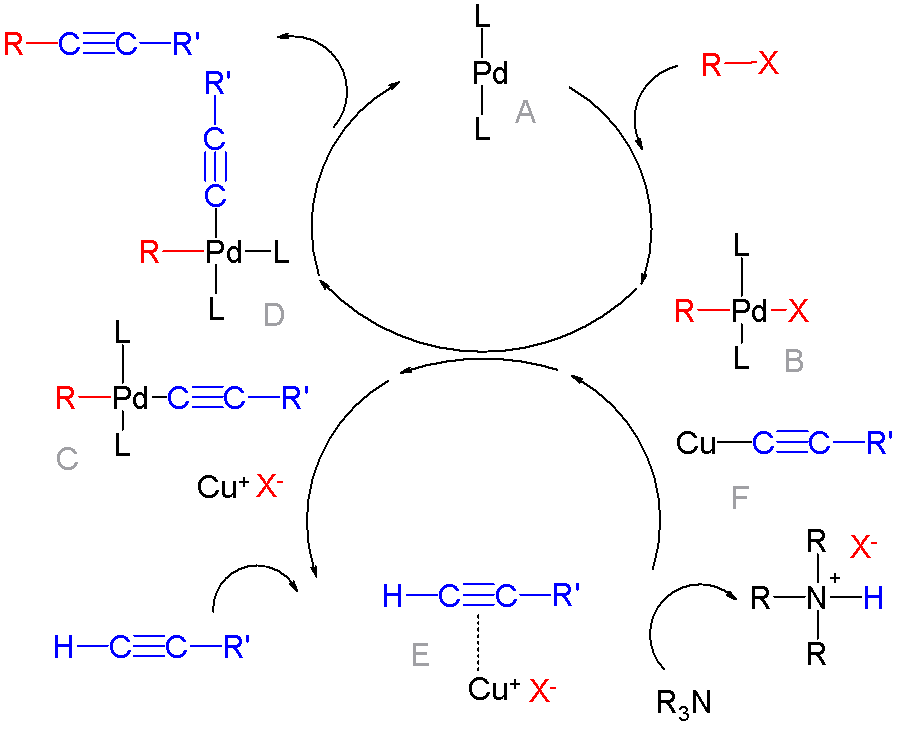
Catalysts are often based on palladium, which is frequently selected due to high functional group tolerance. Organopalladium compounds are generally stable towards water and air. Palladium catalysts can be problematic for the pharmaceutical industry, which faces extensive regulation regarding heavy metals. Many pharmaceutical chemists attempt to use coupling reactions early in production to minimize metal traces in the product. Heterogeneous catalysts based on Pd are also well-developed.
Copper-based catalysts are also common, especially for coupling involving heteroatom-C bonds.
Iron-, cobalt-, and nickel-based catalysts have been investigated.
Leaving groups
The leaving group X in the organic partner is usually a halide, although triflate, tosylate, pivalate esters, and other pseudohalides have been used. Chloride is an ideal group due to the low cost of organochlorine compounds. Frequently, however, C–Cl bonds are too inert, and bromide or iodide leaving groups are required for acceptable rates. The main group metal in the organometallic partner is usually an electropositive element such as tin, zinc, silicon, or boron.
Carbon–carbon cross-coupling
Many cross-couplings entail forming carbon–carbon bonds.
| Reaction | Year | Reactant A | Reactant B | Catalyst | Remark | |||
|---|---|---|---|---|---|---|---|---|
| Cadiot–Chodkiewicz coupling | 1957 | RC≡CH | ||||||
| Castro–Stephens coupling | 1963 | RC≡CH | ||||||
| Corey–House synthesis | 1967 | R2CuLi or RMgX | ||||||
| Kumada coupling | 1972 | RMgBr | ||||||
| Heck reaction | 1972 | alkene | ||||||
| Sonogashira coupling | 1975 | ArC≡CH | ||||||
| Negishi coupling | 1977 | R-Zn-X | ||||||
| Stille cross coupling | 1978 | R-SnR3 | ||||||
| Suzuki reaction | 1979 | R-B(OR)2 | ||||||
| Murahashi coupling | 1979 | R-Li | ||||||
| Hiyama coupling | 1988 | R-SiR3 | ||||||
| Fukuyama coupling | 1998 | R-Zn-I | ||||||
| Liebeskind–Srogl coupling | 2000 | R-B(OR)2 | ||||||
| Cross dehydrogenative coupling | 2004 | R-H | ||||||
| Decarboxylative cross-coupling | 2000s | R-CO2H |
The restrictions on carbon atom geometry mainly inhibit β-hydride elimination when complexed to the catalyst.
Carbon–heteroatom coupling
Many cross-couplings entail forming carbon–heteroatom bonds (heteroatom = S, N, O). A popular method is the Buchwald–Hartwig reaction:
| Reaction | Year | Reactant A | Reactant B | Catalyst | Remark | |||
|---|---|---|---|---|---|---|---|---|
| Ullmann-type reaction | 1905 | ArO-MM, ArNH2,RS-M,NC-M | ||||||
| Buchwald–Hartwig reaction | 1994 | R2N-H | ||||||
| Chan–Lam coupling | 1998 | Ar-B(OR)2 |
Miscellaneous reactions
Palladium-catalyzes the cross-coupling of aryl halides with fluorinated arene. The process is unusual in that it involves C–H functionalisation at an electron deficient arene.
Applications
Cross-coupling reactions are important for the production of pharmaceuticals, with Suzuki coupling being most widely used. Some polymers and monomers are also prepared in this way.
Reviews
References
References
- (2019). "Cross-Coupling of Heteroatomic Electrophiles". Chemical Reviews.
- (2006). "Selected Patented Cross-Coupling Reaction Technologies". Chemical Reviews.
- ''Organic Synthesis using Transition Metals'' Rod Bates {{ISBN. 978-1-84127-107-1
- ''New Trends in Cross-Coupling: Theory and Applications'' Thomas Colacot (Editor) 2014 {{ISBN. 978-1-84973-896-5
- King, A. O.. (2004). "Organometallics in Process Chemistry". Springer.
- (2010-10-06). "The Nobel Prize in Chemistry 2010 - Richard F. Heck, Ei-ichi Negishi, Akira Suzuki". NobelPrize.org.
- (2012). "Palladium-Catalyzed Cross-Coupling: A Historical Contextual Perspective to the 2010 Nobel Prize". Angewandte Chemie International Edition.
- (2014). "Transition-Metal-Free Coupling Reactions". Chemical Reviews.
- Thayer, Ann. (2005-09-05). "Removing Impurities". Chemical & Engineering News.
- Yin, L.. (2007). "Carbon−Carbon Coupling Reactions Catalyzed by Heterogeneous Palladium Catalysts". Chemical Reviews.
- (2006). "Selected Patented Cross-Coupling Reaction Technologies". Chemical Reviews.
- (2008). "Copper-Mediated Coupling Reactions and Their Applications in Natural Products and Designed Biomolecules Synthesis". Chemical Reviews.
- Robin B. Bedford. (2015). "How Low Does Iron Go? Chasing the Active Species in Fe-Catalyzed Cross-Coupling Reactions". Acc. Chem. Res..
- (2010). "Cobalt-Catalyzed Cross-Coupling Reactions". Chemical Reviews.
- (2011). "Nickel-Catalyzed Cross-Couplings Involving Carbon−Oxygen Bonds". Chemical Reviews.
- {{March6th
- (1979). "Stereoselective synthesis of alkenes and alkenyl sulfides from alkenyl halides using palladium and ruthenium catalysts". The Journal of Organic Chemistry.
- Clayden, J.; Greeves, N.; Warren, S. ''Organic Chemistry'', 2nd ed.; Oxford UP: Oxford, U.K., 2012. pp. 1069-1102.
- Ruiz-Castillo, P.. (2016). "Applications of Palladium-Catalyzed C–N Cross-Coupling Reactions". Chemical Reviews.
- Jennifer X. Qiao. (2011). "Boronic Acids: Preparation and Applications in Organic Synthesis, Medicine and Materials". Wiley-VCH.
- (2006). "Catalytic Intermolecular Direct Arylation of Perfluorobenzenes". [[J. Am. Chem. Soc.]].
- (2017). "Applied Homogeneous Catalysis with Organometallic Compounds".
- (2011). "The Medicinal Chemist's Toolbox: An Analysis of Reactions Used in the Pursuit of Drug Candidates". Journal of Medicinal Chemistry.
- Hartwig, J. F. Organotransition Metal Chemistry, from Bonding to Catalysis; University Science Books: New York, 2010. {{ISBN. 1-891389-53-X
This article was imported from Wikipedia and is available under the Creative Commons Attribution-ShareAlike 4.0 License. Content has been adapted to SurfDoc format. Original contributors can be found on the article history page.
Ask Mako anything about Cross-coupling reaction — get instant answers, deeper analysis, and related topics.
Research with MakoFree with your Surf account
Create a free account to save articles, ask Mako questions, and organize your research.
Sign up freeThis content may have been generated or modified by AI. CloudSurf Software LLC is not responsible for the accuracy, completeness, or reliability of AI-generated content. Always verify important information from primary sources.
Report