From Surf Wiki (app.surf) — the open knowledge base
Critical point (thermodynamics)
Temperature and pressure point where phase boundaries disappear

Temperature and pressure point where phase boundaries disappear
|Subcritical ethane, liquid and gas phase coexist. |Critical point (32.17 °C, 48.72 bar), displaying critical opalescence. |Supercritical ethane, fluid.
In thermodynamics, a critical point (or critical state) is the end point of a phase equilibrium curve. One example is the liquid–vapor critical point, the end point of the pressure–temperature curve that designates conditions under which a liquid and its vapor can coexist. At higher temperatures, the gas comes into a supercritical phase, and so cannot be liquefied by pressure alone. At the critical point, defined by a critical temperature Tc and a critical pressure pc, phase boundaries vanish. Other examples include the liquid–liquid critical points in mixtures, and the ferromagnet–paramagnet transition (Curie temperature) in the absence of an external magnetic field.
Liquid–vapor critical point
Overview

The liquid–vapor critical point was the first critical point to be discovered, and it remains the best known and most studied one.
The figure shows the schematic P-T diagram of a pure substance (as opposed to mixtures, which have additional state variables and richer phase diagrams, discussed below). The commonly known phases solid, liquid and vapor are separated by phase boundaries, i.e. pressure–temperature combinations where two phases can coexist. At the triple point, all three phases can coexist. However, the liquid–vapor boundary terminates in an endpoint at some critical temperature Tc and critical pressure pc. This is the critical point.
The critical point of water occurs at 647.096 K and 22.064 MPa.
In the vicinity of the critical point, the physical properties of the liquid and the vapor change dramatically, with both phases becoming even more similar. For instance, liquid water under normal conditions is nearly incompressible, has a low thermal expansion coefficient, has a high dielectric constant, and is an excellent solvent for electrolytes. Near the critical point, all these properties change into the exact opposite: water becomes compressible, expandable, a poor dielectric, a bad solvent for electrolytes, and mixes more readily with nonpolar gases and organic molecules.Anisimov, Sengers, Levelt Sengers (2004): Near-critical behavior of aqueous systems. Chapter 2 in Aqueous System at Elevated Temperatures and Pressures Palmer et al., eds. Elsevier.
At the critical point, only one phase exists. The heat of vaporization is zero. There is a stationary inflection point in the constant-temperature line (critical isotherm) on a PV diagram. This means that at the critical point:
\begin{align} \left(\frac{\partial p}{\partial V}\right)_T &= 0\ \left(\frac{\partial^2p}{\partial V^2}\right)_T &= 0 \end{align}
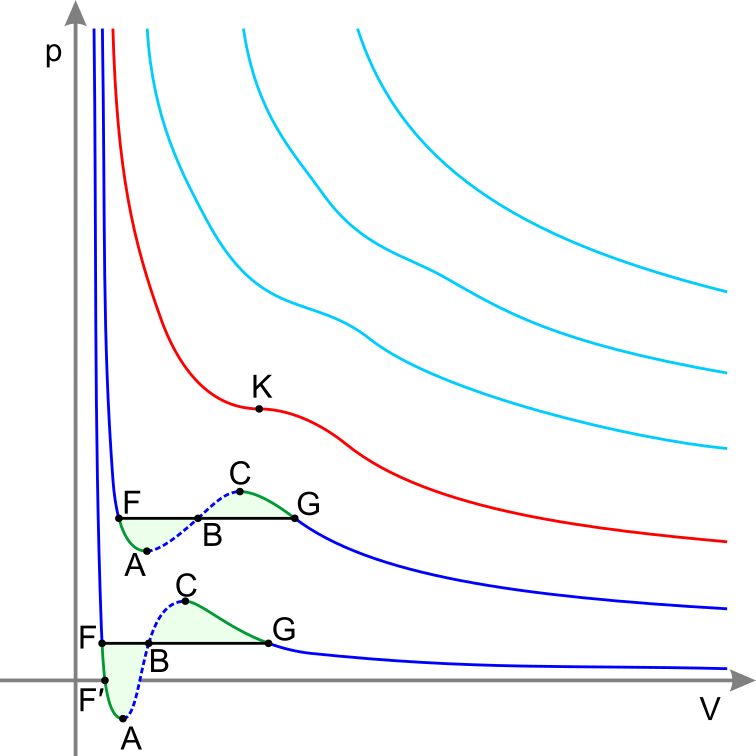
Above the critical point there exists a state of matter that is continuously connected with (can be transformed without phase transition into) both the liquid and the gaseous state. It is called supercritical fluid. The common textbook knowledge that all distinction between liquid and vapor disappears beyond the critical point has been challenged by Fisher and Widom, who identified a p–T line that separates states with different asymptotic statistical properties (Fisher–Widom line). Note that even at temperatures above the critical point temperature, sufficient pressure can still potentially compress the matter into a solid.
Sometimes the critical point does not manifest in most thermodynamic or mechanical properties, but is "hidden" and reveals itself in the onset of inhomogeneities in elastic moduli, marked changes in the appearance and local properties of non-affine droplets, and a sudden enhancement in defect pair concentration.
History

The existence of a critical point was first discovered by Charles Cagniard de la Tour in 1822 and named by Dmitri Mendeleev in 1860Mendeleev called the critical point the "absolute temperature of boiling" (; ).
- The "absolute temperature of boiling" is defined on p. 151. Available at Wikimedia
- German translation: The "absolute temperature of boiling" is defined on p. 11: " (As the "absolute temperature of boiling" we must regard the point at which (1) the cohesion of the liquid equals 0° and a2 = 0 [where a2 is the coefficient of capillarity, p. 6], at which (2) the latent heat of vaporization also equals zero, and at which (3) the liquid is transformed into vapor, independently of the pressure and the volume.)
- In 1870, Mendeleev asserted, against Thomas Andrews, his priority regarding the definition of the critical point: and Thomas Andrews in 1869. Cagniard showed that CO2 could be liquefied at 31 °C at a pressure of 73 atm, but not at a slightly higher temperature, even under pressures as high as 3000 atm.
Theory
Solving the above condition (\partial p / \partial V)T = 0 for the van der Waals equation, one can compute the critical point as : T\text{c} = \frac{8a}{27Rb}, \quad V_\text{c} = 3nb, \quad p_\text{c} = \frac{a}{27b^2}. However, the van der Waals equation, based on a mean-field theory, does not hold near the critical point. In particular, it predicts wrong scaling laws.
To analyse properties of fluids near the critical point, reduced state variables are sometimes defined relative to the critical properties
: T_\text{r} = \frac{T}{T_\text{c}}, \quad p_\text{r} = \frac{p}{p_\text{c}}, \quad V_\text{r} = \frac{V}{RT_\text{c} / p_\text{c}}.
The principle of corresponding states indicates that substances at equal reduced pressures and temperatures have equal reduced volumes. This relationship is approximately true for many substances, but becomes increasingly inaccurate for large values of pr.
For some gases, there is an additional correction factor, called Newton's correction, added to the critical temperature and critical pressure calculated in this manner. These are empirically derived values and vary with the pressure range of interest.
Table of liquid–vapor critical temperature and pressure for selected substances
| Substance | Critical temperature | Critical pressure (absolute) | |||
|---|---|---|---|---|---|
| Argon | |||||
| Ammonia (NH3) | |||||
| R-134a | |||||
| R-410A | |||||
| Bromine | |||||
| Caesium | |||||
| Chlorine | |||||
| Ethane () | |||||
| Ethanol () | |||||
| Fluorine | |||||
| Helium | |||||
| Hydrogen | |||||
| Krypton | |||||
| Methane (CH4) | |||||
| Neon | |||||
| Nitrogen | |||||
| Oxygen (O2) | |||||
| Carbon dioxide (CO2) | |||||
| Nitrous oxide (N2O) | |||||
| Sulfuric acid (H2SO4) | |||||
| Xenon | |||||
| Lithium | |||||
| Mercury | |||||
| Sulfur | |||||
| Iron | |||||
| Gold | |||||
| Aluminium | |||||
| title = Critical Temperature and Pressure | publisher = Purdue University | url = http://www.chem.purdue.edu/gchelp/liquids/critical.html | access-date = 2006-12-19 }} |
Mixtures: liquid–liquid critical point

The liquid–liquid critical point of a solution, which occurs at the critical solution temperature, occurs at the limit of the two-phase region of the phase diagram. In other words, it is the point at which an infinitesimal change in some thermodynamic variable (such as temperature or pressure) leads to separation of the mixture into two distinct liquid phases, as shown in the polymer–solvent phase diagram to the right. Two types of liquid–liquid critical points are the upper critical solution temperature (UCST), which is the hottest point at which cooling induces phase separation, and the lower critical solution temperature (LCST), which is the coldest point at which heating induces phase separation.
Mathematical definition
From a theoretical standpoint, the liquid–liquid critical point represents the temperature–concentration extremum of the spinodal curve (as can be seen in the figure to the right). Thus, the liquid–liquid critical point in a two-component system must satisfy two conditions: the condition of the spinodal curve (the second derivative of the free energy with respect to concentration must equal zero), and the extremum condition (the third derivative of the free energy with respect to concentration must also equal zero or the derivative of the spinodal temperature with respect to concentration must equal zero).
References
References
- Horstmann, Sven. (2000). "Theoretische und experimentelle Untersuchungen zum Hochdruckphasengleichgewichtsverhalten fluider Stoffgemische für die Erweiterung der PSRK-Gruppenbeitragszustandsgleichung". [[University of Oldenburg.
- Stanley, H. Eugene. (1987). "Introduction to phase transitions and critical phenomena". Oxford University Press.
- (June 2002). "The IAPWS Formulation 1995 for the Thermodynamic Properties of Ordinary Water Substance for General and Scientific Use". Journal of Physical and Chemical Reference Data.
- P. Atkins and J. de Paula, Physical Chemistry, 8th ed. (W. H. Freeman 2006), p. 21.
- K. J. Laidler and J. H. Meiser, Physical Chemistry (Benjamin/Cummings 1982), p. 27.
- P. A. Rock, Chemical Thermodynamics (MacMillan 1969), p. 123.
- (1969). "Decay of Correlations in Linear Systems". Journal of Chemical Physics.
- (1989). "Supercritical phase transitions at very high pressure". J. Chem. Educ..
- (3 June 2015). "Pre-Yield Non-Affine Fluctuations and A Hidden Critical Point in Strained Crystals". Scientific Reports.
- Charles Cagniard de la Tour. (1822). "Exposé de quelques résultats obtenu par l'action combinée de la chaleur et de la compression sur certains liquides, tels que l'eau, l'alcool, l'éther sulfurique et l'essence de pétrole rectifiée". Annales de Chimie et de Physique.
- Berche, B., Henkel, M., Kenna, R (2009) Critical phenomena: 150 years since Cagniard de la Tour. Journal of Physical Studies 13 (3), pp. 3001-1–3001-4.
- Landau, Lifshitz, Theoretical Physics, Vol. V: Statistical Physics, Ch. 83 [German edition 1984].
- Andrews, Thomas. (1869). "The Bakerian lecture: On the continuity of the gaseous and liquid states of matter". Philosophical Transactions of the Royal Society.
- (2002). "Thermodynamics: an engineering approach". McGraw-Hill.
- (1953). "Compressibility Chart for Hydrogen and Inert Gases". Ind. Eng. Chem..
- Emsley, John. (1991). "The Elements". [[Oxford University Press]].
- (2002). "Thermodynamics: An Engineering Approach". [[McGraw-Hill]].
- "Ammonia – NH3 – Thermodynamic Properties".
- "Critical Temperature and Pressure". Purdue University.
This article was imported from Wikipedia and is available under the Creative Commons Attribution-ShareAlike 4.0 License. Content has been adapted to SurfDoc format. Original contributors can be found on the article history page.
Ask Mako anything about Critical point (thermodynamics) — get instant answers, deeper analysis, and related topics.
Research with MakoFree with your Surf account
Create a free account to save articles, ask Mako questions, and organize your research.
Sign up freeThis content may have been generated or modified by AI. CloudSurf Software LLC is not responsible for the accuracy, completeness, or reliability of AI-generated content. Always verify important information from primary sources.
Report