From Surf Wiki (app.surf) — the open knowledge base
Creeslough
Village in County Donegal, Ireland
Village in County Donegal, Ireland
| Field | Value |
|---|---|
| name | Creeslough |
| native_name | An Craoslach |
| settlement_type | Village |
| image_skyline | Ancraoslachcropped2.jpg |
| image_caption | Main Street |
| pushpin_map | Ireland |
| pushpin_label_position | left |
| pushpin_map_caption | Location in Ireland |
| subdivision_type | Country |
| subdivision_name | Ireland |
| subdivision_type1 | Province |
| subdivision_name1 | Ulster |
| subdivision_type2 | County |
| subdivision_name2 | County Donegal |
| subdivision_type3 | Barony |
| subdivision_name3 | Kilmacrenan |
| unit_pref | Metric |
| population_footnotes | |
| population_as_of | 2022 |
| population_total | 398 |
| population_density_km2 | auto |
| timezone1 | WET |
| utc_offset1 | +0 |
| timezone1_DST | IST (WEST) |
| utc_offset1_DST | -1 |
| coordinates | |
| blank_name | Irish Grid Reference |
| blank_info | |
| website |
Creeslough ( , locally ; ) is a village in County Donegal, Ireland, 12 km south of Dunfanaghy on the N56 road. It overlooks an arm of Sheephaven Bay, with the population of the surrounding area engaged mainly in agriculture, mostly livestock rearing.
Name
The English name 'Creeslough' (occasionally 'Cresslough') is an anglicised respelling of an Irish name, the modern official spelling of which is An Craoslach (including the definite article An). According to the Placenames Database of Ireland, this means "the gorge". whereas Creeslough village is outside the Gaeltacht and its English name has equal status. Craoslach is usually interpreted as craos+loch; where loch means "lake", while craos literally means "gullet, throat" and metaphorically can mean either a gap or gluttony. In the 1830s, John O'Donovan glossed the name as "Craoslaoch [sic] swallowing lake; throat lake", and Patrick Weston Joyce glossed it in 1875 as "Craos-loch — a lake that swallows up everything". In 2000, Lawrence Donegan wrote: :Craos Loch in Irish, meaning Throat Lake or Gullet Lake. Why? Because there was a tiny lake at the top of the village that gathered a lot of rainwater from the surrounding hills and leaked only a little away through a tiny stream. Where did all the water go? It had been swallowed by the hungry lake, obviously. Why not call the village Hungry Lake? It wasn't poetic enough.
Suggested alternative derivations are craos+lacha[n] "duck[s] throat", or crioslach (or variant críoslach) "limit, border". Niall Ó Dónaill advised the Placenames Branch in 1962 that, although there was evidence that Crioslach was the older Irish form, it had long been changed to An Craoslach.
History
(1881 C. 3204-IV p. 382; 1911 Cd. 6051-IV p. 20 No. 31; 1926 Vol. 1 Table 11 p. 125 No. 31; 1936 Vol. 1 Table 13 p. 138; 1946 Vol. 1 Table 13 p. 134; 1951 Vol. 1 Table 14 p. 144; 1956 Vol. 1 Table 14 p. 142; 1961 Vol. 1 Table 8 p. 19; 1971 Vol. 1 Table 8 p. 35; 1986 Vol. 1 Table 10 p. 70) and from CSO interactive tables (1996 A0112; 2006 C0105; 2016 E2016). | 1841 | 235 | 1851 | 272 | 1861 | 229 | 1871 | 154 | 1881 | 155 | 1891 | 132 | 1901 | 179 | 1911 | 150 | 1926 | 156 | 1936 | 199 | 1946 | 167 | 1951 | 170 | 1956 | 198 | 1961 | 242 | 1966 | 262 | 1971 | 269 | 1981 | 352 | 1986 | 340 | 1991 | 299 | 1996 | 300 | 2002 | 304 | 2006 | 327 | 2011 | 410 | 2016 | 393 | 2022 | 398 Evidence of ancient settlement in the area includes a number of ringfort, holy well, enclosure and burial sites in the townlands of Creeslough, Killoughcarran and Masiness. Nearby Doe Castle, a tower house with a surrounding bawn, dates from the 1420s.
On 7 October 2022, an explosion at Creeslough destroyed a shop and Applegreen petrol station, as well as the adjoining apartment block, resulting in ten deaths and multiple injuries.
Places of interest
,_Creeslough,_County_Donegal,_Ireland_02.jpg)
Nearby places of interest include:
- Doe Castle, a 15th-century castle of the MacSuibhne clan, restored between 2002 and 2005. It is perhaps best known as the place to which Owen Roe O'Neill returned to command the Irish Confederate's Ulster army in 1642 during the Irish Confederate Wars.
- Ards Forest Park, which contains some megalithic tombs, ringforts and a Mass rock. The forest park encompasses a variety of habitats, including sand dunes, tidal salt marsh as well as several small lakes, two of which are vegetation-filled and in the process of becoming bogs.
- Owencarrow Viaduct, the scene of a 1925 rail disaster.
- Glenveagh National Park, created in 1981 from lands granted by Henry P. McIlhenny, of Philadelphia.
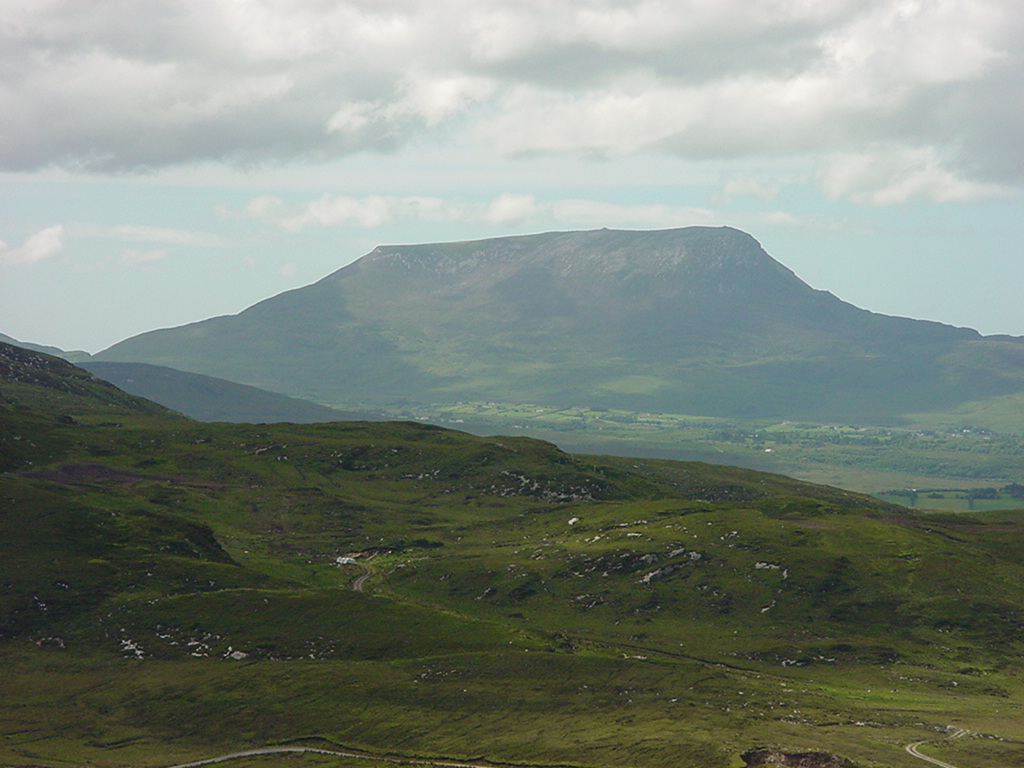
- Muckish, a mountain with a distinctive outline and a number of routes to the summit, a common hiking destination. The surrounding mountainous areas are also suitable for hiking. The annual Glover Highlander walk goes from Muckish to Errigal. There are also several marked trails in Glenveagh National Park.
- Doe Chapel (1784–1971); the remains of its outer walls are situated within the current graveyard at Doe (in Cashelmore, 3 km north of Creeslough). The bell tower stands intact.
- St. Michael's Catholic Church, known locally as 'the Chapel', designed by Derry architect Liam McCormick in 1971. Notable for its unique design, which mimics the shape of the nearby table mountain of Muckish. McCormick was also responsible for the design of the RIAI Triennial Gold Medal-winning St Aengus' Church in Burt, County Donegal. The chapel bell was moved from the bell tower at Doe Chapel.
Transport
Creeslough railway station opened on 9 March 1903, closed for passenger traffic on 3 June 1940, and finally closed altogether on 6 January 1947.
Education

The area around Creeslough is served by three primary schools:
- Scoil Mhuire – Roman Catholic, 142 pupils (2011 figures)
- Creeslough National School – Church of Ireland, 20 pupils (2011 figures)
- Glassan National School – Roman Catholic, 29 pupils (2011 figures), located 5 km to the west of Creeslough village
People
- Kathleen Antonelli, programmer of ENIAC, the first ever computer
- Thomas Bartholomew Curran, barrister and Anti-Parnellite
- Lawrence Donegan, Scottish journalist and musician, author of No News at Throat Lake (2000). Donegan lived in Creeslough for a short time.
- Bridie Gallagher, singer described as "Ireland's first truly international pop star"
- Bernard Lafferty, butler and heir to Doris Duke
- Neil McBride (Niall Mac Gioll Bhridé), poet, author, and lyricist
- Martin McElhinney, Gaelic footballer
- Colm McFadden, Gaelic footballer
- James McNulty, activist for Irish Independence and father of Kathleen Antonelli
- Christy Toye, Gaelic footballer
In popular culture
- No News at Throat Lake is a memoir by Lawrence Donegan about his year living in Creeslough as a reporter for the bi-weekly newspaper, Tirconaill Tribune.
- The area has featured in a number of Irish folk songs, including "Cutting the Corn in Creeslough" which has been covered by Daniel O'Donnell and Creeslough native Bridie Gallagher.
References
References
- "Census Interactive Map – Towns: Creeslough". [[Central Statistics Office (Ireland).
- "An Craoslach / Creeslough [town]". [[Placenames Database of Ireland]].
- McKay, Patrick. (1999). "A Dictionary of Ulster Place-Names". The Institute of Irish Studies, [[The Queen's University of Belfast]].
- Under the [[Official Languages Act 2003]], only the Irish name of Creeslough [[Electoral division (Ireland). electoral division]] has official status, because part of it is in the [[Gaeltacht]],[https://www.irishstatutebook.ie/eli/2004/si/872/made/ga/print S.I. 2004/872, Schedule Part 7 Section A Chapter 4 No. 12]
- [https://www.irishstatutebook.ie/eli/2005/si/59/made/ga/print S.I. 2005/59, Schedule Section D Chapter 2 No. 38]
- (1977). "Foclóir Gaeilge–Béarla".
- Placenames Branch file on Creeslough, [https://www.logainm.ie/Iomhanna/po14342_2.JPG card 2]
- "An Craoslach/Creeslough [townland]".
- (1902). "The origin and history of Irish names of places". Longmans Green / Dublin.
- (2000). "No news at Throat Lake". Pocket Books.
- (1970). "Observations on Vowel Lengthening in Irish". Studia Celtica.
- (1864). "An Irish-English Dictionary". J. Duffy.
- Placenames Branch file on Creeslough, [https://www.logainm.ie/Iomhanna/po14342_5.JPG card 5]
- (1983). "Archaeological Survey of County Donegal. A description of the field antiquities of the County from the Mesolithic Period to the 17th century". Donegal County Council.
- "Doe Castle". Office of Public Works.
- (7 October 2022). "At least three people dead after explosion at service station in Donegal". RTÉ News.
- (8 October 2022). "Creeslough: Ten dead after Donegal explosion". [[BBC News]].
- "THE MASSROCK".
- (20 January 2011). "Walking Ireland's Iconic Mountains – Number 2: Muckish".
- [http://www.simonstewart.ie/Glover/glover.htm The Glover Highlander Walk]
- "St. Michael's Church".
- (7 April 2006). "Liam McCormick - Father of modern Irish church architecture".
- "Creeslough station". Railscot - Irish Railways.
- "Department of Education".
- Zibart, Eve. (2000). "No News At Throat Lake BookPage review".
- McFaul, Anna Marie. (10 January 2012). "Bridie Gallagher: Ireland's 'first international pop star'". BBC News.
- Sheridan, Kathy. (9 November 1996). "Flamboyant life and death of a billionaire butler". The Irish Times.
- Gallagher, Bridie. (3 May 2010). "Noreen Bawn".
- McNulty, Chris. (6 March 2019). "All-Ireland winner Martin McElhinney pulls out of Donegal panel".
This article was imported from Wikipedia and is available under the Creative Commons Attribution-ShareAlike 4.0 License. Content has been adapted to SurfDoc format. Original contributors can be found on the article history page.
Ask Mako anything about Creeslough — get instant answers, deeper analysis, and related topics.
Research with MakoFree with your Surf account
Create a free account to save articles, ask Mako questions, and organize your research.
Sign up freeThis content may have been generated or modified by AI. CloudSurf Software LLC is not responsible for the accuracy, completeness, or reliability of AI-generated content. Always verify important information from primary sources.
Report