From Surf Wiki (app.surf) — the open knowledge base
Crankshaft
Mechanism for converting reciprocating motion to rotation
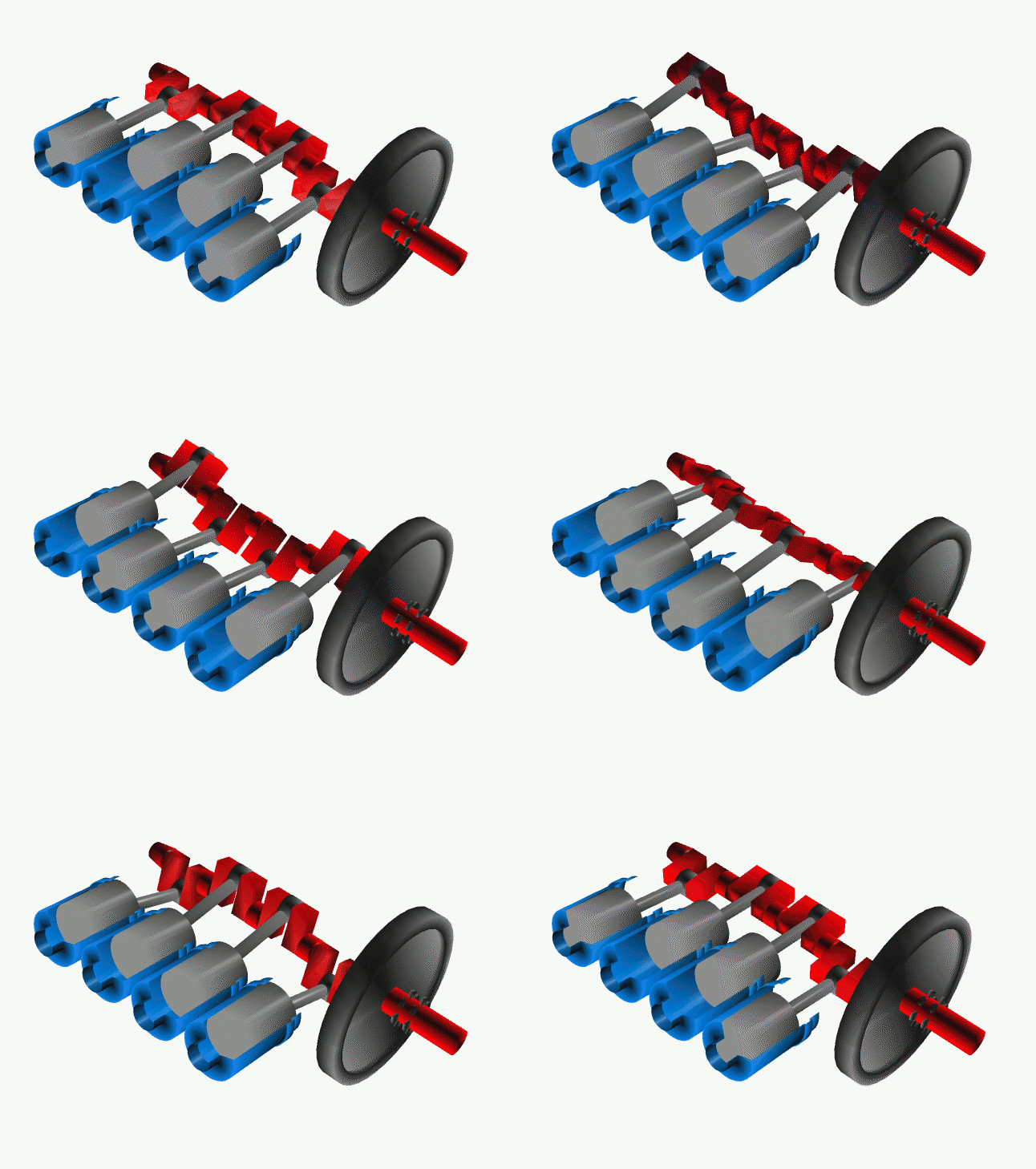
Mechanism for converting reciprocating motion to rotation
A crankshaft is a mechanical component used in a piston engine to convert the reciprocating motion into rotational motion. The crankshaft is a rotating shaft containing one or more crankpins, that are driven by the pistons via the connecting rods.
The crankpins are also called rod bearing journals, and they rotate within the "big end" of the connecting rods.
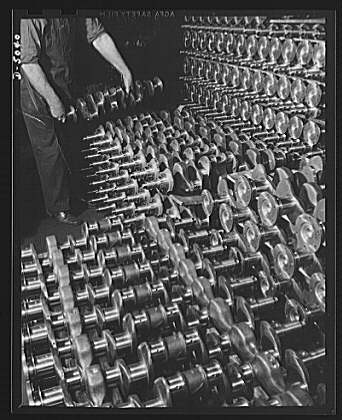
Most modern crankshafts are located in the engine block. They are made from steel or cast iron, using either a forging, casting or machining process.
Design


The crankshaft is located within the engine block and held in place via main bearings which allow the crankshaft to rotate within the block. The up-down motion of each piston is transferred to the crankshaft via connecting rods. A flywheel is often attached to one end of the crankshaft, in order to smoothen the power delivery and reduce vibration.
A crankshaft is subjected to enormous stresses, in some cases more than 19000 lb per cylinder. Crankshafts for single-cylinder engines are usually a simpler design than for engines with multiple cylinders.
Bearings
Main article: Main bearing
The crankshaft is able to rotate in the engine block due to the 'main bearings'. Since the crankshaft is subject to large horizontal and torsional forces from each cylinder, these main bearings are located at various points along the crankshaft, rather than just one at each end. The number of main bearings is determined based on the overall load factor and the maximum engine speed. Crankshafts in diesel engines often use a main bearing between every cylinder and at both ends of the crankshaft, due to the high forces of combustion present.
Flexing of the crankshaft was a factor in replacing straight-eight engines in the 1950s; the long crankshafts suffered from an unacceptable amount of flex when engine designers began using higher compression ratios and higher engine speeds (RPM).
Piston stroke
The distance between the axis of the crankpins and the axis of the crankshaft determines the stroke length of the engine.
Most modern car engines are classified as "over square" or short-stroke, wherein the stroke is less than the diameter of the cylinder bore. A common way to increase the low-RPM torque of an engine is to increase the stroke, sometimes known as "stroking" the engine. Historically, the trade-off for a long-stroke engine was a lower rev limit and increased vibration at high RPM, due to the increased piston velocity.
Cross-plane and flat-plane configurations
When designing an engine, the crankshaft configuration is closely related to the engine's firing order.
Most production V8 engines (such as the Ford Modular engine and the General Motors LS engine) use a cross-plane crank whereby the crank throws are spaced 90 degrees apart. However, some high-performance V8 engines (such as the Ferrari 488) instead use a flat-plane crank, whereby the throws are spaced 180° apart, which essentially results in two inline-four engines sharing a common crankcase. Flat-plane engines are usually able to operate at higher RPM, however they have higher second-order vibrations, so they are better suited to racing car engines.
Engine balance
For some engines it is necessary to provide counterweights for the reciprocating mass of the piston, conrods and crankshaft, in order to improve the engine balance. These counterweights are typically cast as part of the crankshaft but, occasionally, are bolt-on pieces.
Flying arms

In some engines, the crankshaft contains direct links between adjacent crankpins, without the usual intermediate main bearing. These links are called flying arms. This arrangement is sometimes used in V6 and V8 engines, in order to maintain an even firing interval while using different V angles, and to reduce the number of main bearings required. The downside of flying arms is that the rigidity of the crankshaft is reduced, which can cause problems at high RPM or high power outputs.
Counter-rotating crankshafts
In most engines, each connecting rod is attached to a single crankshaft, which results in the angle of the connecting rod varying as the piston moves through its stroke. This variation in angle pushes the pistons against the cylinder wall, which causes friction between the piston and cylinder wall.{{citation |chapter=Company's perspective in vehicle tribology |title=18th Leeds-Lyon Symposium |editor-last1=Dowson |editor-first1=D |editor-last2=Taylor |editor-first2=C M |editor-last3=Godet |editor-first3=M
Eccentricity and dynamic displacement of diesel engines
Eccentricity and dynamic displacement are critical factors influencing the performance, efficiency, and durability of diesel engines. These phenomena arise due to the flexibility of the crankshaft, secondary piston motion, and varying loads during engine operation. Understanding these effects is essential for reducing mechanical wear, improving fuel efficiency, and optimizing engine design.
Construction
Forged crankshafts

Crankshafts can be created from a steel bar using roll forging. Today, manufacturers tend to favour the use of forged crankshafts due to their lighter weight, more compact dimensions and better inherent damping. With forged crankshafts, vanadium micro-alloyed steels are mainly used as these steels can be air-cooled after reaching high strengths without additional heat treatment, except for the surface hardening of the bearing surfaces. The low alloy content also makes the material cheaper than high-alloy steels. Carbon steels also require additional heat treatment to reach the desired properties.
Cast crankshafts
Another construction method is to cast the crankshaft from ductile iron. Cast iron crankshafts are today mostly found in cheaper production engines where the loads are lower.
Machined crankshafts
Crankshafts can also be machined from billet, often a bar of high quality vacuum remelted steel. Though the fiber flow (local inhomogeneities of the material's chemical composition generated during casting) does not follow the shape of the crankshaft (which is undesirable), this is usually not a problem since higher quality steels, which normally are difficult to forge, can be used. Per unit, these crankshafts tend to be expensive due to the large amount of material that must be removed with lathes and milling machines, the high material cost, and the additional heat treatment required. However, since no expensive tooling is needed, this production method allows small production runs without high up-front costs.
History
Crankshaft
In 9th century Abbasid Baghdad, automatically operated cranks appear in several of the hydraulic devices described by the Banū Mūsā brothers in the Book of Ingenious Devices. These automatically operated cranks appear in several devices, two of which contain an action which approximates to that of a crankshaft, five centuries before the earliest known European description of a crankshaft. However, the automatic crank mechanism described by the Banū Mūsā would not have allowed a full rotation, but only a small modification was required to convert it to a crankshaft.
In the Artuqid Sultanate, Arab engineer Ismail al-Jazari (1136–1206) described a crank and connecting rod system in a rotating machine for two of his water-raising machines, which include both crank and shaft mechanisms.


Crankshafts were described by Leonardo da Vinci (1452–1519) and a Dutch farmer and windmill owner by the name Cornelis Corneliszoon van Uitgeest in 1592. His wind-powered sawmill used a crankshaft to convert a windmill's circular motion into a back-and-forward motion powering the saw. Corneliszoon was granted a patent for his crankshaft in 1597.
From the 16th century onwards, evidence of cranks and connecting rods integrated into machine design becomes abundant in the technological treatises of the period: Agostino Ramelli's The Diverse and Artifactitious Machines of 1588 depicts eighteen examples, a number that rises in the Theatrum Machinarum Novum by Georg Andreas Böckler to 45 different machines. Cranks were formerly common on some machines in the early 20th century; for example almost all phonographs before the 1930s were powered by clockwork motors wound with cranks. Reciprocating piston engines use cranks to convert the linear piston motion into rotational motion. Internal combustion engines of early 20th century automobiles were usually started with hand cranks, before electric starters came into general use.
References
Sources
- {{Citation
- {{Citation
- {{Citation
- {{Citation | author1-link = Ahmad Y. al-Hassan | author2-link = Donald Routledge Hill | url-access = registration
- {{Citation
- {{Citation
- {{Citation
- {{Citation
- {{Citation
- {{Citation
- {{Citation
- {{Citation | author-link = Lynn Townsend White Jr.
- {{Citation | author-link = Andrew Wilson (classical archaeologist)
References
- "How the crankshaft works – All the details".
- (17 October 2024). "Definition of Crankshaft".
- Jones, Brian. (August 5, 2023). "All About Crankshafts and How They Work".
- (27 May 2021). "Crankshaft: Parts, Function, Types, Diagram & More".
- (1 January 2001). "Encyclopedia of Materials: Science and Technology". Elsevier.
- (13 June 2018). "How Does A Flywheel Work? Explained In Simple Words".
- (5 April 2015). "How to Build Racing Engines: Crankshafts Guide".
- (20 January 2022). "Flat-Plane Cranks, Part 2 — Calculating Crankshaft Secondary Forces".
- (2004). "Automotive Handbook". Robert Bosch.
- "A Brief History Of The Straight-Eight Engine – Carole Nash".
- (22 December 2020). "All you need to know about stroker engines and kits".
- (25 April 2017). "What's the best firing order?".
- "Crankshaft Design Evolution".
- (15 January 2015). "Flat Plane Crankshafts vs. Crossplane Crankshafts".
- (15 September 2015). "Ferrari 488 Spider debuts in Frankfurt, is faster than Lamborghini's new drop-top in every way".
- (15 October 2015). "2016 Ferrari 488 Spider: Losing the Roof Doesn't Compromise the Magic".
- (15 June 2022). "Difference Between Cross-Plane and Flat-Plane Cranks".
- (8 April 2016). "How The Flat-Plane Crank Turns Muscle Cars Into Exotics".
- "Crankshaft Balance Factors".
- (17 March 2016). "Finding Balance (Part 1): The Basics of Crankshaft Balancing".
- Nunney, Malcolm J.. (2007). "Light and Heavy Vehicle Technology". Elsevier Butterworth-Heinemann.
- (30 June 2015). "Crankshaft guide – Flat vs Cross plane & lightened crankshafts".
- (January 2022). "Validated Analytical Modeling of Eccentricity and Dynamic Displacement in Diesel Engines with Flexible Crankshaft". Energies.
- "Cast vs Forged Crankshaft".
- Dempsey, Paul. (2018). "Troubleshooting and Repairing Diesel Engines". McGraw-Hill Education.
- Silvey, Todd. (2023-04-24). "Forged vs Billet: Callies Explains Crankshaft Choices". Dragzine.
- A. F. L. Beeston, M. J. L. Young, J. D. Latham, Robert Bertram Serjeant. (1990). "The Cambridge History of Arabic Literature". [[Cambridge University Press]].
- [[Banū Mūsā]]. (1979). "The Book of Ingenious Devices (Kitáb al-Ḥiyal) by the Banú (sons of) Músà bin Shákir". Springer Publishing.
- [[Ahmad Y Hassan]]. [http://www.history-science-technology.com/Notes/Notes%203.htm The Crank-Connecting Rod System in a Continuously Rotating Machine].
- [[Donald Hill]] (2012), [https://books.google.com/books?id=EUTqCAAAQBAJ&pg=PA273 ''The Book of Knowledge of Ingenious Mechanical Devices'', page 273], [[Springer Science + Business Media]]
- {{harvnb. Hall. 1979
- (1978). "Medieval Religion and Technology: Collected Essays". University of California Press.
- {{harvnb. White. 1962
This article was imported from Wikipedia and is available under the Creative Commons Attribution-ShareAlike 4.0 License. Content has been adapted to SurfDoc format. Original contributors can be found on the article history page.
Ask Mako anything about Crankshaft — get instant answers, deeper analysis, and related topics.
Research with MakoFree with your Surf account
Create a free account to save articles, ask Mako questions, and organize your research.
Sign up freeThis content may have been generated or modified by AI. CloudSurf Software LLC is not responsible for the accuracy, completeness, or reliability of AI-generated content. Always verify important information from primary sources.
Report