From Surf Wiki (app.surf) — the open knowledge base
Crab fisheries
Fisheries which capture or farm crabs

Fisheries which capture or farm crabs
Crab fisheries are fisheries which capture or farm crabs. True crabs make up 20% of all crustaceans caught and farmed worldwide, with about 1.4 million tonnes being consumed annually. The horse crab, Portunus trituberculatus, accounts for one quarter of that total. Other important species include flower crabs (Portunus pelagicus), snow crabs (Chionoecetes), blue crabs (Callinectes sapidus), edible or brown crabs (Cancer pagurus), Dungeness crab (Metacarcinus magister), and mud crabs (Scylla serrata), each of which provides more than 20,000 tonnes annually.
Commercial catch
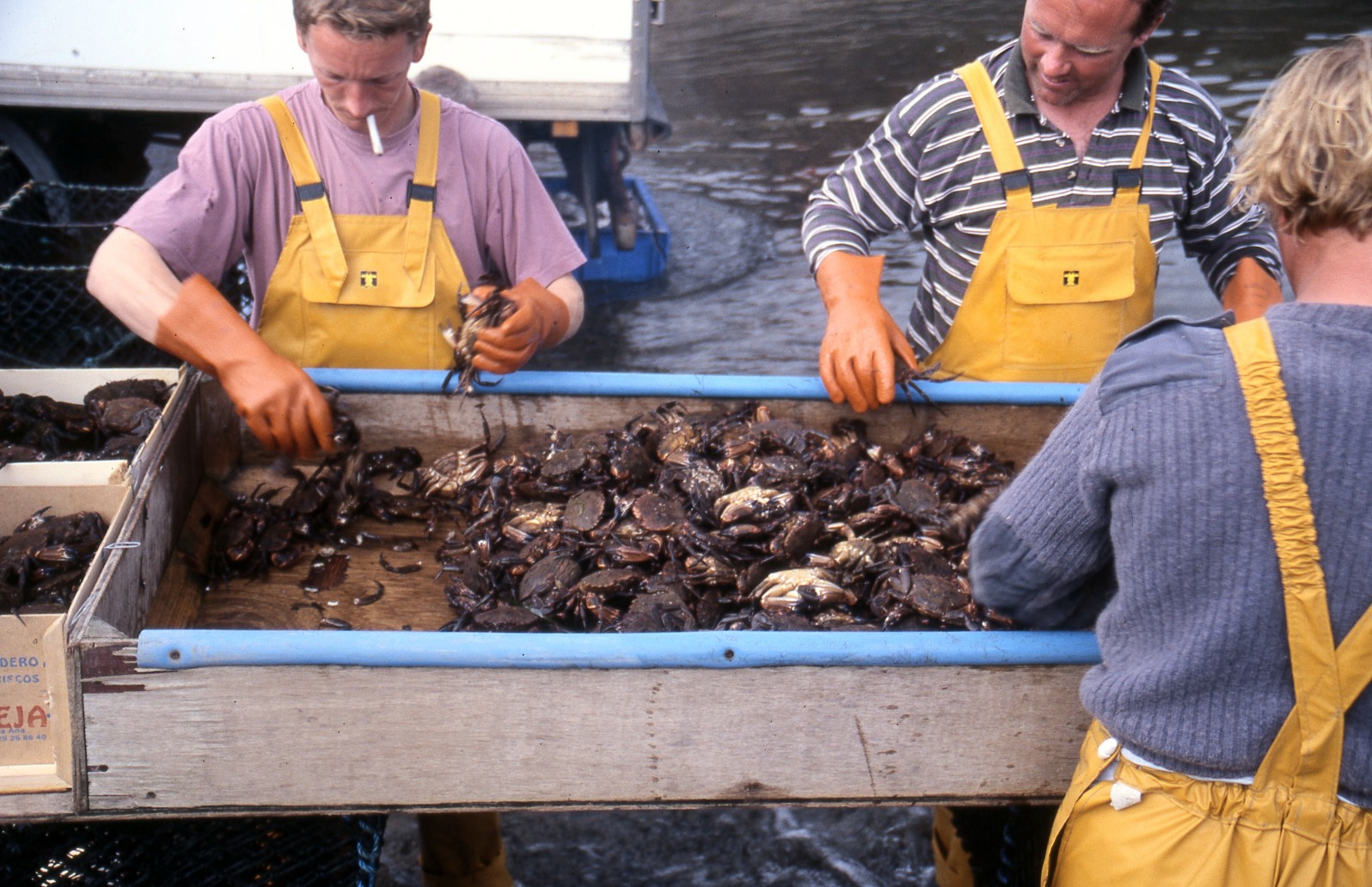


The FAO groups fishery catches using the ISSCAAP classification (International Standard Statistical Classification of Aquatic Animals and Plants). ISSCAAP has a group for crabs and sea-spiders, and another group for king crabs and squat lobsters.
- Crabs and sea-spiders are defined as including "Atlantic rock crab, black stone crab, blue crab, blue swimming crab, dana swimcrab, dungeness crab, edible crab, cazami crab, geryons nei, green crab, hair crab, harbour spidercrab, Indo-Pacific swamp crab, jonah crab, marine crabs nei, Mediterranean shore crab, Pacific rock crab, portunus swimcrabs nei, queen crab, red crab, spinous spider crab, swimcrabs nei, and tanner crabs nei".
The following table summarises crab production from 2000 to 2008, both caught wild and from aquaculture, in tonnes.
| Commercial crab production in tonnes | Group | 2000 | 2001 | 2002 | 2003 | 2004 | 2005 | 2006 | 2007 | 2008 |
|---|---|---|---|---|---|---|---|---|---|---|
| Capture | 1,046,269 | 1,034,898 | 1,061,697 | 1,246,889 | 1,252,260 | 1,233,523 | 1,302,069 | 1,300,559 | 1,319,953 | |
| Aquaculture | 125,501 | 145,130 | 171,979 | 167,533 | 178,838 | 195,995 | 198,258 | 231,065 | 240,781 | |
| Total | 1,171,770 | 1,180,028 | 1,233,676 | 1,414,422 | 1,431,098 | 1,429,518 | 1,500,327 | 1,531,624 | 1,560,734 |
Commercially important crab species
| Species | Description | Global catch in thousand tonnes | ||||||||||
|---|---|---|---|---|---|---|---|---|---|---|---|---|
| reported by the FAO | ||||||||||||
| Portunus trituberculatus | ||||||||||||
| Portunus pelagicus | ||||||||||||
| Chionoecetes | ||||||||||||
| Callinectes sapidus | ||||||||||||
| Cancer pagurus | ||||||||||||
| Metacarcinus magister | ||||||||||||
| Scylla serrata | ||||||||||||
| Maja squinado | ||||||||||||
| Cancer borealis | ||||||||||||
| [[File:Jonah crab noaa overhead picture accessed-2024-04-24.jpg | 140x140px]] | |||||||||||
| Portunus trituberculatus, known as the horse crab, known as the gazami crab or Japanese blue crab, is the most widely fished species of crab in the world, with over 300,000 tonnes being caught annually, 98% of it off the coast of China. | float=right | width=190px | image1=Distribution map | [[File:World catch horse crab 1950–2007.png | 280px]] | |||||||
| Portunus pelagicus (known as flower crabs, blue crabs, blue swimmer crabs, blue manna crabs or sand crabs) is a large crab found in the intertidal estuaries of the Indian and Pacific Oceans (Asian coasts) and the Middle-Eastern coast of the Mediterranean Sea. The name flower crab is used in east Asian countries while the latter names are used in Australia. The crabs are widely distributed in eastern Africa, Southeast Asia, Japan, Australia and New Zealand. | [[File:World catch flower crab 1950–2007.png | 280px]] | ||||||||||
| Species of Chionoecetes (known as Tanner Crabs, Snow Crabs, Spider Crabs, and other names) live in the cold waters of the northern Pacific and Atlantic Ocean. | [[File:World catch queen crab 1950–2007.png | 280px]] | ||||||||||
| The Chesapeake Bay, located in Maryland and Virginia, is famous for its "blue crabs", Callinectes sapidus. In 1993, the combined harvest of the blue crabs was valued at around 100 million U.S. dollars. Over the years the harvests of the blue crab dropped; in 2000, the combined harvest was around 45 million dollars. | [[File:World catch blue crab 1950–2007.png | 280px]] | ||||||||||
| Cancer pagurus, the edible crab or brown crab, is a species found in the North Sea, North Atlantic and the Mediterranean Sea. It is a robust crab of a reddish-brown colour, having an oval carapace with a characteristic "pie crust" edge and black tips to the claws. Mature adults may have a carapace width of up to about 25 cm and weigh up to 3 kg. | [[File:World catch Edible crab 1950–2007.png | 280px]] | ||||||||||
| The Dungeness crab (Metacarcinus magister) inhabits eelgrass beds and water bottoms from the Aleutian Islands in Alaska to Santa Cruz, California. Its binomial name, Cancer magister, simply means "master crab" in Latin. | [[File:World catch Dungeness crab 1950–2007.png | 280px]] | ||||||||||
| Scylla serrata (known as mud crab, or more ambiguously as mangrove crab or black crab) is an economically important crab species found in the estuaries and mangroves of Africa, Australia and Asia. In their most common form, the shell colour varies from a deep, mottled green to very dark brown. Generally cooked with their shells on, when they moult their shells, they can be served as a seafood delicacy, one of many types of soft shell crab. They are among the tastiest crab species and have a huge demand in South Asian countries where they are often bought alive in the markets. In the northern states of Australia and especially Queensland, mud crabs are relatively common and generally prized above other seafood within the general public. | [[File:World catch mud crab 1950–2007.png | 280px]] | ||||||||||
| Maja squinado (European spider crabs) are a species of migratory crabs found in the north-east Atlantic and the Mediterranean Sea. They are the subject of commercial fishery, with about 5,000 tonnes caught annually, 70% off the coast of France, 10% off the coast of the United Kingdom, 6% from the Channel Islands, 3% from each of Spain and Ireland, 2% from Croatia, 1% from Portugal, and the remainder from Serbia and Montenegro, Denmark and Morocco, although official production figures are open to doubt. The European Union imposes a minimum landing size of 120 mm for M. squinado, and some individual countries have other regulations, such as a ban on landing egg-bearing females in Spain and a closed season in France and the Channel Islands. | ||||||||||||
| Cancer borealis, known as the Jonah crab, is a species of crab native to the east coast of North America from Newfoundland south to Florida, and thus found in waters ranging from subarctic to subtropical. It is found seasonally inshore on the continental shelf, moving to depths up to 750m in autumn. Once considered as bycatch to lobster fishing, it has become an emerging fishery with the catch increasing from about 900 tonnes in 2000 to about 6,000 tonnes in 2014. Most are caught in New England. In 2016, NOAA and the Atlantic States Marine Fisheries Commission established a fisheries management plan for the species. |
Notes
References
References
- "Global Capture Production 1950-2008". [[Food and Agriculture Organization]] (FAO).
- "ASFIS List of Species for Fishery Statistics Purposes". [[Food and Agriculture Organization]].
- "The current International Standard Statistical Classification of Aquatic Animals and Plants (ISSCAAP) in use from 2000". [[Food and Agriculture Organization]].
- "Global Aquaculture Production 1950-2008". [[Food and Agriculture Organization.
- [[FAO]]: Species Fact Sheets: [http://www.fao.org/fishery/species/2630/en ''Portunus trituberculatus''], Retrieved 26 November 2009.
- [[FAO]]: Species Fact Sheets: [http://www.fao.org/fishery/species/2629/en ''Portunus pelagicus''], Retrieved 26 November 2009.
- Jadamec, L. S., W. E. Donaldson & P. Cullenberg. (November 13, 2005 }} [http://www.uaf.edu/seagrant/bookstore/pubs/AK-SG-99-02-b.pdf Part 2] {{webarchive). "Biological Field Techniques for Chionoecetes crabs". University of Alaska Sea Grant College Program.
- [http://dsc.discovery.com/fansites/deadliestcatch/deadliestcatch.html Deadliest Catch Official Site]
- [[FAO]]: Species Fact Sheets: [http://www.fao.org/fishery/species/2644/en ''Chionoecetes opilio''], Retrieved 26 November 2009.
- [[FAO]]: Species Fact Sheets: [http://www.fao.org/fishery/species/2632/en ''Callinectes sapidus''], Retrieved 26 November 2009.
- (2005). "Edible crab, ''Cancer pagurus''". [[Marine Life Information Network]].
- "Edible crab (''Cancer pagurus'')". [[ARKive.org]].
- [[FAO]]: Species Fact Sheets: [http://www.fao.org/fishery/species/2627/en ''Cancer pagurus''], Retrieved 26 November 2009.
- "The Dungeness Crab". Dungeness community website.
- "Dungeness Crab and Seafood Festival".
- Andrea Cohen. (2006-08-09). "Crab nabbed; circumstances fishy". [[Massachusetts Institute of Technology.
- [[FAO]]: Species Fact Sheets: [http://www.fao.org/fishery/species/3461/en ''Cancer magister''], Retrieved 26 November 2009.
- [[FAO]]: Species Fact Sheets: [http://www.fao.org/fishery/species/2637/en ''Scylla serrata''], Retrieved 26 November 2009.
- Carl Meyer. "''Maja squinado'', the European Spider Crab: Biology and Fishery".
- (1986-10-07). "Council Regulation (EEC) No 3094/86". [[Official Journal of the European Communities]].
- (15 May 2025). "Jonah crab".
- White, Cliff. (March 6, 2016). "Creating a sustainable fishery: The Jonah crab story".
This article was imported from Wikipedia and is available under the Creative Commons Attribution-ShareAlike 4.0 License. Content has been adapted to SurfDoc format. Original contributors can be found on the article history page.
Ask Mako anything about Crab fisheries — get instant answers, deeper analysis, and related topics.
Research with MakoFree with your Surf account
Create a free account to save articles, ask Mako questions, and organize your research.
Sign up freeThis content may have been generated or modified by AI. CloudSurf Software LLC is not responsible for the accuracy, completeness, or reliability of AI-generated content. Always verify important information from primary sources.
Report