From Surf Wiki (app.surf) — the open knowledge base
Cover-up tattoo
Tattoo that covers an earlier tattoo, scar, or skin condition
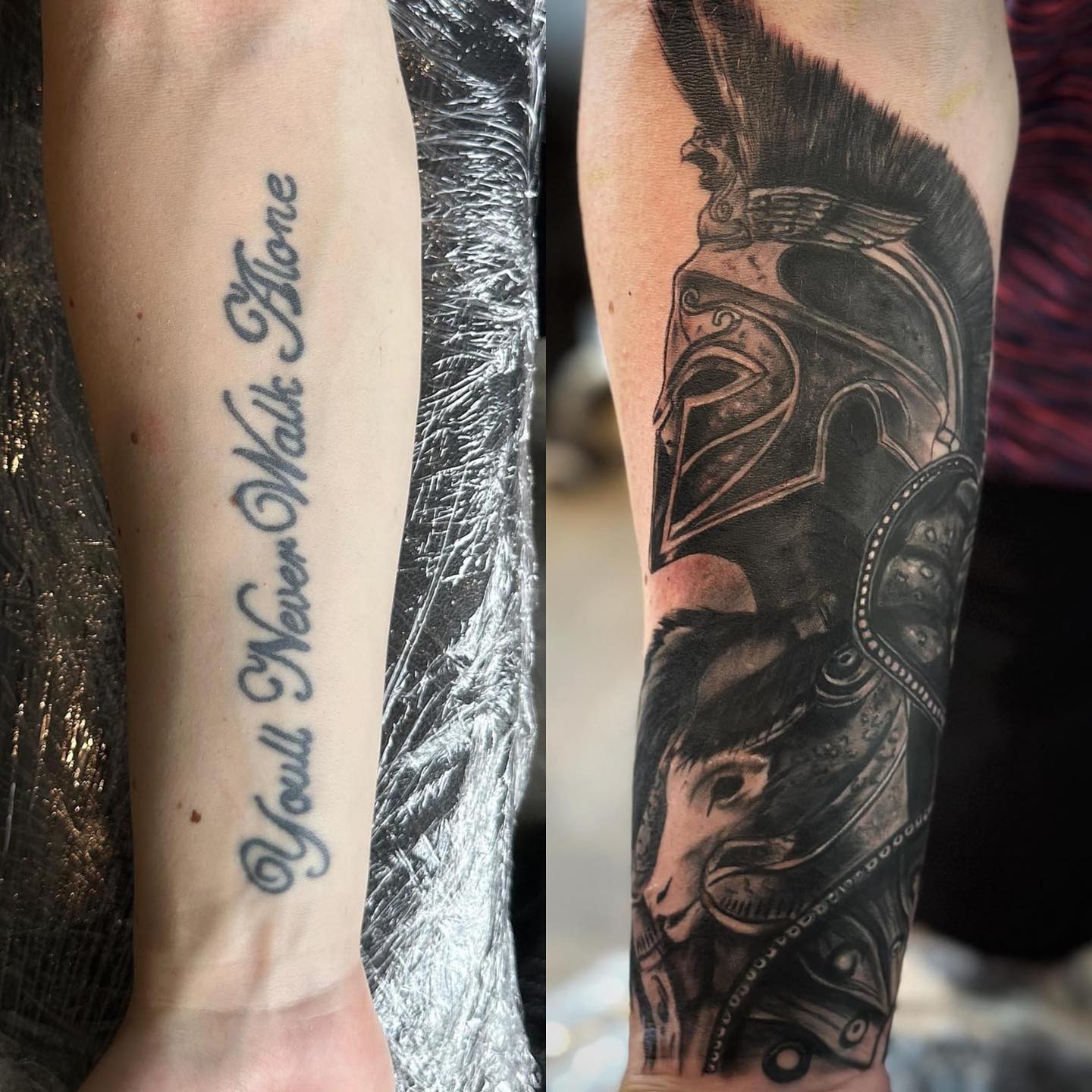
Tattoo that covers an earlier tattoo, scar, or skin condition
Cover-up tattoos are those done over one or more previous tattoos, scars, or skin conditions.
People cover up old tattoos for a variety of reasons, such as that the tattoos were references to relationships that have ended, the tattoos were nonconsensual, or the tattoos relate to gangs or hate speech. Cover-ups after breakups have received particular attention due to high-profile cases involving celebrities. Cover-ups are one of the two main options of removing an unwanted tattoo, the other being laser removal. Covering up an unwanted tattoo is generally cheaper, less painful and an overall easier solution than tattoo removal.
A decorative cover-up tattoo can obscure a scar or skin condition with personally meaningful art, making it an alternative to more flesh-like paramedical tattoos. For example, in lieu of reconstruction post-mastectomy, a person may choose to get a decorative tattoo over their scars. Self-harm scars are another common target for cover-ups.
Both scars and old tattoo ink present additional challenges for a tattoo artist. Some tattoo artists specialize in cover-ups, and some give free cover-ups for cases such as hate symbols, human trafficking tattoos, and self-harm scars.
Contexts
Unwanted past tattoos
A person may seek a cover-up tattoo if they wish to distance themselves from existing tattoos. The simplest reason is that they do not like how a tattoo appears on their body. In particular, cover-ups are associated with regret for the original tattoo. A 2013 study of tattoo removal and cover-up recipients found that regret often stems from dissatisfaction with the narrative that the tattoo represents, either due to the tattoo not being meaningful or to the symbolism being unsatisfying. Tattoo artists who do cover-ups are commonly asked to cover tattoos related to a person's past relationship. People also cover up tattoos related to non-romantic relationships, such as relatives from whom they have become estranged.
As tattoos grew more mainstream in the 1990s and even more in the 2000s, celebrity tattoos received significant attention, especially cover-ups of couples tattoos after breakups. After breaking up with actress Winona Ryder in 1993, actor Johnny Depp partially covered up a "Winona Forever" tattoo, to read "Wino Forever". Further notable post-breakup cover-ups include Denise Richards and Angelina Jolie.
Popular culture in the 2010s included further growth in the popularity of tattoos and coverage of celebrity cover-up tattoos. In 2017, influencer Kylie Jenner had her "T" for rapper Tyga changed to "LA" after their breakup. After marital separation in 2020, Nick Cannon replaced a large back tattoo of singer Mariah Carey's first name with a depiction of the crucifixion of Jesus. Comedian Pete Davidson and singer Ariana Grande got a combined 16 tattoos relating to each other before breaking off their engagement in 2018, then multiple cover-ups.
People also seek to cover up tattoos they received non-consensually. In the 17th century, the use of ja (penal tattoos) for prisoners in Japan fell out of practice largely because released prisoners would cover them up with decorative designs. Some sex trafficking victims who are subjected to branding tattoos later cover them up with chosen tattoos. In the United States and Canada, organizations including Survivor's Ink and Unbound facilitate such cover-ups.
Cover-ups can also be due to a change in what a person wants to be associated with, such as tattoos that convey religious views or connections to drugs or violence. Tattoos that represent hateful views or affiliation with criminal groups are a frequent subject of cover-ups. In the 1800s, prisoners on convict ships from Great Britain to Van Diemen's Land (Tasmania) sometimes "over-tattooed" old tattoos with new designs that defied state efforts to track their tattoos as identifying marks. Alphonse Bertillon's Signaletic Instructions, translated into English in 1896, contains instructions on identifying former prisoners who have had their tattoos "surcharged" (covered up) or removed. Due to rising anti-gang enforcement from the 1990s onwards, it has become increasingly common for gangsters to cover up their gang tattoos despite still being members.
Scars and skin conditions

The use of flesh-like medical tattoos to cover up skin conditions and surgical scars is a long-established practice, dating to the German doctor Pauli in 1835, who used mercury sulfide and white lead to tattoo over skin lesions including nevi and purple plaque, or even to Galen, who executed tattoos of sorts over corneal opacities in 150 CE.
In the 21st century, decorative cover-up tattoos became a more popular approach to obscuring scars, including burns, self-harm scars, surgical scars, and stretch marks. In cases of scars that are hyperpigmented, uneven in texture, or cover a large area, it is often not possible to restore the flesh's previous appearance; decorative tattoos serve to either cover or camouflage these scars instead. one of the first medical articles on the subject, noted patients taking the initiative in receiving decorative cover-ups. Some transmasculine people who receive mastectomies also opt for decorative cover-ups. A 2021 systematic review speculated that decorative scar concealment is one of the most common applications of medical tattooing in a cosmetic or reconstructive context, but noted a lack of evidence, perhaps because many such tattoos happen at the patient's initiative rather than through a medical provider.
_and_Up_the_Ladder_to_the_Roof_(tattoo),_cropped_and_retouched.jpg)
Similarly, it can be difficult to hide vitiligo with tattooed pigment, and so some people choose to get artistic tattoos as a distraction. Tattoos are recommended only for people whose conditions are stable, as tattooing may itself trigger vitiligo. In 2021, a research team developed a system to print customized temporary tattoos onto the bodies of children with vitiligo.
For people with self-harm scars, cover-up tattoos can be a way of moving past trauma. One motivation for tattooing an area may be to discourage oneself from self-harming in it again, although some may nonetheless cut on top of a tattoo. Some people choose to incorporate self-harm scars into tattoo designs, for instance making them look like scratch marks from a dragon. Public figures with self-harm cover-up tattoos include Paris Jackson and Pete Davidson. Self-harm cover-ups raise the complication that the pain of the tattoo process may trigger memories of self-harming.
Like past tattoos, intentional scars may also be covered due to their associations. For instance, actress India Oxenberg covered the brand she received in the NXIVM cult with a mandala design.
Methods
Technique
Covering a previous tattoo is more difficult than creating a fresh tattoo, so it requires skill and experience. In cover-up tattoos, the previous tattoo has made the skin more sensitive and more passes of the needle are required, damaging the skin more than a first tattoo does. This means the artist needs to be especially careful to work at the correct depth and with the right amount of color in the needle.
Poorly applied, faded, or light tattoos are the easiest to cover, especially tattoos that are at least several years old. A person may choose to lighten a tattoo using laser removal before getting a cover-up design.
When tattooing over scars, especially raised scars, it can be difficult for an artist to get the ink to stay in place. As a result, some artists are averse to the practice. Canadian tattoo artist Becky Jónsson, who has cover-ups over their own dermatillomania scars and specializes in scarred skin, told CBC News in 2023 that many clients choose to continue with tattoos even if their tissue cannot hold ink to the desired degree.
Design
A cover-up can modify an existing tattoo by adding details, colors, or new elements, or it can completely mask the old tattoo with a new design. A colorful image with a lot of shading and shapes, such as animals or flowers, can offer more coverage than an image in black-and-gray style.
A person may choose to completely cover an old tattoo with black ink with a simple boxy shape or a "blackout" tattoo design. Flesh tones are generally ineffective for cover-ups, as they lack the translucence of untattooed skin and are rarely able to cover up dark colors.
Cover-up designs are typically bigger in size compared to the previous design, as it helps to hide the design. Some of the previous tattoo may still be partially visible to a person familiar with the original design. Special photography techniques, including infrared photography, may also be able to detect the underlying tattoo design.
Individuals may choose a new design that does not completely obscure the previous tattoo, a style known as "blast-over" tattooing.
Practices

Tattoo artists may offer discounted or complimentary sessions for cover-up tattoos. Some artists have gained note for doing so for sexual trafficking survivors. Others do so for covering self-harm scars.
One tattoo shop in Kentucky, United States, which began offering free cover-ups of racist tattoos in the wake of the murder of George Floyd, received 20 requests in about a month. Three months later, a different Kentucky shop with the same policy reported doing four to six cover-ups a week of racist tattoos. They deferred excess demand to other shops, some of which requested donations to Black Lives Matter in lieu of payment. In the U.S. state of Oklahoma, an annual event offers free cover-ups of hateful and gang-related tattoos, including those associated with Juggalo culture (due to the existence of Juggalo gangs). The event's organizer noted that "Just because you hate your ex-wife, doesn't make that a hate tattoo" that will be covered up for free.
A tattoo applied on top of another tattoo can make laser removal more challenging, because lasers target specific wavelengths, and in the same location there may be multiple pigments with different wavelengths.
References
References
- (December 2013). "The identification of tattoo designs under cover-up tattoos using digital infrared photography". Journal of Visual Communication in Medicine.
- King, Olivia. (2023-08-21). "Ingenious Cover-Up Tattoos: Unveiling Tattooing's Underrated Artistry".
- Preston, Devon. (2018-11-12). "What to Do About Tattoo Regret".
- Hopkins, A. R.. (2023-07-26). "What To Expect When You Go For A Tattoo Coverup".
- (1 December 2013). "The dilemmas of embodied symbolic representation: Regret in contemporary American tattoo narratives". [[The Social Science Journal]].
- Davidson, Deborah. (2016-12-15). "The Tattoo Project: Commemorative Tattoos, Visual Culture, and the Digital Archive". Canadian Scholars.
- Shaw, Gabbi. "22 times celebrities had to cover up their regrettable tattoos".
- Lubitz, Rachel. "6 Celebrities Who Covered Up Their Tattoos After A Breakup". Vice Media.
- Barron, Lee. (2020). "Tattoos and Popular Culture: Cultural Representations in Ink". Emerald Publishing Limited.
- VanHoose, Benjamin. (2022-06-28). "Winona Ryder Describes Her Life in '90s Post Johnny Depp Split as 'My Girl, Interrupted Real Life'".
- Fernández, Alexia. (2017-07-04). "Kylie Jenner Unveils New Tattoo Replacing Lowercase 'T'".
- Obell, Sylvia. (2020-10-27). "Nick Cannon Covers Up 'Mariah' Tattoo in a Big Way".
- Lubitz, Rachel. "16 Tattoos Later — What Will Happen To Ariana & Pete's Shared Ink?". Vice Media.
- Henderson, Cydney. "Ouch! Pete Davidson covers up matching Ariana Grande tattoo with the word 'CURSED'".
- Chambers, Hannah. (2019-02-11). "Pete Davidson Just Savagely Covered an Ariana Tattoo with the Word 'Cursed'".
- Lubitz, Rachel. "Pete Davidson Has Officially Started Covering Up His Ariana-Inspired Ink". Vice Media.
- (2000). "Tattoo History: A Source Book". [[Juno Books]].
- (January 2023). "Liberating more than light: Laser removal of branding tattoos is impactful in the recovery of sex trafficking survivors". Lasers in Surgery and Medicine.
- Fiedler, Rebecca. (2022-02-19). "Bryan tattoo artist creates cover-up pieces for branded survivors of human trafficking".
- (1 July 2020). "Fans Tell Us Why They Want to Cover Up Their Harry Potter Tattoos". [[Vice (magazine).
- (2020-06-16). "Fans are covering or removing their 'Harry Potter' tattoos after J.K. Rowling's comments about trans people". [[Business Insider]].
- (18 June 2020). "This illustrator is offering trans people free Harry Potter tattoo coverups". [[Dazed]].
- (12 June 2020). "Trans People With 'Harry Potter' Tattoos Are Grappling With What To Do After J.K. Rowling's Anti-Trans Statements". [[BuzzFeed News]].
- (2020-06-22). "White Americans Say They Are Waking Up to Racism. What Will It Add Up To?". [[The New York Times]].
- Austin, Emma. "Kentucky tattoo shop is working to 'cover the hate' with free cover-ups of racist symbols".
- Slanchik, Amy. (2023-02-21). "'Stop The Hate': Sand Springs Tattoo Parlor Helps More Than 100 People Cover Tattoos".
- Bishop-Baldwin, Sharon. (2023-01-26). "Free tattoo coverup event to replace hate now in its sixth year: 'How can you quit that?'".
- (2000). "Written on the Body: The Tattoo in European and American History". Princeton University Press.
- Bertillon, Alphonse. (1896). "Signaletic Instructions: Including the Theory and Practice of Anthropometrical Identification". Werner Company.
- (2007). "Gangs and Law Enforcement: A Guide for Dealing with Gang-related Violence". Charles C Thomas.
- (August 2005). "Micropigmentation: Tattooing for Medical Purposes". Dermatologic Surgery.
- (July 2007). "Medical applications of tattooing". [[Clinics in Dermatology]].
- (1922). "Multicolor Tattooing of the Cornea.". [[Transactions of the American Ophthalmological Society]].
- (7 February 2023). "Exploring tattoo artists' understanding of decorative non-medical professional tattooing as a method of scar camouflage and decoration". Psychology, Health & Medicine.
- (October 2009). "Decorative tattooing for scar camouflage: patient innovation". [[Journal of Plastic, Reconstructive & Aesthetic Surgery]].
- (17 October 2023). "Gender-affirming tattooing can bring post-op euphoria". [[Xtra (magazine).
- Harris, John E.. (2015-03-03). "Should someone with vitiligo get a tattoo?". [[UMass Chan Medical School]].
- (November 2012). "Tattooing: Medical uses and problems". [[Cleveland Clinic Journal of Medicine]].
- (8 May 2021). "Extended Abstracts of the 2021 CHI Conference on Human Factors in Computing Systems".
- (2023-04-17). "Pain into Art: For Taneeta Taljit, tattooing over self-harm scars offers hope". [[CBC News]].
- "'It was almost like closing a chapter in my life': A healing journey through tattooing". [[The Columbia Chronicle]].
- Givissi, Kornilia. (2016). "Splits and integrations: A phenomenological exploration of self-harm marks and scars". [[City University London]].
- (2 January 2019). "An exploratory study of women prisoners' attitudes towards their self-harm and the use of medical skin camouflage". [[The Journal of Forensic Psychiatry & Psychology]].
- "Paris Jackson says tattoos cover scars from past 'self-hatred'". [[United Press International]].
- (25 February 2020). "Pete Davidson Opens Up About Self Harm and His Tattoos". [[Inked (magazine).
- (19 October 2020). "I Was In NXIVM For 7 Years. Here's the Truth".
- (13 October 2020). "India Oxenberg Opens Up About Her Family's NXIVM Nightmare: 'It's Like Freaking Shakespeare'".
- Massacre, Megan. (2019-07-16). "The Art of Tattoo: A Tattoo Artist's Inspirations, Designs, and Hard-Won Advice". Clarkson Potter/Ten Speed.
- (24 March 2015). "Tattooed Skin and Health".
- (1 September 2021). "Applications of Medical Tattooing: A Systematic Review of Patient Satisfaction Outcomes and Emerging Trends". [[Aesthetic Surgery Journal.
- Miranda, Michelle D.. (2015-09-10). "Forensic Analysis of Tattoos and Tattoo Inks". CRC Press.
- Cochrane, Lauren. (2016-03-29). "Dark art: the rise of the blackout tattoo".
- (2015). "Tattooed Skin and Health".
- (2019-01-31). "Beneath cover-up tattoos: possibilities and limitations of various photographic techniques". [[International Journal of Legal Medicine]].
- Marsh, Molly. (2023-08-23). "Blast-overs: the tattoo trend that embraces your body art regrets".
- Adamakos, Tess. (2018-12-17). "Tattoo Parlor Gives Free Cover-Ups to Sex Trafficking Survivors".
- Preston, Devon. (2018-12-07). "Tattoo Artist Changes the Lives of People Who Self-Harm With Free Tattoos".
- (2022-02-09). "Meet the young Houston artist who offers free self-harm cover-up tattoos". [[Houston Chronicle]].
- (2015). "Tattooed Skin and Health". S. Karger.
This article was imported from Wikipedia and is available under the Creative Commons Attribution-ShareAlike 4.0 License. Content has been adapted to SurfDoc format. Original contributors can be found on the article history page.
Ask Mako anything about Cover-up tattoo — get instant answers, deeper analysis, and related topics.
Research with MakoFree with your Surf account
Create a free account to save articles, ask Mako questions, and organize your research.
Sign up freeThis content may have been generated or modified by AI. CloudSurf Software LLC is not responsible for the accuracy, completeness, or reliability of AI-generated content. Always verify important information from primary sources.
Report