From Surf Wiki (app.surf) — the open knowledge base
Covent Garden
District in London, England
District in London, England
| Field | Value |
|---|---|
| country | England |
| region | London |
| official_name | Covent Garden |
| coordinates | |
| london_borough | Westminster |
| london_borough1 | Camden |
| constituency_westminster | Cities of London and Westminster |
| constituency_westminster1 | Holborn and St Pancras |
| os_grid_reference | TQ303809 |
| static_image_name | File:Covent Garden Interior May 2006 crop.jpg |
| static_image_width | 300px |
| static_image_caption | Interior of the former vegetable market, 2006 |
| post_town | London |
| postcode_area | WC |
| postcode_district | WC2 |
Covent Garden is a district in London, on the eastern fringes of the West End, between St Martin's Lane and Drury Lane. It is associated with the former fruit-and-vegetable market in the central square, now a popular shopping and tourist site, and with the Royal Opera House, itself known as "Covent Garden". The district is divided by the main thoroughfare of Long Acre, north of which is given over to independent shops centred on Neal's Yard and Seven Dials, while the south contains the central square with its street performers and most of the historical buildings, theatres and entertainment facilities, including the London Transport Museum and the Theatre Royal, Drury Lane.
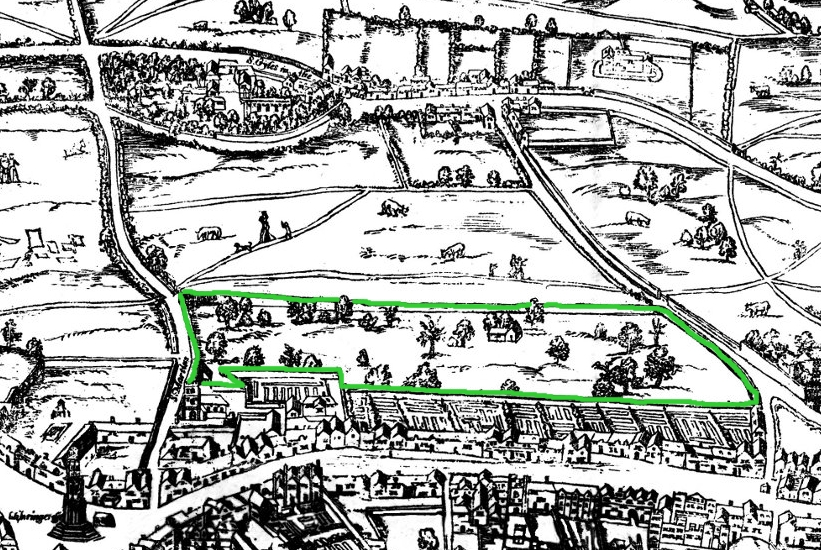
The area was fields until briefly settled in the 7th century when it became the heart of the Anglo-Saxon trading town of Lundenwic, then abandoned at the end of the 9th century after which it returned to fields. By 1200 part of it had been walled off by the Abbot of Westminster Abbey for use as arable land and orchards, later referred to as "the garden of the Abbey and Convent", and later "the Convent Garden". Following the Dissolution of the Monasteries it was granted in 1552 by the young King Edward VI to John Russell, 1st Earl of Bedford (1485–1555), the trusted adviser to his father King Henry VIII. The 4th Earl commissioned Inigo Jones to build some fine houses to attract wealthy tenants. Jones designed the Italianate arcaded square along with the church of St Paul's. The design of the square was new to London and had a significant influence on modern town planning, acting as the prototype for new estates as London grew.
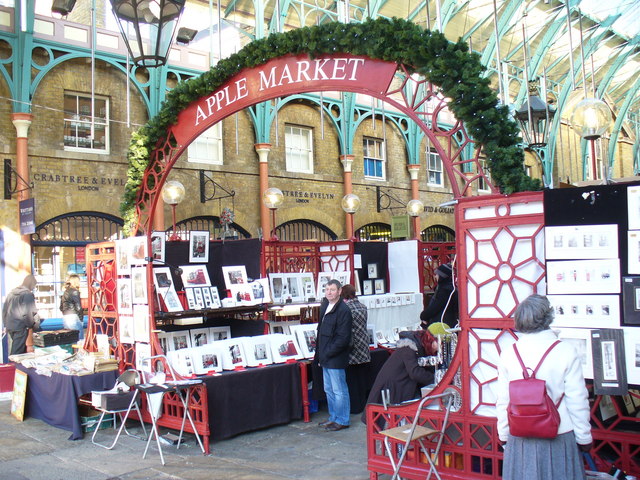
By 1654, a small open-air fruit-and-vegetable market had developed on the south side of the fashionable square. Gradually, both the market and the surrounding area fell into disrepute, as taverns, theatres, coffee houses and brothels opened up. and Charles Fowler's neo-classical building was erected in 1830 to cover and help organise the market. The market grew and further buildings were added: the Floral Hall, Charter Market, and in 1904 the Jubilee Market. By the end of the 1960s traffic congestion was causing problems, and in 1974 the market relocated to the New Covent Garden Market about three miles (5 km) southwest at Nine Elms. The central building re-opened as a shopping centre in 1980 and is now a tourist location containing cafes, pubs, small shops, and a craft market called the Apple Market, along with another market held in the Jubilee Hall.
Covent Garden falls within the London boroughs of Westminster and Camden and the parliamentary constituencies of Cities of London and Westminster and Holborn and St Pancras. The area has been served by the Piccadilly line at Covent Garden tube station since 1907; the 300 yd journey from Leicester Square tube station is the shortest in London. The side of Covent Garden that lies in the City of Westminster is a district of Westminster.
History
Early history
During the Roman period, what is now the Strand – running along the southern boundary of the area that was to become the "Covent Garden" – was part of the route to Silchester, known as "Iter VII" on the Antonine Itinerary. Excavations in 2006 at St Martin-in-the-Fields revealed a group of late Roman graves, suggesting the site had been sacred since at least 350 AD. The area to the north of the Strand was long thought to have remained as unsettled fields until the 16th century, but theories by Alan Vince and Martin Biddle that there had been an Anglo-Saxon settlement to the west of the old Roman town of Londinium were borne out by excavations in 1985 and 2005. These revealed that a trading town, called Lundenwic, developed around 600 AD, stretching from Trafalgar Square to Aldwych, with Covent Garden at the centre. Alfred the Great gradually shifted the settlement into the old Roman town of Londinium from around 886 AD onwards, leaving no mark of the old town, and the site returned to fields.
The first mention of a walled garden comes from a document, , detailing land owned by the Benedictine monks of the Abbey of St Peter, Westminster. A later document, dated between 1250 and 1283, refers to "the garden of the Abbot and Convent of Westminster". By the 13th century this had become a 40 acre quadrangle of mixed orchard, meadow, pasture and arable land, lying between modern-day St Martin's Lane and Drury Lane, and Floral Street and Maiden Lane. The use of the name "Covent"—an Anglo-French term for a religious community, equivalent to "monastery" or "convent"—appears in a document in 1515, when the Abbey, which had been letting out parcels of land along the north side of the Strand for inns and market gardens, granted a lease of the walled garden, referring to it as "a garden called Covent Garden". This is how it was recorded from then on.
Bedford Estate (1552–1918)

Following the Dissolution of the monasteries in 1540 under King Henry VIII, monastic lands in England reverted to the crown, including lands belonging to Westminster Abbey such as the Convent Garden and seven acres to the north called Long Acre. In 1552 King Edward VI granted it to John Russell, 1st Earl of Bedford,
Russell built Bedford House and garden on part of the land, with an entrance on the Strand, the large garden stretching back along the south side of the old walled-off convent garden. In 1630 Francis Russell, 4th Earl of Bedford commissioned the architect Inigo Jones to design and build a church and three terraces of fine houses around a large square or piazza. This had been prompted by King Charles I having taken offence at the poor condition of the road and houses along Long Acre, which were the responsibility of Russell and Henry Carey, 2nd Earl of Monmouth. Russell and Carey complained that under the 1625 Proclamation concerning Buildings, which restricted building in and around London, they could not build new houses. For a fee of £2,000, the King then granted Russell a licence to build as many new houses on his land as he "shall thinke fitt and convenient".
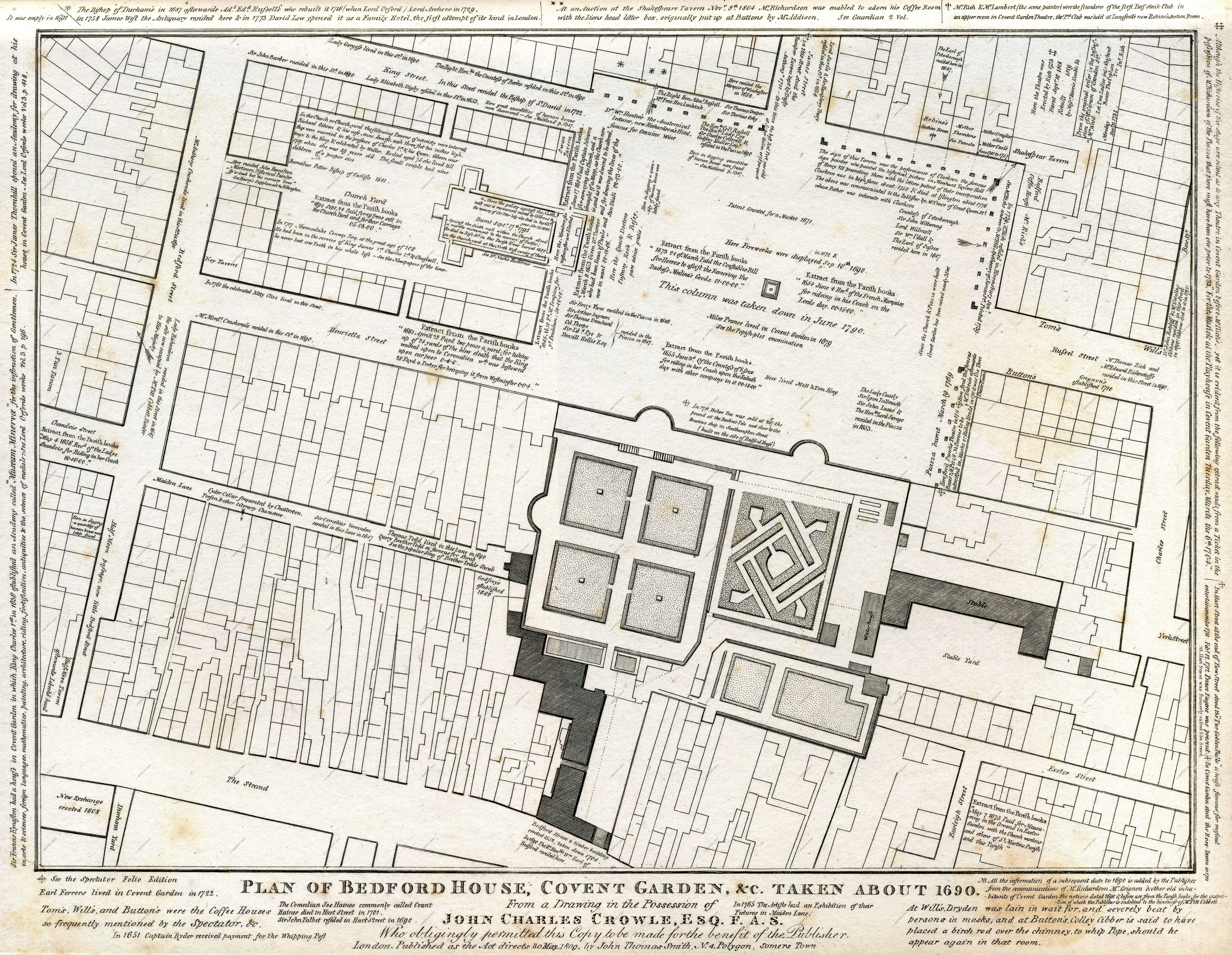
The houses initially attracted the wealthy, although they moved out when a market developed on the south side of the square around 1654, and coffee houses, taverns, and prostitutes moved in.
The Bedford Estate was expanded by the inheritance of the former manor of Bloomsbury to the immediate north of Covent Garden following the marriage of William Russell, Lord Russell (1639–1683) (third son of William Russell, 1st Duke of Bedford of Woburn Abbey in Bedfordshire) to Rachel Wriothesley, heiress of Bloomsbury, younger of the two daughters and co-heiresses of Thomas Wriothesley, 4th Earl of Southampton (1607-1667). Rachel's son and heir was Wriothesley Russell, 2nd Duke of Bedford (1680–1711).
By the 18th century, Covent Garden had become a well-known red-light district, attracting notable prostitutes such as Betty Careless and Jane Douglas. Descriptions of the prostitutes and where to find them were provided by Harris's List of Covent Garden Ladies, the "essential guide and accessory for any serious gentleman of pleasure". In 1830 a market hall was built to provide a more permanent trading centre. In 1913 Herbrand Russell, 11th Duke of Bedford agreed to sell the Covent Garden Estate for £2 million to the MP and land speculator Harry Mallaby-Deeley, who sold his option in 1918 to the Beecham family for £250,000.
Modern changes
The Covent Garden Estate was part of Beecham Estates and Pills Limited from 1924 to 1928, after which it was managed by a successor company called Covent Garden Properties, owned by the Beechams and other private investors. This new company sold some properties at Covent Garden, while becoming active in property investment in other parts of London. In 1962 the bulk of the remaining properties in the Covent Garden area, including the market, were sold to the newly established government-owned Covent Garden Authority for £3,925,000.
By the end of the 1960s, traffic congestion had reached such a level that the use of the square as a modern wholesale distribution market was becoming untenable, and significant redevelopment was planned. Following a public outcry, buildings around the square were protected in 1973, preventing redevelopment. The following year the market moved to a new site in Nine Elms, between Battersea and Vauxhall in southwest London. The square languished until its central building re-opened as a shopping centre in 1980.
After consulting with residents and local businesses, Westminster Council drew up an action plan to improve the area while retaining its historic character in 2004. The market buildings, along with several other properties in Covent Garden, were bought by a property company in 2006.
Geography

Historically, the Bedford Estate defined the boundary of Covent Garden, with Drury Lane to the east, the Strand to the south, St Martin's Lane to the west, and Long Acre to the north. However, over time the area regarded as part of Covent Garden has expanded northwards past Long Acre to High Holborn. Since 1971, with the creation of the Covent Garden Conservation Area which incorporated part of the area between St Martin's Lane and Charing Cross Road, Charing Cross Road has sometimes been taken as its western boundary. Long Acre is the main thoroughfare, running north-east from St Martin's Lane to Drury Lane. Shelton Street, running parallel to the north of Long Acre, marks the London borough boundary between Camden and Westminster.
The area to the south of Long Acre contains the Royal Opera House, the market and central square, and most of the elegant buildings, theatres and entertainment facilities, including the Theatre Royal, Drury Lane, and the London Transport Museum; while the area to the north of Long Acre is largely given over to independent retail units centred on Neal Street, Neal's Yard and Seven Dials; though this area also contains residential buildings such as Odhams Walk, built in 1981 on the site of the Odhams print works, and is home to 7,000 residents.
For a list of street name etymologies in Covent Garden see: Street names of Covent Garden.
Governance
The Covent Garden estate was originally under the control of Westminster Abbey and lay in the parish of St Margaret. During a reorganisation in 1542 it was transferred to St Martin in the Fields, and then in 1645 a new parish was created, splitting governance of the estate between the parishes of St Paul Covent Garden and St Martin, both still within the Liberty of Westminster. St Paul Covent Garden was completely surrounded by the parish of St Martin in the Fields. It was grouped into the Strand District in 1855. In 1900 it became part of the Metropolitan Borough of Westminster and was abolished as a civil parish in 1922. The northern reaches of Covent Garden were within the ancient parish of St Giles in the Fields and outside the Liberty of Westminster. They were from 1855 to 1900 part of the St Giles District and from 1900 part of the Metropolitan Borough of Holborn.
Covent Garden came within the area of responsibility of the Metropolitan Board of Works from 1855 and in 1889 became part of the County of London. Since 1965 Covent Garden falls within the London boroughs of Westminster and Camden, and is in the Parliamentary constituencies of Cities of London and Westminster and Holborn and St Pancras. For local council elections it falls within the St James's ward for Westminster, and the Holborn and Covent Garden ward for Camden.
Economy

Covent Garden Market reopened in 1980 as a shopping arcade with restaurants and a pub. The central hall has shops, cafes and bars alongside the Apple Market stalls selling antiques, jewellery, clothing and gifts; there are additional casual stalls in the Jubilee Hall Market on the south side of the square. In 2010, what was then the largest Apple Store in the world opened in The Piazza. Long Acre has clothes shops and boutiques, and Neal Street is noted for its numerous shoe shops. London Transport Museum and the side entrance to the Royal Opera House box office and other facilities are also located on the square. During the late 1970s and 1980s the Rock Garden music venue was popular with up-and-coming punk rock and new wave artists.
The market halls and several other buildings in Covent Garden were bought by Capital & Counties Properties (now known as Shaftesbury Capital) in partnership with GE Real Estate in August 2006 for £421 million, on a 150-year head lease. The buildings are let to the Covent Garden Area Trust, who pay an annual peppercorn rent of one red apple and a posy of flowers for each head lease, and the Trust protects the property from being redeveloped. In March 2007 CapCo also acquired the shops located under the Royal Opera House. The complete Covent Garden Estate owned by CapCo consists of 550000 sqft, and, as of 2025, has a market value of £2.7 billion.
Landmarks
Royal Opera House
Main article: Royal Opera House
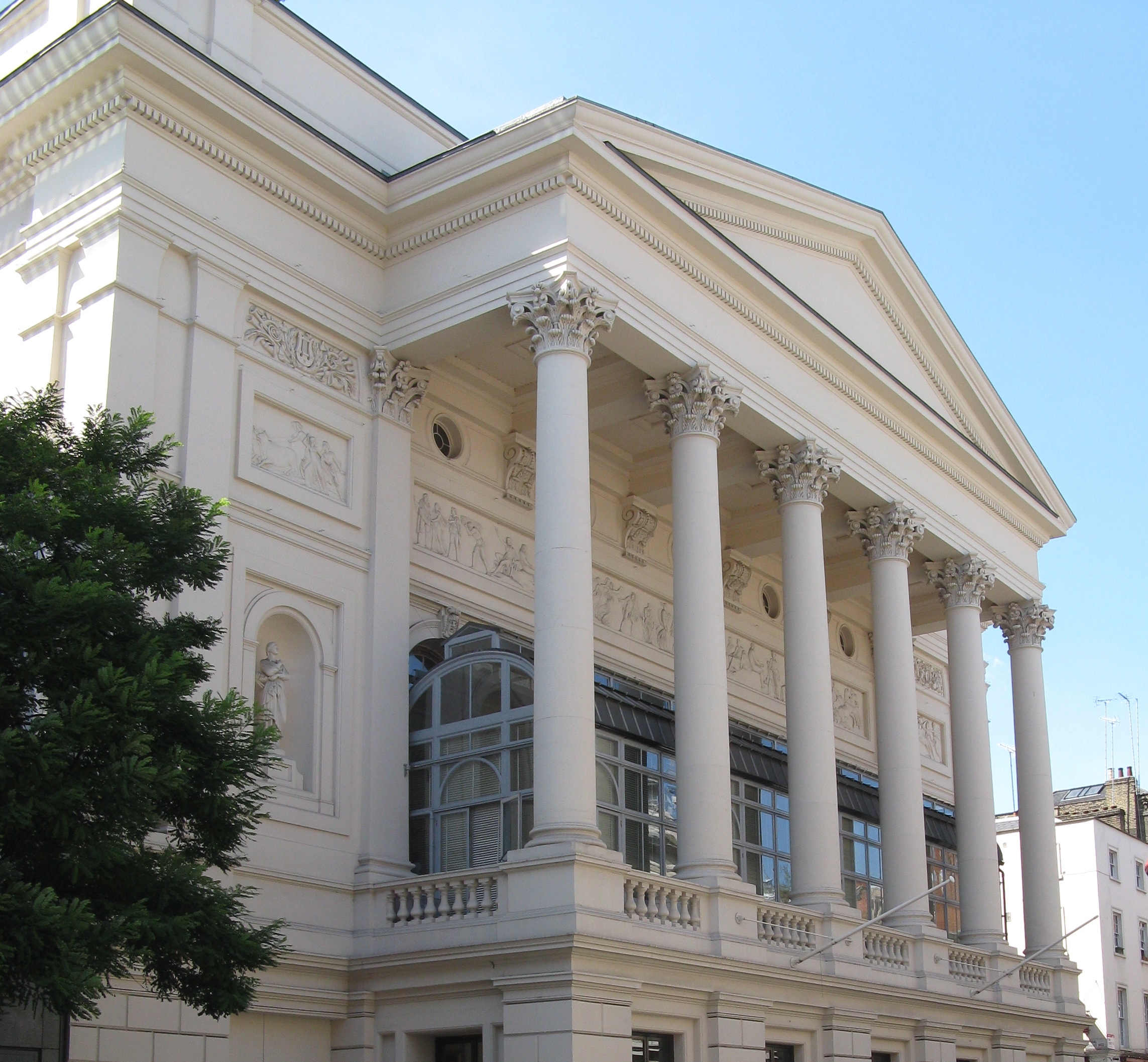
The Royal Opera House, known as "Covent Garden", was constructed as the "Theatre Royal" in 1732 to a design by Edward Shepherd. During the first hundred years or so of its history, the theatre was primarily a playhouse, with the Letters Patent granted by Charles II giving Covent Garden and Theatre Royal, Drury Lane, exclusive rights to present spoken drama in London. In 1734, the first ballet was presented; a year later Handel's first season of operas began. Many of his operas and oratorios were specifically written for Covent Garden and had their premières here. It has been the home of The Royal Opera since 1945, and the Royal Ballet since 1946.
The current building is the third theatre on the site following destructive fires in 1808 and 1857. The façade, foyer and auditorium were designed by Edward Barry, and date from 1858, but almost every other element of the present complex dates from an extensive £178 million reconstruction in the 1990s. In 1779 the pavement outside the playhouse was the scene of the murder of Martha Ray, mistress of the Earl of Sandwich, by her admirer the Rev. James Hackman.
Covent Garden Piazza
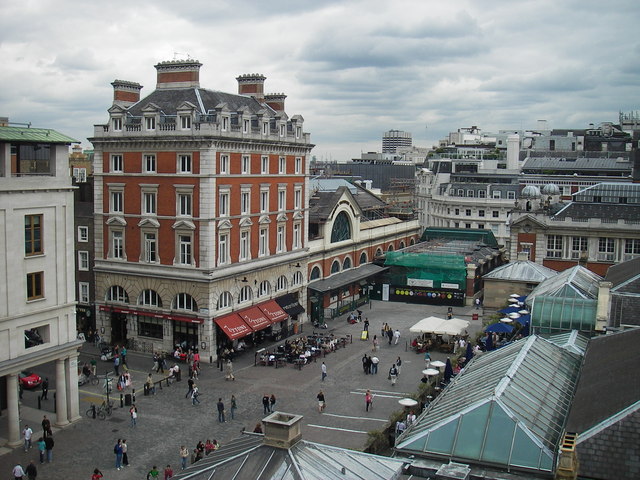
The central square in Covent Garden is simply called "Covent Garden", often marketed as "Covent Garden Piazza" to distinguish it from the eponymous surrounding area. Designed and laid out in 1630, it was the first modern square in London—originally a flat, open space or piazza with low railings. From about 1635 onwards there were many private residents of note, including the nobility, living in the Great Piazza. A casual market started on the south side, and by 1830 the present market hall had been built. The space is popular with street performers, who audition with the site's owners for an allocated slot. The square was originally laid out when the 4th Earl of Bedford, Francis Russell, commissioned Inigo Jones to design and build a church and three terraces of fine houses around the site of a former walled garden belonging to Westminster Abbey. The centrepiece of the project was the large square, the concept of which was new to London, and this had a significant influence on modern town planning as the metropolis grew, Isaac de Caus, the French Huguenot architect, designed the individual houses under Jones's overall design.
The church of St Paul's was the first building and was begun in July 1631 on the western side of the square. The last house was completed in 1637. Seventeen of the houses had arcaded portico walks organised in groups of four and six either side of James Street on the north side, and three and four either side of Russell Street. These arcades, rather than the square itself, took the name Piazza;
Covent Garden market
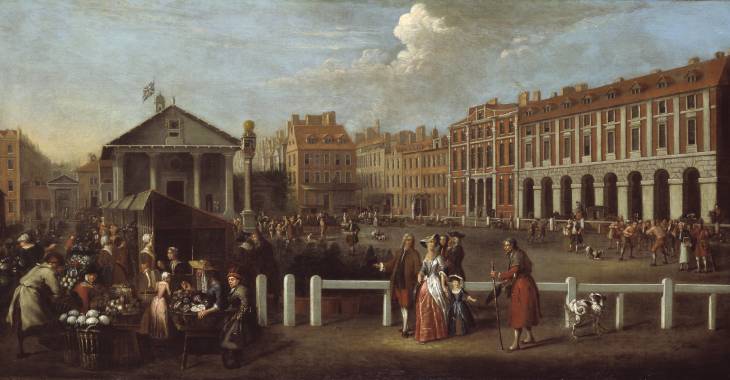
The first record of a "new market in Covent Garden" is in 1654 when market traders set up stalls against the garden wall of Bedford House. The Earl of Bedford acquired a private charter from Charles II in 1670 for a fruit and vegetable market, permitting him and his heirs to hold a market every day except Sundays and Christmas Day. The original market, consisting of wooden stalls and sheds, became disorganised and disorderly, and John Russell, 6th Duke of Bedford, requested an act of Parliament, the Covent Garden Market Act 1813 (53 Geo. 3. c. lxxi), to regulate it, The contractor was William Cubitt and Company.

By the end of the 1960s, traffic congestion was causing problems for the market, which required increasingly large lorries for deliveries and distribution. The redevelopment was considered, but protests from the Covent Garden Community Association in 1973 prompted the Home Secretary, Robert Carr, to give dozens of buildings around the square listed-building status, preventing redevelopment. The following year the market relocated to its new site, New Covent Garden Market, about three miles (5 km) south-west at Nine Elms. The central building re-opened as a shopping centre in 1980, with cafes, pubs, small shops and a craft market called the Apple Market. Among the first shops to relocate here was Benjamin Pollock's Toy Shop. Another market, the Jubilee Market, is held in the Jubilee Hall on the south side of the square. The market halls and several other buildings in Covent Garden have been owned by the property company Capital & Counties Properties (CapCo) since 2006. In 1980 the London Transport Museum opened in part of the old flower market buildings, and these were refurbished in around 2005 to re-open in 2007.
Theatre Royal, Drury Lane
Main article: Theatre Royal, Drury Lane

The current Theatre Royal on Drury Lane is the most recent of four incarnations, the first of which opened in 1663, making it the oldest continuously used theatre in London. For much of its first two centuries, it was, along with the Royal Opera House, a patent theatre granted rights in London for the production of drama, and had a claim to be one of London's leading theatres. The first theatre, known as "Theatre Royal, Bridges Street", saw performances by Nell Gwyn and Charles Hart. After it was destroyed by fire in 1672, English dramatist and theatre manager Thomas Killigrew constructed a larger theatre on the same spot, which opened in 1674. Killigrew's theatre lasted nearly 120 years, under leadership including Colley Cibber, David Garrick, and Richard Brinsley Sheridan. In 1791, under Sheridan's management, the building was demolished to make way for a larger theatre which opened in 1794. However, that survived only 15 years, burning down in 1809. The building that stands today opened in 1812. It has been home to actors as diverse as Shakespearean actor Edmund Kean, child actress Clara Fisher, comedian Dan Leno, the comedy troupe Monty Python (who recorded a concert album there), and musical composer and performer Ivor Novello. Since November 2008 the theatre has been owned by composer Andrew Lloyd Webber and generally stages popular musical theatre. It is a Grade I listed building.
London Transport Museum
Main article: London Transport Museum
The London Transport Museum is in a Victorian iron and glass building on the east side of the market square. It was designed as a dedicated flower market by William Rogers of William Cubitt and Company in 1871, The Covent Garden building has on display many examples of buses, trams, trolleybuses and rail vehicles from the 19th and 20th centuries as well as artefacts and exhibits related to the operation and marketing of passenger services and the impact that the developing transport network has had on the city and its population.
St Paul's Church
Main article: St Paul's, Covent Garden
St Paul's, commonly known as the Actors' Church, was built in 1633, at a cost of £4,000, though was not consecrated until 1638. In 1645 Covent Garden was made a separate parish and the church was dedicated to St Paul. How much of Jones's original building is left is unclear, as the church was damaged by fire in 1795 during restoration work by Thomas Hardwick; the columns are thought to be original but the rest is mostly Georgian or Victorian reconstruction.
Bow Street Magistrates' Court building
Main article: Bow Street Magistrates' Court, Bow Street Museum of Crime and Justice
.jpg)
The building, opposite the Royal Opera House, was opened in 1881 to house both a Magistrates' Court and a police station. As well as dealing with local petty criminals, a number of high-profile defendants appeared in the court, including Oscar Wilde, Dr Crippen and the Kray twins, and those facing extradition proceedings, such as Augusto Pinochet and James Earl Ray.
The police station closed in 1992, with its work moving to the more modern Charing Cross police station. The court building's Grade II listed status meant it was not economic to update it to modern standards and the court closed in July 2006. Sold to developers, planning permission was obtained to convert the building into a hotel and museum. A 91-room hotel and a public restaurant, run by the New York based NoMad chain, opened in May 2021, as did a museum of local police history in the former police station.
Freemasons' Hall
Main article: Freemasons' Hall, London
Freemasons' Hall is the headquarters of the United Grand Lodge of England and the Supreme Grand Chapter of Royal Arch Masons of England, as well as a meeting place for many Masonic Lodges in the London area. It is in Great Queen Street between Holborn and Covent Garden and has been a Masonic meeting place since 1775. Parts of the building are open to the public daily, and its preserved classic Art Deco style, together with its regular use as a film and television location, have made it a tourist destination.
Historical diversity
London newspaper adverts printed in the 17th and 18th century confirm the presence of free and unfree men, women and children of African and Asian heritage living and working in the area. Like "Sarah", a young enslaved woman of colour who ran away from Mary Vernon, at Fishers Warehouse in Tavistock Street, Covent Garden in 1746.
RUN away from her Mistress on Saturday Morning last...Sarah, but is suppos’d to have been lately christen’d; she is about twenty Years of Age, short and thick, has one of her little Fingers bent inwards, and is mark’d on the Right Shoulder with the Letters IV, speaks pretty good English, and took away with her a white Linnen Gown, a blue and white Linnen Gown, and a brown Stuff Gown, of her own Apparel: Whoever will bring her to her Mistress, Mary Vernon, at Fisher’s Warehouse in Tavistock-Street, Covent-Garden, shall have Five Guineas Reward; or who yet will give Notice where she may be found, shall have Guinea for their Trouble; and if she will voluntarily return to her Mistress, she shall be kindly receiv’d, and all her Faults forgiven; but whoever shall harbour or entertain her after the Publication thereof, will be prosecuted to the Rigour of the Law.
Mary Vernon is believed to be the daughter of James Vernon Senior (whose wife was also called Mary) who was clerk to the supreme court of Jamaica. Mary was, therefore, the sister of James Vernon Junior, and Admiral Edward Vernon who coined the term ‘grog’ and sailed a fleet to Jamaica in July 1739. Admiral Vernon would have been tended to by enslaved domestic servants like Sarah when in Jamaica, and it was relatively common for Royal Navy commanders to bring these individuals to Britain when they returned, often gifting unfree women and girls to their mothers, wives and daughters. The initials I and V branded on Sarah’s shoulders could indicate that she had belonged to a Vernon in Jamaica before coming to Britain. There were a number of plantation owners in Jamaica of the same name who were related to the Vernons of Westminster.
Culture
Covent Garden Festival
The Covent Garden area has long been associated with entertainment and shopping. Covent Garden has 13 theatres, and over 60 pubs and bars, with most south of Long Acre, around the main shopping area of the old market. The Seven Dials area in the north of Covent Garden was home to the punk rock club The Roxy in 1977, and the area remains focused on young people with its trendy mid-market retail outlets. From 1996 to 2001 there was a "Covent Garden Festival", which had opera and drama performances at venues such as Bow Street Magistrates' Court,
Street performance

Street entertainment at Covent Garden was noted in Samuel Pepys's diary in May 1662, when he recorded the first mention of a Punch and Judy show in Britain. Impromptu performances of song and swimming were given by local celebrity William Cussans in the eighteenth century. Covent Garden is licensed for street entertainment, and performers audition for timetabled slots in a number of venues around the market, including the North Hall, West Piazza, and South Hall Courtyard. The courtyard space is dedicated to classical music only.
There are street performances at Covent Garden Market every day of the year, except Christmas Day. Shows run throughout the day and are about 30 minutes in length. In March 2008, the market owner, CapCo, proposed to reduce street performances to one 30-minute show each hour.
Pubs and bars
The Covent Garden area has over 60 pubs and bars; several of them are listed buildings, with some also on CAMRA's National Inventory of Historic Pub Interiors; some, such as The Harp in Chandos Place, have received consumer awards. The Harp's awards include London Pub of the Year in 2008 by the Society for the Preservation of Beers from the Wood, and National Pub of the Year by CAMRA in 2010. It was at one time owned by the Charrington Brewery, when it was known as The Welsh Harp; in 1995 the name was abbreviated to just The Harp, before Charrington sold it to Punch Taverns in 1997. It was eventually purchased by the landlady Binnie Walsh around 2010 then subsequently sold by her to Fuller's Brewery in 2014. It continues to win regular CAMRA pub awards under its new owners.
The Lamb and Flag in Rose Street is possibly the oldest pub in the area. The first mention of a pub on the site is 1772 (when it was called the Cooper's Arms – the name changing to Lamb & Flag in 1833); the 1958 brick exterior conceals what may be an early 18th-century frame of a house replacing the original one built in 1638. The pub acquired a reputation for staging bare-knuckle prize fights during the early 19th century when it earned the nickname "Bucket of Blood". The alleyway beside the pub was the scene of an attack on John Dryden in 1679 by thugs hired by John Wilmot, 2nd Earl of Rochester, with whom he had a long-standing conflict.
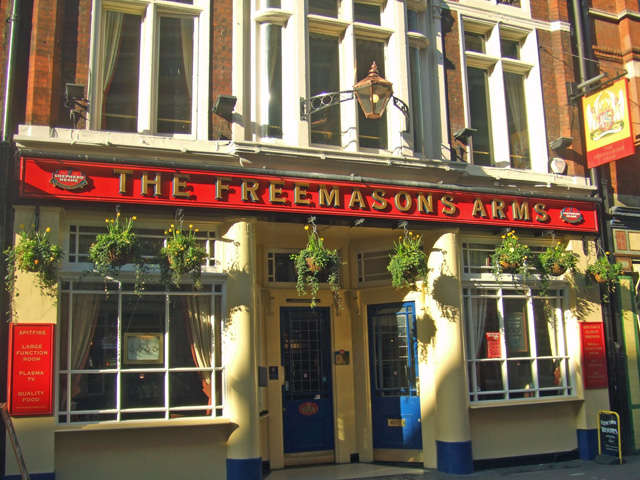
The Salisbury in St Martin's Lane was built as part of a six-storey block around 1899 on the site of an earlier pub that had been known under several names, including the Coach & Horses and Ben Caunt's Head; it is both Grade II listed, and on CAMRA's National Inventory, due to the quality of the etched and polished glass and the carved woodwork, summed up as "good fin de siècle ensemble". The Freemasons Arms on Long Acre is linked with the founding of the Football Association in 1863; however, the meetings took place at The Freemason's Tavern on Great Queen Street, which was replaced in 1909 by the Connaught Rooms.
Other Grade II listed pubs include three 19th century rebuilds of 17th century/18th century houses, the Nell Gwynne Tavern in Bull Inn Court, the Nag's Head on James Street, and the White Swan on New Row; a Victorian pub built by lessees of the Marquis of Exeter, the Old Bell on the corner of Exeter Street and Wellington Street; and a late 18th or early 19th century pub the Angel and Crown on St Martin's Lane.
Restaurants
There is a wide range of restaurants, mainly in Covent Garden's central area around the piazza, and in the St Martin's Lane area bordering the West End; some of these with international reputations. Among the restaurants are the historic theatrical eating places, the oldest of which is Rules, which was founded in 1798, making it the oldest restaurant in London, followed by J. Sheekey, an oyster bar and fish restaurant founded in 1893 by market-stall holder Josef Sheekey in Lord Salisbury's St Martin's Court, and The Ivy, which was founded as an unlicensed Italian cafe by Abel Giandellini in 1917. Other restaurants include Gaby's Deli, a Jewish cafe and restaurant serving falafels and salt beef sandwiches since 1965, and Mon Plaisir, founded in 1943, one of the oldest French restaurants in London. Covent Garden was home to some of London's earliest coffee shops, such as Old Slaughter's Coffee House, which ran from 1692 until 1843, and a Beefsteak Club, the Sublime Society of Beef Steaks, which was co-founded in 1736 by William Hogarth at the Theatre Royal (now the Royal Opera House).
Cultural connections
Covent Garden, and especially the market, have appeared in a number of works. It is the place where Job Trotter, character of the Pickwick Papers by Dickens, spends the nights. In 1867, Johann Strauss II from Austria composed "Erinnerung an Covent Garden" (Memory of Covent Garden, op. 329). Eliza Doolittle, the central character in George Bernard Shaw's play, Pygmalion, and the musical adaptation by Alan Jay Lerner, My Fair Lady, is a Covent Garden flower seller. Alfred Hitchcock's 1972 film Frenzy about a Covent Garden fruit vendor who becomes a serial sex killer, was set in the market where his father had been a wholesale greengrocer. The daily activity of the market was the topic of a 1957 Free Cinema documentary by Lindsay Anderson, Every Day Except Christmas, which won the Grand Prix at the Venice Festival of Shorts and Documentaries.
Cinemas
The Garden Cinema, which opened in March 2022, is located in Parker Street. The cinema is designed in Art Deco style, inside and out. It was founded by retired legal publisher Michael Chambers, of Orbach and Chambers, who bought the office building in 2010 and, after selling his business in 2018, had it converted by architects Burrell Foley Fischer. It was ready by 2020, but the COVID-19 pandemic delayed its opening. The cinema partners with a number of film festivals and other organisations, as well as hosting Q&As, live music, and poetry recitals.
Transport

Covent Garden tube station is situated on the corner of Long Acre and James Street. It is served by Piccadilly line trains, which link the area directly to important Central London destinations including King's Cross St Pancras, South Kensington, and Heathrow Airport (). The station opened in 1907, and is one of the few in Central London for which platform access is only by lift or stairs.
The journey from Covent Garden to Leicester Square is London's shortest tube journey, at less than 300 yards. Leicester Square tube station is on the Piccadilly and Northern lines. The Northern line links Covent Garden directly to destinations such as Waterloo, Euston, and Camden Town.
Other nearby tube stations include Charing Cross, Embankment, and Holborn. Charing Cross is the nearest National Rail ('mainline') station to Covent Garden.
More than 30 London Buses routes run along Covent Garden's perimeters, although no routes run directly through Covent Garden following the permanent withdrawal of the RV1 route in 2019.
The Quietway 1 cycle route passes through Covent Garden. The route is signposted and runs on quieter roads or contraflow cycle lanes. The route runs northbound towards the Bloomsbury, and southbound to the Strand and Waterloo Bridge, via Bow Street.
The Santander Cycles bike sharing scheme operates in Covent Garden, with several docking points throughout the area.
References
Bibliography
- Anderson, Christy (2007). Inigo Jones and the Classical Tradition. Cambridge University Press. .
- Banham, Martin (1995). The Cambridge Guide to Theatre. Cambridge University Press. .
- Boursnell, Clive; Ackroyd, Peter (2008). Covent Garden: The Fruit, Vegetable and Flower Markets. Frances Lincoln Publishers. .
- Burford, E. J. (1986). Wits, Wenchers and Wantons – London's Low Life: Covent Garden in the Eighteenth Century. Robert Hale Ltd. .
- Kilburn, Mike; Arzoz, Alberto (2002). London's Theatres. New Holland Publishers. .
- Porter, Roy (1998). London: A Social History. Harvard University Press. .
- Sheppard, F. H. W. (1970). Survey of London: volume 36: Covent Garden. Institute of Historical Research.
- Summerson, John (1983). Inigo Jones. Penguin. .
- Thorne, Robert (1980). Covent Garden Market: its History and Restoration. Architectural Press. .
- Weinreb, Ben; Hibbert, Christopher (2008). The London Encyclopaedia. Pan Macmillan. .
References
- (1813). "Covent Garden Market Act 1813". legislation.gov.uk.
- (17 April 2007). "London's shortest tube journey". Time Out London.
- "The Antonine Itinerary". Roman Britain.
- J. S. Cockburn. (1969). "A History of the County of Middlesex: Volume 1". Institute of Historical Research.
- (1 December 2006). "Ancient body prompts new theories". BBC News.
- Jim Leary. "Excavations at 15–16 Bedford Street, Covent Garden, London". Pre-Construct Archaeology.
- "The early years of Lundenwic". Museum of London.
- John Clark. (1999). "King Alfred's London and London's King Alfred". London Archaeologist Association.
- E. J. Burford. (1986). "Wits, Wenchers and Wantons – London's Low Life: Covent Garden in the Eighteenth Century". Robert Hale Ltd.
- F. H. W. Sheppard. (1970). "Survey of London: volume 36: Covent Garden". Institute of Historical Research.
- "Convent".
- (1951). "[[The Concise Oxford Dictionary]]". Clarendon Press.
- Alzina Stone Dale, Barbara Sloan-Hendershott. (2004). "Mystery Reader's Walking Guide: London". iUniverse.
- John Richardson. (2000). "The annals of London: a year-by-year record of a thousand years of history, Volume 2000, Part 2". University of California Press.
- "Plan of Bedford House, Covent Garden, &c. Taken About 1690". MAPCO.
- E. J. Burford. (1986). "Wits, Wenchers and Wantons – London's Low Life: Covent Garden in the Eighteenth Century". Hale.
- F. H. W. Sheppard. (1970). "Survey of London: volume 36: Covent Garden". Institute of Historical Research.
- Roy Porter. (1998). "London: A Social History". Harvard University Press.
- "History of the Bloomsbury Estate". Bedford Estates.
- E. J. Burford. (1986). "Wits, Wenchers and Wantons – London's Low Life: Covent Garden in the Eighteenth Century". Hale.
- Gerald Isaaman. (29 July 2005). "The A to Z of Covent Garden's prostitutes". Camden New Journal.
- F. H. W. Sheppard. (1970). "Survey of London: volume 36: Covent Garden". Institute of Historical Research.
- "Covent Garden Action Plan".
- "About Us". Covent Garden London Official Guide.
- (2008). "[[The London Encyclopaedia]]". Pan Macmillan.
- Robert Thorne. (1980). "Covent Garden Market: Its History and Restoration". Architectural Press.
- Conservation Area Audits Team. (2007). "Covent Garden Extension Report". westminster.gov.uk.
- (July 2006). "Draft Supplementary Planning Guidance for Entertainment Uses". westminster.gov.uk.
- "Our Neighbourhood". CGCA.
- "Street features: Long Acre". Covent Garden London: Online Magazine.
- "Ward and polling district map". Camden Council.
- "Showcase: Odham's Walk: Overview". Academy for Sustainable Communities.
- "Membership of The Covent Garden Community Association". Covent Garden Community Association.
- F. H. W. Sheppard. (1970). "Survey of London: volume 36: Covent Garden". Institute of Historical Research.
- F. H. W. Sheppard. (1970). "Survey of London: volume 36: Covent Garden". Institute of Historical Research.
- Frederic Youngs. (1979). "Guide to the Local Administrative Units of England, Volume 1: Southern England". Royal Historical Society.
- M. H. Port. (1986). "The Commissions for building fifty new churches: The minute books, 1711–27, a calendar". Institute of Historical Research.
- "Registration Districts". City of Westminster Archives Centre.
- "The Parliamentary Constituencies (England) Order 2007". The National Archives.
- "Westminster's Wards on a map". westminster.gov.uk.
- "Camden ward map". camden.gov.uk.
- Alan C. Parnell. (30 Aug 2013). "Building Legislation and Historic Buildings". Elsevier.
- (2010). "Frommer's England 2011". Frommer's.
- Jemima Kiss. (5 August 2010). "Apple chooses London to open its biggest store in the world". The Guardian.
- Pete Frame. (1999). "Pete Frame's rockin' around Britain: rock'n'roll landmarks of the UK and Ireland". Omnibus.
- Laura Chesters. (2 November 2007). "Covent Garden, Selfridges style". Property Week.
- Molly Dover. (28 July 2006). "Capital & Counties JV wins Covent Garden". Property Week.
- (26 March 2007). "CapCo grows in Covent Garden". Shopping centre.
- Paul Norman. "Norges buys 25% of Shaftesbury Capital's £2.7 billion Covent Garden estate". costar.com.
- Matthew Hoch. (28 Apr 2014). "A Dictionary for the Modern Singer". Scarecrow Press.
- (2000). "Merriam-Webster's collegiate encyclopedia". Merriam-Webster.
- Winton Dean. (2006). "Handel's operas, 1726–1741". Boydell Press.
- "Ninette de Valois Bequest and Papers". Royal Opera House Collections Online.
- "History". Royal Opera House.
- Philip Rawlings. (2004). "Hackman, James (bap. 1752, d. 1779)". Oxford University Press.
- Walter Thornbury. (1878). "Old and New London: Volume 3". Institute of Historical Research.
- F. H. W. Sheppard. (1970). "Survey of London: volume 36: Covent Garden". Institute of Historical Research.
- "Street performer auditions". Covent Garden London Official Guide.
- F. H. W. Sheppard. (1970). "Survey of London: volume 36: Covent Garden". Institute of Historical Research.
- Christy Anderson. (2007). "Inigo Jones and the Classical Tradition". Cambridge University Press.
- F. H. W. Sheppard. (1970). "Survey of London: volume 36: Covent Garden". Institute of Historical Research.
- (2 July 2008). "Proposed Development at Bedford Chambers and No. 1 and Nos. 6–7 (inclusive) The Piazza". City of Westminster.
- "Room Guide – Room 5: Street Life". Tate Britain.
- F. H. W. Sheppard. (1970). "Survey of London: volume 36: Covent Garden". Institute of Historical Research.
- (2008). "Covent Garden: The Fruit, Vegetable and Flower Markets". Frances Lincoln Publishers.
- Robert Thorne. (1980). "Covent Garden Market: Its History and Restoration". Architectural Press.
- (1990). "Banff & Buchan: An Illustrated Architectural Guide". Mainstream Publications Ltd..
- (2008). "[[The London Encyclopaedia]]". Pan Macmillan.
- "Covent Garden". Museum of London.
- (2008). "[[The London Encyclopaedia]]". Pan Macmillan.
- "About us".
- Suzy Gershman. (2008). "Suzy Gershman's Born to Shop London: The Ultimate Guide for People Who Love to Shop". Frommer's.
- "Brief history of the Museum". London Transport Museum.
- (9 May 2007). "Theatres in Victorian London". Victorian Web.
- Martin Banham. (1995). "The Cambridge Guide to Theatre". Cambridge University Press.
- Sylvia Stoler Wagonheim. (21 August 2013). "The Annals of English Drama 975–1700". Routledge.
- Paul Kuritz. (1988). "The Making of Theatre History". Paul Kuritz.
- Robert D. Hume. (2007). "Players, Playwrights, Playhouses: Investigating Performance, 1660–1800". Palgrave Macmillan.
- Martin Banham. (1995). "The Cambridge Guide to Theatre". Cambridge University Press.
- "The Theatre Royal Drury Lane". The Music Hall and Theatre History Site.
- Mike Kilburn, Alberto Arzoz. (2002). "London's Theatres". New Holland Publishers.
- "Collections". London Transport Museum.
- "Welcome to St. Paul's Church website". The Actor's Church.
- F. H. W. Sheppard. (1970). "Survey of London: volume 36: Covent Garden". Institute of Historical Research.
- John Summerson. (1966). "Inigo Jones". Penguin.
- Brown, Mark. (27 May 2021). "Not like I remember it': Bow Street police station reopens as museum". [[The Guardian]].
- (18 December 2020). "London's Bow Street Police Station to be turned into museum". [[BBC News]].
- (2008). "The London Encyclopedia". Pan MacMillan.
- RISE Management, Consulting news. (2015). "Appointment of construction manager for conversion of Bow Street Magistrates' Court into luxury Boutique Hotel".
- O’Flaherty, Mark. (28 May 2021). "London's most famous courtroom is now the capital's hottest hotel". [[The Daily Telegraph]].
- (2017). "Freemasons' Hall". United Grand Lodge of England.
- Newman, Simon. (2022-02-01). "Freedom Seekers: Escaping from Slavery in Restoration London". University of London.
- "Runaways :: Management - Display Record".
- "VERNON, James I (1646-1727), of Frith Street, Westminster, Mdx. {{!}} History of Parliament Online".
- Newman, Simon P. (October 2019). "Freedom-Seeking Slaves in England and Scotland, 1700–1780". The English Historical Review.
- (November 2023). "Filippo Argelati to Lodovico Antonio Muratori, Tuesday, 14 July 1739 [muraloLO0030552a1c]".
- "VERNON Admiral Edward Verno - Genealogy.com".
- Walker, Christine. (2020-06-08). "Jamaica Ladies". University of North Carolina Press.
- "Details of Estate {{!}} Legacies of British Slavery".
- (2010). "Party Earth – Europe". Party Earth LLC.
- "Theatres Index Page". Covent Garden Street Site.
- "Pubs in Covent Garden". Fancyapint?.
- (4 October 2007). "Roxy music". The Guardian.
- Rhonda Carrier. (2005). "Frommer's London with Kids". Frommer's.
- Webb, Paul. (13 October 2001). "UK's Covent Garden Festival to Close".
- (21 March 2013). "Fine tuning". [[The Irish Times]].
- "After the Ball".
- Dunnett, Roderic. (11 May 2000). "The garden of earthly delights".
- Glyn Edwards. "Covent Garden and the story of Punch and Judy". Covent Garden Life.
- John Thomas Smith. (1829). "Nollekens and his times, volume 2". H. Colburn.
- (27 March 2008). "Buskers fear 'thin end of wedge'". BBC News.
- (23 March 2011). "London Pubs Group Evening Crawl of The Strand and Covent Garden". CAMRA North London.
- "The Harp – Reviews and Awards". The Harp Bar, Covent Garden.
- Michelle Perrett. (16 February 2011). "The Harp in Covent Garden: a national treasure". Morning Advertiser.
- "Greater London Pub of the Year 2008". The Society for the Preservation of Beers from the Wood.
- "Welsh Harp, 47 Chandos Street, St Martins in Fields". Dead Pubs.
- "The Lamb and Flag". Pubs.com.
- F. H. W. Sheppard. (1970). "Survey of London: volume 36: Covent Garden". Institute of Historical Research.
- (2007). "Frommer's England 2008". Frommer's.
- John Richardson. (2000). "The Annals of London". University of California Press.
- {{Cite EB1911
- "St Martins Lane". Heritage Pubs.
- "Welcome to The Freemasons Arms, Covent Garden". shepherdneame.co.uk/pubs.
- Jaime Orejan. (2011). "Football/Soccer: History and Tactics". McFarland.
- "The History of The FA". thefa.com.
- "Freemasons' Tavern". londonremembers.com.
- {{National Heritage List for England
- {{National Heritage List for England
- {{National Heritage List for England
- {{National Heritage List for England
- F. H. W. Sheppard. (1970). "Survey of London: Volume 36, Covent Garden". London County Council.
- {{National Heritage List for England
- (July 2006). "Draft Supplementary Planning Guidance for Entertainment Uses". westminster.gov.uk.
- Paul Ibell. (1 July 2009). "Theatreland: A Journey Through the Heart of London's Theatre". A&C Black.
- John Walsh. (14 March 2009). "J Sheekey Oyster Bar". independent.co.uk.
- Robb Walsh. (2009). "Sex, Death & Oysters: A Half-shell Lover's World Tour". Counterpoint.
- Matthew Fort. (4 November 2010). "The Ivy: dine with the stars". theguardian.com.
- "History". the-ivy.co.uk.
- Vanessa Thorpe. (11 December 2011). "Stars unite to save the falafels that fuelled theatreland". theguardian.com.
- Elizabeth Sharland. (16 November 2009). "Behind the Doors of Notorious Covent Garden". iUniverse.
- Ryan Ver Berkmoes. (2000). "London". Lonely Planet Publications.
- (2008). "[[The London Encyclopaedia]]". Pan Macmillan.
- Mark Hailwood, Deborah Toner. (5 February 2015). "Biographies of Drink: A Case Study Approach to our Historical Relationship with Alcohol". Cambridge Scholars Publishing.
- David S. White. (2000). "Let's Take the Kids to London: A Family Travel Guide". Take the Kids to London.
- (2008). "Covent Garden: The Fruit, Vegetable and Flower Markets". Frances Lincoln Publishers.
- Chuck Arrington. (19 February 2001). "The Alfred Hitchcock Collection: Frenzy". DVD Talk.
- Christophe Dupin. "Every Day Except Christmas (1957)". BFI Screenonline.
- (22 January 2024). "About Us / The Garden Cinema".
- (15 March 2022). "Garden Cinema in London, GB".
- (21 August 2023). "The Garden Cinema".
- Baron, Saskia. (22 July 2023). "Michael Chambers on founding London's Garden Cinema".
- (11 January 2024). "Partners / The Garden Cinema".
- "London's Rail and Tube Services".
- Oliver Green. (20 November 2012). "The Tube: Station to Station on the London Underground". Bloomsbury Publishing.
- "TfL confirms RV1 will be axed in central London bus changes".
- "Getting to Covent Garden by bus". Covent Garden London.
- "Cycle".
This article was imported from Wikipedia and is available under the Creative Commons Attribution-ShareAlike 4.0 License. Content has been adapted to SurfDoc format. Original contributors can be found on the article history page.
Ask Mako anything about Covent Garden — get instant answers, deeper analysis, and related topics.
Research with MakoFree with your Surf account
Create a free account to save articles, ask Mako questions, and organize your research.
Sign up freeThis content may have been generated or modified by AI. CloudSurf Software LLC is not responsible for the accuracy, completeness, or reliability of AI-generated content. Always verify important information from primary sources.
Report