From Surf Wiki (app.surf) — the open knowledge base
Couscous
Traditional Maghrebi dish

Traditional Maghrebi dish
| Field | Value |
|---|---|
| name | Couscous |
| image | Moroccan cuscus, from Casablanca, September 2018.jpg |
| image_size | 235px |
| caption | Couscous served with vegetables and chickpeas |
| alternate_name | Kesksou, seksu, ta'ām, kosksi, aberbuc, uccu |
| place_of_origin | Maghreb |
| course | Main course, side dish or dessert |
| main_ingredient | Semolina |
| variations | Moghrabieh, maftoul |
| serving_size | , dry |
| calories | 150 |
| calories_ref | |
| protein | 5 |
| fat | 0 |
| carbohydrate | 30 |
Couscous () is a traditional North African dish of small steamed granules of rolled semolina that is often served with a stew spooned on top. Pearl millet, sorghum, bulgur, and other cereals are sometimes cooked in a similar way in other regions, and the resulting dishes are also sometimes called couscous.
Couscous is a staple food throughout the Maghrebi cuisines of Algeria, Tunisia, Mauritania, Morocco, and Libya. It was integrated into French and European cuisine at the beginning of the twentieth century, through the French colonial empire and the Pieds-Noirs of Algeria.
In 2020, couscous was added to UNESCO's Intangible Cultural Heritage list.
Etymology
The word "couscous" (alternately cuscus or kuskus) was first noted in early 17th century French, from Arabic kuskus, from kaskasa 'to pound', and is probably of Berber origin. The term seksu is attested in various Berber dialects such as Kabyle and Rifain, while Saharan Berber dialects such as Touareg and Ghadames have a slightly different form, keskesu. This widespread geographical dispersion of the term strongly suggests its local Berber origin, lending further support to its likely Berber roots as Algerian linguist Salem Chaker suggests.
The Berber root *KS means "well formed, well rolled, rounded." Numerous names and pronunciations for couscous exist around the world.
According to María Teresa Santamaría Hernández, the Arabic name kuskūs, first recorded in the 13th century in Al-Andalus, can be better explained from Latin adjective *coscosus. The Latin noun coscus had an ancient Mediterranean origin, and referred to small rounded or curved objects, and hence to small animals such as worms, ants, termites and woodworms. This word coscus and its variant cossus appear in Latin veterinary treatises and in glossaries, and might have been very common in North Africa, and perhaps also in southern Spain. Therefore, *coscosus meant ‘full of worms’, also in a metaphorical sense referring to this dish of granules or rolled semolina. In medieval Spanish, the word cozcucho, from Andalusi Arabic, is recorded in the 13th century, and alcuzcuzu, alcuzcuçu, cuzcuz and other variants referred since the first half of the 15th century to this dish considered typical of Moors and Moriscos. This same dish was also called formigos, hormigos and hormiguillos (‘resembling ants’) from the 15th century onwards in a metaphorical sense, since the original meaning of cuzcuz had not been lost.
History
It is unclear when couscous originated. Food historian Lucie Bolens believes couscous originated millennia ago, during the reign of Masinissa in the ancient kingdom of Numidia in present-day Algeria. Traces of cooking vessels akin to couscoussiers have been found in graves from the 3rd century BC, from the time of the Berber kings of Numidia, in Kabylia, Algeria. Cooking utensils that closely resemble couscoussiers dating back to the 9th century were found in Tiaret, Algeria. Couscoussiers dating back to the 12th century were found in the ruins of Igiliz, located in the Sous valley of Morocco.
According to food writer Charles Perry, couscous originated among the Berbers of Algeria and Morocco between the end of the 11th-century Zirid dynasty, modern-day Algeria, and the rise of the 13th-century Almohad Caliphate. The historian Hady Idris noted that couscous is attested to during the Hafsid dynasty, but not the Zirid dynasty. Historian Marianne Brisville stated that couscous could be recognised in the 11th century under the word taam, the oldest mention is in Ouargla, Algeria.
In the 12th century, Maghrebi cooks were preparing dishes of non-mushy grains by stirring flour with water to create light, round balls of couscous dough that could be steamed.
The historian Maxime Rodinson found three recipes for couscous from the 13th century Arabic cookbook Kitab al-Wusla ila al-Habib, written by an Ayyubid author, and the anonymous Arabic cooking book Kitab al tabikh and Ibn Razin al-Tujibi's Fadalat al-khiwan also contain recipes.
Couscous is believed to have been spread among the inhabitants of the Iberian Peninsula by the Berber dynasties of the 13th century, though it is no longer found in traditional Spanish or Portuguese cuisine. In modern-day Trapani, Sicily, the dish is still made to the medieval recipe of Andalusian author Ibn Razin al-Tujibi. Ligurian families that moved from Tabarka to Sardinia brought the dish with them to Carloforte in the 18th century.
Known in France since the 16th century, it was brought into French cuisine at the beginning of the 20th century via the French colonial empire and the Pieds-Noirs.
Preparation

Couscous is traditionally made from semolina, the hardest part of the grain of durum wheat (the hardest of all forms of wheat), which resists the grinding of the millstone. The semolina is sprinkled with water and rolled with the hands to form small pellets, sprinkled with dry flour to keep them separate, and then sieved. Any pellets that are too small to be finished granules of couscous fall through the sieve and are again rolled and sprinkled with dry semolina and rolled into pellets. This labor-intensive process continues until all the semolina has been formed into tiny couscous granules. In the traditional method of preparing couscous, groups of people come together to make large batches over several days, which are then dried in the sun and used for several months. Handmade couscous may need to be rehydrated as it is prepared; this is achieved by a process of moistening and steaming over stew until the couscous reaches the desired light and fluffy consistency.
In some regions, couscous is made from farina or coarsely ground barley or pearl millet.

In modern times, couscous production is largely mechanized, and the product is sold worldwide. This couscous can be sauteed before it is cooked in water or another liquid. Properly cooked couscous is light and fluffy, not gummy or gritty.
Traditionally, North Africans use a food steamer (called a taseksut in the Berber language, a كِسْكَاس kiskas in Arabic or a couscoussier in French). The base is a tall metal pot shaped like an oil jar, where the meat and vegetables are cooked as a stew. On top of the base, a steamer sits where the couscous is cooked, absorbing the flavours from the stew. The steamer's lid has holes around its edge so steam can escape. It is also possible to use a pot with a steamer insert. If the holes are too big, the steamer can be lined with damp cheesecloth.
The couscous that is sold in most Western grocery stores is usually pre-steamed and dried. It is typically prepared by adding 1.5 measures of boiling water or stock to each measure of couscous and then leaving it covered tightly for about five minutes. Pre-steamed couscous takes less time to prepare than regular couscous, most dried pasta, or dried grains (such as rice). Packaged sets of quick-preparation couscous and canned vegetables, and generally meat, are routinely sold in European grocery stores and supermarkets. Couscous is widely consumed in France, where it was introduced by Maghreb immigrants and voted the third most popular dish in a 2011 survey.
Recognition
In December 2020, Algeria, Mauritania, Morocco, and Tunisia obtained official recognition for the knowledge, know-how, and practices pertaining to the production and consumption of couscous on the Representative List of the Intangible Cultural Heritage of Humanity by UNESCO. The joint submission by the four countries was hailed as an "example of international cooperation."
Local variations

Couscous proper is about 2 mm in diameter, but there also exists a larger variety (3 mm more) known as berkoukes, as well as an ultra-fine version (around 1 mm). In Morocco, Algeria, Tunisia, and Libya, it is generally served with vegetables (carrots, potatoes, and turnips) cooked in a spicy or mild broth or stew, usually with some meat (generally, chicken, lamb, or mutton).[[File:MoroccanCouscous.jpg|thumb|Couscous with vegetables, meat, and [[tfaya]]]]
Algeria
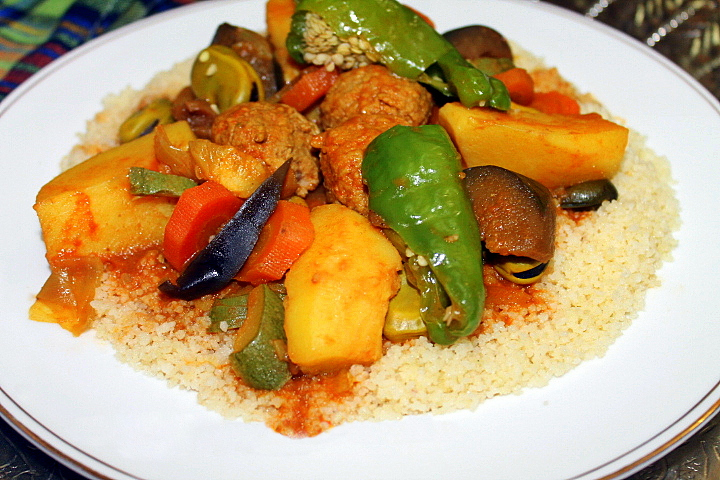
Algerian couscous is a traditional staple food in Algeria, and it plays an important role in Algerian culture and cuisine. It is commonly served with vegetables, meat, or fish. In Algeria, there are various types of couscous dishes.
Egypt
In Egypt, couscous (, arz) is traditionally prepared and consumed as a sweet dish, differing notably from the savory couscous dishes commonly associated with other North African cuisines. It is typically served for breakfast, as a light evening meal, or as a dessert. The preparation involves steaming or soaking the couscous with melted butter and hot water, after which it is topped with a variety of sweet ingredients. Common toppings include sugar (white, brown, or powdered), cinnamon, grated coconut, raisins, and assorted nuts such as almonds, walnuts, or hazelnuts. In some variations, sweetened condensed milk may also be used.
Tunisia

In Tunisia, couscous is usually spicy, made with harissa sauce, and served commonly with vegetables and meat, including lamb, fish, seafood, beef, and sometimes (in southern regions) camel. Fish couscous is a Tunisian specialty and can also be made with octopus, squid or other seafood in a hot, red, spicy sauce. Couscous can also be served as a dessert. It is then called masfuf. Masfuf can also contain raisins, grapes, or pomegranate seeds.
Libya
In Libya, couscous is mostly served with lamb (but sometimes camel meat or, rarely, beef) in Tripoli and the western parts of Libya, but not during official ceremonies or weddings. Another way to eat couscous is as a dessert; it is prepared with dates, sesame, and pure honey and is locally referred to as maghrood.
Malta
In Malta, small round pasta slightly larger than typical couscous is known as kusksu. It is commonly used in a dish of the same name, which includes broad beans (known in Maltese as ful) and ġbejniet, a local type of cheese.
Mauritania
In Mauritania, the couscous uses large wheat grains (mabroum) and is darker than the yellow couscous of Morocco. It is cooked with lamb, beef, or camel meat together with vegetables, primarily onion, tomato, and carrots, then mixed with a sauce and served with ghee, locally known as dhen.
Similar foods
Couscous is made from crushed wheat flour rolled into its constituent granules or pearls, making it distinct from pasta, even pasta such as orzo and risoni of similar size, which is made from ground wheat and either molded or extruded. Couscous and pasta have similar nutritional value, although pasta is usually more refined.
Several dishes worldwide are also made from granules, like those of couscous rolled from flour from grains or other milled or grated starchy crops.

- Attiéké, a staple food in Côte d'Ivoire and surrounding regions of West Africa, is made from granulated grated cassava.
- Dambou is a couscous-like dish from Niger. It may be made from semolina for special occasions but is often made with rice, millet, or other grain. Moringa leaves are traditionally included in the dish. In France, this Nigerien dish has been adapted as a specific variant (called couscous aux épinards) of the Maghreb-syle couscous commonly found there, often using spinach in place of the moringa.
- Fregula is a type of pasta from Sardinia. It is similar to North African Berkoukes and Middle Eastern Moghrabieh. Fregula comes in varying sizes but typically consists of semolina dough rolled into balls 2–3 mm in diameter and toasted in an oven.
- Kouskousaki (Κουσκουσάκι (in Greek) or kuskus (in Turkish) is a pasta from Greece and Turkey, that is boiled and served with cheese and walnuts.
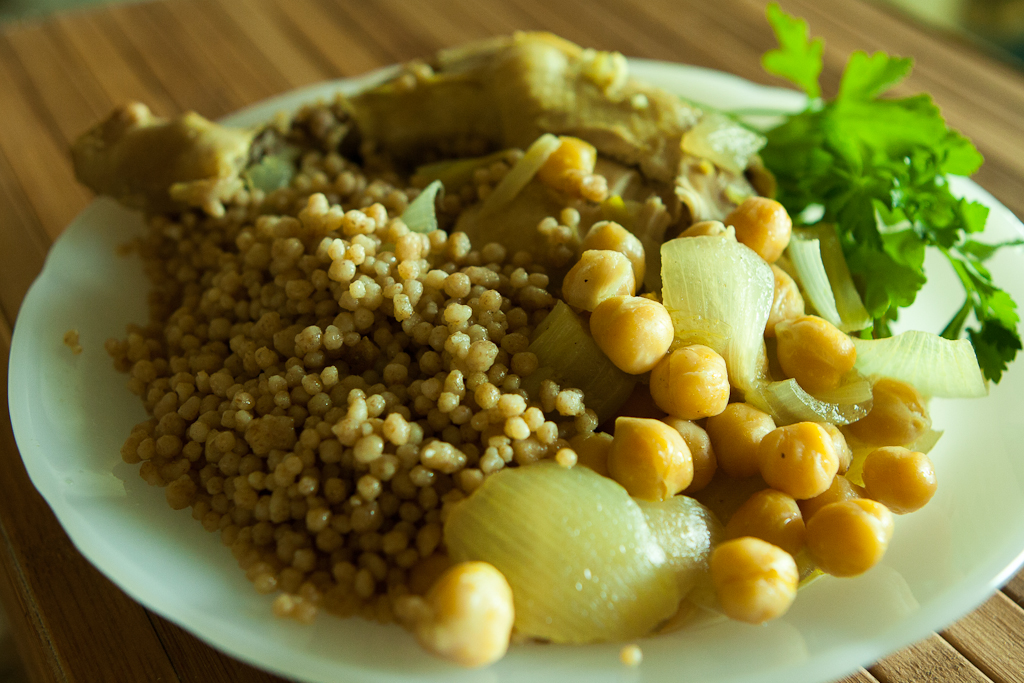
- Wusu-Wusu is a couscous that is prepared out of fonio in the Hausa region of Nigeria, Benin, Togo and Ghana.
Cuscuz
Cuscuz () is a couscous-like dish from the Northeast Region of Brazil. It is made out of cornmeal and eaten hot with meat and cold with milk. In the state of São Paulo, a speciality known as is made with cornmeal, tomato sauce, tomato pieces, olive oil, boiled egg and other ingredients, such as peas, sweet corn, hearts of palm and sardines. It is also possible to find the dish made with shredded chicken, tuna or shrimp. All the ingredients are cooked in a pan and then placed and left to set in a mould with a hole in the middle. The mould is then inverted onto a serving dish.
Moghrabieh
In the Levant, the dish known as moghrabieh (, a reference to the Maghreb region) uses the same durum-based semolina flour but rolled into larger (5-6 mm in diameter) 'pearls' to create a dish that is commonly served across Jordan, Lebanon and Syria. The pearls are either cooked as part of a stew or flavored with cinnamon and served alongside a chicken and chickpea broth.
Maftoul
Palestinian maftoul () uses granules that are larger than the North African variety but smaller than moghrabieh pearls (2-3 mm in diameter) and made with bulgur or semolina, or a mix of both; white or whole wheat flour are sometimes used in place of semolina, which can sometimes be expensive. It is similarly served alongside a chicken and chickpea broth. "Maftoul" is an Arabic word derived from the root "fa-ta-la," which means to roll or to twist, describing the hand-rolling method used to make the granules.
Dishes with similar names
Israeli couscous is an extruded and toasted pasta and does not share main ingredients or method of production with couscous.
Notes
References
References
- "Health Benefits of Couscous".
- "Couscous".
- (September 2018). "Couscous: Ethnic making and consumption patterns in the Northeast of Algeria". Journal of Ethnic Foods.
- Shulman, Martha Rose. (23 February 2009). "Couscous: Just Don't Call It Pasta".
- (September 2023). "Pearl Millet—New Developments in an Ancient Food Grain". Cereal and Grains Association.
- (2010). "Pearl Millet—New Developments in an Ancient Food Grain". Cereal Foods World.
- "The Codex Alimentarius (Codex Standard) (1995)". Food and Agriculture Organization of the United Nations.
- Naylor, Phillip C.. (May 2015). "Historical Dictionary of Algeria". Rowman & Littlefield.
- (2006). "Turismo gastronomico in Italia, Volume 1". Touring Club Italiano.
- Sainéan, L.. (1921). "L'Histoire Naturelle dans L'Oeuvre de Rabelais (8 e et dernier article)". Revue du Seizième siècle.
- Wagda, Marin. (1997). "L'histoire d'une migration culinaire". Hommes & Migrations.
- Tabois, Stéphanie. (2005). "Cuisiner le passé. Souvenirs et pratiques culinaires des exilés pieds-noirs". Diasporas. Histoire et sociétés.
- Albert-Llorca, Marlène. (2004). "La mémoire des Pieds-noirs : une transmission impossible ?". Horizons Maghrébins - le droit à la mémoire.
- (December 16, 2020). "UNESCO adds couscous to list of intangible world heritage".
- Chaker, Salem. "Couscous : sur l'étymologie du mot".
- (March 2010). "Couscous, boulgour et polenta. Transformer et consommer les céréales dans le monde". Karthala Editions.
- Perry, Charles. (1990). "Oxford Symposium on Food & Cookery, 1989: Staplefoods : Proceedings". Oxford Symposium.
- (1950–1952). "Dictionnaire touareg-français : dialecte de l'Ahaggar". Impr. nationale de France.
- (2025). ""En los hormigos estaba la clave: etimología latina de (al)cuzcuz"". Revista de Estudios Latinos, 25: 121-152.
- (22 March 2022). "Durum Wheat Couscous Grains: An Ethnic Mediterranean Food at the Interface of Traditional Domestic Preparation and Industrial Manufacturing". Foods.
- Bolens, Lucie. (1990). "La cuisine andalouse, un art de vivre: XIe-XIIIe siècle". Albin Michel.
- (February 2, 2018). "Can North Africa unite over couscous?". AFP.
- (December 20, 2020). "The unexpected allure of couscous: the history and tradition behind the North African staple". The National News.
- de Castro, Teresa. (2003). "COUSCOUS". [[Charles Scribner's Sons]].
- Chemache, Loucif, Farida Kehal, Hacène Namoune, Makhlouf Chaalal, and Mohammed Gagaoua. "Couscous: Ethnic making and consumption patterns in the Northeast of Algeria." Journal of Ethnic Foods 5, no. 3 (2018): [https://www.sciencedirect.com/science/article/pii/S2352618118300714 211-219].
- (February 13, 2018). "Can North Africa unite over couscous?". France 24.
- Sidi Boumediene, Rachid. (2024). "L'arbre des couscous: Unité et diversité d'un patrimoine". Chihab.
- (2020). "Première approche typologique de la céramique protoalmohade d'Igiliz (Maroc)". Bulletin d'Archéologie Marocaine.
- Brisville, Marianne. (May 2020). "Et le Moyen Âge inventa le couscous". L’Histoire (Revue).
- Zaouali, Lilia. (September 2009). "Medieval Cuisine of the Islamic World: A Concise History with 174 Recipes". Univ of California Press.
- Zaouali, Lilia. (September 2009). "Medieval Cuisine of the Islamic World: A Concise History with 174 Recipes". Univ of California Press.
- Asbell, Robin. (August 2007). "The New Whole Grain Cookbook: Terrific Recipes Using Farro, Quinoa, Brown Rice, Barley, and Many Other Delicious and Nutritious Grains". Chronicle Books.
- (31 March 2006). "French abandon traditional cuisine in favour of couscous". [[The Daily Telegraph]].
- "Les plats préférés des Français".
- (November 30, 2016). "Magret is the No1 dish for French - Moules-frites and couscous trail duck dish as study looks at what's on people's plates".
- (December 1, 2020). "UNESCO - Knowledge, know-how and practices pertaining to the production and consumption of couscous". UNESCO.
- (December 17, 2020). "Couscous joins UNESCO Intangible Cultural Heritage list".
- Nasr, Noor. (March 12, 2011). "Egyptian Couscous".
- (2016-01-05). "Kusksu - A traditional Maltese soup made with broad beans, peas and giant couscous.".
- United Nations Development Programme - Climate Change Adaption Facility. (June 2017). "Adaptive Farms, Resilient Tables: Building secure food systems and celebrating distinct culinary traditions in a world of climate uncertainty".
- Collaborative Crop Research Program. "Nutrition for Agriculture: Food Processing 2009-2017". The McKnight Foundation.
- (June 18, 2017). "Couscous aux épinards - Dambou (Niger)".
- (2020). "Wheat Quality for Improving Processing and Human Health". Springer International Publishing.
- Martin Brink, Getachew Melese Belay. (2006). "Céréales et légumes secs". PROTA.
- "Receitas".
- Hutcherson, Aaron. (May 14, 2021). "A guide to couscous: The history, different types and how to cook with it". The Washington Post.
- (26 April 2022). "My mother-in-law's moghrabieh is what my family gathers around". [[SBS Food]].
- (19 May 2017). "Moghrabieh (pearl couscous)".
- Ottolenghi, Yotam. (April 26, 2013). "Yotam Ottolenghi's maftoul recipes".
- (2016). "The Gaza Kitchen: A Palestinian Culinary Journey". Just World Books.
- (9 February 2017). "Palestinian recipes for maftoul tabbouleh and za'atar chicken". The Guardian.
- Gaunt, Doram. (9 May 2008). "Ben-Gurion rice".
This article was imported from Wikipedia and is available under the Creative Commons Attribution-ShareAlike 4.0 License. Content has been adapted to SurfDoc format. Original contributors can be found on the article history page.
Ask Mako anything about Couscous — get instant answers, deeper analysis, and related topics.
Research with MakoFree with your Surf account
Create a free account to save articles, ask Mako questions, and organize your research.
Sign up freeThis content may have been generated or modified by AI. CloudSurf Software LLC is not responsible for the accuracy, completeness, or reliability of AI-generated content. Always verify important information from primary sources.
Report