From Surf Wiki (app.surf) — the open knowledge base
Courtroom sketch
Drawings of court proceedings

Drawings of court proceedings
A courtroom sketch is an artistic depiction of the proceedings in a court of law. In many jurisdictions, the use of cameras in courtrooms is generally prohibited in order to prevent distractions and preserve privacy. This requires news media to rely on sketch artists for illustrations of the proceedings.
Creation
Courtroom sketch artists attend judicial proceedings as members of the public or as credentialed media depending on the venue and jurisdiction. Judges may require or allow artists to sit in a designated area or they may sit in general public seating. In some jurisdictions, including the United Kingdom and Hong Kong, courtroom artists are not permitted to sketch proceedings while in court and must create sketches from memory or notes after leaving the courtroom.
Courtroom artists can quickly capture a moment on paper and then sell their work to media outlets who would otherwise be denied a visual record of the trial. They may be paid per sketch or on a per diem commission. Sketches are often sold to television stations, newswire services, newspapers, or the subjects of a sketch. Courtroom sketches may also be acquired by institutional archives. The entire set of courtroom sketches related to the Lindy Chamberlain trial were purchased by the National Museum of Australia from the Australian Broadcasting Corporation. Selected works of American court artists Richard Tomlinson and Elizabeth Williams are held at the Lloyd Sealy Library at the John Jay College of Criminal Justice. Other collections of courtroom art include the works of Howard Brodie held in the Library of Congress, the Collection of the Supreme Court of the United States, which holds selected court artwork from artist Aggie Kenny, and early 20th century examples by William Hartley at the Crime Museum in London.
A courtroom artist must work quickly, particularly during arraignment hearings where a witness may appear in court for only a few minutes. A television-ready illustration can be produced in that time, and viewed on television after a court proceeding is finished. Courtroom artists can be barred from drawing alleged victims of sexual abuse, minors, and jurors or some witnesses in high-profile trials.
In the United States
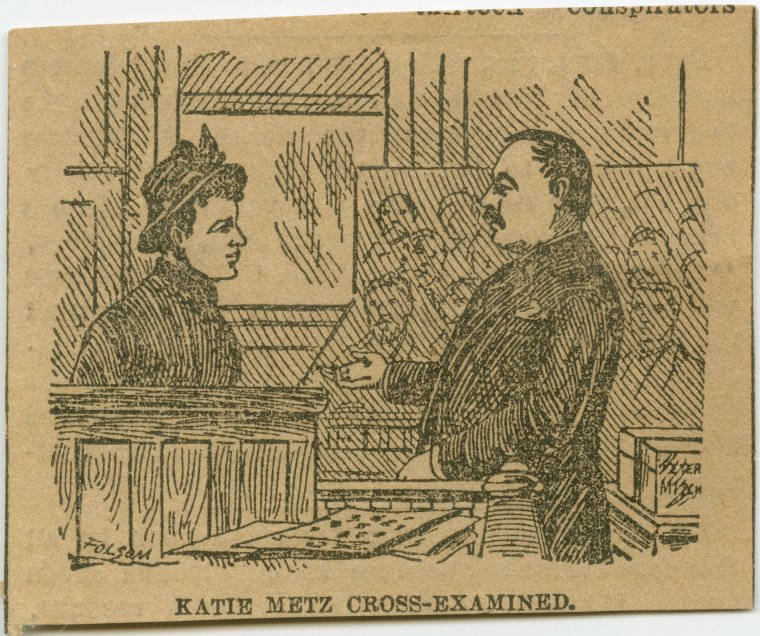
Courtroom sketches in the United States date back as far as the 19th century. Courtroom sketch artists were present for the trial of abolitionist John Brown and the impeachment of Andrew Johnson. By the mid-19th century, there were well-known court artists and printmakers such as George Caleb Bingham and David G. Blyth. Sketches during this era were reproduced as engravings in print publications, because photography was not a practical option for courtroom news coverage.
As mass media technology advanced in the early twentieth century, courts began experimenting with allowing photography and radio broadcasts of court proceedings. Following the media "circus" surrounding the trial of Bruno Richard Hauptmann for the Lindbergh kidnapping, broadcasts from federal courtrooms were banned by Rule 53 of the Federal Rules of Criminal Procedure. Additionally, the American Bar Association adopted Judicial Canon 35, which prohibited the use of motion or still cameras in the courtroom and was codified into law by the majority of states.
In 1973, courtroom artist Aggie Whelan (Kenny) was hired by CBS to illustrate the Gainesville Eight trial. The restrictions were too broad and violated both CBS and Whelan's First Amendment rights.
Television networks began using sketches to illustrate courtroom events during news broadcasts in the 1960s. As long as the artist arrived on time, and did not disturb the proceedings by making unnecessary noise, their presence was rarely challenged in most jurisdictions. In jurisdictions where artists were restricted from sketching inside the courtroom, they created sketches from memory. Courtroom artists including Ida Libby Dengrove protested these restrictions, and gradually courtrooms began allowing sketch artists to work during trials whilst seated in the public gallery.
The reintroduction of cameras into courtrooms has been credited with a decline in courtroom sketch artists. By 1987, courtroom photography was allowed in 44 states. all 50 states allowed the use of courtroom photography by 2014.
Notable American courtroom artists
Notable American courtroom artists include Howard Brodie, Marguerite Martyn, Bill Robles, Carole Kabrin, Aggie Whelan Kenny, Elizabeth Williams, Jane Rosenberg, Christine Cornell (WNBC and CNN), Art Lien (NBC, SCOTUSblog), Marilyn Church (The New York Times), Richard Tomlinson (WNEW-TV), and Joseph W. Papin (The New York Daily News).
One of the most well-known courtroom artists was Walt Stewart, whose career began with the trial of Jack Ruby. Over the next 35 years while on retainer by various networks, he covered famous trials such as the Manson Family, Soledad Brothers, Angela Davis and Patty Hearst. His work now hangs in museums and his sketches of the Patty Hearst trial were purchased by Liza Minnelli.

Joseph W. Papin worked for The New York Daily News from 1969 to 1992 and covered most of the major American trials during that period of time. Among them, the Watergate hearings, the Patty Hearst, Son of Sam (David Berkowitz), The Pizza Connection, and the Jean Harris trial.
Howard Brodie was a courtroom artist whose work included covering the trials of Jack Ruby, Sirhan Sirhan, William Calley, Charles Manson, Patty Hearst, and the Chicago Seven. He primarily worked for the CBS Evening News and anchor Walter Cronkite coined the term "artist-correspondent" to describe his work.
Bill Robles is an Emmy Award-nominated The first trial Robles covered as a television news courtroom artist was the trial of Manson.
Aggie Whelan Kenny is a courtroom artist known for her work on covering the Supreme Court of the United States and trials including James Earl Ray, David Berkowitz, and Jerry Sandusky. Kenny received an Emmy for her work for the CBS Evening News on the trials of John N. Mitchell and Maurice Stans. Her work is included in the Collection of the Supreme Court of the United States. Kenny's sketches of Gainesville Eight trial led to the court case United States v. Columbia Broadcasting System (1974), which established the right of courtroom artists to create sketches and for those sketches to be broadcast on television.
Elizabeth Williams has covered the trials of John DeLorean, Martha Stewart, John Gotti, Michael Milken, Bernard Madoff, Dominique Strauss-Kahn, and the Times Square Bomber. She is best known for her coverage of white-collar criminals tried in New York City. Her sketches depicting the Sean Bell trial are held by the Lloyd Sealy Library at the John Jay College of Criminal Justice.
Actor Terry Crews stated in an appearance on Jimmy Kimmel Live! that his first job in the entertainment industry was as the courtroom sketch artist for WJRT in Flint, Michigan.
References
References
- "Contempt of Court". Crown Prosecution Service.
- Guy Dammann. (14 November 2006). "A Sketchy Future for Courtroom Artists". The Guardian.
- "Chapter 228, Section 7 – Summary Offences Ordinance".
- (23 February 2009). "As courtroom sketch artist, she's the people's witness". Daily News.
- Morozow, Anna. (25 July 2011). "Courtroom Drawings Sketch Chamberlain's History". Australian Broadcasting Corporation.
- (Spring 2012). "Classified Information the Lloyd Sealy Library Newsletter".
- "Faces in Court 1893-1918: Drawings of William Hartley from New Scotland Yard's Crime Museum". [[Gresham College]].
- Sakai, Mike. (16 January 2011). "Courtroom sketch artist in Loughner case says eyes tell the story". East Valley Tribune.
- (1999). "Covering the courts: free press, fair trials & journalistic performance". Transaction Publishers.
- "Contemporary Courtroom Artists". Syracuse University.
- Sarner, Joshua. (Summer 2000). "Comment: Justice, Take Two: The Continuing Debate over Cameras in the Courtroom". Seton Hall University.
- (11 July 1974)
- Cohen, Mark C.. (1974). "United States v. Columbia Broadcasting System, Inc.: Courtroom Sketching and the Right to Fair Trial". New England School of Law.
- (29 November 1987). "Artists Brace for Entry of Cameras into Courts". The New York Times.
- Michael Tarm. (28 January 2012). "Need for courtroom artists fade as cameras move in".
- Paul, Angelique M.. (1997). "Turning the Camera on TV: Does Televising Trials Teach Us". Ohio State University.
- Pugsley, Robert A.. "This Courtroom is not a Television Studio: Why Judge Fujisaki Made the Correct Call in Gagging the Lawyers and Parties, and Banning the Cameras from the O. J. Simpson Civil Case". Loyola Marymount University.
- (2014). "The Illustrated Courtroom: 50 Years of Court Art". CUNY Journalism Press.
- (8 January 2013). "Welcome Back, Aggie".
- "'A lot of expression': Courtroom sketch artist Jane Rosenberg talks drawing Trump at his arraignment". ABC News.
- "This court artist has drawn everyone from Manafort to RBG. Will his craft survive?". The Washington Post.
- "Collection of Sketchy Characters". The Library of Congress.
- "Times Daily - Google News Archive Search".
- (5 December 2002). "Walt Stewart -- sketch artist for famous trials".
- (15 August 1976). "Contemporary courtroom artists: Anthony Accurso, Marilyn Church, Stephen Cohen, Ida Libby Dengrove, Albert Herr, Joseph Papin, Richard Tomlinson, Meryl Treatner, Betty Wells : March 3-28, 1976, Joe and Emily Lowe Art Gallery, Sims Hall, College of Visual and Performing Arts, Syracuse University, Syracuse, New York.". The Gallery.
- COURTROOM ARTISTS The East Hampton Star, "Opinion" section, East Hampton, New York, 23 May 1985
- William Grimes. (25 September 2010). "Howard Brodie, 94, Combat and Courtroom Artist, Dies". [[The New York Times]].
- "Search Results: "Brodie, Howard 1915-2010"". Library of Congress.
- "Society of Illustrators: Howard Brodie". Society of Illustrators.
- Daniel Grant. (10 August 2010). "The Fine Art of Crime". [[The Wall Street Journal]].
- Justin Jones. (29 May 2014). "O.J., Martha, Jagger, and Manson: Capturing Celebrities in the Dock".
- Adriana Rambay Fernández. (7 February 2013). "Sketching the scene". Hudson Reporter.
- Charles Hack. (8 February 2013). "See drawings of famous courtroom scenes at Hoboken gallery". The Jersey Journal.
- Fred Graham. (17 November 1974). "Gagging the Press in the Courtroom". The Washington Post.
- Daniel Fitzsimmons. (6 November 2013). "Reporting By Drawing". New York Press.
- John W. Miller. (13 December 2011). "Live Blog: Sandusky Waives Right to Hearing". [[The Wall Street Journal]].
- Alexandra Stevenson. (14 April 2014). "Capturing on Canvas the Downfall of Wall Street's Criminals". The New York Times.
This article was imported from Wikipedia and is available under the Creative Commons Attribution-ShareAlike 4.0 License. Content has been adapted to SurfDoc format. Original contributors can be found on the article history page.
Ask Mako anything about Courtroom sketch — get instant answers, deeper analysis, and related topics.
Research with MakoFree with your Surf account
Create a free account to save articles, ask Mako questions, and organize your research.
Sign up freeThis content may have been generated or modified by AI. CloudSurf Software LLC is not responsible for the accuracy, completeness, or reliability of AI-generated content. Always verify important information from primary sources.
Report