From Surf Wiki (app.surf) — the open knowledge base
Court of Final Appeal Building
Home to Hong Kong's highest court

Home to Hong Kong's highest court
| Field | Value |
|---|---|
| name | Court of Final Appeal Building |
| native_name | 終審法院大樓 |
| former_names | Supreme Court Building |
| Legislative Council Building | |
| image | Court of Final Appeal Building.jpg |
| caption | Court of Final Appeal Building |
| building_type | Court building |
| architectural_style | Neo-classical |
| height | 40 m |
| location | Hong Kong |
| diameter | 70 x |
| website | https://www.hkcfa.hk/en/visiting/cfa_building/index.html |
| address | 8 Jackson Road, Central |
| coordinates | |
| completion_date | |
| renovation_date | 2013–2015 |
| ren_cost | $463.6 million HKD |
| opened_date | (current use) |
| architect | Sir Aston Webb |
| Ingress Bell | |
| owner | Judiciary of Hong Kong |
| floor_count | 3 |
| embedded | {{Infobox designation list |
| embed | yes |
| designation1 | Declared Monument of Hong Kong |
| designation1_offname | Exterior of the Old Supreme Court Building |
| designation1_date | 1984 |
| embed | yes |
| designation2 | HK Grade I |
| designation2_date | 1980 |
the building in Hong Kong
Legislative Council Building Ingress Bell
The Court of Final Appeal Building, also known as the Old Supreme Court Building, is the home of the Hong Kong Court of Final Appeal. It housed the former Supreme Court from 1912 to 1983 and the Legislative Council from 1985 to 2011. It is located at 8 Jackson Road, in Central, along the eastern side of Statue Square, directly west of Chater Garden. As the Old Supreme Court, its exterior is one of the declared monuments of Hong Kong.
History
Construction (1900–1912)
The building was designed by Sir Aston Webb and Ingress Bell, the British architects responsible for the eastern façade of Buckingham Palace and the Cromwell Road frontage of the Victoria and Albert Museum in London.
Construction of the building started in 1900 and it was opened on 15 January 1912 by the Governor Sir Frederick Lugard. The two-storey granite building is neo-classical in style supported by Ionic columns. It is surmounted by a 2.7 m high blindfolded statue of Justice, represented by Themis, the Greek goddess of justice and law. This statue was inspired by the one erected at London's Old Bailey.
As the Supreme Court (1912–1941, 1945–1978, 1982–1984)
From 1912 to 1941, the building was used as the Supreme Court and as the offices of the Attorney General and Crown Solicitor. During the Japanese occupation of Hong Kong (December 1941 to August 1945), the building was used as the headquarters of the Kempeitai (Military Police). Following the Japanese surrender and restoration of British rule in 1945, the Supreme Court resumed use of the building, which was shared at various times with the Tenancy Tribunal, the Victoria District Court, and the Legal Department.
In 1978, this building was severely affected by the construction of the MTR, requiring restoration work. The changes in the groundwater level and the resulting subsidence created cracks in the building. As a consequence, the Supreme Court had to be relocated in July 1978 to the former Central Magistracy, the old Fire Brigade Building, and the Former French Mission Building, which was then used by the Victoria District Court. The building was given Grade 1 historic building status in 1980. The Supreme Court briefly reoccupied the building from 1982 to 1984 before moving to its current location in Admiralty in July 1984.
As the Legislative Council (1985–2011)
In 1983, the Executive Council authorised the conversion of the former Supreme Court Building into the Legislative Council Building, a move that was described by the then-Chief Secretary Sir Philip Haddon Cave as giving the Legislative Council "a new and clearer identity, emphasising its separation from the Executive Council and the Administration". The Architectural Services Department began the conversion works in 1984, the same year the exterior of the building was declared a monument.
The renovations involved the conversion of the court's library into the Council Chamber, the construction of a mezzanine floor to accommodate public galleries, and the conversion of courtrooms and ancillary rooms into conference rooms and a dining hall, with judges' chambers repurposed to become the offices of legislators.
In October 1985, the building took up service as the seat of the Legislative Council, when it was known as 'the Legislative Council Building', while the Supreme Court moved to the Supreme Court Building in Admiralty, which was renamed the High Court Building in 1997.
In 2011, the Legislative Council moved into the new Legislative Council Complex within the Central Government Complex at Tamar.
As the Court of Final Appeal (2015–present)
In March 2013, the Government submitted a proposal to the Legislative Council to relocate the Court of Final Appeal from its "manifestly inadequate" premises in the former French Mission Building to the old Supreme Court Building at 8 Jackson Road. The move, which was estimated to cost $463.6 million HKD, would double the net operational floor area of the CFA, and involve the construction of two courtrooms, two exhibition galleries, a library, and other facilities.
On 7 September 2015, the building reverted to its former judicial function. It now houses the Hong Kong Court of Final Appeal. The opening ceremony was held on 25 September 2015 by the Chief Justice of the Court of Final Appeal Geoffrey Ma Tao-li.
Architectural features
The building was erected on reclaimed land. Its foundation was formed by driving hundreds of Chinese fir tree trunks into the mixture of reclamation materials and silt on the site. As a consequence, the building is in effect "floating" on a timber raft. Such a foundation system requires the groundwater level to be maintained at a constant level, and a groundwater replenishment system is installed to replace groundwater as required.
The plan of the building follows a rectangular pattern and is symmetrical. The building occupies an area of around 2660 m2 (about 70 x) and is surrounded by columns. Its height, fronze Tudor Crown, is about 40 m.
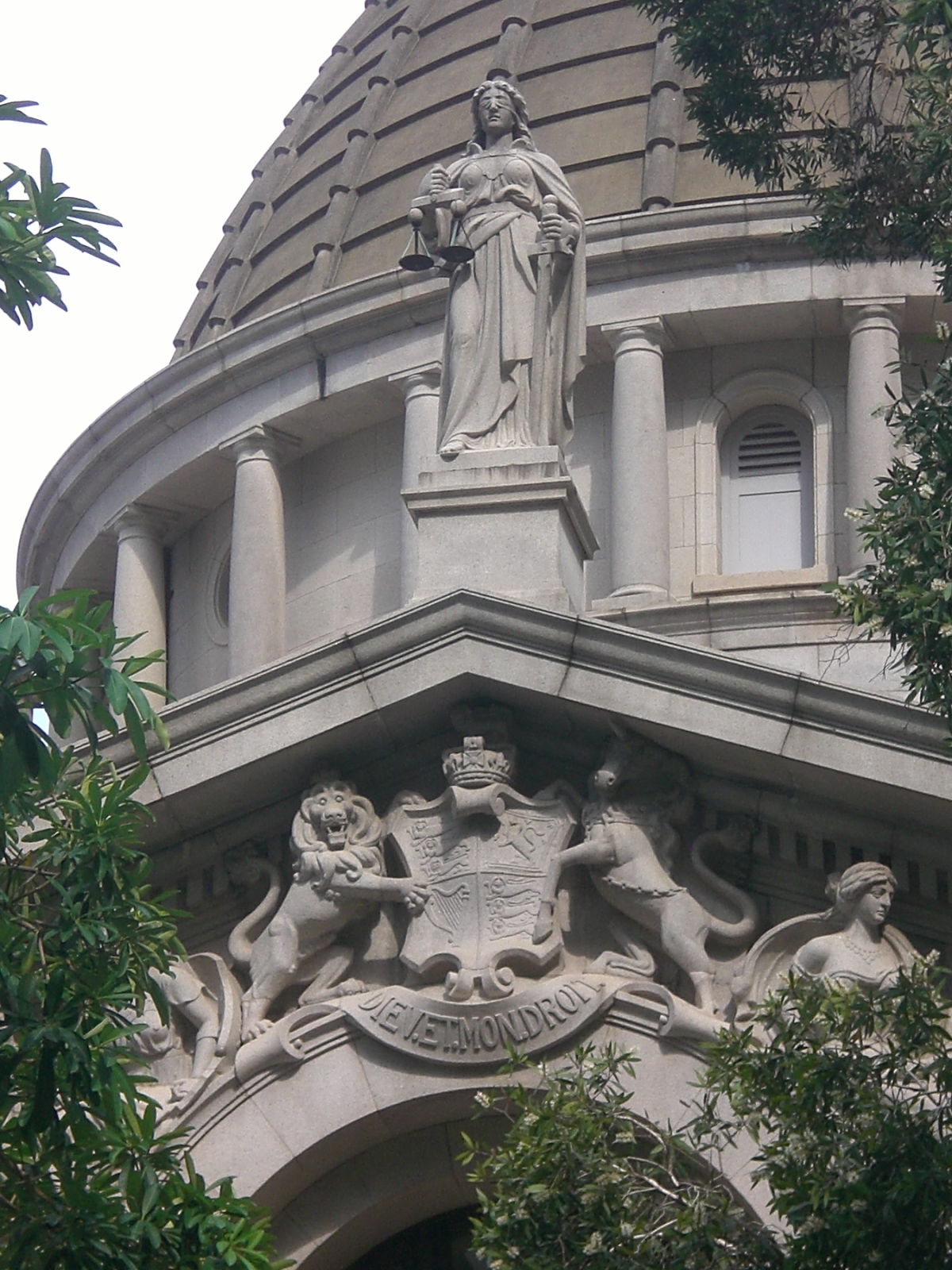
A pediment surmounts the central section of the building facing Statue Square. The pediment is topped by a Statue of Justice and under it is the inscription "Erected AD MDCCCCX" (Erected AD 1910). The pediment incorporates a semi-circular window and the carving of the British royal coat of arms is above it. The shield shows the various royal emblems of the various parts of the United Kingdom: the three lions of England in the first and fourth quarters, the lion of Scotland in the second and the harp of Ireland in the third. The shield is supported by the English lion and Scottish unicorn and is surmounted by the royal crown. The motto of the sovereign, Dieu et mon droit (God and my right), is displayed underneath it. The figures of Mercy and Truth are located on both sides of the British royal arms.
Gallery
Interior of the building as the Legislative Council Building (1985–2011)
File:HKLCB ConferenceRoomA.jpg|Conference Room A File:HKLCB ConferenceRoomB.jpg|Conference Room B File:HKLCB ConferenceRoomC.jpg|Conference Room C File:HKLCB PresidentOffice2007.jpg|President's office File:HKLCB PressConferenceRoom.jpg|Press Conference Room File:HKLCB MembersRoom.jpg|Office for the members of the Legislative Council File:HKLCB AnteChamber.jpg|Ante Chamber File:HKLCB Chmber PresidentSeat.jpg|President's seat File:HKLCB DiningHall.jpg|Dining Hall File:HKLCB ChamberCeiling.jpg|Ceiling of the Main Chamber File:RLCW7086.JPG|Chamber interior File:HKLCB Chamber.jpg|Chamber interior
References
References
- (1911). "Picturesque Hong Kong: A Handbook for Travellers". Printed by Tillotson & Sons.
- "The Legislative Council Building".
- "Hong Kong Court of Final Appeal - The Court of Final Appeal Building - Brief History".
- Legislative Council Secretariat. "Information Note IN26/02-03: The Legislative Council Building".
- Roberts, Denys. (2006). "Another Disaster: Hong Kong Sketches". The Radcliffe Press.
- Legislative Council of Hong Kong. (15 July 2011). "Bidding Farewell to the Legislative Council Building - Official Record of Proceedings".
- Legislative Council. (13 March 2013). "ITEM FOR PUBLIC WORKS SUBCOMMITTEE OF FINANCE COMMITTEE. Relocation of the Court of Final Appeal to No. 8 Jackson Road".
- Hong Kong Legislative Council. (15 May 1985). "Legislative Council (Powers and Privileges) Bill 1985". Official Report of Proceedings.
- Cheung, Karen. (7 September 2015). "Court of Final Appeal moves into former Legislative Council Building". Hong Kong Free Press.
- (25 September 2015). "Hong Kong's Court of Final Appeal Building opens". GlobalPost.
This article was imported from Wikipedia and is available under the Creative Commons Attribution-ShareAlike 4.0 License. Content has been adapted to SurfDoc format. Original contributors can be found on the article history page.
Ask Mako anything about Court of Final Appeal Building — get instant answers, deeper analysis, and related topics.
Research with MakoFree with your Surf account
Create a free account to save articles, ask Mako questions, and organize your research.
Sign up freeThis content may have been generated or modified by AI. CloudSurf Software LLC is not responsible for the accuracy, completeness, or reliability of AI-generated content. Always verify important information from primary sources.
Report