From Surf Wiki (app.surf) — the open knowledge base
Coupe
Car body style

Car body style
the car body style
A coupe or coupé (, ) is a passenger car with a sloping or truncated rear roofline and typically with two doors.
The term coupé was first applied to horse-drawn carriages for two passengers without rear-facing seats. It comes from the French past participle of couper, "cut".
Some coupé cars only have two seats, while some also feature rear seats. However, these rear seats are usually lower quality and much smaller than those in the front. Furthermore, "A fixed-top two-door sports car would be best and most appropriately be termed a 'sports coupe' or 'sports coupé'".
TOC
Etymology and pronunciation {{anchor|Name|Etymology|Pronuncation}}
Coupé () is based on the past participle of the French verb couper ("to cut") and thus indicates a car which has been "cut" or made shorter than standard. It was first applied to horse-drawn carriages for two passengers without rear-facing seats. These berlines coupées or carrosses coupés ("clipped carriages") were eventually clipped to coupés.
There are two common pronunciations in English:
- () – the anglicized version of the French pronunciation of coupé.
- () – as a spelling pronunciation when the word is written without an accent. This is the usual pronunciation and spelling in the United States and much of Canada, with the pronunciation entering American vernacular no later than 1936 and featuring in the Beach Boys' hit 1963 song "Little Deuce Coupe".
Definition

A coupé is a fixed-roof car with a sloping rear roofline and one or two rows of seats. However, there is some debate surrounding whether a coupe must have two doors for passenger egress or whether cars with four doors can also be considered coupés. This debate has arisen since the early 2000s, when four-door cars such as the Mazda RX-8 and Mercedes-Benz CLS-Class have been marketed as "four-door coupés" or "quad coupés", although the Rover P5 was a much earlier example, with a variant introduced in 1962 having a lower, sleeker roofline marketed as the Rover P5 Coupé.
In the 1940s and 1950s, coupés were distinguished from sedans by their shorter roof area and sportier profile. Similarly, in more recent times, when a model is sold in both coupé and sedan body styles, generally the coupe is sportier and more compact. There have been a number of two-door sedans built as well, a bodystyle the French call a coach.
The 1977 version of International Standard ISO3833—Road vehicles - Types - Terms and definitions—defines a coupe as having two doors (along with a fixed roof, usually with limited rear volume, at least two seats in at least one row and at least two side windows). On the other hand, the United States Society of Automotive Engineers publication J1100 does not specify the number of doors, instead defining a coupé as having a rear interior volume of less than 33 cuft.
The definition of coupé started to blur when manufacturers began to produce cars with a 2+2 body style (which have a sleek, sloping roofline, two doors, and two functional seats up front, plus two small seats in the back).
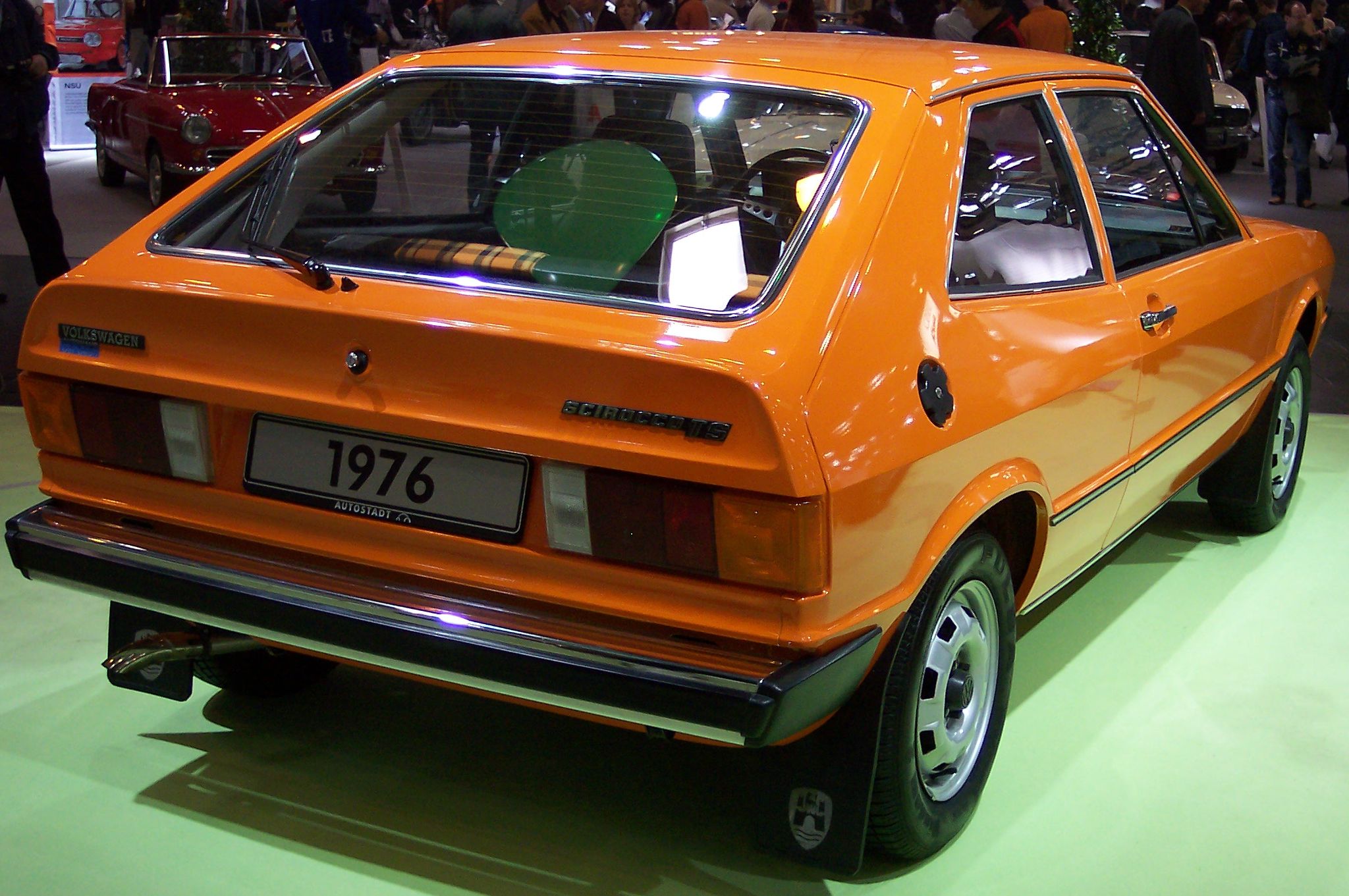
Some manufacturers also blur the definition of a coupé by applying this description to models featuring a hatchback or a rear cargo area access door that opens upwards. Most often also featuring a fold-down back seat, the hatchback or liftback layout of these cars improves their practicality and cargo room.
Horse-drawn carriages

The coupe carriage body style originated from the berline horse-drawn carriage. The coupe version of the berline was introduced in the 18th century as a shortened ("cut") version with no rear-facing seat. Normally, a coupé had a fixed glass window in the front of the passenger compartment. The coupé was considered an ideal vehicle for women to use to go shopping or to make social visits.
History
The early coupé automobile's passenger compartment followed in general conception the design of horse-drawn coupés, with the driver in the open at the front and an enclosure behind him for two passengers on one bench seat. The French variant for this word thus denoted a car with a small passenger compartment.
By the 1910s, the term had evolved to denote a two-door car with the driver and up to two passengers in an enclosure with a single bench seat. The coupé de ville, or coupé chauffeur, was an exception, retaining the open driver's section at front.
In 1916, the Society of Automobile Engineers suggested nomenclature for car bodies that included the following:
Coupelet: A small car seating two or three with a folding top and full height doors with fully retractable windows.
Convertible coupe: A roadster with a removable coupe roof.}}
During the 20th century, the term coupé was applied to various close-coupled cars (where the rear seat is located further forward than usual and the front seat further back than usual).
Since the 1960s the term coupé has generally referred to a two-door car with a fixed roof.
Since 2005, several models with four doors have been marketed as "four-door coupés", however, reactions are mixed about whether these models are actually sedans instead of coupés. According to Edmunds, an American automotive guide, "the four-door coupe category doesn't really exist."
Variations
Berlinetta
Main article: Berlinetta
A berlinetta is a lightweight sporty two-door car, typically with two seats but also including 2+2 cars.
Club coupe
A club coupe is a two-door car with a larger rear-seat passenger area, compared with the smaller rear-seat area in a 2+2 body style. Thus, club coupes resemble coupes as both have two doors, but feature a full-width rear seat that is accessible by tilting forward the backs of the front seats.
Hardtop coupé
A hardtop coupe is a two-door car that lacks a structural pillar ("B" pillar) between the front and rear side windows. When these windows are lowered, the effect is like that of a convertible coupé with the windows down. The hardtop body style was popular in the United States from the early 1950s until the 2000s. It was also available in European and Japanese markets. Safety regulations for roof structures to protect passengers in a rollover were proposed, limiting the development of new models. The hardtop body style went out of style with consumers while the automakers focused on cost reduction and increasing efficiencies.
Combi coupé
Main article: Combi coupé
Saab used the term "combi coupé" for a car body similar to the liftback.
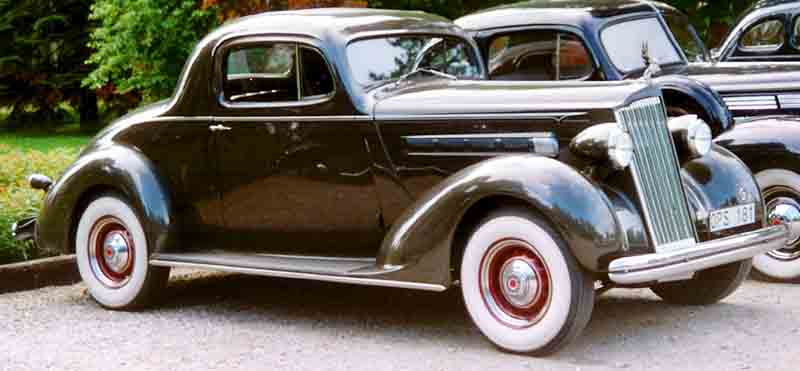
Business coupe
Four-door coupe / quad coupe

The 1921 and 1922 LaFayette models were available in a variety of open and closed body styles that included a close-coupled version featuring two center-opening doors on each side that was marketed as a Four-Door Coupe. The 1927 Nash Advanced Six was available in four-door coupe body style.
More recently, the description has been applied by marketers to describe four-door cars with a coupe-like roofline at the rear. The low-roof design reduces back-seat passenger access and headroom. The designation was used for the low-roof model of the 1962–1973 Rover P5, followed by the 1992–1996 Nissan Leopard / Infiniti J30. Recent examples include the 2005 Mercedes-Benz CLS, 2010 Audi A7, Volkswagen CC, Volkswagen Arteon, and 2012 BMW 6 Series Gran Coupe.
Similarly, several cars with one or two small rear doors for rear seat passenger egress and no B-pillar have been marketed as "quad coupes". For example, the 2003 Saturn Ion, the 2003 Mazda RX-8, and the 2011–2022 Hyundai Veloster.
Three-door coupe
Opera coupe
A two-door car designed for driving to the opera with easy access to the rear seats. Features sometimes included a folding front seat next to the driver or a compartment to store top hats.
Often they would have solid rear-quarter panels, with small, circular windows, to enable the occupants to see out without being seen. These opera windows were revived on many U.S. automobiles during the 1970s and early 1980s.
Three-window coupe
The three-window coupe (commonly just "three-window") is a style of automobile characterized by two side windows and a backlight (rear window). The front windscreens are not counted. The three-window coupe has a distinct difference from the five-window coupe, which has an additional window on each side behind the front doors. These two-door cars typically have small-sized bodies with only a front seat and an occasional small rear seat.
The style was popular from the 1920s until the beginning of World War II. While many manufacturers produced three-window coupes, the 1932 Ford coupe is often considered the classic hot rod.
Coupe SUV
Main article: Coupe SUV
Some SUVs or crossovers with sloping rear rooflines are marketed as "coupe crossover SUVs" or "coupe SUVs", even though they have four side doors for passenger egress to the seats and rear hatches for cargo area access however only a car with 2 doors and no B style are considered a true coupe.
Positioning in model range

In the United States, some coupes are "simply line-extenders two-door variants of family sedans", while others have significant differences from their four-door counterparts.
The AMC Matador coupe (1974–1978) has a shorter wheelbase with a distinct aerodynamic design and fastback styling, sharing almost nothing with the conventional three-box design and more "conservative" four-door versions.
Similarly, the Chrysler Sebring and Dodge Stratus coupes and sedans (late-1990 through 2000s), have little in common except their names. The coupes were engineered by Mitsubishi and built in Illinois, while the sedans were developed by Chrysler and built in Michigan. Some coupes may share platforms with contemporary sedans.
Coupes may also exist as model lines in their own right, either closely related to other models, but named differently – such as the Alfa Romeo GT or Infiniti Q60 – or have little engineering in common with other vehicles from the manufacturer – such as the Toyota GT86.
Gallery
File:1932 Ford Three Window Coupe hot rod (5409924810).jpg|1932 Ford Model 18 - a three-window coupe File:Buick 37 46S Opera Coupe 1937.jpg|1937 Buick 37 46S - an opera coupe File:1946 Ford V8 Club Coupe (15359652557).jpg|A 1946 Ford V8 - a club coupe File:1948 Bentley coupé de ville - fvl.jpg|1948 Bentley Coupe de Ville File:Ferrari-250-GT-Berlinetta-1.jpg|1961 Ferrari 250 GT Berlinetta - a Berlinetta coupe File:Saab 900i 16v.jpg|1978–1987 Saab 900 marketed as a combi coupe File:RX-8 2010Y-MODEL-SIDE.jpg|2010 Mazda RX-8 - marketed as a four-door coupe File:2017 Ford Mustang (FM) coupe (2017-07-15) 01.jpg|2017 Ford Mustang File:Toyota Supra GR Genf 2019 1Y7A5650.jpg|2020 Toyota GR Supra - 3-door liftback/fastback coupe
References
References
- (2004). "Coach Building Terminology".
- Haajanen, Lennart W.. (2017). "Illustrated Dictionary of Automobile Body Styles". McFarland.
- Haajanen, Lennart W.. (2003). "Illustrated Dictionary of Automobile Body Styles". McFarland.
- (1893). "Oxford English Dictionary". Oxford University Press.
- "Merriam-Webster Dictionary". Merriam-Webster.
- (9 December 2016). "Porsche Actually Made a Video on How to Pronounce Its Name".
- Mencken, Henry L.. (1936). "The American Language".
- "For the Last Time, a Coupe Is a Car With Two Doors".
- "Range Rover's $295K Coupe SUV Proves No Niche Is Too Small".
- "Sedan vs. Coupe Cars: Meaning, Definition & Differences".
- Breitenstein, Jeff. (2004). "The ultimate hot rod dictionary: a-bombs to zoomies". Motorbooks International.
- (2010). "Coupé". Random House Kernerman Webster’s College Dictionary.
- ((Technical Committee ISO/TC22, Road vehicles)). "ISO 3833-1977: Road vehicles – Types – Terms and definitions". International Organization for Standardization.
- "J1100: Motor Vehicle Dimensions - SAE International".
- Adolphus, David Traver. (March 2007). "Club Coupes - If you think you know what a Club Coupe is, think again". Hemmings Classic Car.
- "Coupe – Coupe Body Style – Two Door Coupe".
- Jack. (2022-12-28). "What is a Coupe Car".
- Weber, Bob. (1 June 2019). "What is the difference between coupe and sedan?". Chicago Tribune.
- (2014). "hatchback - definition".
- "Hatchback - definition".
- (4 February 2020). "Best Hatchbacks".
- Adolphus, David Traver. (March 2007). "Club Coupes - If you think you know what a Club Coupe is, think again". Hemmings Classic Car.
- {{harvtxt. Haajanen. 2017
- "Royal carriages".
- Stratton, Ezra. (1878). "World on Wheels". Ezra Stratton.
- Clough, Albert L.. (1913). "A dictionary of automobile terms". The Horseless Age.
- (20 August 1916). "What's What in Automobile Bodies Officially Determined". The New York Times.
- Forbes, Kingston. (1922). "The Principles of Automobile Body Design: covering the fundamentals of open and closed passenger body design". Ware Bros..
- Beattie, Ian. (1977). "The Complete Book of Automobile Body Design". Haynes Publishing Group.
- "Sedan vs. Coupe: What's the Difference?".
- "Car Review: 2005 Mercedes-Benz CLS 500".
- "2018 Mercedes-Benz CLS Class Review".
- (16 March 2005). "2005 Mercedes-Benz CLS 500 - First Look".
- (28 May 2013). "Defining Vehicle Types". Edmunds.
- (28 April 2016). "Porsche 960: une nouvelle berlinette à moteur flat-8".
- "Club coupe".
- (27 July 2020). "Curbside Classic: 1984 Subaru GL Hardtop Coupe – A Requiem For The Affordable Hardtop".
- (2 March 2016). "Jaguar XK140 Hardtop Coupe".
- (9 April 2008). "What is a hardtop?". Ate Up With Motor.
- (April 2006). "A History of Hardtops". Hemmings Classic Car.
- Jazar, Reza N.. (2008). "Vehicle dynamics: theory and applications". Springer-Verlag.
- "Automotive History: Trying To Make (Business Coupe) Sense Of The Gremlin".
- Tracy, Deb. (19 May 2020). "LaFayette".
- "The Nash Advanced Six, Seven Passenger Sedan, Four Door Coupé, Victoria (brochure)".
- Powell, Philip. (8 January 2008). "The Fastback is Back Thanks to Mercedes, Audi, BMW, Volkswagen". Classical Drives.
- Langworth, Richard M.. (1986). "Complete book of collectible cars, 1930–1980". Random House Value Publishing.
- "The Infiniti J30 Was A Four-Door Coupe Before It Was Fashionable".
- "Mercedes CLS-Klasse". Auto, Motor und Sport.
- (27 July 2010). "Neuer Audi A7 Sportback: Erste Bilder, Details und Preise". Heise.
- Giuliani, Stefan. (January 2011). "Audi A7 Sportback 3.0 TDI quattro S tronic (DPF)". ADAC.
- (10 January 2017). "Alfa Romeo Brera {{!}} Used Car Buying Guide".
- Enright, Andy. (8 Apr 2009). "Ford Cougar (1998 - 2002) used car review".
- (13 January 2015). "The Top Gear car review: Volkswagen Scirocco".
- "Dictionary of Historic Automotive Terms". Chalk Hill Educational Media.
- Burness, Tad. (2005). "American Car Spotter's Bible 1940–1980". Krause Publications.
- (6 September 2016). "Archival Revival: One-of-a-kind Nash here a few more weeks". Kenosha News.
- Frazee, Irving Augustus. (1949). "Automotive Fundamentals". American Technical Society.
- (17 December 2017). "What's the difference between an old three-window coupe and a five-window model?". Belleville News-Democrat.
- "What Is the Difference Between a 1934 Ford 3-Window & 5-Window Coupe?". It Still Runs.
- (21 November 2020). "What is a Three Window Coupe?". WiseGeek.
- (6 October 2020). "Hot Rod 3-Pack: 1932 Ford Three-Window Coupes". Hot Rod (Motor Trend).
- (2007). "'32 Ford Deuce: the official 75th anniversary edition". Motorbooks.
- (15 March 2018). "How the 1932 Ford Deuce became the quintessential hot rod". Hagerty.
- Loh, Edward. (11 February 2008). "Comparison: 2008 Honda Accord Coupe vs 2008 Mitsubishi Eclipse vs 2008 Nissan Altima Coupe (Front-wheel-drive coupe comparison)". Motor Trend.
- Severson, Aaron. (25 December 2009). "What's a Matador? The AMC Matador, Rebel, and Classic".
- McGuire, Bill. (6 May 2018). "Fish Out of Water: AMC's 1974-78 Matador Coupe".
- (15 December 2008). "1974 AMC Matador Coupe – the Forgotten Coupe".
- (1 September 2009). "Dodge Stratus and Chrysler Sebring". Car and Driver.
- Krebs, Michelle. (18 February 2001). "Dodge Stratus and Chrysler Sebring; When Lightning Doesn't Strike Twice". The New York Times.
This article was imported from Wikipedia and is available under the Creative Commons Attribution-ShareAlike 4.0 License. Content has been adapted to SurfDoc format. Original contributors can be found on the article history page.
Ask Mako anything about Coupe — get instant answers, deeper analysis, and related topics.
Research with MakoFree with your Surf account
Create a free account to save articles, ask Mako questions, and organize your research.
Sign up freeThis content may have been generated or modified by AI. CloudSurf Software LLC is not responsible for the accuracy, completeness, or reliability of AI-generated content. Always verify important information from primary sources.
Report