From Surf Wiki (app.surf) — the open knowledge base
County of Aragon
Frankish marcher county (802–1035)
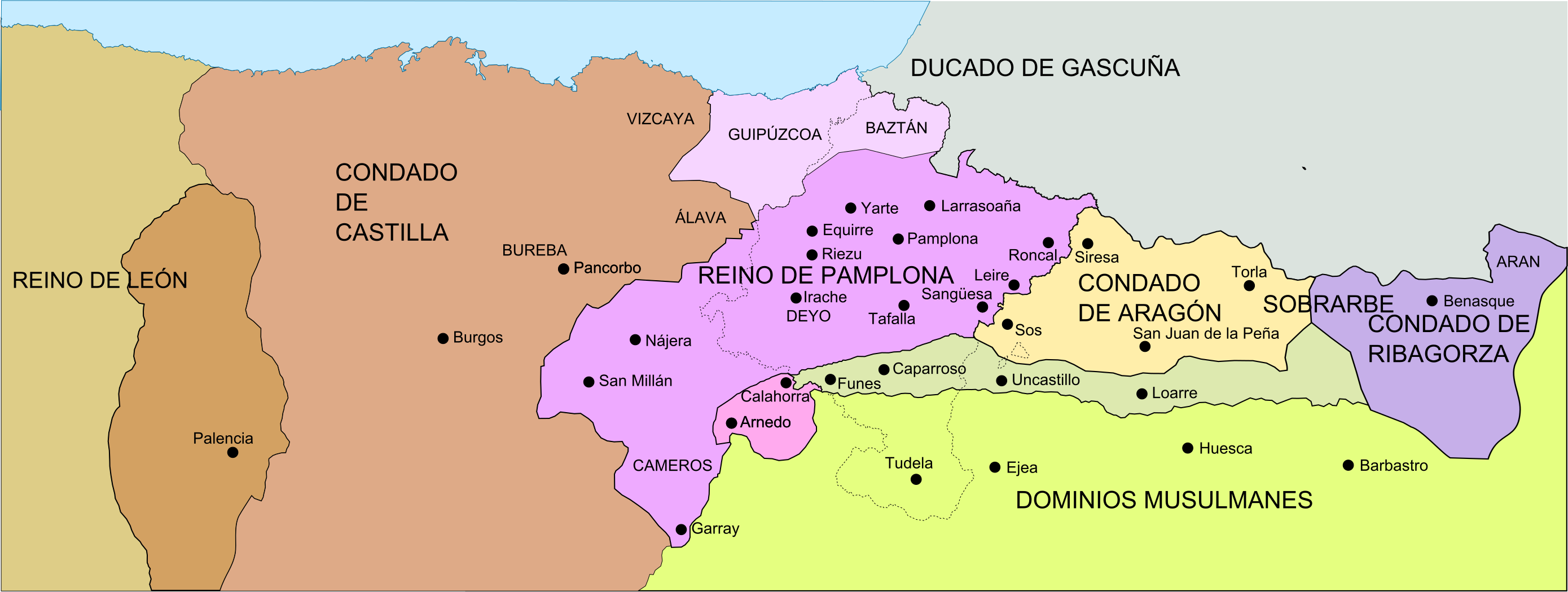
Frankish marcher county (802–1035)
The County of Aragon () or County of Jaca () was a small Frankish marcher county in the central Pyrenean valley of the Aragon river, comprising Ansó, Echo, and Canfranc and centered on the small town of Jaca (Iacca in Latin and Chaca in Aragonese), an area now part of Spain. It was created by the Carolingians late in the 8th or early in the 9th century, but soon fell into the orbit of the Kingdom of Navarre, into which it was absorbed in 922. It would later form the core of the 11th century Kingdom of Aragon.
Carolingian rule
Originally intended to protect the central Pyrenean passes from the Moors in the same way that the Duchy of Vasconia and the Marca Hispanica were to protect the west and east, Aragon remained largely out of the reach of its nominal Carolingian lords, though it was an expressly Frankish creation and not an ethnically distinct region. The earliest attested local ruler was Oriol (807), probably Frankish, Visigothic or Hispano-Roman. That Aragon was a combined creation of Frankish efforts at Reconquest and the activity of the local Hispano-Visigothic elite to unite the rural populace against the Moors of the Ebro valley seems assured.
In the first half of the 9th century, under the strong Carolingians, such as Charlemagne, the county of Aragon was culturally oriented northwards, across the important passes at Echo and Canfranc. The monastery of San Pedro de Siresa, founded about that time, was a Benedictine house nourished by the reforms of Benedict of Aniane. The cultural endowment of the monastery was extensive; by 848 its collection of manuscripts included Vergil, Horace, Juvenal, Porphyry, Aldhelm, and Augustine of Hippo's De Civitate Dei.
Conversion into kingdom
Sancho the Great, who had united most of Christian Iberia under his control, gave lands in Aragon to his illegitimate son, Ramiro as early as 1015. With the deaths of his father in 1035 and brother, Gonzalo of Sobrarbe and Ribagorza, whose lands he also acquired, in 1043, Ramiro held the nucleus of what would become the Kingdom of Aragon.
List of counts
- ???–809: Aureolus (attested 807-809 but probably ruling before 802)
- 809–820: Aznar Galíndez I, deposed in 820 by Pamplona
- 820–833: García the Bad, installed as vassal by Pamplona
- 833–844: Galindo Garcés, son of García the Bad
- 844–867: Galindo Aznárez I, son of Aznar Galíndez I, family restored on accepting suzerainty of Pamplona
- 867–893: Aznar Galíndez II, son of Galindo Aznárez I
- 893–922: Galindo Aznárez II, son of Aznar Galíndez II
From the death of Galindo Aznárez II, the county of Aragon was incorporated within the crown of Navarre (for kings of Navarre during this period see: List of Navarrese monarchs). The rulers of Navarre appointed a series of nobles as their (non-sovereign) counts in Aragon. These are poorly documented, but include:
- Guntislo Galíndez (fl. c. 923), illegitimate son of Galindo Aznárez II
- Fortún Jiménez, count from 947 to 958
- Gonzalo Sánchez, son of king Sancho II Garcés of Navarre (970–994), count of Aragon under tutelage of his mother Urraca Fernández
Notes
Sources
- Arco y Garay, Ricardo del. "España Christiana: Hasta el año 1035, fecha de la Muerte de Sancho Garcés III" in España Christiana: Comienzo de la Reconquista (711-1038). Historia de España [dirigida por Don Ramón Menéndez Pidal], vol. 6. Espasa Calpe: Madrid, 1964.
- Bisson, Thomas N. The Medieval Crown of Aragon: A Short History. Oxford: Clarendon Press, 1986. . For the county, see pp. 10–11.
References
- Antonio Ubieto Arteta, ''Historia de Aragón: la formación territorial'' (Zaragoza: Anubar, 1981), p. 19 n. 14.
This article was imported from Wikipedia and is available under the Creative Commons Attribution-ShareAlike 4.0 License. Content has been adapted to SurfDoc format. Original contributors can be found on the article history page.
Ask Mako anything about County of Aragon — get instant answers, deeper analysis, and related topics.
Research with MakoFree with your Surf account
Create a free account to save articles, ask Mako questions, and organize your research.
Sign up freeThis content may have been generated or modified by AI. CloudSurf Software LLC is not responsible for the accuracy, completeness, or reliability of AI-generated content. Always verify important information from primary sources.
Report