From Surf Wiki (app.surf) — the open knowledge base
County Longford
County in Ireland

County in Ireland
| Field | Value |
|---|---|
| name | County Longford |
| native_name | Contae an Longfoirt |
| native_name_lang | ga |
| image_shield | Longford Coat of Arms.png |
| shield_size | 100px |
| motto | Daingean agus Dílis(Irish) |
| "Strong and Loyal" | |
| area_total_km2 | 1091 |
| area_rank | 29th |
| seat_type | County town |
| seat | Longford |
| blank_name_sec1 | Vehicle index |
| mark code | |
| blank_info_sec1 | LD |
| population_total | 46,751 |
| population_density_km2 | auto |
| population_rank | 31st |
| population_as_of | 2022 |
| population_footnotes | |
| leader_title | Local authority |
| leader_name | Longford County Council |
| leader_title2 | Dáil constituency |
| leader_name2 | Longford–Westmeath |
| leader_title3 | EP constituency |
| leader_name3 | Midlands–North-West |
| subdivision_type | Country |
| subdivision_name | Ireland |
| subdivision_type1 | Province |
| subdivision_name1 | Leinster |
| subdivision_type2 | Region |
| subdivision_name2 | Eastern and Midland |
| website | |
| timezone | WET |
| utc_offset | ±0 |
| timezone_DST | IST |
| utc_offset_DST | +1 |
| established_title | Established |
| established_date | 1570 |
| area_code_type | Telephone area codes |
| area_code | 043 (primarily) |
| postal_code_type | Eircode routing keys |
| postal_code | N39 (primarily) |
| elevation_max_m | 278 |
| elevation_max_point | Carn Clonhugh |
| mapframe | yes |
| mapframe-zoom | 8 |
| iso_code | IE-LD |
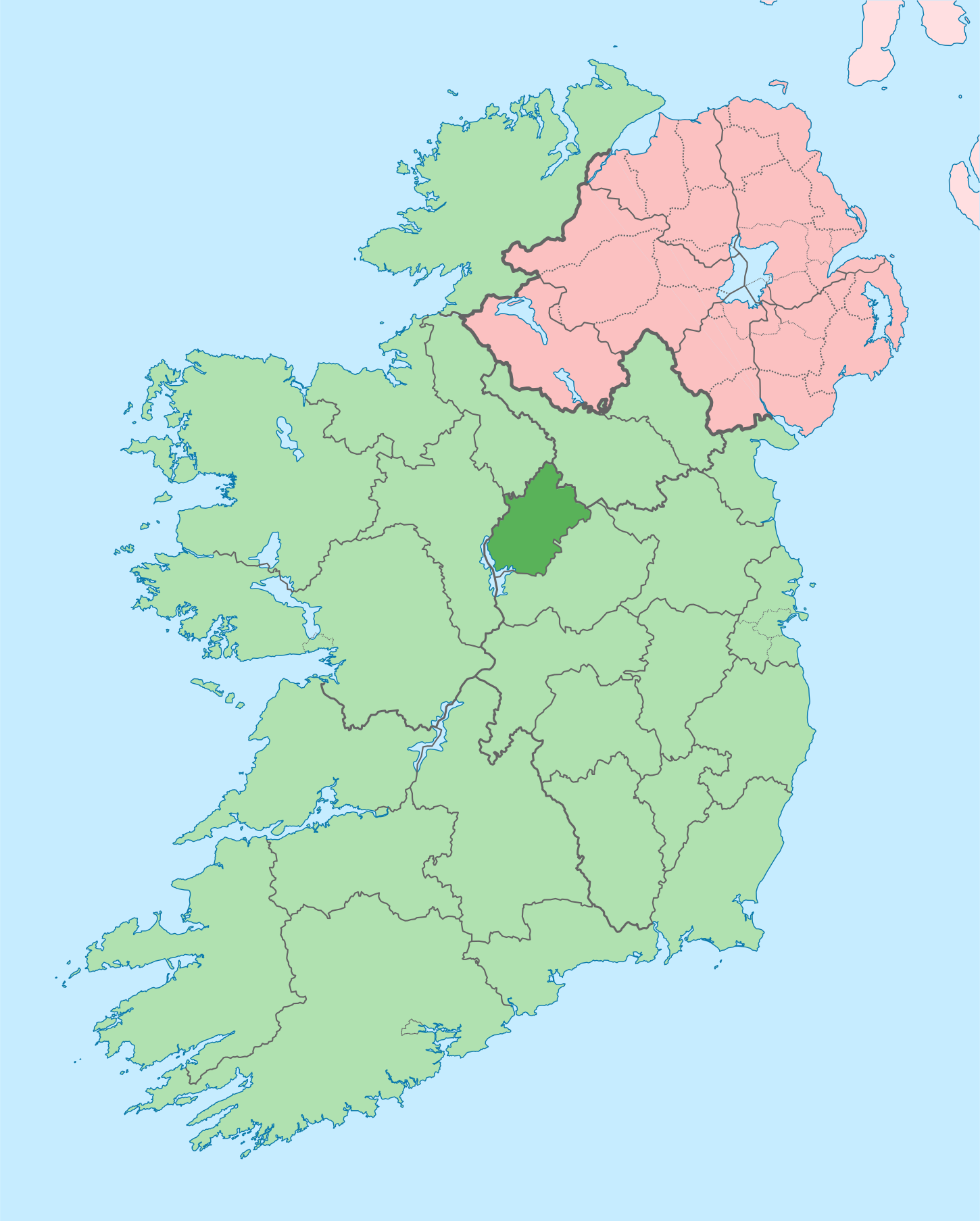
"Strong and Loyal" mark code](vehicle-registration-plates-of-ireland) | mapframe-zoom = 8 County Longford () is a county in Ireland. It is in the province of Leinster. It is named after the town of Longford. Longford County Council is the local authority for the county. The population of the county was 46,634 at the 2022 census.
Geography
Most of Longford lies in the basin of the River Shannon with Lough Ree forming much of the county's western boundary. The north-eastern part of the county, however, drains towards the River Erne and Lough Gowna. Lakeland, bogland, pasture-land and wetland typify Longford's generally low-lying landscapes: the highest point of the county is in the north-west – Carn Clonhugh (also known as Cairn Hill or Corn Hill) between Drumlish and Ballinalee in the parish of Killoe, at 278 m. Cairn Hill is the site of a television transmitter broadcasting to much of the Irish midlands.
In the list of Irish counties by highest point, Longford ranks third lowest – only Meath and Westmeath have lower maxima. In general, the northern third of the county is hilly, forming part of the drumlin belt and Esker Riada stretching across the northern midlands of Ireland. The southern parts of the county are low-lying, with extensive areas of raised bogland and the land being of better quality for grazing and tillage. The River Shannon marks the county's border with Roscommon while the Rivers Inny and Tang form much of the boundary with Westmeath.
The Royal Canal flows through the south of the county, terminating at Cloondara at the Shannon. The canal was refurbished and reopened in 2010, 39 years after its closure by the CIÉ. Notable lakes include Lough Kinale and Lough Gowna on the County Cavan border, Lough Forbes on the County Roscommon border and Lough Ree in the south where counties Longford, Westmeath and Roscommon meet.
Subdivisions
There are six historical baronies:
- Ardagh
- Granard
- Longford
- Moydow
- Rathcline
- Shrule or Abbeyshrule
Largest towns
- Longford 10,952
- Edgeworthstown 2,199
- Lanesborough* 1,733 (includes Ballyleague, County Roscommon)
- Ballymahon 1,714
- Drumlish 1,124
- Granard 1,058
- Newtownforbes 851
- Keenagh 753
- Ballinalee 395
- Legan 346
Towns and villages
- Abbeylara
- Abbeyshrule
- Ardagh
- Aughnacliffe
- Ballinamuck
- Ballymahon
- Ballinalee
- Cloondara
- Colehill
- Drumlish
- Edgeworthstown
- Granard
- Kenagh
- Killashee
- Killoe
- Lanesborough
- Legan
- Lisryan
- Longford
- Moydow
- Mullinalaghta
- Newtowncashel
- Newtownforbes
- Taghshinny
Townlands are the smallest officially defined geographical divisions in Ireland, with 944 townlands in the county.
Governance and politics

The county is part of the Dáil constituency of Longford–Westmeath.
History

The territory corresponding to County Longford was presumably a frontier colony of the Kingdom of Meath in the first millennium. Between the fifth and twelfth centuries, the territory was called the kingdom of Tethbae ruled by various tuath such as the Cairpre Gabra in the north. Tethbae () originally referred to an area north of the River Inny approximating to present-day County Longford.
In the year AD 1070, Tethbae was conquered by the Ó Cuinns, Ó Fearghails and other Conmhaícne tribes, henceforth being known as "Muintir Annaly", so named after "Anghaile" the great-grandfather of Fearghail O'Farrell. Furthermore, County Longford was often called Upper Conmaicne, to distinguish it from south Leitrim, then called Lower Conmaicne, because both districts were ruled by the descendants of Conmac, son of Fergus and Queen Meadbh of Connacht.
Following the Norman invasion of the 12th century, Annaly was granted to Hugh de Lacy as part of the Liberty of Meath. An English settlement was established at Granard, with Norman Cistercian monasteries being established at Abbeylara and Abbeyshrule and Augustinian monasteries at Abbeyderg and at Saints' Island on the shore of Lough Ree. Monastic remains at Ardagh, Abbeylara, Abbeyderg, Abbeyshrule, Inchcleraun Island in Lough Ree and Inchmore Island in Lough Gowna are reminders of the county's long Christian history. However, by the 14th century, English influence in Ireland was on the wane. The town of Granard was sacked by Edward Bruce's army in 1315, and the O'Farrells soon recovered complete control over the territory. Annaly later became Longphoirt, now Longford, after O'Farrell's fortress of this name.
The county was officially shired in 1586 in the reign of Elizabeth I from the northern portion of Westmeath, but English control was not fully established until the aftermath of the Nine Years' War. County Longford was added to Leinster by James I in 1608 (it had previously been considered part of Connacht), with the county being divided into six baronies and its boundaries being officially defined. The county was planted by English and Scottish landowners in 1620, with much of the O'Farrell lands being confiscated and granted to new owners. The change in control was completed during the Cromwellian plantations of the 1650s. On these lands in County Longford, are the historic ruins of the Coolamber Hall House, which was besieged by one of the Cromwells.
The county was a centre of the 1798 rebellion, when the French expeditionary force led by Humbert, which had landed at Killala, was defeated outside the village of Ballinamuck on 8 September by a British army led by Cornwallis. General Humbert had hoped to amalgamate his forces with other rebels located in Granard but Cornwallis aware of the danger had defeated these forces in the second battle of Granard prior to defeating General Humbert in Ballinamuck. Considerable reprisals were inflicted by the British on the civilian inhabitants of the county in the aftermath of the battle.
A revolutionary spirit was again woken in the county during the Irish War of Independence when the North Longford flying column, led by Seán Mac Eoin, became one of the most active units on the Irish side during that war.
Demographics
|1500|3021 |1510|2054 |1550|2307 |1580|2089 |1585|2212 |1600|2054 |1610|4534 |1653|5150 |1659|5392 |1672|10784 |1680|21568 |1690|33136 |1700|35770 |1710|33105 |1725|36272 |1735|37668 |1745|42544 |1755|41335 |1765|39888 |1771|38771 |1775|49557 |1781|55088 |1788|70176 |1790|75352 |1801|80584 |1811|94168 |1813|88336 |1816|80205 |1821|107570 |1831|112558 |1841|115491 |1851|82348 |1861|71694 |1871|64501 |1881|61009 |1891|52647 |1901|46672 |1911|43820 |1926|39847 |1936|37847 |1946|36218 |1951|34553 |1956|32969 |1961|30643 |1966|28989 |1971|28250 |1979|30785 |1981|31140 |1986|31496 |1991|30296 |1996|30166 |2002|31068 |2006|34391 |2011|38970 |2016|40873 |2022|46634 ||footnote={{cite book |editor2-first=L. A.|title=Irish Population, Economy, and Society: Essays in Honour of the Late K. H. Connell | author-link = Joel Mokyr | last2 = Ó Gráda | first2 = Cormac | author2-link = Cormac Ó Gráda | title = New Developments in Irish Population History, 1700–1850 | journal = The Economic History Review | volume = 37 | issue = 4
With an area of 1091 km2 and a population of 46,634, It is also the fourth smallest of Leinster's 12 counties by size and smallest by population. It borders counties Cavan to the northeast, Westmeath to the southeast, Roscommon to the southwest and Leitrim to the northwest.
Longford's population growth during the period 2002–2006 (10.6%) has been stronger than the National average (8.2%).
Agriculture is an important facet in the way of life and for the economy in County Longford. There are 73,764 hectares of area (67.6% of the county's total area) farmed in the county. There are approximately 126,904 cattle in the county too.
People
- Willie Browne (1936–2004), Republic of Ireland international footballer
- Padraic Colum (1881–1972), writer
- Francis Ysidro Edgeworth (1845–1926), philosopher, economist, mathematician
- Maria Edgeworth (1768–1849), writer, lived at Edgeworthstown House
- Albert Reynolds (1932–2014), politician, former Taoiseach
References and notes
Notes
Primary references
Secondary references
Medieval history
- {{cite book
- {{cite journal
- {{cite journal
- {{cite book
References
- (23 June 2022). "Census of Population 2022 – Preliminary Results". [[Central Statistics Office (Ireland)]].
- (6 March 2013). "'Geographical loyalty'? Counties, palatinates, boroughs and ridings".
- The county is based on the historic [[Gaelic Ireland. Gaelic]] territory of [[Annaly]] (''Anghaile''), formerly known as [[Tethbae. Teffia]] (''Teathbha'').Dr. Kieran O’Conor and Dr. Paul Naessens. [http://www.longfordlibrary.ie/Heritage/Projects/Non-Invasive-Archaeology-Castles-2012.pdf "Non-invasive investigation of Anglo-Norman castle sites in County Longford"] {{Webarchive. link. (15 November 2017 . [[Galway University]], 2012. pp.6–7)
- "Westmeath – Topographical Dictionary of Ireland (1837)".
- For 1653 and 1659 figures from Civil Survey Census of those years, Paper of Mr Hardinge to Royal Irish Academy 14 March 1865.
- "Server Error 404 – CSO – Central Statistics Office".
- "Histpop – The Online Historical Population Reports Website".
- "Northern Ireland Statistics and Research Agency – Census Home Page".
- "Demographic context". Offaly County Council Development Plan 2009 – 2015.
- "Server Error 404 – CSO – Central Statistics Office".
This article was imported from Wikipedia and is available under the Creative Commons Attribution-ShareAlike 4.0 License. Content has been adapted to SurfDoc format. Original contributors can be found on the article history page.
Ask Mako anything about County Longford — get instant answers, deeper analysis, and related topics.
Research with MakoFree with your Surf account
Create a free account to save articles, ask Mako questions, and organize your research.
Sign up freeThis content may have been generated or modified by AI. CloudSurf Software LLC is not responsible for the accuracy, completeness, or reliability of AI-generated content. Always verify important information from primary sources.
Report