From Surf Wiki (app.surf) — the open knowledge base
Country Club Park, Los Angeles
| Field | Value |
|---|---|
| name | Country Club Park |
| image_skyline | Country Club Park Signage.jpg |
| image_caption | Country Club Park neighborhood sign located at Crenshaw Boulevard immediately north of Pico Boulevard |
| pushpin_map | United States Los Angeles Central |
| pushpin_label_position | right |
| pushpin_map_caption | Location within Central Los Angeles |
| settlement_type | Neighborhood of Los Angeles |
| coordinates | |
| subdivision_type | Country |
| subdivision_name | United States |
| subdivision_type1 | State |
| subdivision_name1 | California |
| subdivision_type2 | County |
| subdivision_name2 | Flag of Los Angeles County, California.svg Los Angeles |
| subdivision_type3 | City |
| postal_code_type | Zip Code |
| postal_code | 90019 |
| area_code | 323 |
| timezone | Pacific |
Country Club Park is a neighborhood in Los Angeles, California.
History
The name Country Club Park refers to the area's previous use. In 1897, The Los Angeles Golf Club established a 9-hole course called the Windmill Links at Pico and Alvarado Street. Overcrowding inspired the organizers to move west and in 1899, the club moved to the corner of Pico and Western (the area that is now Country Club Park). The course remained there until 1910, at which time it moved to Holmby Hills.
After The Los Angeles Golf Club moved west, Isaac Milbank, with partner George Chase, subdivided the property for mostly large homes and mansions. Country Club Park matured in the 1920s and homes were constructed in the latest architectural styles: Craftsman, Tudor Revival, Spanish Colonial Revival, Colonial Revival and Mediterranean Revival.
In the wake of the U.S. Supreme Court ruling in Shelley v. Kraemer (1948) which struck down racial exclusionary covenants, Country Club Park was one of the first affluent neighborhoods in Los Angeles to allow blacks to purchase homes.
In 2010, the neighborhood was designated a Los Angeles Historic Preservation Overlay Zone because of the large number of intact buildings dating back to the earliest phases of Los Angeles’ development.
Geography
Country Club Park is bounded by Olympic Boulevard on the north, Crenshaw Boulevard on the west, Pico Boulevard on the south, and Western Avenue on the east. The neighborhood of Arlington Heights is directly south. Wilshire Park is north. Oxford Square is west.
Country Club Park is partially gated; three streets that intersect Pico Boulevard are closed to through-traffic and pedestrians.
Parks and recreation
- Country Club Park Heritage Plaza - 1015 South Wilton Place. It has a children's play area, picnic tables, and a walking path.
In Media
- American Horror Story (pilot episode)
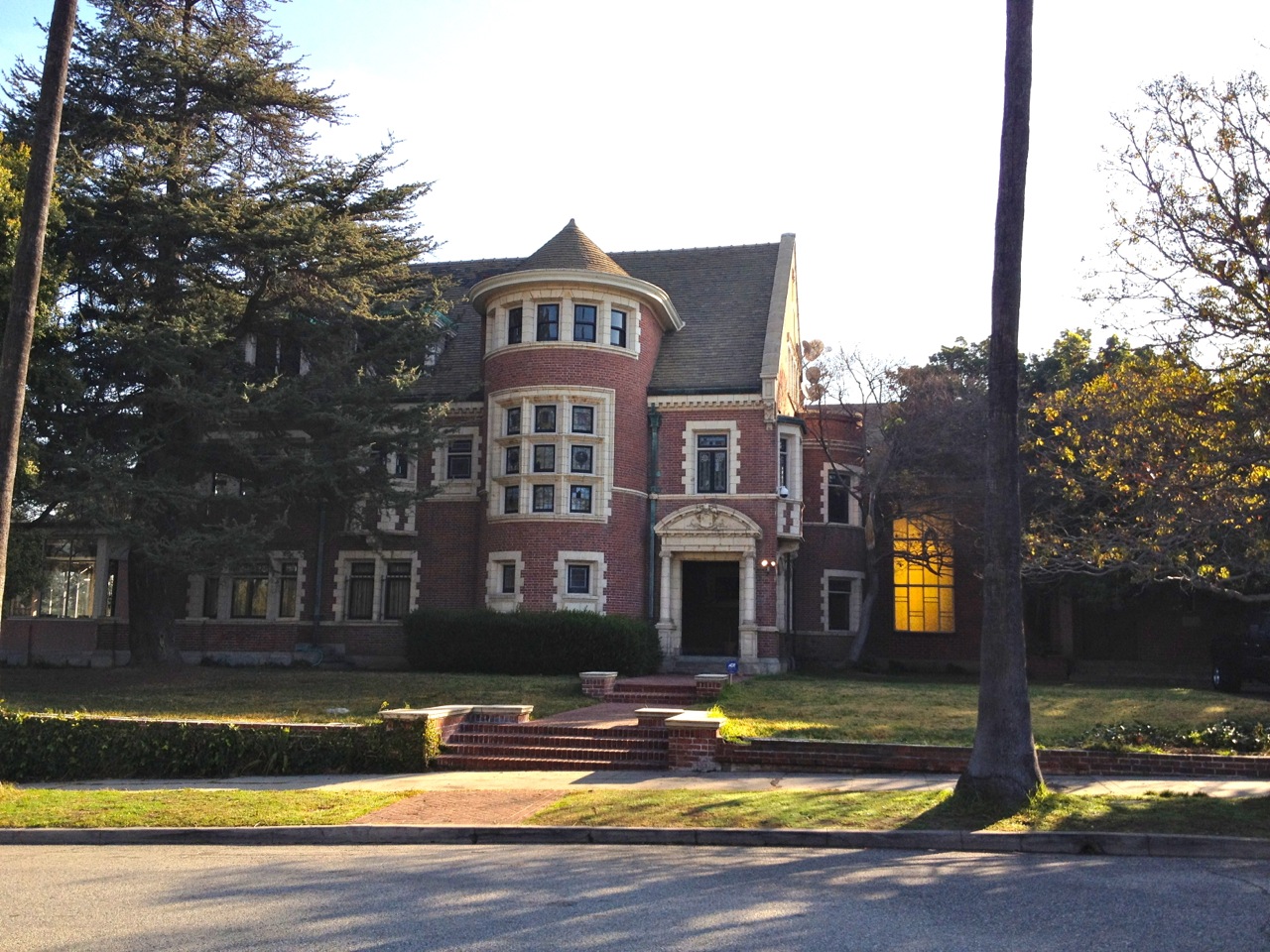
Designed and built in 1902 by Alfred Rosenheim, the president of the American Institute of Architects' Los Angeles chapter, the Collegiate Gothic-style single family home is located at 1120 Westchester Place. It is known as the Rosenheim Mansion. The home was previously used as a convent. An adjoining chapel was removed from exterior shots using CGI.
After the pilot episode, filming continued on sets constructed to be an exact replica of the house. Details such as Lewis Comfort Tiffany stained glass windows, and hammered bronze light fixtures, were re-created to preserve the look of the house.
- Ali
- Daddy Day Care
- Running with Scissors
Notable residents
- Joel Fluellen, actor
- Lena Horne, entertainer
- Mahalia Jackson, gospel singer
- Thomas Kilgore Jr., clergyman and human rights activist
- Hattie McDaniel, actress
- Lou Rawls, singer
- Marl Young, musician and arranger
References
References
- Powers, Kemp. (24 January 2008). "Neighborhood Project: Country Club Park".
- [http://preservation.lacity.org/hpoz/la/country-club-park Preservation.lacity.org: Country Club Park HPOZ; with Survey Map, Adopting Ordinance, and Preservation Plan links].
- Romero, Dennis. (17 June 2017). "L.A.'s Country Club Park Has Stately Homes and Deep History".
- ''The Thomas Guide,'' 2006, page 633
- Smith, Dakota. (2024-02-09). "Locked gates in historic L.A. neighborhood spark debate in City Council election".
- "Country Club Park Heritage Plaza". L.A. Department of Parks & Recreation.
- Kudler, Adrian Glick. (October 4, 2011). "''American Horror Story'' Gave Alfred Rosenheim House in Country Club Park an Early Halloween Costume".
- Keeps, David A.. (October 31, 2011). "Set Pieces: The haunted house of 'American Horror Story'".
- Dos Santos, Kristin. (January 27, 2012). "The American Horror Story House Is on the Market for How Much? Come Take a Tour Inside!".
- Chaney, Jen. (October 5, 2011). "Connie Britton on 'American Horror Story,' 'Friday Night Lights' and what she learned from Rob Zombie". The Washington Post.
- Powers, Kemp. (24 January 2008). "Neighborhood Project: Country Club Park".
- . (January 1969). "Los Angeles Street Address Telephone Directory". *Pacific Bell*.
- . (July 1973). "Los Angeles Street Address Telephone Directory". *Pacific Bell*.
- Powers, Kemp. (24 January 2008). "Neighborhood Project: Country Club Park".
- . (July 1973). "Los Angeles Street Address Telephone Directory". *Pacific Bell*.
This article was imported from Wikipedia and is available under the Creative Commons Attribution-ShareAlike 4.0 License. Content has been adapted to SurfDoc format. Original contributors can be found on the article history page.
Ask Mako anything about Country Club Park, Los Angeles — get instant answers, deeper analysis, and related topics.
Research with MakoFree with your Surf account
Create a free account to save articles, ask Mako questions, and organize your research.
Sign up freeThis content may have been generated or modified by AI. CloudSurf Software LLC is not responsible for the accuracy, completeness, or reliability of AI-generated content. Always verify important information from primary sources.
Report