From Surf Wiki (app.surf) — the open knowledge base
Country
Distinct territorial body or political entity

Distinct territorial body or political entity
A country is an area of land, colloquially used as a synonym for sovereign state or other political entities, but also used to refer to the hinterland surrounding urban areas, as well as to describe the culture of people living in these places. Usually, the term country is applied to occupied areas of land, however it can be used to refer to uninhabited areas or wastelands. When referring to a specific polity, the term "country" may refer to a sovereign state, a state with limited recognition, a constituent country, or a dependent territory. Most sovereign states, but not all countries, are members of the United Nations.
There is no universal agreement on the number of "countries" in the world with a range between 193 to 237. This ambiguity is a result of several states having disputed sovereignty status or limited recognition, and a number of non-sovereign entities are commonly considered countries. The definition and usage of the word "country" has fluctuated and changed over time. The Economist wrote in 2010 that "any attempt to find a clear definition of a country soon runs into a thicket of exceptions and anomalies."
Areas much smaller than a political entity may be referred to as a "country", such as the West Country in England, "big sky country" (used in various contexts of the American West), "coal country" (used to describe coal-mining regions), or simply "the country" (used to describe a rural area). The term "country" is also used as a qualifier descriptively, such as country music or country living.
Etymology
The word country comes from Old French contrée, which derives from Vulgar Latin (terra) contrata ("(land) lying opposite"; "(land) spread before"), derived from contra ("against, opposite"). It most likely entered the English language after the Franco-Norman invasion during the 11th century.
Definition of a country
In English, the word has increasingly become associated with political divisions, so that one sense, associated with the indefinite article – "a country" – is now frequently applied as a synonym for a state or a former sovereign state. It may also be used as a synonym for "nation". Taking as examples Canada, Sri Lanka, and Yugoslavia, cultural anthropologist Clifford Geertz wrote in 1997 that "it is clear that the relationships between 'country' and 'nation' are so different from one [place] to the next as to be impossible to fold into a dichotomous opposition as they are into a promiscuous fusion."
Areas much smaller than a political state may be referred to as countries, such as the West Country in England, "big sky country" (used in various contexts of the American West), "coal country" (used to describe coal-mining regions in several sovereign states) and many other terms. The word "country" is also used for the sense of native sovereign territory, such as the widespread use of Indian country in the United States. The term "country" in English may also be wielded to describe rural areas, or used in the form "countryside." Raymond Williams, a Welsh scholar, wrote in 1975:
The unclear definition of "country" in modern English was further commented upon by philosopher Simon Keller:
Melissa Lucashenko, an Aboriginal Australian writer, expressed the difficulty of defining "Country" in a 2005 essay, "Unsettlement": mean? ... I spoke with others who said country meant Home, but who added the caveat that Home resided in people rather than placesa kind of portable Country... I tried to tease out some ways in which non-Indigenous people have understood country. I made categories: Country as Economy. Country as Geography. Country as Society. Country as Myth. Country as History. For all that I walked, slept, breathed and dreamed Country, the language still would not come.}}
Statehood
Main article: Sovereign state
When referring to a specific polity, the term "country" may refer to a sovereign state, state with limited recognition, constituent country, or dependent territory. A sovereign state is a political entity that has supreme legitimate authority over a part of the world. There is no universal agreement on the number of "countries" in the world since several states have disputed sovereignty status, and a number of non-sovereign entities are commonly called countries. No definition is binding on all the members of the community of nations on the criteria for statehood. State practice relating to the recognition of a country typically falls somewhere between the declaratory and constitutive approaches.{{cite web | access-date=18 January 2024 | archive-date=18 March 2024 | archive-url=https://web.archive.org/web/20240318013739/https://openyls.law.yale.edu/bitstream/handle/20.500.13051/13240/27_53YaleLJ385_1943_1944_.pdf?sequence=2 | url-status=live

]]
International law defines sovereign states as not under another. The declarative theory outlined in the 1933 Montevideo Convention describes a "state as a person of international law" in Article 1:{{cite web | access-date= 18 January 2024 | archive-date= 14 January 2024 | archive-url= https://web.archive.org/web/20240114065544/https://www.ilsa.org/Jessup/Jessup15/Montevideo%20Convention.pdf | url-status= live
- Having a permanent population
- Having a defined territory
- Having a government
- Having the ability to enter into relations with other states The Montevideo Convention in Article 3 implies that a sovereign state can exist even if no other countries recognise it. As a restatement of customary international law, the Montevideo Convention merely codified existing legal norms and its principles, and therefore does not apply merely to the signatories of international organizations (such as the United Nations), but to all subjects of international law as a whole. A similar opinion has been expressed by the European Economic Community, reiterated by the European Union, in the principal statement of its Badinter Committee, and by Judge Challis Professor, James Crawford.
According to the constitutive theory, a state is a legal entity of international law if, and only if, it is recognised as sovereign by at least one other country. Because of this, new states could not immediately become part of the international community or be bound by international law, and recognised nations did not have to respect international law in their dealings with them. In 1912, L. F. L. Oppenheim said the following, regarding constitutive theory:
In 1976 the Organisation of African Unity define state recognition as:
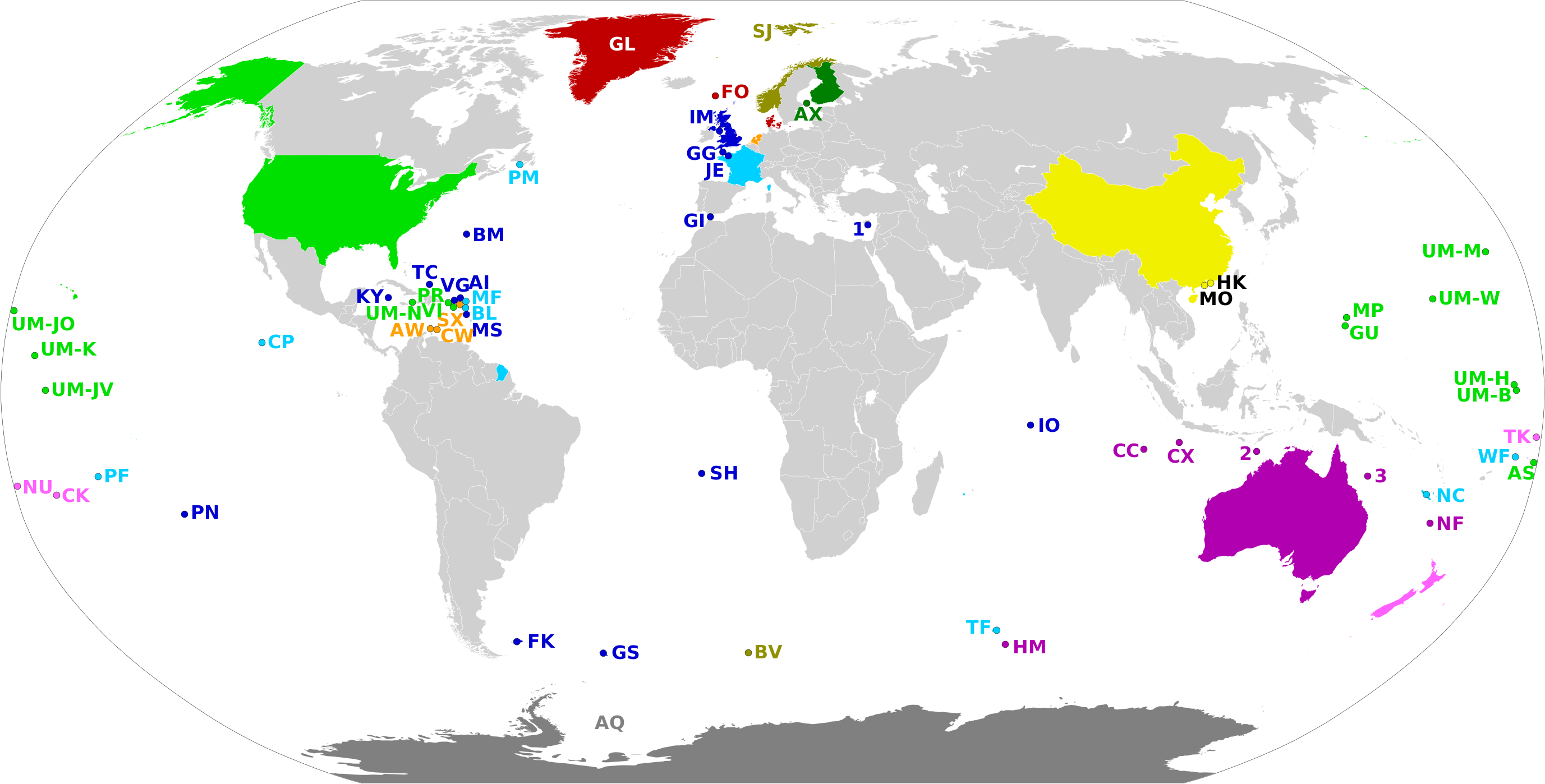
Some countries, such as Taiwan, Sahrawi Republic and Kosovo, have limited recognition or actively disputed sovereignty from sovereign states. Some sovereign states are unions of separate polities, each of which may also be considered a country in its own right, called constituent countries. The Danish Realm consists of Denmark proper, the Faroe Islands, and Greenland. The Kingdom of the Netherlands consists of the Netherlands proper, Aruba, Curaçao, and Sint Maarten. The United Kingdom consists of England, Scotland, Wales, and Northern Ireland.
Dependent territories are the territories of a sovereign state that are outside of its proper territory. These include the overseas territories of New Zealand, the dependencies of Norway, the British Overseas Territories and Crown Dependencies, the territories of the United States, the external territories of Australia, the special administrative regions of China, the autonomous regions of the Danish Realm, Åland, Overseas France, and the Caribbean Netherlands. Some dependent territories are treated as a separate "country of origin" in international trade, such as Hong Kong, Greenland, and Macau.
Identification
Symbols of a country may incorporate cultural, religious or political symbols of any nation that the country includes. Many categories of symbols can be seen in flags, coats of arms, or seals.
Name

Most countries have a long name and a short name. The long name is typically used in formal contexts and often describes the country's form of government. The short name is the country's common name by which it is typically identified. Unlike the short name, the long name can change more often when the government changes. For certain states, the long form and the short form are identical.
The name of a country can hold cultural and diplomatic significance. Upper Volta changed its name to Burkina Faso to reflect the end of French colonization, and the name of North Macedonia was disputed for years due to a conflict with the similarly named Macedonia region in Greece. Southern Rhodesia changed its name to Zimbabwe, Northern Rhodesia to Zambia, Bechuanaland to Botswana, the Congo to Zaire and back again to the Congo, Dahomey to Benin, Ivory Coast to Côte d'Ivoire, Swaziland to Eswatini, Persia to Iran, East Pakistan to East Bengal and then to Bangladesh, Ceylon to Sri Lanka, Siam to Thailand, Burma changed its English name to Myanmar, Cambodia to Kampuchea and back again to Cambodia, Byelorussia to Belarus, Kirghizia to Kyrgyzstan, Moldavia to Moldova, or Turkey to Türkiye.
The International Organization for Standardization maintains a list of country codes as part of ISO 3166 to designate each country with a country code. The ISO 3166 standard currently comprises 249 countries, 193 of which are sovereign states that are members of the United Nations.
Flags
Main article: National flag

Originally, flags representing a country would generally be the personal flag of its rulers; however, over time, the practice of using personal banners as flags of places was abandoned in favor of flags that had some significance to the nation, often its patron saint. Early examples of these were the maritime republics such as Genoa which could be said to have a national flag as early as the 12th century. However, these were still mostly used in the context of marine identification.
Although some flags date back earlier, widespread use of flags outside of military or naval context begins only with the rise of the idea of the nation state at the end of the 18th century and particularly are a product of the Age of Revolution. Revolutions such as those in France and America called for people to begin thinking of themselves as citizens as opposed to subjects under a king, and thus necessitated flags that represented the collective citizenry, not just the power and right of a ruling family. With nationalism becoming common across Europe in the 19th century, national flags came to represent most of the states of Europe. Flags also began fostering a sense of unity between different peoples, such as the Union Jack representing a union between England and Scotland, or began to represent unity between nations in a perceived shared struggle, for example, the Pan-Slavic colors or later Pan-Arab colors.
As Europeans colonized significant portions of the world, they exported ideas of nationhood and national symbols, including flags, with the adoption of a flag becoming seen as integral to the nation-building process. Political change, social reform, and revolutions combined with a growing sense of nationhood among ordinary people in the 19th and 20th centuries led to the birth of new nations and flags around the globe. With so many flags being created, interest in these designs began to develop and the study of flags, vexillology, at both professional and amateur levels, emerged. After World War II, Western vexillology went through a phase of rapid development, with many research facilities and publications being established.
National anthems
Main article: National anthem
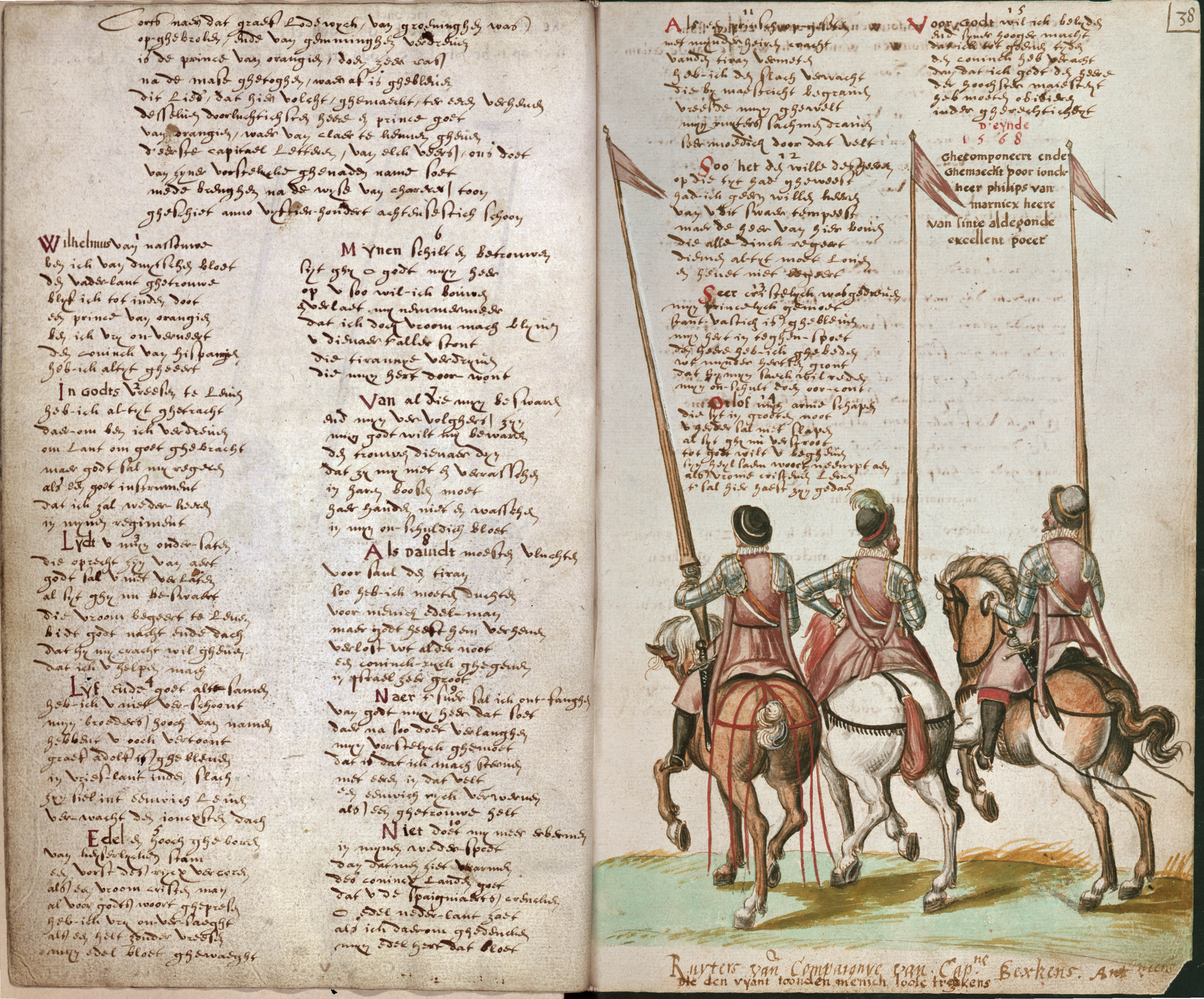
A national anthem is a patriotic musical composition symbolizing and evoking eulogies of the history and traditions of a country or nation. Though the custom of an officially adopted national anthem became popular only in the 19th century, some national anthems predate this period, often existing as patriotic songs long before designation as national anthem. Several countries remain without an official national anthem. In these cases, there are established de facto anthems played at sporting events or diplomatic receptions. These include the United Kingdom ("God Save the King") and Sweden (Du gamla, Du fria). Some sovereign states that are made up of multiple countries or constituencies have associated musical compositions for each of them (such as with the United Kingdom, Russia, and the Soviet Union). These are sometimes referred to as national anthems even though they are not sovereign states (for example, "Hen Wlad Fy Nhadau" is used for Wales, part of the United Kingdom).
Other symbols
- Coats of arms or national emblems
- Seals or stamps
- National mottos
- National colors
Patriotism
Main article: Patriotism
A positive emotional connection to a country a person belongs to is called patriotism. Patriotism is a sense of love for, devotion to, and sense of attachment to one's country. This attachment can be a combination of many different feelings, and language relating to one's homeland, including ethnic, cultural, political, or historical aspects. It encompasses a set of concepts closely related to nationalism, mostly civic nationalism and sometimes cultural nationalism.
Economy
_per_capita_in_2020.png)
Several organizations seek to identify trends to produce economy country classifications. Countries are often distinguished as developing countries or developed countries.
The United Nations Department of Economic and Social Affairs annually produces the World Economic Situation and Prospects Report classifying states as developed countries, economies in transition, or developing countries. The report classifies country development based on per capita gross national income (GNI) and identifies subgroups within broad categories based on geographical location or ad hoc criteria. Geographic regions with developing economies are Africa, East Asia, South Asia, Western Asia, and Latin America and the Caribbean. Economies in transition are in the former Soviet Union and South-Eastern Europe. Regions with developed countries are in Northern America, Europe, and Asia and the Pacific. The majority of economies in transition and developing countries are found in Africa, Asia, Latin America, and the Caribbean.
The World Bank also classifies countries based on GNI per capita. The World Bank Atlas method classifies countries as low-income economies, lower-middle-income economies, upper-middle-income economies, or high-income economies. For the 2020 fiscal year, the World Bank defines low-income economies as countries with a GNI per capita of $1,025 or less in 2018; lower-middle-income economies as countries with a GNI per capita between $1,026 and $3,995; upper-middle-income economies as countries with a GNI per capita between $3,996 and $12,375; high-income economies as countries with a GNI per capita of $12,376 or more..
It also identifies regional trends. The World Bank defines its regions as East Asia and Pacific, Europe and Central Asia, Latin America and the Caribbean, Middle East and North Africa, North America, South Asia, and Sub-Saharan Africa. Lastly, the World Bank distinguishes countries based on its operational policies. The three categories include International Development Association (IDA) countries, International Bank for Reconstruction and Development (IBRD) countries, and Blend countries.
Notes
References
- Anderson, Benedict; 'Imagined Communities: Reflections On the origin and Spread of Nationalism'; London, Verso; 1991
- Viotti, Paul R. and Kauppi, Mark V.; 'International Relations and World Politics – Security, Economy, Identity; Second Edition; New Jersey, Prentice-Hall; 2001 --
Works cited
References
- "country". Merriam-Webster.
- "country Definition and Citations".
- (2018). "Introduction to Geography". McGraw Hill.
- (1993). "USITC Publication". U.S. Government Printing Office.
- Jones, J. (1964). "What Makes a Country?". Human Events.
- Saunders, Toby. (December 22, 2024). "How many countries are there in 2025?".
- (8 April 2010). "In quite a state". [[The Economist]].
- (2024-02-29). "Definition of COUNTRY".
- (2024-02-28). "country".
- "Definition of COUNTRY".
- Geertz, Clifford. (1997). "What is a Country if it is Not a Nation?". The Brown Journal of World Affairs.
- (1991). "country, n.". Oxford University Press.
- Matal, Joseph. (1997-12-01). "A Revisionist History of Indian Country". Alaska Law Review.
- Williams, Raymond. (1973). "The country and the city". Oxford University Press.
- Keller, Simon. (2009). "New waves in political philosophy". Palgrave Macmillan.
- Lucashenko, Melissa. (2005-01-01). "Country: Being and belonging on aboriginal lands". Journal of Australian Studies.
- (1996). "What constitutes the sovereign state?". Cambridge University Press (CUP).
- "Recognition and its Variants".
- Philpott, Daniel. (1995). "Sovereignty: An Introduction and Brief History". Journal of International Affairs.
- Seguin, Denis. (2011-07-29). "What makes a country?".
- Bedjaoui, M.. (1991). "International Law: Achievements and Prospects". Springer Netherlands.
- (2003). "International law". Cambridge University Press.
- Cohen, Rosalyn. (1961). "The Concept of Statehood in United Nations Practice". University of Pennsylvania Law Review.
- Kelsen, Hans. (1941). "Recognition in International Law: Theoretical Observations". American Society of International Law.
- Lauterpacht, H.. (1944). "Recognition of States in International Law". The Yale Law Journal Company, Inc..
- Lowe, Vaughan. (2015-11-26). "International Law: A Very Short Introduction". Oxford University PressOxford.
- (26 July 1999). "States, Sovereignty, Treaties".
- (2012). "Unrecognized States in the International System". Taylor & Francis.
- D’Aspremont, Jean. (2019-08-29). "The Global Community Yearbook of International Law and Jurisprudence 2018". Oxford University Press.
- Harris, D.J. (ed) 2004 "Cases and Materials on International Law" 6th Ed. at p. 99. Sweet and Maxwell, London
- Castellino, Joshua. (2000). "International Law and Self-Determination: The Interplay of the Politics of Territorial Possession With Formulations of Post-Colonial National Identity". [[Martinus Nijhoff Publishers]].
- Castellino, Joshua. (2000). "International Law and Self-Determination: The Interplay of the Politics of Territorial Possession With Formulations of Post-Colonial National Identity". Martinus Nijhoff Publishers.
- (18 January 2024 }}'' (full title), named for its chair, ruled on the question of whether the Republics of Croatia, Macedonia, and Slovenia, who had formally requested recognition by the members of the European Union and by the EU itself, had met conditions specified by the Council of Ministers of the European Community on 16 December 1991. {{cite web). "The Opinions of the Badinter Arbitration Committee: A Second Breath for the Self-Determination of Peoples".
- Crawford, James R.. (2007-03-15). "The Creation of States in International Law". Oxford University Press.
- "Statehood and Recognition".
- Hillier, Tim. (1998). "Sourcebook on Public International Law". Routledge.
- (2005). "International Law: A Treatise". The Lawbook Exchange, Ltd..
- Talmon, S.. (1998). "Recognition of Governments in International Law: With Particular Reference to Governments in Exile". Clarendon Press.
- Kyris, George. (2022). "State recognition and dynamic sovereignty". European Journal of International Relations.
- (1998-07-20). "History, Map, Flag, Population, Languages, & Capital".
- (15 January 2020). "Greenland and the Faroe Islands". The Danish Parliament – EU Information Centre.
- (2022). "Netherlands Yearbook of International Law 2020: Global Solidarity and Common but Differentiated Responsibilities". T.M.C. Asser Press.
- Barnett, H.. (2023). "Constitutional and Administrative Law". Taylor & Francis.
- (23 November 2021). "Canadian Importers Database – Home".
- (20 June 2017). "Consolidated federal laws of canada, General Preferential Tariff and Least Developed Country Tariff Rules of Origin Regulations".
- "Made In The British Crown Colony". Thuy-Tien Crampton.
- "Matchbox label, made in Hong Kong". delcampe.net.
- "Carrhart Made In Hong Kong?". ContractorTalk.
- "Product of Greenland Inland Ice Trademark of Inland Ice Denmark ApS. Application Number: 017910465 :: Trademark Elite Trademarks".
- (2019-12-20). "Hong Kong & Macau".
- "National symbol(s)".
- (17 Jan 2024). "United States Department of State".
- "Publications Office – Interinstitutional Style Guide – Annex A5 – List of countries, territories and currencies".
- "UNGEGN World Geographical Names".
- "FAO Country Profiles".
- "Countries: Designations and abbreviations to use".
- Savage, Jonathan. (2018-01-21). "Why do names matter so much?". BBC News.
- [https://www.gov.uk/government/publications/country-names/timeline-of-country-name-changes-in-hmg-use-1919-to-present Timeline of country name changes in HMG use: 1919 to present]
- "ISO 3166 – Country Codes".
- (12 Mar 2018). "Standard Classification of Countries and Areas of Interest (SCCAI) 2017".
- Devereux, E.. (1994). "Flags: The New Compact Study Guide and Identifier". Chartwell Books.
- M. de Bruin, "Het Wilhelmus tijdens de Republiek", in: L.P. Grijp (ed.), ''Nationale hymnen. Het Wilhelmus en zijn buren. Volkskundig bulletin 24'' (1998), p. 16-42, 199–200; esp. p. 28 n. 65.
- "National anthem – The World Factbook".
- Harrison, Ellie. (29 November 2022). "The history of the Welsh national anthem that's gripped the world".
- Harvey Chisick. (2005). "Historical Dictionary of the Enlightenment". Scarecrow Press.
- (Nov 29, 2001). "Nationalism". Stanford Encyclopedia of Philosophy.
- Paprotny, Dominik. (14 Sep 2020). "Convergence Between Developed and Developing Countries: A Centennial Perspective". Springer Science and Business Media LLC.
- Nations, United. (20 Sep 2020). "What We Do". United Nations.
- (1 Dec 2023). "UN list of least developed countries".
- (1 Jul 2022). "How does the World Bank classify countries?".
This article was imported from Wikipedia and is available under the Creative Commons Attribution-ShareAlike 4.0 License. Content has been adapted to SurfDoc format. Original contributors can be found on the article history page.
Ask Mako anything about Country — get instant answers, deeper analysis, and related topics.
Research with MakoFree with your Surf account
Create a free account to save articles, ask Mako questions, and organize your research.
Sign up freeThis content may have been generated or modified by AI. CloudSurf Software LLC is not responsible for the accuracy, completeness, or reliability of AI-generated content. Always verify important information from primary sources.
Report