From Surf Wiki (app.surf) — the open knowledge base
Cotyledon
Embryonic leaf first appearing from a germinating seed

Embryonic leaf first appearing from a germinating seed
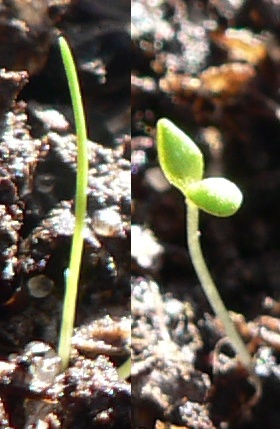
A cotyledon ( ; ; ; gen. (), ) is a "seed leaf" – a significant part of the embryo within the seed of a plant – and is formally defined as "the embryonic leaf in seed-bearing plants, one or more of which are the first to appear from a germinating seed." Botanists use the number of cotyledons present as one characteristic to classify the flowering plants (angiosperms): species with one cotyledon are called monocotyledonous ("monocots"); plants with two embryonic leaves are termed dicotyledonous ("dicots"). Many orchids with minute seeds have no identifiable cotyledon, and are regarded as acotyledons. The Dodders (Cuscuta spp.) also lack cotyledons, as does the African tree Mammea africana (Calophyllaceae). A very small number of Dicots have more than two cotyledons, with perhaps Psittacanthus schiedeanus being the most extreme, having up to twelve.
In the case of dicot seedlings whose cotyledons are photosynthetic, the cotyledons are functionally similar to leaves. However, true leaves and cotyledons are developmentally distinct. Cotyledons form during embryogenesis, along with the root and shoot meristems, and are therefore present in the seed prior to germination. True leaves, however, form post-embryonically (i.e. after germination) from the shoot apical meristem, which generates subsequent aerial portions of the plant.
The cotyledon of grasses and many other monocotyledons is a highly modified leaf composed of a scutellum and a coleoptile. The scutellum is a tissue within the seed that is specialized to absorb stored food from the adjacent endosperm. The coleoptile is a protective cap that covers the plumule (precursor to the stem and leaves of the plant).
Gymnosperm seedlings also have cotyledons. Gnetophytes, cycads, and ginkgos all have 2, whereas in conifers they are often variable in number (multicotyledonous), with 2 to 24 cotyledons forming a whorl at the top of the hypocotyl (the embryonic stem) surrounding the plumule. Within each species, there is often still some variation in cotyledon numbers, e.g. Monterey pine (Pinus radiata) seedlings have between 5 and 9, and Jeffrey pine (Pinus jeffreyi) 7 to 13 (Mirov 1967), but other species are more fixed, with e.g. Mediterranean cypress always having just two cotyledons. The highest number reported is for big-cone pinyon (Pinus maximartinezii), with 24 (Farjon & Styles 1997).
Cotyledons may be ephemeral, lasting only days after emergence, or persistent, enduring at least a year on the plant. The cotyledons contain (or in the case of gymnosperms and monocotyledons, have access to) the stored food reserves of the seed. As these reserves are used up, the cotyledons may turn green and begin photosynthesis, or may wither as the first true leaves take over food production for the seedling.
Epigeal versus hypogeal development
Main article: Epigeal germination, Hypogeal germination


Cotyledons may be either epigeal, expanding on the germination of the seed, throwing off the seed shell, rising above the ground, and perhaps becoming photosynthetic; or hypogeal, not expanding, remaining below ground and not becoming photosynthetic. The latter is typically the case where the cotyledons act as a storage organ, as in many nuts and acorns.
Hypogeal plants have (on average) significantly larger seeds than epigeal ones. They are also capable of surviving if the seedling is clipped off, as meristem buds remain underground (with epigeal plants, the meristem is clipped off if the seedling is grazed). The tradeoff is whether the plant should produce a large number of small seeds, or a smaller number of seeds which are more likely to survive.
The ultimate development of the epigeal habit is represented by a few plants, mostly in the family Gesneriaceae in which the cotyledon persists for a lifetime. In Streptocarpus wendlandii of South Africa, one cotyledon grows to be up to 75 cm in length and up to 61 cm wide, the largest cotyledon of any dicot, and exceeded only by the monocot Lodoicea. Adventitious flower clusters form along the midrib of the cotyledon. The second cotyledon is much smaller and ephemeral.
Related plants may show a mixture of hypogeal and epigeal development, even within the same plant family. Groups which contain both hypogeal and epigeal species include, for example, the Southern Hemisphere conifer family Araucariaceae, the pea family, Fabaceae, and the genus Lilium (see Lily seed germination types). The frequently garden grown common bean, Phaseolus vulgaris, is epigeal, while the closely related runner bean, Phaseolus coccineus, is hypogeal.
History
The term cotyledon was coined by Marcello Malpighi (1628–1694). John Ray was the first botanist to recognize that some plants have two and others only one, and eventually the first to recognize the immense importance of this fact to systematics, in Methodus plantarum (1682).
Theophrastus (3rd or 4th century BC) and Albertus Magnus (13th century) may also have recognized the distinction between the dicotyledons and monocotyledons.
Notes
References
Bibliography
- Mirov, N. T. (1967). The Genus Pinus. Ronald Press Company, New York.
- Farjon, A. & Styles, B. T. (1997). Pinus (Pinaceae). Flora Neotropica Monograph 75: 221–224.
References
- Quattrocchi, Umberto. (17 November 1999). "CRC World Dictionary of Plant Names: Common Names, Scientific Names, Eponyms, Synonyms, and Etymology". [[CRC Press]].
- (December 1995). "Seed Dispersal by Elephants...etc". Biotropica.
- Kuijt, Job. (1969). "The Biology of Parasitic Flowering Plants". Univ. of Calif. Press.
- (2007). "Response of Seedlings of Two Hypogeal Brush Species to CO2 Enrichment". Fort Collins, CO: U.S. Department of Agriculture, Forest Service, Rocky Mountain Research Station.
- (2007). "Seed size, seedling morphology, and response to deep shade and damage in neotropical rain forest trees". American Journal of Botany.
- (2004). "Characterization of Anisocotylous Leaf Formation in Streptocarpus Wendlandii (Gesneriaceae): Significance of Plant Growth Regulators.". Annals of Botany.
- Perry, Frances and Leslie Greenwood. (1972). "Flowers of the World". Hamlyn Publishing Group.
- (1998). "Phyloghuhenetic relationships within Araucariaceae based on rbcL gene sequences". American Journal of Botany.
- Vines, Sydney Howard. (1913). "Makers of British botany". Cambridge University Press.
- Greene, Edward Lee. (1983). "Landmarks of botanical history: Part 2". Stanford University Press.
- "Bioetymology: Origin in Biomedical Terms: cotyledon, monocotyledon (plural usually monocots), dicotyledons(plural usually dicot)".
This article was imported from Wikipedia and is available under the Creative Commons Attribution-ShareAlike 4.0 License. Content has been adapted to SurfDoc format. Original contributors can be found on the article history page.
Ask Mako anything about Cotyledon — get instant answers, deeper analysis, and related topics.
Research with MakoFree with your Surf account
Create a free account to save articles, ask Mako questions, and organize your research.
Sign up freeThis content may have been generated or modified by AI. CloudSurf Software LLC is not responsible for the accuracy, completeness, or reliability of AI-generated content. Always verify important information from primary sources.
Report