From Surf Wiki (app.surf) — the open knowledge base
Cotton States and International Exposition
1895 world's industrial fair

1895 world's industrial fair
| Field | Value |
|---|---|
| image | Cotton States and International Exposition of 1895.png |
| caption | An illustration of the event |
| year | 1895 |
| name | Cotton States and International Exposition |
| visitors | 800,000 |
| cnt | 13 |
| country | United States |
| city | Atlanta, Georgia |
| venue | Piedmont Park (now) |
| coord | |
| open | September 18, 1895 |
| close | December 31, 1895 |
| area | 11.5 acres (4.7 ha) |
The Cotton States and International Exposition was a world's fair held in Atlanta, Georgia, United States in 1895. The exposition was designed "to foster trade between southern states and South American nations as well as to show the products and facilities of the region to the rest of the nation and Europe."
The Cotton States and International Exposition featured exhibits from six states, including various innovations in agriculture and technology, and exhibits about women and African Americans. President Grover Cleveland presided over the opening of the exposition remotely by flipping an electric switch from his house in Massachusetts on September 18, 1895.
The event is best remembered for the "Atlanta Compromise" speech given by Booker T. Washington on September 18, promoting racial cooperation.
Background
The idea for an international exposition in Atlanta was first proposed in November 1893 by William Hemphill, a former mayor of Atlanta. Hemphill served as vice president and director of the exposition.
Bradford Lee Gilbert was the supervising architect. He designed the Administration Building with the Main Entrance and Exits, the Agricultural Building, the Auditorium, the Chime Tower and Band Stand, the Electricity Building, the Fire Building, the Machinery Hall, the Manufacturers & Liberal Arts Building, the Minerals and Forestry Building, the Negro Building, the Semi-Circular Entrance and Exit Gateway, the Transportation Building, and the United States Government Building.
The grounds were designed by Joseph Forsyth Johnson. Over $2,000,000 was spent transforming the exhibition site. A pond was expanded to 11.5 acre Lake Clara Meer for the event. Tropical gardens, now known as the Atlanta Botanical Garden, were also constructed for the fair.
The government allocated $250,000 for the construction of a government building. Many states and countries such as Argentina also had buildings.
The Exposition was open for 100 days, beginning on September 18, 1895, and ending on December 31, 1895. It attracted nearly 800,000 visitors from the United States and thirteen countries. However, the exposition was plagued by financial issues.
Exhibits
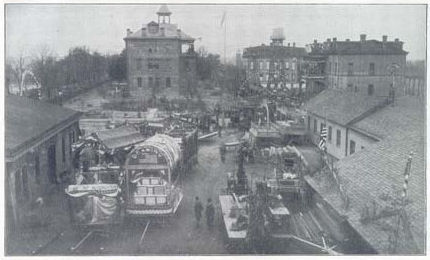


Walter McElreath described the fair in his memoirs:
The exposition included many exhibits on Minerals and Forestry, Agriculture, Food and Accessories, Machinery and Appliances, Horticulture, Machinery, Manufacturers, Electricity, Fine Arts, Painting and Sculpture, Liberal Arts, Education, and Literature. About 6,000 exhibits were examined by the Award Committee. The Awards Committee awarded a total of 1,573 medals: 634 gold medals, 444 silver medals, and 495 bronze medals.
In late September Charles Francis Jenkins demonstrated an early movie projector called the "Phantoscope." Organist and composer Fannie Morris Spencer chaired the exposition’s music committee. John Philip Sousa composed his famous march, "King Cotton", for the exposition and dedicated it to the people of Georgia.
December26, 1895, was "Negro Day" at the exposition. Famed African American quilter Harriet Powers attended this day and met with Irvine Garland Penn, the chief of the Negro Building.
The National League of Mineral Painters, with Adelaïde Alsop Robineau and Mary Chase Perry, contributed decorative objects and artwork to the New York City exhibit. An electric railway was built for the exposition by the Dixie Intramural Railway Company, founded and presided by Col. Ira Yale Sage.
Women's Building
Pennsylvania's first woman American architect, Elise Mercur (1864–1947) designed the Palladian style Woman's Building. The Women's Building showcased accomplishments of women throughout the South, and the country, in the areas of education, health care, and the fine and decorative arts. Its exhibitions were curated by women from Georgia. The contents were contributed by women around the country. Women culled historical artifacts, decorative arts objects, and industrial products to compose displays in each room, including the Baltimore Room, the Lucy Cobb Room, Mary Ball Washington Tea Room, the Columbus Room, Model Library, Assembly Hall, and others, each assigned to a different state. The many elaborate displays reflected a diversity of views spanning the mainstream social and domestic roles of Southern women, such as patriotism and the ideals of traditional motherhood to little-known achievements of women counter to mainstream stereotypes.
The Legion of Loyal Women display presented an arrangement of 45 dolls, each one adorned with a small shield showing the name of a state, to illustrate the American Patriotic salute. Other displays posed a challenge to the roles of women and other social conventions. The Colonial Room presented utensils and furnishings, as well as Dolly Madison's spectacles, a gun carried in the Battle of Concord, and brass medallions belonging to George Washington; the display was said to represent "the growing bond of cooperation between the North and South."
The exposition introduced new ideas to foster trade and collaboration between the Southern and Northern states and to also show ideas, products, and facilities to the rest of the nation and to Europe. The exhibitions presented prototypes for a hospital room, a nursery, a kindergarten classroom, and a model library—each one in working order. These functional rooms represented the environments where women played important roles outside the home and family, and were equipped with the most up-to-date equipment, features, and furnishings. The model library included a collection of publications by women authors from every state in the nation. A photography exhibition featured portraits of women in every branch of literature, appended with a verse, letter, or section of a manuscript by the authors.
Booker T. Washington's speech
On September 18, 1895, Booker T. Washington gave the "Atlanta Compromise" speech was an address on the topic of race relations. Washington's speech laid the foundation for the Atlanta Compromise, an agreement between African American leaders and Southern white leaders in which blacks would work meekly and submit to white political rule, while whites guaranteed that blacks would receive basic education and due process of law. The speech was presented before a predominantly white audience and has been recognized as one of the most important, influential, and controversial speeches in American history.
Legacy
The Cotton States Exposition successfully showcased Atlanta as a business center and attracted investment to the city. After the exposition, the grounds were purchased by the City of Atlanta and became Piedmont Park and the Atlanta Botanical Garden. The buildings were demolished, but the park grounds remain largely as Joseph Forsyth Johnson designed it for the exposition. However, the stone balustrades scattered around the park are the only remaining part of the enormous main building.
References
References
- "Cotton Expositions in Atlanta".
- Cooper, Walter Gerald. (1896). "The Cotton States and International Exposition and South, Illustrated". Illustrator Company.
- (June 13, 2007). "William Arnold Hemphill collection, 1898-1902".
- Bishir, Catherine W.. (2016). "Bradford L. Gilbert". North Carolina State University Libraries.
- White, James Terry. (1910). "The National Cyclopaedia of American biography".
- (1895). "Sketch Portfolio of Railroad Stations and Kindred Structures: From Original Designs & Supplement". The Railroad Gazette.
- (1895-08-01). "For Atlanta's Big Show". New York Times Online.
- "Park History". Piedmont Park Conservancy.
- (1998-10-19). "Session 3: Address to the Country". Library of Congress.
- "Atlanta:Piedmont Park". National Park Service.
- McElreath, Walter, ''An Autobiography'', Mercer University Press, p.129-130
- "Exposition Medals". Medals of Atlanta Cotton States and International Exposition of 1895.
- Benjamin, W. H.. (1908). "Biographies of celebrated organists of America.". Benjamin Pub. Co.
- "This is Negro Day," ''Atlanta Constitution'' December 26, 1895, p. 5
- "This I Accomplish: Harriet Powers' Bible Quilt and Other Pieces, by Kyra E. Hicks, Black Threads Press, 2009, p. 40-41.
- [https://books.google.com/books?id=I4hNAAAAYAAJ&dq=%22The+Dixie+Intramural+Railway+Company%22&pg=PA127 An Intramural Railway at the Atlanta Exposition], The Street Railway Journal, Volume 11, 1895, p. 127
- (April 23, 1983). "Forgotten Lady Architect". Observer Reporter.
- (1995). "The Eyes of the World Are Upon Us: A Look at the Cotton States and International Exposition of 1895". Atlanta History.
- (2015). "Visual Art and the Urban Evolution of the New South". University of South Carolina Press.
- (2004). "Southern Ladies, New Women: Race, Region, and Clubwomen in South Carolina, 1890-1930". University of Florida Press.
- Washington, Booker T. (1896). "Report of the Board of Commissioners representing the state of New York at the Cotton States and International Exposition held at Atlanta, Georgia, 1895". Albany, N.Y.: Wynkoop Hallenbeck Crawford Co. [[OCLC (identifier). OCLC]] 4197235
- "Atlanta Compromise Speech". New Georgia Encyclopedia.
- [http://www.africawithin.com/bios/booker/atlanta_compromise.htm Text of Atlanta Compromise Speech]
This article was imported from Wikipedia and is available under the Creative Commons Attribution-ShareAlike 4.0 License. Content has been adapted to SurfDoc format. Original contributors can be found on the article history page.
Ask Mako anything about Cotton States and International Exposition — get instant answers, deeper analysis, and related topics.
Research with MakoFree with your Surf account
Create a free account to save articles, ask Mako questions, and organize your research.
Sign up freeThis content may have been generated or modified by AI. CloudSurf Software LLC is not responsible for the accuracy, completeness, or reliability of AI-generated content. Always verify important information from primary sources.
Report