From Surf Wiki (app.surf) — the open knowledge base
Corynanthe johimbe
Species of flowering plant

Species of flowering plant
- Pausinystalia johimbe (K.Schum.) Pierre
- Pausinystalia zenkeri W.Brandt
Corynanthe johimbe, synonym Pausinystalia johimbe, common name yohimbe, is a plant species in the family Rubiaceae native to western and central Africa (Nigeria, Cabinda, Cameroon, Congo-Brazzaville, Gabon, Equatorial Guinea).
Extracts from yohimbe have been used in traditional medicine in West Africa as an aphrodisiac, and have been marketed in developed countries as dietary supplements.
Synonyms
Botanical
According to Royal Botanical Gardens Kew, Plants of the World Online, the accepted name is Corynanthe johimbe K.Schum (first published in Notizbl. Bot. Gart. Berlin-Dahlem 3: 94, 1901) and it has the following recognised synonyms:
Homotypic:
- Pausinystalia johimbe (K.Schum.) Pierre in Actes Soc. Linn. Bordeaux 61: 130 (1906)
- Pseudocinchona johimbe (K.Schum.) A.Chev. in : 266 (1926)
Heterotypic:
- Pausinystalia trillesii Beille in Actes Soc. Linn. Bordeaux 61: 130 (1906)
- Pausinystalia zenkeri W.Brandt in Arch. Pharm. (Berlin) 260: 67 (1922).
Scientific (general)
In scientific papers generally (i.e. not just in specialist botanical literature) the usage Pausinystalia johimbe is the most frequent, followed by Pausinystalia yohimbe.The database Google Scholar interrogated with alternative names (access date 13 December 2022), gave:
- Corynanthe johimbe = 619 books or papers
- Corynanthe yohimbe = 895 books or papers
- Pausinystalia johimbe = 2,090 books or papers
- Pausinystalia yohimbe = 1,590 books or papers.
Description
Yohimbe is one of a number of Corynanthe evergreen species growing in West and Central Africa in lowland forests.
Conservation
The demand for yohimbe bark has led to over-exploitation, with the possibility of long-term threat to sustainability of the species. Cameroon is the biggest exporter.
Uses
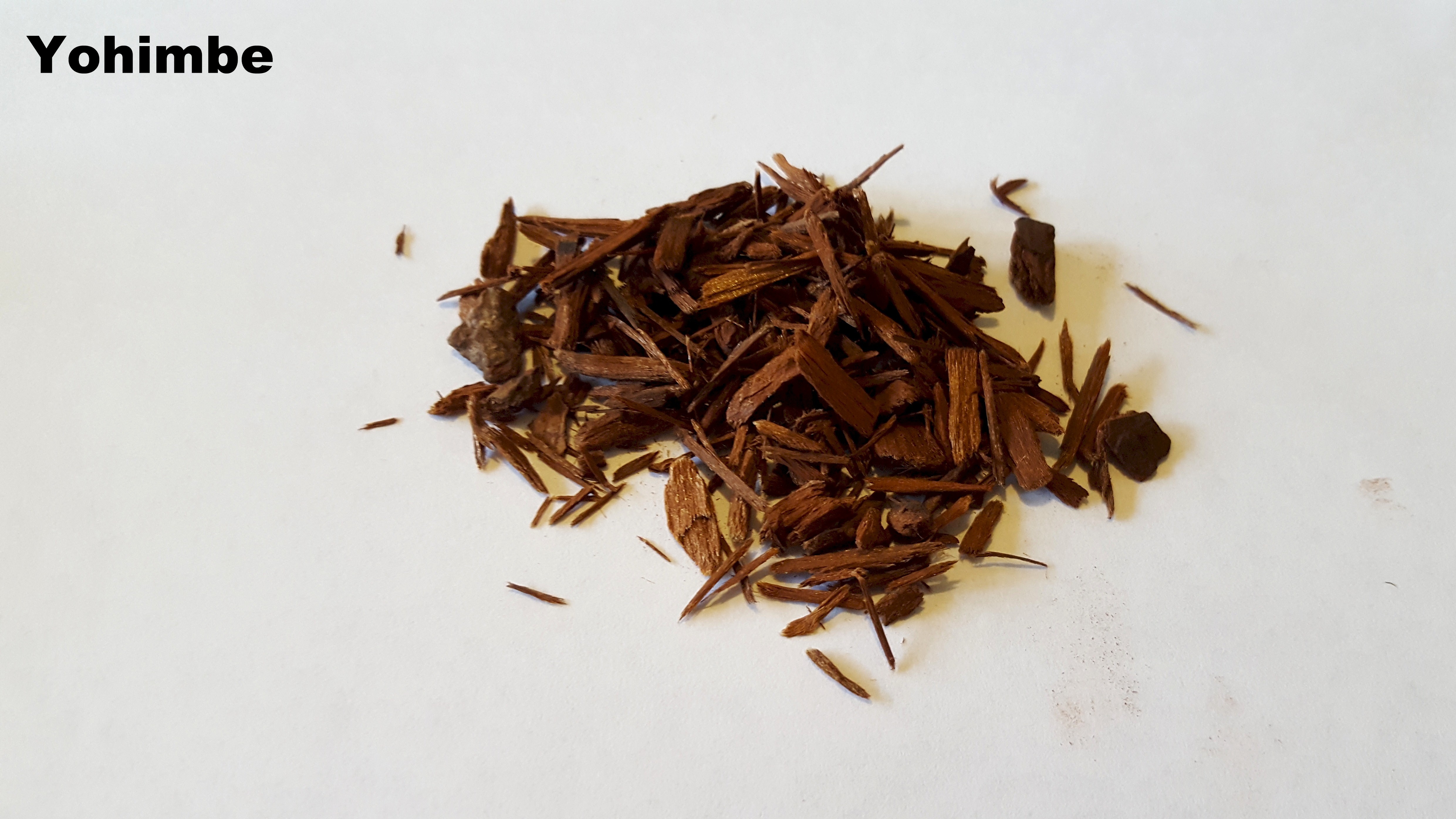
The wood and bark are used for firewood and construction. Bark the most commercially important product is used in extractions to make tinctures for traditional medicine and dietary supplements.
The main phytochemical in the extract is the indoloquinolizidine alkaloid yohimbine. It also contains other alkaloids, such as corynanthine and raubasine, with undefined properties, adding further to concerns about its safety.
Human use and adverse effects
Extracts from yohimbe bark are used in West African traditional medicine in the belief that it is a herbal tonic and aphrodisiac.
Yohimbe bark and extract are used in manufactured dietary supplements, but there is inconclusive scientific evidence that they have an effect or are safe to use, as yohimbine levels may vary substantially among supplement products. Yohimbe bark extract is insufficiently characterized for its properties, and is possibly unsafe to consume.
Although proposed as a potential treatment for erectile dysfunction in humans, there are concerns about the safety of yohimbe and no good evidence for its effectiveness. Adverse effects of using yohimbe, particularly in high doses, may include hypertension, increased heart rate, headache, nausea, tremors, and insomnia.
Yohimbe products should not be used during pregnancy or breastfeeding.
References
References
- "''Corynanthe johimbe'' K.Schum.". Royal Botanic Gardens, Kew.
- (26 June 2024). "Yohimbe". Drugs.com.
- Kew Science. "Corynanthe johimbe K.Schum".
-
- m tall, with a straight bole that is rarely larger than {{cvt. 50–60. cm in diameter. The bark is grey to reddish-brown, with longitudinal fissures, easy to peel and bitter-tasting. The inner bark is pinkish and fibrous. The sapwood is yellowish and the heartwood is ochre-yellow; the wood is fine-grained and relatively dense and moderately hard. The leaves grow in groups of three, with short (about 2 cm) [[Petiole (botany). 9789290814955
- (2013). "New Vistas in Agroforestry: A Compendium for the 1st World Congress of Agroforestry, 2004". Springer Science and Business Media.
- (April 2025). "Yohimbe". National Center for Complementary and Integrative Health, US National Institutes of Health.
- R.b. Jiofack Tafokou. Pausinystalia johimbe. pp 516-519 in Timbers Volume 2; Volume 7 of Plant Resources of Tropical Africa. Eds. Lemmens, R.H.M.J., Louppe, D. & Oteng-Amoako, A.A., G.J.H Grubben. PROTA Foundation, 2012. {{ISBN. 9789290814955
This article was imported from Wikipedia and is available under the Creative Commons Attribution-ShareAlike 4.0 License. Content has been adapted to SurfDoc format. Original contributors can be found on the article history page.
Ask Mako anything about Corynanthe johimbe — get instant answers, deeper analysis, and related topics.
Research with MakoFree with your Surf account
Create a free account to save articles, ask Mako questions, and organize your research.
Sign up freeThis content may have been generated or modified by AI. CloudSurf Software LLC is not responsible for the accuracy, completeness, or reliability of AI-generated content. Always verify important information from primary sources.
Report