From Surf Wiki (app.surf) — the open knowledge base
Cortical column
Group of neurons in the cortex of the brain
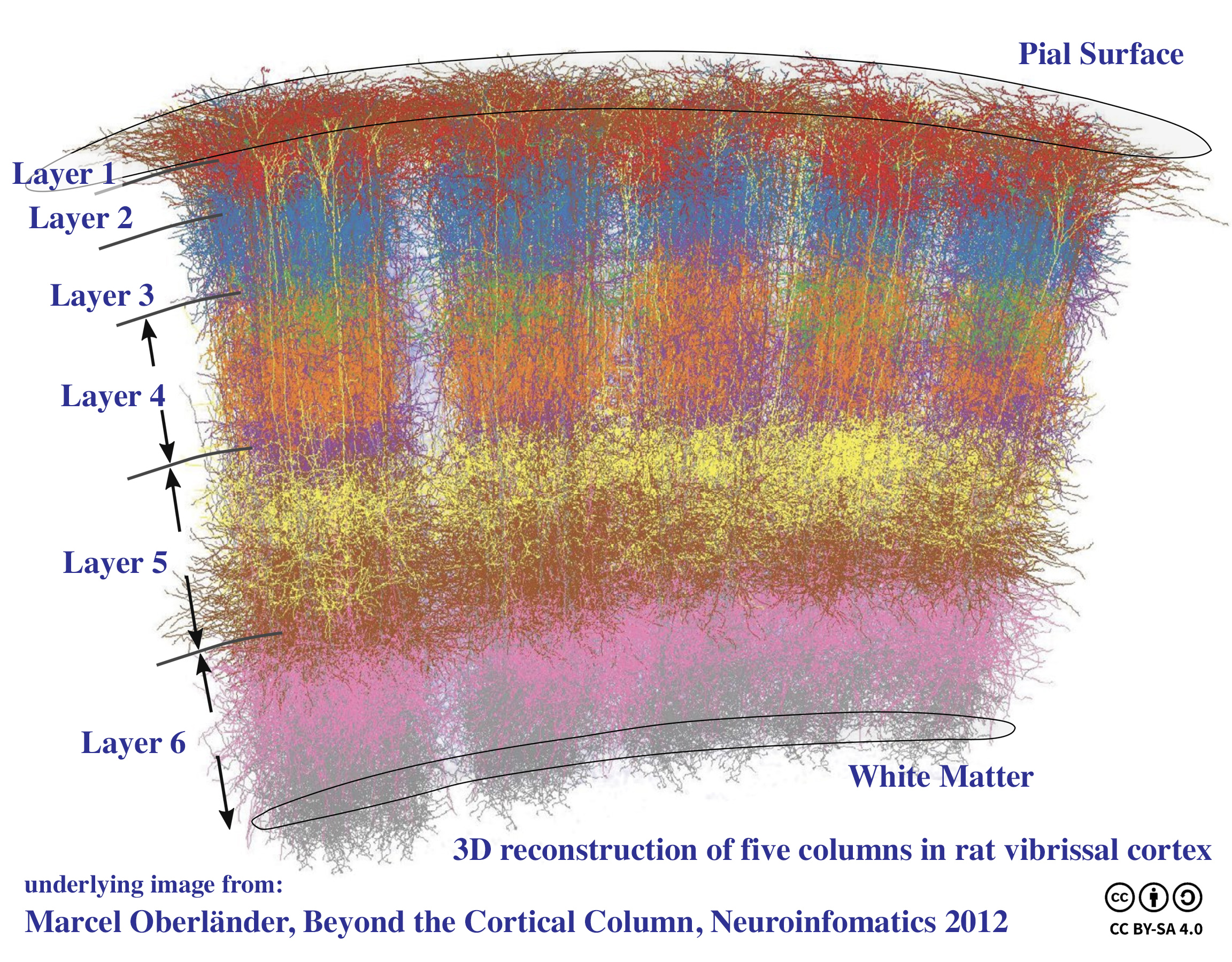
Group of neurons in the cortex of the brain
A cortical column is a group of neurons forming a cylindrical structure through the cerebral cortex of the brain perpendicular to the cortical surface. The structure was first identified by Vernon Benjamin Mountcastle in 1957. He later identified minicolumns as the basic units of the neocortex which were arranged into columns. Each contains the same types of neurons, connectivity, and firing properties. Columns are also called hypercolumn, macrocolumn, functional column or sometimes cortical module. Neurons within a minicolumn (microcolumn) encode similar features, whereas a hypercolumn "denotes a unit containing a full set of values for any given set of receptive field parameters". A cortical module is defined as either synonymous with a hypercolumn or as a tissue block of multiple overlapping hypercolumns.
Cortical columns are proposed to be the canonical microcircuits for predictive coding, in which the process of cognition is implemented through a hierarchy of identical microcircuits. The evolutionary benefit to this duplication allowed human neocortex to increase in size by almost 3-fold over just the last 3 million years.
The columnar hypothesis states that the cortex is composed of discrete, modular columns of neurons, characterized by a consistent connectivity profile. The columnar organization hypothesis is currently the most widely adopted to explain the cortical processing of information.
Mammalian cerebral cortex
Main article: Cerebral cortex
The mammalian cerebral cortex, the grey matter encapsulating the white matter, is composed of layers. The human cortex is between 2 and 3 mm thick. The number of layers is the same in most mammals, but varies throughout the cortex. 6 layers can be recognized in the neocortex, although many regions lack one or more layers. For example, fewer layers are present in the archipallium and the paleopallium.
Columnar functional organization
The columnar functional organization, as originally framed by Vernon Mountcastle, suggests that neurons that are horizontally more than 0.5 mm (500 μm) from each other do not have overlapping sensory receptive fields, and other experiments give similar results: 200–800 μm. Various estimates suggest there are 50 to 100 cortical minicolumns in a hypercolumn, each comprising around 80 neurons. Their role is best understood as 'functional units of information processing.'
An important distinction is that the columnar organization is functional by definition, and reflects the local connectivity of the cerebral cortex. Connections "up" and "down" within the thickness of the cortex are much denser than connections that spread from side to side.
Hubel and Wiesel studies
David Hubel and Torsten Wiesel followed up on Mountcastle's discoveries in the somatic sensory cortex with their own studies in vision. A part of the discoveries that resulted in them winning the 1981 Nobel Prize was that there were cortical columns in vision as well, and that the neighboring columns were also related in function in terms of the orientation of lines that evoked the maximal discharge. Hubel and Wiesel followed up on their own studies with work demonstrating the impact of environmental changes on cortical organization, and the sum total of these works resulted in their Nobel Prize.
Number of cortical columns
There are about 200 million (2×10⁸) cortical minicolumns in the human neocortex with up to about 110 neurons each, and with estimates of 21–26 billion (2.1×10¹⁰–2.6×10¹⁰) neurons in the neocortex. With 50 to 100 cortical minicolumns per cortical column a human would have 2–4 million (2×10⁶–4×10⁶) cortical columns. There may be more if the columns can overlap, as suggested by Tsunoda et al. Jeff Hawkins claims that there are only 150,000 columns in the human neocortex, based on research made by his company Numenta.
There are claims that minicolumns may have as many as 400 principal cells, but it is not clear if that includes glia cells.
Some contradict the previous estimates, claiming the original research is too arbitrary. The authors propose a uniform neocortex, and choose a fixed width and length to calculate the cell numbers. Later research pointed out that the neocortex is indeed not uniform for other species, and studying nine primate species they found that "the number of neurons underneath 1 mm2 of the cerebral cortical surface ... varies by three times across species." The neocortex is not uniform across species. The actual number of neurons within a single column is variable, and depends on the cerebral areas and thus the function of the column.
References
References
- (July 1957). "Modality and topographic properties of single neurons of cat's somatic sensory cortex". Journal of Neurophysiology.
- (1997). "The columnar organization of the neocortex". Brain.
- (2020). "An Attempt at a Unified Theory of the Neocortical Microcircuit in Sensory Cortex". Frontiers in Neural Circuits.
- Buxhoeveden, D. P.. (2002-05-01). "The minicolumn hypothesis in neuroscience". Brain.
- (2015-11-13). "Generating Neuronal Diversity in the Mammalian Cerebral Cortex". Annual Review of Cell and Developmental Biology.
- (2003). "Fundamentals of human neuropsychology". Worth.
- (2005). "The cortical column: a structure without a function". Philos. Trans. R. Soc. Lond. B Biol. Sci..
- (Mar 1963). "Shape and arrangement of columns in cat's striate cortex". J Physiol.
- (2012). "Canonical microcircuits for predictive coding". Neuron.
- (2012). "The neocortical column". Frontiers in Neuroanatomy.
- (2011). "Human anatomy". McGraw-Hill.
- (1998). "The central nervous system of vertebrates". Springer.
- (September 1977). "Orientation columns in macaque monkey visual cortex demonstrated by the 2-deoxyglucose autoradiographic technique". Nature.
- Leise EM. (1990). "Modular construction of nervous systems: a basic principle of design for invertebrates and vertebrates". Brain Research. Brain Research Reviews.
- "The Nobel Prize in Medicine 1981".
- (2008). "Sleep as a fundamental property of neuronal assemblies". Nature Reviews Neuroscience.
- (August 2001). "Complex objects are represented in macaque inferotemporal cortex by the combination of feature columns". Nat. Neurosci..
- (2021). "A Thousand Brains: A New Theory of Intelligence". Basic Books.
- O. David, in Brain Mapping. (2015). "Brain Mapping – An Encyclopedic Reference".
- (June 1980). "The basic uniformity in structure of the neocortex.". Brain: A Journal of Neurology.
- Rakic, Pasko. (2008-08-26). "Confusing cortical columns". Proceedings of the National Academy of Sciences.
- (2008-08-26). "The basic nonuniformity of the cerebral cortex". Proceedings of the National Academy of Sciences.
- (2012). "How many neurons do you have? Some dogmas of quantitative neuroscience under revision". European Journal of Neuroscience.
- Molnár, Z.. (January 2013). "Chapter 7 - Cortical Columns". Neural Circuit Development and Function in the Brain.
This article was imported from Wikipedia and is available under the Creative Commons Attribution-ShareAlike 4.0 License. Content has been adapted to SurfDoc format. Original contributors can be found on the article history page.
Ask Mako anything about Cortical column — get instant answers, deeper analysis, and related topics.
Research with MakoFree with your Surf account
Create a free account to save articles, ask Mako questions, and organize your research.
Sign up freeThis content may have been generated or modified by AI. CloudSurf Software LLC is not responsible for the accuracy, completeness, or reliability of AI-generated content. Always verify important information from primary sources.
Report