From Surf Wiki (app.surf) — the open knowledge base
Corpus cavernosum of clitoris
One of a pair of regions in the clitoris that contain the blood during erection
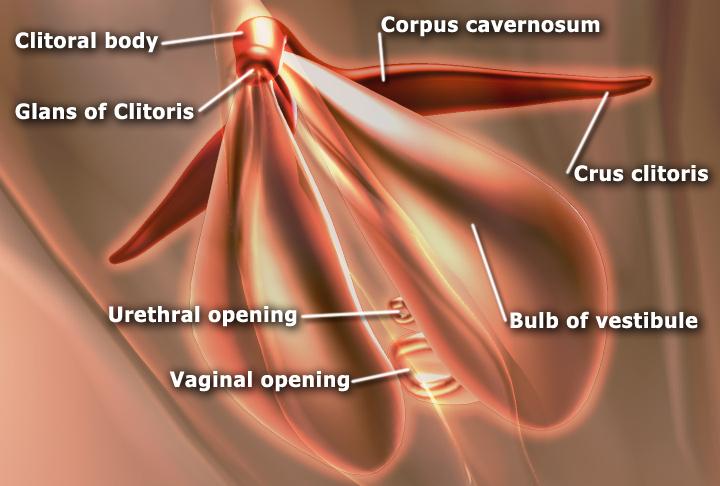
One of a pair of regions in the clitoris that contain the blood during erection
| Field | Value |
|---|---|
| Name | Corpus cavernosum of clitoris |
| Latin | corpus cavernosum clitoridis |
| Image | File:Clitoral body, internal anatomy.png |
| Caption | Internal anatomy of clitoral body: 1. Trabeculae of corpora cavernosa of clitoris; 2. Cavernous spaces; 3. Dorsal nerve of clitoris; 4. Dorsal artery of clitoris; 5. Superficial dorsal veins of clitoris; 6. Deep dorsal vein of clitoris; 7. Deep artery of clitoris; 8. Skin; 9. Membranous layer of subcutaneous tissue; 10. Clitoral fascia; 11. Tunica albuginea; 12. Septum of clitoris. |
| Image2 | File:Clitoral anatomy updated.jpglang=en |
| Caption2 | The internal anatomy of the human vulva, with the clitoral hood and labia minora indicated as lines. |
| System | Reproductive system |
| Part_of | Clitoris |
| Function | Clitoral erection |
The corpus cavernosum of the clitoris is one of a pair of sponge-like regions of erectile tissue that engorge with blood during an erection. This is homologous to the corpus cavernosum of the penis. The term corpora cavernosa literally means "cave-like bodies".
Structure
The two corpora cavernosa are expandable erectile tissues of the clitoris. They are joined together along their medial surfaces by an incomplete fibrous septum. Each corpus cavernosum is connected to the rami of the pubis and ischium by a clitoral crus. There is connection to the ischiocavernosus muscle. Each can be up to 7 cm long in an adult.
Development
The corpus cavernosum is homologous to the corpus cavernosum penis in the male. It develops from the genital tubercle in the embryo.
The clitoris also has two vestibular bulbs beneath the skin of the labia minora (at the entrance to the vagina), which expand at the same time as the glans clitoridis to cap the ends of the corpora cavernosa.
Microanatomy
The corpus cavernosum is made of a sponge-like tissue. This contains irregular blood-filled spaces, lined by endothelium, and separated by connective tissue septa.
Function
The corpora cavernosa fill with blood during arousal. Their size increases 2 fold to 3 fold. In some circumstances, release of nitric oxide precedes relaxation of the clitoral cavernosal artery and nearby muscle, in a process similar to male erection. More blood flows in through the clitoral cavernosal artery, the pressure in the corpora cavernosa clitoridis rises. The clitoris is engorged with blood. This leads to extrusion of the glans clitoridis and enhanced sensitivity to physical contact.
Clinical significance
The corpora cavernosa can reduce in size before the menopause. This can impair sexual function in some women.
References
References
- (2015). "Handbook of Clinical Neurology". [[Elsevier]].
- (2015). "Stevens & Lowe's Human Histology". [[Mosby (publisher).
- Gray, Henry. (1918). "Atlas of the Human Body". Lea & Febiger.
This article was imported from Wikipedia and is available under the Creative Commons Attribution-ShareAlike 4.0 License. Content has been adapted to SurfDoc format. Original contributors can be found on the article history page.
Ask Mako anything about Corpus cavernosum of clitoris — get instant answers, deeper analysis, and related topics.
Research with MakoFree with your Surf account
Create a free account to save articles, ask Mako questions, and organize your research.
Sign up freeThis content may have been generated or modified by AI. CloudSurf Software LLC is not responsible for the accuracy, completeness, or reliability of AI-generated content. Always verify important information from primary sources.
Report