From Surf Wiki (app.surf) — the open knowledge base
Coronet
Crown
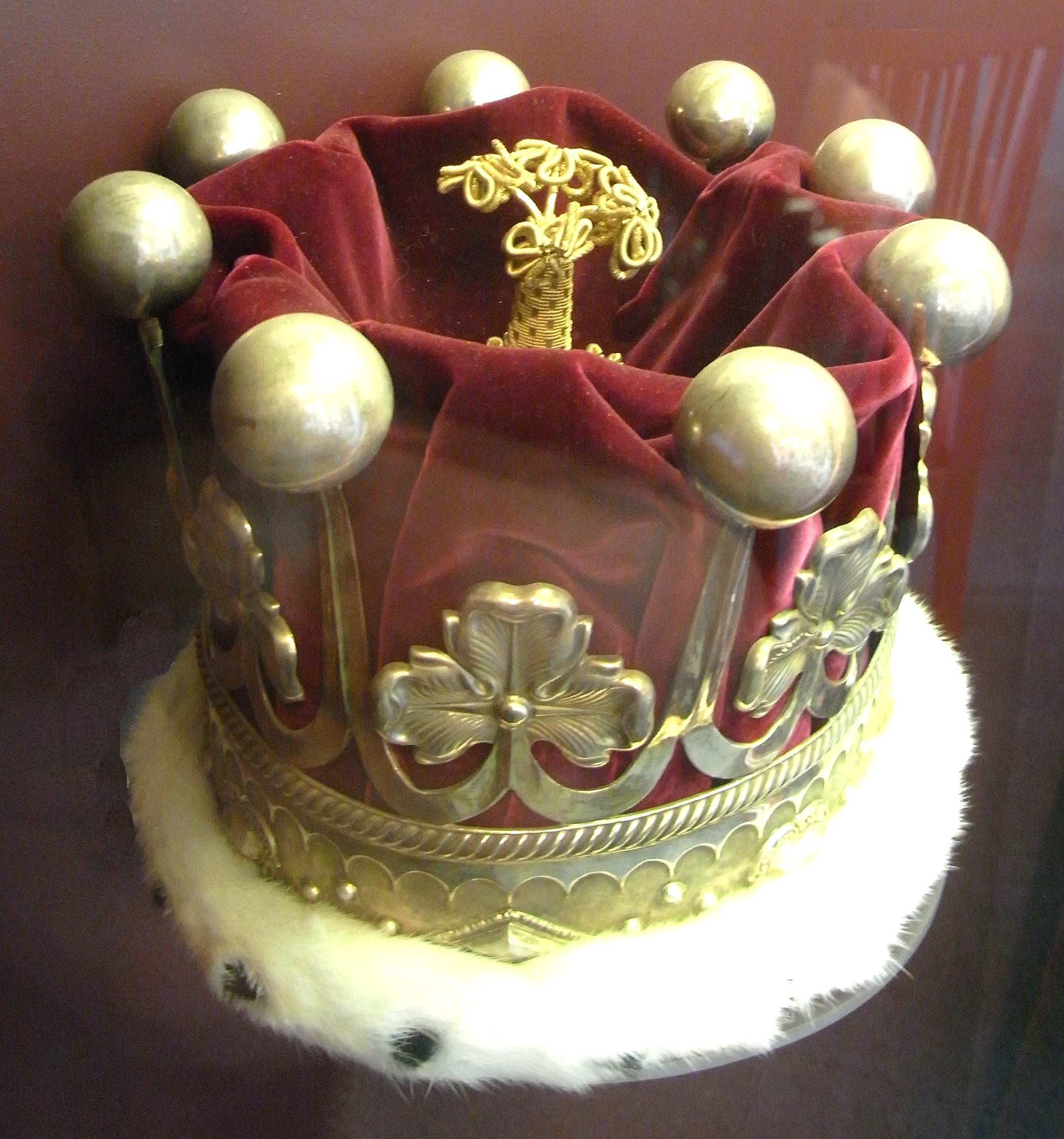
Crown
In British heraldry, a coronet is a type of crown that is a mark of rank of non-reigning members of the royal family and peers. In other languages, this distinction is not made, and usually the same word for crown is used irrespective of rank (, , , , , etc.) In this use, the English coronet is a purely technical term for all heraldic images of crowns not used by a sovereign. A coronet is another type of crown, but is reserved for the nobility: dukes, marquesses, earls, viscounts and barons. The specific design and attributes of the crown or coronet signifies the hierarchy and ranking of its owner.
Certain physical coronets are worn by the British peerage on rare ceremonial occasions, such as the coronation of the monarch. These are also sometimes depicted in heraldry, and called coronets of rank in heraldic usage. Their shape varies depending on the wearer's rank in the peerage, according to models laid down in the 16th century. Similar depictions of crowns of rank () are used in continental heraldry, but physical headgear has never been made to imitate them.
Due to the extreme rarity of occasions in which peers' coronets are worn (sometimes more than fifty years pass before a new coronation and occasion to wear physical coronets), practical use of the term coronet today is almost exclusively confined to pictorial crowns and rank symbols in heraldry, adorning someone's coat of arms (indeed, many people entitled to a coronet never have a physical one made). Depiction of ordinary crowns or coronets in heraldry, rather than coronets of rank, including a variety of crest coronets sometimes placed under the crest, are not confined to peers, and are often shown in British heraldry outside the peerage.
Etymology
The word stems from the Old French coronete, a diminutive of co(u)ronne ('crown'), itself from the and from the .
Traditionally, such headgear is used by nobles and by princes and princesses in their coats of arms, rather than by monarchs, for whom the word 'crown' is customarily reserved in English, while many languages have no such terminological distinction. As a coronet shows the rank of the respective noble, in the German and Scandinavian languages there is also the term rangkrone (literally 'rank crown').
British coronet rankings
Usage in the United Kingdom and Commonwealth
_coronet.JPG)
Royal usage
Members of the British royal family often display coronets in their coats of arms and may wear actual coronets at coronations (e.g., Princesses Elizabeth and Margaret at the 1937 coronation of their father as George VI). Such coronets were made according to regulations instituted by Charles II in 1661, shortly after his return from exile in France (getting a taste for its lavish court style; Louis XIV started monumental work at Versailles that year). They vary depending on the individual's relationship to the monarch. Occasionally, additional royal warrants vary the designs for individuals.
The most recent (and most comprehensive) royal warrant concerning coronets was the 19 November 1917 warrant of George V. The coronet of the British heir apparent is distinctive in itself, as it has a single arch with a globe and cross. Charles III opted against the use of coronets at his coronation in 2023, for both members of the royal family and peers, but he did not abolish the tradition.
Usage by peers
In the United Kingdom, a peer traditionally wears a coronet on one occasion only – for a royal coronation, when it is worn along with coronation robes, equally standardised as a luxurious uniform. However, for the 2023 coronation of Charles III and Camilla, on the government's advice, the King forbade the wearing of coronets by those peers who had been invited, except those performing specific ceremonial roles.
In the peerages of the United Kingdom, the design of a coronet shows the rank of its owner, as in German, French and various other heraldic traditions. Dukes were the first individuals authorised to wear coronets. Marquesses acquired coronets in the 15th century, earls in the 16th, then viscounts and barons in the 17th. Until the barons received coronets in 1661, the coronets of earls, marquesses and dukes were engraved, while those of viscounts were plain. After 1661, however, viscomital coronets became engraved, while baronial coronets were plain. Coronets may not bear any precious or semi-precious stones. Since people entitled to wear a coronet customarily display it in their coat of arms above the shield and below the helmet and crest, this can provide a useful clue as to the owner of a given coat of arms.
Table of coronet rankings
| Image | Details | Princes and Princesses | (Non-royal) Peers and Peeresses | |
|---|---|---|---|---|
| [[File:Crown of the British Heir Apparent.svg | 100px]] | Heir apparent | ||
| [[File:Coronet of a Child of the Sovereign.svg | 100px]] | Child of a sovereign | ||
| [[File:Coronet of a Child of the Heir Apparent.svg | 100px]] | Child of an heir apparent | ||
| [[File:Coronet of a Grandchild of the Sovereign.svg | 100px]] | Child of a son of a sovereign | ||
| [[File:Coronet of a Child of a Daughter of the Sovereign.svg | 100px]] | Child of a daughter of a sovereign | ||
| [[File:Coronet of a British Duke.svg | 100px]] | Duke or Duchess | ||
| [[File:Coronet of a British Marquess.svg | 100px]] | Marquess or Marchioness | ||
| [[File:Coronet of a British Earl.svg | 100px]] | Earl or Countess | ||
| [[File:Coronet of a British Viscount.svg | 100px]] | Viscount or Viscountess | ||
| [[File:Coronet of a British Baron.svg | 100px]] | Baron or Baroness, Lord or Lady of Parliament |
Municipal usage
Certain types of local government have special coronet types assigned to them.
| Image | Details | |
|---|---|---|
| [[File:No image.svg | 100px]] | Coronet of a Scottish Regional Council (1973–1996) |
| [[File:Coronet of a Scottish Island Council (1973-1996).svg | 200px]] | Coronet of a Scottish Island Council (1973–1996) |
| [[File:Coronet of a Scottish District Council (1973-1996).svg | 200px]] | Coronet of a Scottish District Council (1973–1996) |
| [[File:No image.svg | 100px]] | Coronet of a Scottish Community Council (1973–present) |
Other uses
In Canadian heraldry, descendants of the United Empire Loyalists are entitled to use a Loyalist military coronet (for descendants of members of Loyalist regiments) or a Loyalist civil coronet (for others) in their coats of arms.{{Cite web
File:Crown of a British King of Arms.svg|English King of Arms Image:Military Coronet of a Loyalist.svg|Loyalist military coronet (Canadian) Image:Civil Coronet of a Loyalist.svg|Loyalist civil coronet (Canadian)
Belgian coronet rankings
These are the heraldic crowns and coronets as they are in use today in the Kingdom of Belgium. In the past, the systems of the German (Holy Roman Empire), Spanish and Austrian monarchies, as well as those of the First French Empire and the United Kingdom of the Netherlands, have also be in use on the current Belgian territory. File:Royal Crown of Belgium (Heraldic).svg|King File:Princely Crown of Belgium (Heraldic).svg|Crown prince File:Rangkronen-Fig. 10.svg|Prince File:Rangkronen-Fig. 04.svg|Duke File:Rangkronen-Fig. 15.svg|Marquess File:Rangkronen-Fig. 18.svg|Count File:Rangkronen-Fig. 25.svg|Viscount File:Rangkronen-Fig. 27.svg|Baron File:Rangkronen-Fig. 34.svg|Knight File:Rangkronen-Fig. 38.svg|Ecuyer and untitled Nobility
Danish coronet rankings
File:Crown of the Crown Prince of Denmark.svg|Crown prince or crown princess File:Crown of a Prince of Denmark.svg|Non-hereditary prince or princess File:T02 Danish Duke.svg|Duke File:T03 Danish Marquis.svg|Marquis File:T04 Danish Count.svg|Count File:T05 Danish Baron.svg|Baron File:T06 Danish Nobility.svg|Crown of Nobility
Spanish coronet rankings
All over the world, Spanish heraldry has used these crowns and coronets: File:Heraldic Crown of the Prince of Asturias.svg|Heir Apparent File:Heraldic Crown of the Spanish Heir Apparent as Prince of Girona.svg|Heir Apparent (Variant for the Spanish territories of the former Crown of Aragon) File:Heraldic Crown of Spanish Infantes.svg|Infante or Infanta (Prince or Princess) File:Crown of Spanish Infantes for the Aragonese Terriories.svg|Infante or Infanta (Variant for the Spanish territories of the former Crown of Aragon) File:Heraldic Crown of Spanish Grandee.svg|Spanish Grandee File:Heraldic Crown of Spanish Dukes (Variant 1).svg|Duke File:Heraldic Crown of Spanish Marqueses (Variant 1).svg|Marquess File:Heraldic Crown of Spanish Count.svg|Count File:Heraldic Crown of the Spanish Viscounts.svg|Viscount File:Heraldic Crown of Spanish Barons.svg|Baron File:Heraldic Crown of Spanish Lords.svg|Lord (señor) File:Heraldic Crown of Hispanic Hidalgos.svg|Hidalgo (Spanish nobleman) File:Heraldic Crown of a Spanish King of Arms.svg|Spanish Officer of Arms (Herald and Pursuivant / Persevante)
Swedish coronet rankings
_&_subsequent_Princes_2014.jpg)
File:Coronet of the Crown Prince of Sweden.svg|Heir Apparent File:Coronet of a Swedish Duke.svg|Duke / Duchess File:Grevlig rangkrona.svg|Count / Countess File:Friherrlig rangkrona.svg|Baron / Baroness File:Obetitlad adel.svg|Crown of Nobility
Thai coronet rankings

File:The Great Crown of Victory (Thailand).svg|King File:The Great Crown (Thailand).svg|Queen Regent File:The Crown of the Great Lady (Thailand).svg|Queen Consort File:The Crown of The Heir (Thailand).svg|Crown Prince File:The Crown of The Princess Consort (Thailand).svg|Princess Consort File:Mahakatin Crown (Thailand).svg|Child of a sovereign (special class) File:The medium crown (Thailand).svg|Child of a sovereign (semi-special class) File:The simplified crown (Thailand).svg|Child of a sovereign
Former monarchies
Kingdom of France
The hierarchy among the French nobility, which was identical for non-royal titles to the British hierarchy of peers, should not be understood to be as rigid in the ranking of titleholders as the latter. In particular, a title was not a good indication of actual preeminence or precedence: ancestry, marriages, high office, military rank and the family's historical renown counted far more than the precise title. Some distinguished families held a title no higher than count or even baron, but were proud of their ancient origin. Moreover, most of the nobility was legally untitled. Some hereditary titles could be acquired by a nobleman who purchased a "titled" fief, while titres de courtoisie ('courtesy titles') were freely assumed in the absence of strict regulation by the French crown and became more numerous than titles legally borne. In the 17th and 18th centuries, people assumed and used freely coronets of ranks that they did not have; and, in the 19th and 20th centuries abuse was still made of 'courtesy titles'. Titles continued to be granted until the Second Empire fell in 1870, and legally survive among their descendants.
The only title that was never usurped under the ancien régime, and rarely without some excuse afterwards, was the title of duc – because it was so often attached to the rank of peer of France, which carried specific legal prerogatives, such as the right to a seat in the Parlement of Paris. As a result, the title of duc was actually, as well as nominally, at the top of the scale after the royal family and foreign princes, and a cut above all of the other nobility. During the ancien régime, 'prince' was a rank, not a title, hence there was no coronet.

- Roi (sovereign): closed crown of fleurs-de-lis (the crown was open until the early 16th century)
- Dauphin (heir apparent): initially an open crown of fleurs-de-lis; starting with Henri IV's son (1601–10), the crown is closed with dolphins instead of arches
- Fils de France and Petit-fils de France (sons and grandsons of a sovereign): open coronet of fleurs-de-lis
- Prince du sang (male-line descendants of a grandson of the sovereign): originally an open coronet alternating fleurs-de-lis and acanthus leaves (called strawberry leaves in English blazon), but the open coronet of fleurs-de-lis was used in the 17th and 18th centuries
- Pair de France (peer of the realm): coronet of the title (usually duke) with a blue velvet bonnet, along with a mantle armoyé (reproducing the arms) fringed with gold and lined with ermine
- Duc (duke): coronet of acanthus leaves
- Marquis (marquess): coronet of alternating acanthus leaves and groups of three pearls in trefoil (or two pearls side by side in some versions)
- Comte (count): coronet of pearls
- Vicomte (viscount): coronet of four large pearls (three visible) alternating with smaller pearls
- Vidame (peculiar French title, for protectors of the temporal estates of a bishopric): coronet of four crosses (three visible)
- Baron: helm of gold wreathed with a string of small pearls
- Chevalier (knight): helm of gold
- Ecuyer (squire): helm
File:Royal Crown of France (red lozenge).svg|Roi File:Crown of the Dauphin of France.svg|Dauphin File:Crown of a Royal Prince of the Blood of France (variant).svg|Fils de France Petit-fils de France File:Crown of a Prince of the Blood of France (variant).svg|Prince du sang File:Crown of a Duke of France.svg|Duc (peer) File:Crown of a Duke of France (variant).svg|Duc File:Crown of a Marquis of France.svg|Marquis (peer) File:Crown of a Marquis of France (variant).svg|Marquis File:Crown of a Count of France.svg|Comte (peer) File:Crown of a Count of France (variant).svg|Comte File:Old Crown of a Count (France & Belgium).svg|Comte (older variant) File:Crown of a Viscount of France (variant).svg|Vicomte File:Crown of a Vidame of France.svg|Vidame File:Crown of a Baron of France.svg|Baron File:Crown of a Chevalier of France.svg|Chevalier
Holy Roman Empire
The Holy Roman Empire, and consequently its successor states (Austria, Germany and others), had a system very similar to that of the British, although the design varied.
- Herzogskrone: the coronet of a Herzog (duke) displays five visible leaves, with a crimson bonnet on top, surmounted by five visible arches and a globus cruciger.
- Fürstenkrone: the coronet of a Fürst (ruling prince) shows five visible leaves, with a crimson bonnet on top, surmounted by three visible arches and a globus cruciger.
- Landgrafenkrone: the coronet of a Landgraf (landgrave) shows five visible leaves, surmounted by three visible arches and a globus cruciger.
- Grafenkrone: the coronet of a Graf (count) displays nine visible tines with pearls. Some of the senior comital houses used coronets showing five leaves and four pearls (some mediatized counties and minor principalities had other types of coronets that distinguished them from regular counts).
- Freiherrnkrone: the coronet of a Freiherr (baron) shows seven visible tines with pearls.
- Adelskrone: the coronet of Adel members (untitled nobility) displays five visible tines with pearls. Sometimes, the central and outer tines are leaves and the other tines are headed by pearls. In the southern states of Bavaria and Württemberg, usually all tines are headed by pearls. File:Ducal crown.svg|Herzogskrone File:Princely crown.svg|Fürstenkrone File:Landgraf crown.svg|Landgrafenkrone File:Rangkronen-Fig. 18.svg|Grafenkrone File:Rangkronen-Fig. 27.svg|Freiherrnkrone File:Rangkronen-Fig. 37.svg|Adelskrone
Considering the religious nature of the Holy Roman Empire, one can say that, except for the short-lived Napoleonic states, no continental secular system of heraldry historically was so neatly regulated as under the British crown. Still, there are often traditions (often connected to the Holy Roman Empire, e.g., those in Sweden, Denmark or Russia) that include the use of crown and coronets. While most languages do not have a specific term for coronets, but simply use the word meaning crown, it is possible to determine which of those crowns are for peerage or lower-level use, and thus can by analogy be called coronets.
Precisely because there are many traditions and more variation within some of these, there is a plethora of continental coronet types. Indeed, there are also some coronets for positions that do not exist or entitle one to a coronet in the Commonwealth tradition. Such a case in French (ancien, i.e., royal era) heraldry, where coronets of rank did not come into use before the 16th century, is the vidame, whose coronet (illustrated) is a metal circle mounted with three visible crosses (there is no documentary or archeological evidence that such a coronet was ever made).
Often, coronets are substituted by helmets, or only worn on a helmet.
Austro-Hungarian Monarchy
In Austria-Hungary, coronets were usually granted with arms, but sometimes a coronet was not granted. File:T07 König.svg|Royal crown File:Archducal Coronet.svg|Archduke File:Ducal Hat.svg|Duke File:Princely Hat.svg|Prince File:Count Coronet Austria-Hungary (9 Pearls).svg|Count File:Baron coronet Austria (pre-1862).svg|Baron (pre-1862) File:Ströhl-Rangkronen-Fig. 27.png|Baron (post-1862) File:Noble Coronet Austria-Hungary.svg|Noble
Kingdom of Portugal
These coronets (, singular: coronel) and crowns (Portuguese: coroas, singular: coroa) were used in Portuguese heraldry: File:Heraldic Royal Crown of Portugal - Eight Arches.svg|Royal Crown of Portugal File:Crown of the Heir Apparent of the Kingdom of Portugal.svg|Prince Royal (Heir Apparent) File:Crown of the Prince of Beira.svg|Prince of Beira (Heir Apparent's eldest son) File:Coronet of an Infante - Kingdom of Portugal.svg|Infante (Prince) File:Coronet of a Duke - Kingdom of Portugal.svg|Duke File:Coronet of a Marquess - Kingdom of Portugal.svg|Marquis File:Coronet of Count - Portugal.svg|Count File:Coronet of a Viscount - Kingdom of Portugal.svg|Viscount File:Coronet of Baron - Portugal.svg|Baron File:Coronet of Knight - Portugal.svg|Knight / Fidalgo
References
References
- [http://www.heraldica.org/topics/britain/prince_highness_docs.htm#Warrant_of_Nov_19_1917 1917 royal warrant]
- Rayner, Gordon. (14 April 2023). "Coronation row over hundreds of peers forbidden from wearing robes". The Telegraph.
- Cox, Noel. (1999). "The Coronets of Members of the Royal Family and of the Peerage".
- Ciara.Berry. (15 January 2016). "Honours of the Principality of Wales".
- "Titles and Heraldry: Prince of Wales".
- "Practical Heraldry for the Self-Isolator (5A)". Court of the Lord Lyon.
- "Practical Heraldry for the Self-Isolator (5B)". Court of the Lord Lyon.
- "Practical Heraldry for the Self-Isolator (5B)". Court of the Lord Lyon.
- "Practical Heraldry for the Self-Isolator (9A)". Court of the Lord Lyon.
This article was imported from Wikipedia and is available under the Creative Commons Attribution-ShareAlike 4.0 License. Content has been adapted to SurfDoc format. Original contributors can be found on the article history page.
Ask Mako anything about Coronet — get instant answers, deeper analysis, and related topics.
Research with MakoFree with your Surf account
Create a free account to save articles, ask Mako questions, and organize your research.
Sign up freeThis content may have been generated or modified by AI. CloudSurf Software LLC is not responsible for the accuracy, completeness, or reliability of AI-generated content. Always verify important information from primary sources.
Report