From Surf Wiki (app.surf) — the open knowledge base
Corner reflector antenna
Type of directional antenna

Type of directional antenna
A corner reflector antenna is a type of directional antenna used at VHF and UHF frequencies.{{cite book
Corner reflector antennas are widely used for UHF television receiving antennas, point-to-point communication links and data links for wireless WANs, and amateur radio antennas on the 144, 420, and 1296 MHz bands. They radiate linearly polarized radio waves and can be mounted for either horizontal or vertical polarization.
The corner reflector antenna should not be confused with a corner reflector, a passive device used to reflect radio waves back toward the source.
Physical design
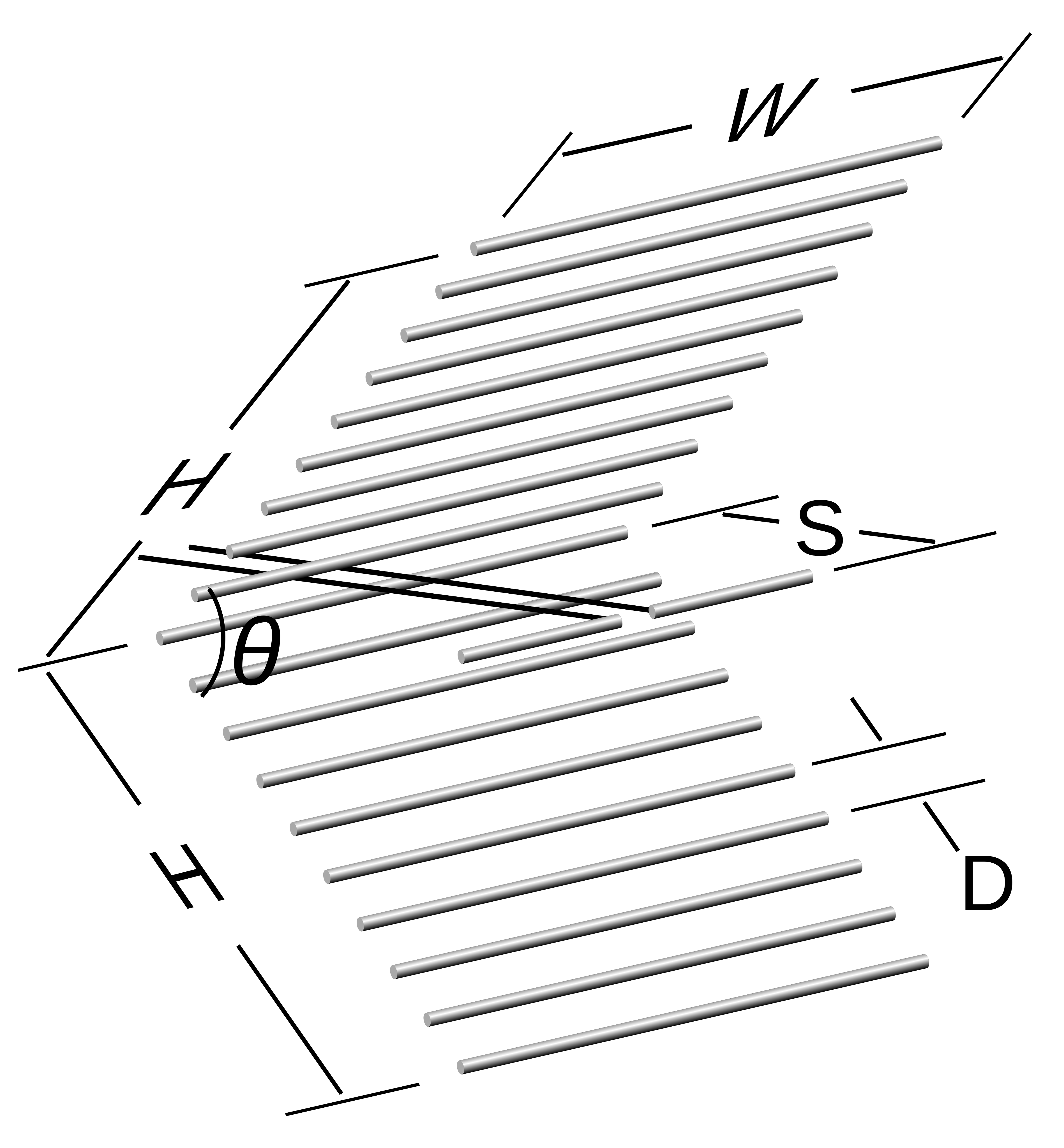
The flat reflecting surfaces can be metal sheets, but are more often made of wire screen or rod elements parallel to the driven element, to reduce weight and wind loads on the antenna. The spacing of the rods D should not be more than 0.06 (6%) of the wavelength. The angle θ between the sides is most commonly 90°. The gain increases as the angle narrows, but the increase below 90° is minimal, and requires longer reflector screens be used. However, angles down to 45° have been used.
The spacing (S) of the driven element in front of the point where the reflectors meet is approximately but is not very critical; for 90° antennas the gain doesn't vary more than 1.5 dB for S between and . The radiation resistance of the dipole increases with this spacing, so the spacing can be adjusted to match the driven element to the feed line. Bowtie driven elements are often used for wide bandwidth applications like television antennas.
The antenna can be regarded as a form of directive antenna with a gain intermediate between a plane reflective array antenna and a parabolic antenna. Corner reflector antennas are particularly suitable in applications where a broadband directional antenna around one to wavelengths in size is needed. A parabolic dish this size has no advantage in gain over the corner reflector, so its simplicity of design and construction make it attractive.
Variations
Several different variations of the antenna are used
- The single driven element can be replaced by a Yagi array. UHF Yagi television antennas very often use a corner reflector. These antennas actually function more like two separate antennas: the corner reflector and driven element serves to provide broad bandwidth gain at the lower end of the UHF band, while the Yagi array is cut to give extra gain at the high end of the band.
- Monopole versions for use at lower frequencies have been built by placing vertical reflecting screens behind a vertical monopole antenna.
References
References
- Kraus, John D., US patent 2270314, [https://patents.google.com/patent/US2270314 Corner reflector antenna], filed January 31, 1940; granted January 20, 1942.
This article was imported from Wikipedia and is available under the Creative Commons Attribution-ShareAlike 4.0 License. Content has been adapted to SurfDoc format. Original contributors can be found on the article history page.
Ask Mako anything about Corner reflector antenna — get instant answers, deeper analysis, and related topics.
Research with MakoFree with your Surf account
Create a free account to save articles, ask Mako questions, and organize your research.
Sign up freeThis content may have been generated or modified by AI. CloudSurf Software LLC is not responsible for the accuracy, completeness, or reliability of AI-generated content. Always verify important information from primary sources.
Report