From Surf Wiki (app.surf) — the open knowledge base
Corner reflector
Retroreflector with three orthogonal, intersecting flat surfaces

Retroreflector with three orthogonal, intersecting flat surfaces
A corner reflector is a retroreflector consisting of three mutually perpendicular, intersecting flat reflective surfaces. It reverses the direction of an incoming wave with being translated by reflections on the three orthogonal sides. The three intersecting surfaces often are triangles (forming a tetrahedron) or may have square shapes. Radar corner reflectors made of metal are used to reflect radio waves from radar sets. Optical corner reflectors, called corner cubes or cube corners, made of three-sided glass prisms, are used in surveying and laser ranging.
Principle
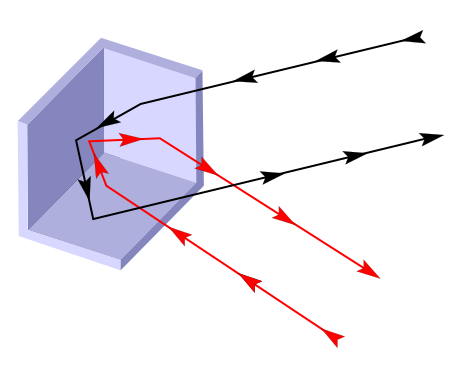
The incoming ray is reflected three times, once by each surface, which results in a reversal of direction.{{cite book
A roof mirror, sometimes called a roof prism mirror if two prisms are used to construct it, consisting of two flat reflection surfaces meeting together at the right angle, does retroreflection but only in the plane formed by the surface normals (e.g., a x-y plane if the normals are x and y axes, respectively) while the corner reflector dose full retroreflection.

In radar
Radar corner reflectors are designed to reflect the microwave radio waves emitted by radar sets back toward the radar antenna. This causes them to show a strong "return" on radar screens. A simple corner reflector consists of three conducting sheet metal or screen surfaces at 90° angles to each other, attached to one another at the edges, forming a "corner". These reflect radio waves coming from in front of them back parallel to the incoming beam. To create a corner reflector that will reflect radar waves coming from any direction, 8 corner reflectors are placed back-to-back in an octahedron (diamond) shape. The reflecting surfaces must be larger than several wavelengths of the radio waves to function.
In maritime navigation they are placed on bridge abutments, buoys, ships and, especially, lifeboats, to ensure that these show up strongly on ship radar screens. Corner reflectors are placed on the vessel's masts at a height of at least 4.6 m above sea level (giving them an approximate minimum horizon distance of 8 km). Marine radar uses X-band microwaves with wavelengths of 2.5 -, so small reflectors less than 30 cm across are used. In aircraft navigation, corner reflectors are installed on rural runways, to make them show up on aircraft radar.
An object that has multiple reflections from smooth surfaces produces a radar return of greater magnitude than might be expected from the physical size of the object. This effect was put to use on the ADM-20 Quail, a small decoy missile which had the same radar cross section as a B-52.
The corner reflector is not the only efficient radar reflector design; other retroreflector designs have also seen use. Luneburg lens, for example, are used on the ADM-141 TALD.
In optics


In optics, corner reflectors typically consist of three mirrors or reflective prism faces which return an incident light beam in the opposite direction. In surveying, retroreflector prisms are commonly used as targets for long-range electronic distance measurement using a total station.
Five arrays of optical corner reflectors have been placed on the Moon for use by Lunar Laser Ranging experiments observing a laser's time-of-flight to measure the Moon's orbit more precisely than was possible before. The three largest were placed by NASA as part of the Apollo program, and the Soviet Union built two smaller ones into the Lunokhod rovers.
Automobile and bicycle tail lights are molded with arrays of small corner reflectors, with different sections oriented for viewing from different angles. Reflective paint for visibility at night usually contains retroreflective spherical beads. Thin plastic with microscopic corner reflector structures can be used as tape, on signs, or sewn or molded onto clothing.
Other examples
Corner reflectors can also occur accidentally. Tower blocks with balconies are often accidental acoustic corner reflectors and return a distinctive echo to an observer making a sharp sound noise, such as a hand clap, nearby.
References
References
- (2026-01-22). "Retroreflecting Hollow Roof Prism Mirrors".
- (2002). "Antennas for All Applications". McGraw Hill.
- "IMI ADM-141 TALD".
This article was imported from Wikipedia and is available under the Creative Commons Attribution-ShareAlike 4.0 License. Content has been adapted to SurfDoc format. Original contributors can be found on the article history page.
Ask Mako anything about Corner reflector — get instant answers, deeper analysis, and related topics.
Research with MakoFree with your Surf account
Create a free account to save articles, ask Mako questions, and organize your research.
Sign up freeThis content may have been generated or modified by AI. CloudSurf Software LLC is not responsible for the accuracy, completeness, or reliability of AI-generated content. Always verify important information from primary sources.
Report