From Surf Wiki (app.surf) — the open knowledge base
Coriander
Annual herb

Annual herb
the herb
Coriander (), or Coriandrum sativum, is an annual herb in the family Apiaceae. The leaves are known as cilantro () in the United States (but not in the United Kingdom). Most people perceive the leaves as having a fresh, slightly citrus taste. Due to variations in the gene OR6A2, some people perceive its flavor to be more soaplike or rotten.
The species is native to the Mediterranean Basin. All parts of the plant are edible, with the fresh leaves and dried seeds most traditionally used in cooking. It is included in Peruvian, Mexican, Indian and Southeast Asian cuisines.
Description
It is a soft plant growing to 50 cm tall. The leaves are variable in shape, broadly lobed at the base of the plant, and slender and feathery higher on the flowering stems.
The flowers are borne in small umbels, white or very pale pink, asymmetrical, with the petals pointing away from the centre of the umbel longer (5–6 mm) than those pointing toward it (only 1–3 mm long). The fruit is a globular, dry schizocarp 3–5 mm in diameter. The pollen size is approximately 30 μm.
Taste and smell
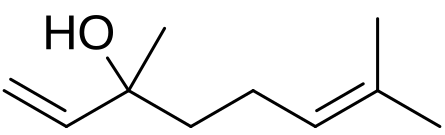
The essential oil from coriander leaves and seeds contains mixed polyphenols and terpenes, including linalool as the major constituent accounting for the aroma and flavour of coriander.
Different people may perceive the taste of coriander leaves differently. Those who enjoy it say it has a refreshing, lemony or lime-like flavour, while those who dislike it have a strong aversion to its pungent taste and smell, characterizing it as soapy or rotten. Studies also show variations in preference among different ethnic groups: 21% of East Asians, 17% of Caucasians, and 14% of people of African descent expressed a dislike for coriander, but among the groups where coriander is popular in their cuisine, only 7% of South Asians, 4% of Hispanics, and 3% of Middle Eastern subjects expressed a dislike.
About 80% of identical twins shared the same preference for the herb, but fraternal twins agreed only about half the time, strongly suggesting a genetic component to the preference. In a genetic survey of nearly 30,000 people, two genetic variants linked to the perception of coriander have been found, the more common of which is a gene involved in sensing smells. The gene OR6A2 lies within a cluster of olfactory-receptor genes, and encodes a receptor that is highly sensitive to aldehyde chemicals. Flavour chemists have found that the coriander aroma is created by a half-dozen substances, most of which are aldehydes. Those who dislike the taste are sensitive to the offending unsaturated aldehydes and, at the same time, may be unable to detect the aromatic chemicals that others find pleasant. Association between its taste and several other genes, including a bitter-taste receptor, have also been found.
Similar plants
- Eryngium foetidum, also a member of the Apiaceae, has a similar but more intense taste. Known as culantro and ngò gai, it is found in Mexico, the Caribbean, Central and South America, and South East Asia cuisine.
- Persicaria odorata is commonly called Vietnamese coriander, or rau răm. The leaves have a similar odour and flavour to coriander. It is a member of the Polygonaceae, or buckwheat family.
- "Summer cilantro" is one common name for Porophyllum ruderale subsp. macrocephalum, a member of the Asteraceae, the sunflower family. This species is found growing wild from Texas to Argentina.
Etymology
First attested in English during the late 14th century, the word "coriander" derives from the Old French coriandre, which comes from Latin coriandrum, in turn from Ancient Greek κορίανδρον : grc (also κορίαννον : grc), possibly derived from or related to κόρις : grc (a bed bug), and was given on account of its fetid, bug-like smell.
The earliest attested form of the word is the Mycenaean Greek gmy (variants: gmy, gmy, gmy) written in Linear B syllabic script (reconstructed as grc, similar to the name of Minos' daughter Ariadne) which later evolved to koriannon or koriandron.
Cilantro is the Spanish word for coriander, also deriving from coriandrum. It is the common term in US English for coriander leaves due to their extensive use in Mexican cuisine, but the seeds are referred to as coriander in American English.
Origin and distribution
Coriander is native to the Mediterranean Basin. It grows wild over a wide area of Western Asia and Southern Europe, making it difficult to define where the plant is native and where it was only recently established. Recent works suggest that wild coriander in Israel and Portugal might be an ancestor of cultivated coriander. They have low germination rates and a small vegetative appearance. Israeli coriander has an extremely hard fruit coat.
In Israel, fifteen desiccated mericarps were found in the Pre-Pottery Neolithic B level (six to eight thousand years ago) of the Nahal Hemar Cave, and eleven from ~8,000–7,500 years ago in Pre-Pottery Neolithic C in Atlit-Yam. If these finds do belong to these archaeological layers, they are the oldest find of coriander in the world. The herb is mentioned in the Torah as a point of reference for the taste of manna, implying it was a well-known ingredient in ancient Israel.
About 500 ml of coriander mericarps were recovered from the tomb of Tutankhamen. As coriander does not grow wild in Egypt, this could be proof that coriander was cultivated by the ancient Egyptians.
Coriander may have been cultivated in Greece since at least the second millennium BCE. One of the Linear B tablets recovered from Pylos refers to the species as being cultivated for the manufacture of perfumes. It was used in two forms: as a spice for its seeds and as an herb for the flavour of its leaves. This appears to be confirmed by archaeological evidence: the large quantities of coriander retrieved from an Early Bronze Age layer at Sitagroi in Macedonia could point to cultivation of the herb at that time.
Allergies
Some people are allergic to coriander leaves or seeds, having symptoms similar to those of other food allergies. A cross-sectional study of 589 cases where food allergies to spices were suspected found 32% of pin-prick tests in children and 23% in adults were positive for coriander and other members of the family Apiaceae, including caraway, fennel, and celery. The allergic symptoms may be minor or life-threatening.
Uses
Nutrition
Raw coriander leaves are 92% water, 4% carbohydrates, 2% protein, and less than 1% fat. The nutritional profile of coriander seeds is different from that of fresh stems or leaves. In a 100 g reference amount, the leaves are particularly rich in vitamin A, C, and K, with moderate content of dietary minerals. Although seeds generally have lower vitamin content, they do provide significant amounts of dietary fiber, calcium, selenium, iron, magnesium, and manganese.
Culinary
All parts of the plant are edible. The fresh leaves and dried seeds are the most commonly used in cooking. Coriander is used in cuisines throughout the world.
Leaves
The leaves are variously referred to as coriander leaves, fresh coriander, Chinese parsley, or cilantro (US, commercially in Canada, and Spanish-speaking countries). The fresh leaves are an ingredient in many foods, such as chutneys and salads, salsa, guacamole, and as a widely used garnish for soup, fish, and meat. As heat diminishes their flavour, coriander leaves are often used raw or added to the dish immediately before serving. In Indian and Central Asian recipes, coriander or dhania leaves are used in large amounts and cooked until the flavour diminishes. The leaves spoil quickly when removed from the plant and lose their aroma when dried or frozen. Coriander potentially may be confused with culantro (Eryngium foetidum L.), in the same family (Apiaceae) as coriander (Coriandrum sativum L.), but from a different genus. Culantro has a distinctly different spiny appearance, a more potent volatile leaf oil and a stronger aroma.--
The taste of the leaves differs from that of the seeds. The seeds exhibit citrus overtones. The dominant flavorants in the leaves are the aldehydes 2-decenal and 2-dodecenal. The main flavorant in the seeds is (+)-linalool.
Seeds

The dry fruits are coriander seeds. The word "coriander" in food preparation may refer solely to these seeds (as a spice), rather than the plant. The seeds have a lemony citrus flavor when crushed due to the terpenes linalool (which comprises about two thirds of its volatile components) and pinene. It is described as warm, nutty, spicy, and orange-flavoured.
The variety C. sativum var*. sativum* has a fruit diameter of 3–5 mm, while var. microcarpum fruits have a diameter of 1.5 –, and var. indicum has elongated fruits. Large-fruited types are grown mainly by tropical and subtropical countries, such as Morocco, India, and Australia, and contain a low volatile oil content (0.1–0.4%). They are used for grinding and blending purposes in the spice trade. Types with smaller fruit are produced in temperate regions and usually have a volatile oil content of around 0.4–1.8%, so they are highly valued as a raw material for the preparation of essential oil.
Coriander is commonly found both as whole dried seeds and in ground form. Roasting or heating the seeds in a dry pan heightens the flavor, aroma, and pungency. Ground coriander seed loses flavor quickly in storage and is best ground fresh. Coriander seed is a spice in garam masala, and Indian curries, which often employ the ground fruits in generous amounts together with cumin, acting as a thickener in a mixture called dhania jeera. Roasted coriander seeds, called dhania dal, are eaten as a snack.
Outside of Asia, coriander seed is used widely for pickling vegetables. In Germany and South Africa (see boerewors), the seeds are used while making sausages. In Russia and Central Europe, coriander seed is an occasional ingredient in rye bread (e.g. Borodinsky bread) as an alternative to caraway. The Zuni people of North America have adopted it into their cuisine, mixing the powdered seeds ground with chili peppers, using it as a condiment with meat, and eating leaves as a salad.

Coriander seeds are used in brewing certain styles of beer, particularly some Belgian wheat beers. The coriander seeds are used with orange peel to add a citrus character.
Coriander seeds are one of the key botanicals used to flavor gin.
One preliminary study showed coriander essential oil to inhibit Gram-positive and Gram-negative bacteria, including Staphylococcus aureus, Enterococcus faecalis, Pseudomonas aeruginosa, and Escherichia coli.
Coriander is listed as one of the original ingredients in the secret formula for Coca-Cola.
Roots

Coriander roots have a deeper, more intense flavour than the leaves and are used in a variety of Asian cuisines, particularly in Thai dishes such as soups or curry pastes.
In culture
Coriander was mentioned by Hippocrates (around 400 BCE), as well as Dioscorides (65 CE).
References
References
- (6 October 2011). "Cambridge English Pronouncing Dictionary". Cambridge University Press.
- "Dhania". [[Oxford University Press]].
- (2012). "Crop Plant Anatomy". CABI.
- "- A palynological database".
- (2009). "Safety Assessment of Coriander (''Coriandrum sativum'' L.) Essential Oil as a Food Ingredient". Food and Chemical Toxicology.
- (2014). "Hydrodistillation extraction time effect on essential oil yield, composition, and bioactivity of coriander oil". Journal of Oleo Science.
- Rubenstein, Sarah. (13 February 2009). "Across the Land, People Are Fuming Over an Herb (No, Not That One)". The Wall Street Journal.
- (2 May 2012). "Prevalence of cilantro (''Coriandrum sativum'') disliking among different ethnocultural groups". Flavour.
- (10 September 2012). "A genetic variant near olfactory receptor genes influences cilantro preference". Quantitative Biology.
- Josh Kurz. (26 December 2008). "Getting to the Root of the Great Cilantro Divide". NPR.
- (2012). "Genetic analysis of chemosensory traits in human twins". Chemical Senses.
- (29 November 2012). "A genetic variant near olfactory receptor genes influences cilantro preference". Flavour.
- (1992). "Cilantro Around The World". Herb Companion.
- {{L&S. coriandrum. ref
- {{LSJ. kori/annon. κορίαννον. ref.
- "Coriander", ''Oxford English Dictionary'' 2nd ed., 1989. Oxford University Press.
- {{LSJ. ko/ris. κόρις. shortref.
- {{OEtymD. coriander
- {{cite EB1911
- "The Linear B word ko-ri-ja-da-na". Palaeolexicon.
- Arnott, Robert. (2014). "Medicine and Healing in the Ancient Mediterranean". Oxbow Books.
- Chadwick, John. (1976). "The Mycenaean World". Cambridge University Press.
- (29 February 2012). "Coriander (''Coriandrum sativum'')". Gernot Katzer Spice Pages.
- (29 February 2012). "Coriander (''Coriandrum sativum'')". Gernot Katzer Spice Pages.
- "Coriander". University of California, Davis Nutrition Department.
- (2000). "Domestication of Plants in the Old World". Oxford University Press.
- (9 June 2021). "Wild coriander: an untapped genetic resource for future coriander breeding". Springer.
- (2017). "Characterization and evaluation of traditional and wild coriander in Alentejo (Portugal)". Acta Horticulturae.
- Kislev, Mordechai E.. (1988). "Early Agriculture and Paleoecology of Netiv Hagdud". An Early Neolithic Village in the Jordan Valley.
- (1 September 2004). "Archaeobotanical and archaeoentomological evidence from a well at Atlit-Yam indicates colder, more humid climate on the Israeli coast during the PPNC period". Journal of Archaeological Science.
- (2012). "Domestication of Plants in the Old World: The origin and spread of domesticated plants in Southwest Asia, Europe, and the Mediterranean Basin". Oxford University Press.
- Walton, Joshua AU - Santini, Lauren M.. (2022). "Spices, Herbs, and Sweeteners". T&T Clark.
- (2005). "The Cultural History of Plants". Routledge.
- Fragiska, M.. (2005). "Wild and Cultivated Vegetables, Herbs and Spices in Greek Antiquity". Environmental Archaeology.
- (2002). "Food allergy and IgE sensitization caused by spices: CICBAA data (based on 589 cases of food allergy)". Allergie et Immunologie.
- Christina Agapakis. (18 September 2011). "Allergy Recapitulates Phylogeny".
- (1 April 2019). "Nutrients, coriander seeds per 100 g". FoodData Central, US Department of Agriculture.
- Samuelsson, Marcus. (2003). "Aquavit: And the New Scandinavian Cuisine". Houghton Mifflin Harcourt.
- Moulin, Léo. (2002). "Eating and Drinking in Europe: A Cultural History". Mercatorfonds.
- Ramcharan, C.. (1999). "Perspectives on new crops and new uses – Chapter: Culantro: A much utilized, little understood herb". ASHS Press.
- (2015). "Ullmann's Encyclopedia of Industrial Chemistry".
- (2015). "Volatile and sensory profiling of cocktail bitters". Food Chemistry.
- (2003). "infraspecific taxa of coriander (''Coriandrum sativum'' L.).". Genetic Resources and Crop Evolution.
- Bruce Smallfield. (June 1993). "Coriander – ''Coriandrum sativum''".
- "Dhana Jeera Powder – Also Known As Cumin and Coriander Blend or Dhanajiru Powder". My Spice Sage.
- Stevenson, Matilda Coxe 1915 Ethnobotany of the Zuni Indians. SI-BAE Annual Report #30 (p. 66)
- (2011). "Coriander (''Coriandrum sativum'' L.) essential oil: its antibacterial activity and mode of action evaluated by flow cytometry". Journal of Medical Microbiology.
- Pendergrast, Mark. (1994). "For God, Country and Coca-Cola". Collier.
This article was imported from Wikipedia and is available under the Creative Commons Attribution-ShareAlike 4.0 License. Content has been adapted to SurfDoc format. Original contributors can be found on the article history page.
Ask Mako anything about Coriander — get instant answers, deeper analysis, and related topics.
Research with MakoFree with your Surf account
Create a free account to save articles, ask Mako questions, and organize your research.
Sign up freeThis content may have been generated or modified by AI. CloudSurf Software LLC is not responsible for the accuracy, completeness, or reliability of AI-generated content. Always verify important information from primary sources.
Report