From Surf Wiki (app.surf) — the open knowledge base
Copyright law of the United States
none

none
In the United States of America, copyright grants monopoly protection for "original works of authorship". With the stated purpose to promote art and culture, copyright law assigns a set of exclusive rights to authors: to make and sell copies of their works, to create derivative works, and to perform or display their works publicly. These exclusive rights are subject to a time and generally expire 70 years after the author's death or 95 years after publication. In the United States, works published before January 1, , are in the public domain.
United States copyright law was last generally revised by the Copyright Act of 1976, codified in Title 17 of the United States Code. The United States Constitution explicitly grants Congress the power to create copyright law (and patent law) under Article I, Section 8, Clause 8, known as the Copyright Clause. Under the Copyright Clause, Congress has the power "To promote the Progress of Science and useful Arts, by securing for limited Times to Authors and Inventors the exclusive Right to their respective Writings and Discoveries."
The United States Copyright Office, which is in the Library of Congress, handles copyright registration, recording of copyright transfers, and other administrative aspects of copyright law.
History
Main article: History of copyright law of the United States
United States copyright law traces its lineage back to the British Statute of Anne, which influenced the first U.S. federal copyright law, the Copyright Act of 1790. The length of copyright established by the Founding Fathers was 14 years with an option to renew it once for 14 more. The Copyright Act of 1831 changed the length of the initial term to 28 years.
Through the Copyright Act of 1976, copyright duration was extended to the life of the author plus 50 years or 75 years after publication for works made for hire. The Sonny Bono Copyright Term Extension Act of 1998 (also called the "Mickey Mouse Protection Act", because it prevented the copyright from expiring on the Disney cartoon character Mickey Mouse) further increased the term length to the life of the author plus 70 years or 95 years after publication (or 120 years after creation, whichever is shorter) for works made for hire.
Purpose of copyright
The goal of copyright law, as set forth in the Copyright Clause of the U.S. Constitution, is "to promote the Progress of Science and useful Arts, by securing for limited Times to Authors and Inventors the exclusive Right to their respective Writings and Discoveries." This includes incentivizing the creation of art, literature, architecture, music, and other works of authorship. As with many legal doctrines, the effectiveness of copyright law in achieving its stated purpose is a matter of debate.
Works subject to copyright law
The United States copyright law protects "original works of authorship" fixed in a tangible medium of expression, including literary, dramatic, musical, artistic, and other intellectual works. This protection is available to both published and unpublished works. Copyright law includes the following types of works:
- Literary
- Musical
- Dramatic
- Pantomimes and choreographic works
- Pictorial, graphic, and sculptural works
- Audiovisual works
- Sound recordings
- Derivative works
- Compilations
- Architectural works
Idea–expression dichotomy
Copyright law protects the "expression" of an idea, but copyright does not protect the "idea" itself. This distinction is called the idea–expression dichotomy. The distinction between "idea" and "expression" is fundamental to copyright law. From the Copyright Act of 1976 ():
For example, a paper describing a political theory is copyrightable. The paper is the expression of the author's ideas about the political theory. The theory itself is just an idea, and is not copyrightable. Another author is free to describe the same theory in their own words without infringing on the original author's copyright.
Although fundamental, the idea–expression dichotomy is often difficult to put into practice. Reasonable people can disagree about where the unprotectable "idea" ends and the protectable "expression" begins. As Judge Learned Hand put it, "Obviously, no principle can be stated as to when an imitator has gone beyond copying the 'idea,' and has borrowed its 'expression.' Decisions must therefore inevitably be ad hoc."
Compilations of facts and the sweat of the brow doctrine
Mere facts are not copyrightable. However, compilations of facts are treated differently and may be copyrightable material. Section 103 of the Copyright Act allows copyright protection for compilations as long as there is some creative or original act involved in developing the compilation, such as in the selection (deciding which facts to include or exclude) and arrangement (how facts are displayed and in what order). Copyright protection in compilations is limited to the selection and arrangement of facts, not to the facts themselves.
The Supreme Court decision in Feist Publications, Inc., v. Rural Telephone Service Co. clarified the requirements for copyright in compilations. The Feist case denied copyright protection to a "white pages" phone book (a compilation of telephone numbers, listed alphabetically). In making this ruling, the Supreme Court rejected the "sweat of the brow" doctrine. That is, copyright protection requires creativity, and no amount of hard work ("sweat of the brow") can transform a non-creative list (like an alphabetical listing of phone numbers) into copyrightable subject matter. A mechanical, non-selective collection of facts (e.g., alphabetized phone numbers) cannot be protected by copyright.
Useful articles
Copyright protects artistic expression. Copyright does not protect useful articles, or objects with some useful functionality. The Copyright Act states:
However, many industrial designers create works that are both artistic and functional. Under these circumstances, copyright law only protects the artistic expression of such a work, and only to the extent that the artistic expression can be separated from its utilitarian function.Tracy P. Jong. Copyright of Engineering Drawings, Plans and Designs. Rochester, NY: Tracy Jong Law Firm. http://www.rochesterpatents.com /CopyrightEDPD.htm. Retrieved December 2, 2015.
In 2017, the US Supreme Court granted certiorari in the case Star Athletica, LLC v. Varsity Brands, Inc. to determine when a "pictorial, graphic, or sculptural feature" incorporated into a useful article is eligible for copyright protection, holding that such features are eligible for copyright protection "only if the feature (1) can be perceived as a two- or three-dimensional work of art separate from the useful article and (2) would qualify as a protectable pictorial, graphic, or sculptural work—either on its own or fixed in some other tangible medium of expression—if it were imagined separately from the useful article into which it is incorporated." Star Athletica began as a suit by Varsity Brands against Star Athletica for infringing the copyright of five cheerleader uniform designs. Applying its new test to the cheerleader uniform designs, the court said:
This produces a relatively low threshold for pictorial, graphic, or sculptural features on useful articles to be eligible for copyright protection, which one commentator clearly highlighted: the Star Athletica decision "really has ensured that all but the subtlest graphic designs will be able to gain copyright protection...once we determine that the designs 'hav[e] ... graphic ... qualities ... [and could be] applied ... on a painter's canvas,' the test for copyrightability is met."
Works by the federal government
Works created by the federal government are not copyrightable. This restriction on copyright applies to publications produced by the United States Government, and its agents or employees within the scope of their employment. However, government contractors are generally not considered employees, and their works may be subject to copyright. Additionally, the government can purchase and hold the copyright to works created by third parties.
The government may restrict access to works it has produced through other mechanisms. For instance, classified materials may not be protected by copyright but are restricted by other applicable laws. Even in the case of non-classified materials, there may be specific prohibitions against usage, such as the presidential seal, which is restricted for commercial uses.
Federal and state laws are not restricted by copyright
Main article: Government edicts doctrine
Federal, state, and local statutes and court decisions are in the public domain and are ineligible for copyright, a concept known as the government edicts doctrine. It is not difficult to see the motivations behind this:
Three key Supreme Court cases established this government edicts doctrine: Wheaton v. Peters (1834), Banks v. Manchester (1888), and Callaghan v. Myers (1888). The doctrine was codified into the United States Code at via the Copyright Act of 1976. The Copyright Office upholds this doctrine within its own regulations:
The Supreme Court has also ruled that annotated versions of statutes or court decisions at the federal, state, and local level, when such annotations are done by members of the government as part of their duties, are ineligible for copyright in Georgia v. Public.Resource.Org, Inc. (2020).
Criteria for copyright
Originality

Originality in copyright law is when a work is independently created by a human author with a minimal degree of creativity. Independent creation means that you created it yourself without copying. Originality should not be confused with novelty as work that is identical to another is still considered original if it was created independently. The Supreme Court has said that, to be creative, a work must have a “spark” and “modicum” of creativity. There are things like simple shapes, common and familiar symbols, names, lettering or coloring of the work and mere listings of ingredients or contents that are not creative enough to be eligible for copyright.
Tangible medium
A work is fixed in a tangible medium when it is captured (either by or under the authority of an author) in a sufficiently permanent medium such that the work can be perceived, reproduced, or communicated for more than a short time. The work must be able to be communicated to others whether through visually, audio or tactile means directly or with an aid of a device and must be fixed in a physical medium. Examples of works fixed in a tangible medium are tactile art, compositions recorded or written, paintings and photographs. In contrast, someone singing a tune or speaking or a broadcaster broadcasting something live that hasn’t been recorded will not be eligible for copyright as the work isn’t fixed and not able to be reproduced or communicated in any way.
Exclusive rights
There are six basic rights protected by copyright. The owner of a copyright has the exclusive right to do and authorize others to do the following:
- To reproduce the work in copies or phonorecords;
- To prepare derivative works based upon the work;
- To distribute copies or phonorecords of the work to the public by sale or other transfer of ownership, or by rental, lease, or lending;
- To publicly perform the work, in the case of literary, musical, dramatic, and choreographic works, pantomimes, and motion pictures and other audiovisual works;
- To publicly display the work, in the case of literary, musical, dramatic, and choreographic works, pantomimes, and pictorial, graphic, or sculptural works, including the individual images of a motion picture or other audiovisual work.
- To digitally transmit sound recordings by means of digital audio transmission.
A violation of any of the exclusive rights of the copyright holder is a copyright infringement, unless fair use (or a similar affirmative defense) applies.
Authorship, ownership, and work for hire
The initial owner of the copyright to a work is the author, unless that work is a "work made for hire".
If a work is made "for hire" within the meaning of the Copyright Act, then the employer or commissioning party is deemed to be the author and will own the copyright as though it were the true author. These circumstances under which a work may be found to be a work for hire are:
- Works prepared by an employee within the scope of their employment. In Community for Creative Non-Violence v. Reid, 490 U.S. 730 (1989), the Supreme Court held that the term "employee" in this context should be interpreted according to common law agency principles. If the person doing the work is an "employee" within the meaning of the common law, and the work was done within the scope of their employment (whether the work is the kind they were employed to prepare; whether the preparation takes place primarily within the employer's time and place specifications; and whether the work was activated, at least in part, by a purpose to serve the employer), then the work is a work for hire and the employer is the initial owner of the copyright.
- Specially ordered or commissioned works. Works created by independent contractors (rather than employees) can be deemed works for hire only if two conditions are satisfied. First, the work must fit into one of these categories: a contribution to a collective work, part of a motion picture or other audiovisual work, a translation, a supplementary work, a compilation, an instructional text, a test, answer material for a test, or an atlas. Second, the parties must expressly agree in a written, signed instrument that the work will be considered a work made for hire.
If a work is not a work for hire, then the author will be the initial copyright owner. The author generally is the person who conceives of the copyrightable expression and "fixes" it in a "tangible medium of expression". Special rules apply when multiple authors are involved:
- Joint authorship: US copyright law recognizes joint authorship in Section 101. The authors of a joint work are co-owners of a single copyright in the work. A joint work is "a work prepared by two or more authors with the intention that their contributions be merged into inseparable or independent parts of a unitary whole."
- Collective works: A collective work is a collection of independent, separately copyrightable works of authorship, such as a newspaper, magazine, or encyclopedia. In the absence of an express assignment of copyright, the author of each individual work in the collection retains copyright in that work. The compiler, or author of the collection, owns copyright in the expression he or she contributed, which is primarily the selection and arrangement of the separate contributions, but may include such things as a preface, advertisements, etc., that the collective author created.
Transfers and licenses
Three types of transfers exist for copyrighted works:
- Assignment
- Exclusive license
- Non-exclusive license
The first two, assignment and exclusive licenses, require the transfer to be in writing. Nonexclusive licenses need not be in writing and they may be implied by the circumstances. Transfers of copyright always involve one or more of the exclusive rights of copyright. For instance, a license may provide a right to perform a work, but not to reproduce it or to prepare a derivative work (adaptation right).
The terms of the license are governed by the applicable contract law; however, there is substantial academic debate about to what extent the Copyright Act preempts state contract law principles.
An author, after transferring a copyright, can terminate the transfer under certain circumstances. This right to terminate the transfer is absolute and cannot be waived.
For works published before 1978, copyrights may revert to the author after 56 years. For example, Paul McCartney reclaimed the U.S. publishing rights to early Beatles songs from Sony Music Publishing, beginning in October 2018.
For works published since 1978, copyrights may revert to the original author after 35 years. states that the author must write a letter requesting a termination of the original copyright grant at least two years before the effective termination date.
Limitations on exclusive rights
Title 17, United States Code, Section 108 places limitations on exclusive copyrights for the purposes of certain limited reproduction by a public library or an archive. Title 17, United States Code, Section 107 also places statutory limits on copyright which are commonly referred to as the fair use exception.
Registration procedure
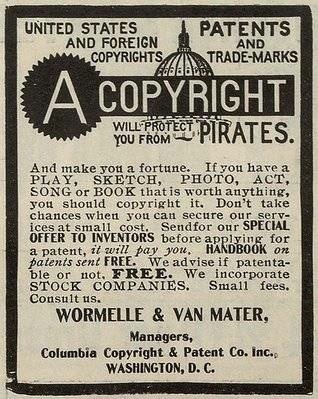
Copyright is automatically granted to the author of an original work (that otherwise meets the basic copyright requirements, discussed above). Registration is not necessary. However, registration amplifies a copyright holder's rights in a number of ways. Registration, or refusal of registration, is required before a lawsuit can be filed, and registration creates the possibility for enhanced "statutory" damages.
A copyright can be registered online at the US Copyright Office's website. The Copyright Office reviews applications for obvious errors or lack of copyrightable subject matter and then issues a certificate of registration. The Copyright Office does not compare the author's new work against a collection of existing works or otherwise check for infringement.
Deposit requirement
The United States Copyright Office requires a deposit copy of the work for which copyright registration is sought. Deposits can be made through the Copyright Office's eCO System. This deposit requirement serves two purposes. First, if a copyright infringement lawsuit arises, the owner may prove that the material that is infringed is exactly the same material for which the owner has secured a registration. Second, this requirement helps the Library of Congress build its collection of works.
Failure to comply with the deposit requirement, as modified by Copyright Office regulations, is punishable by fine, but does not result in forfeiture of copyright.
Copyright notices
Main article: Copyright notice
The use of copyright notices is optional. The Berne Convention, amending US copyright law in 1989, makes copyright automatic. However, the lack of notice of copyright using these marks may have consequences in terms of reduced damages in an infringement lawsuit—using notices of this form may reduce the likelihood of a defense of "innocent infringement" being successful.
Duration of copyright

Copyright protection generally lasts for 70 years after the death of the author. If the work was a "work for hire", then copyright persists for 120 years after creation or 95 years after publication, whichever is shorter. For works created before 1978, the copyright duration rules are complicated. However, works published before January 1, (other than sound recordings), have made their way into the public domain. All copyright terms run to the end of the calendar year in which they would otherwise expire.
Works created before 1978
For works published or registered before 1978, the maximum copyright duration is 95 years from the date of publication, if copyright was renewed during the 28th year following publication. Copyright renewal has been automatic since the Copyright Renewal Act of 1992.
For works created before 1978, but not published or registered before 1978, the standard §302 copyright duration of 70 years from the author's death also applies. Prior to 1978, works had to be published or registered to receive copyright protection. Upon the effective date of the 1976 Copyright Act (which was January 1, 1978) this requirement was removed and these unpublished, unregistered works received protection. However, Congress intended to provide an incentive for these authors to publish their unpublished works. To provide that incentive, these works, if published before 2003, would not have their protection expire before 2048.
All copyrightable works published in the United States before except sound recordings are in the public domain; works created but not published or copyrighted before January 1, 1978, may be protected until 2047. For works that received their copyright before 1978, a renewal had to be filed in the work's 28th year with the Copyright Office for its term of protection to be extended. The need for renewal was eliminated by the Copyright Renewal Act of 1992, but works that had already entered the public domain by non-renewal did not regain copyright protection. Therefore, works published before 1964 that were not renewed are in the public domain.
Before 1972, sound recordings were not subject to federal copyright, but copying was nonetheless regulated under various state torts and statutes, some of which had no duration limit. The Sound Recording Amendment of 1971 extended federal copyright to recordings fixed on or after February 15, 1972, and declared that recordings fixed before that date would remain subject to state or common law copyright. Subsequent amendments had extended this latter provision until 2067. As a result, older sound recordings were not subject to the expiration rules that applied to contemporary visual works. Although these could have entered the public domain as a result of government authorship or formal grant by the owner, the practical effect was to render public domain audio virtually nonexistent.
This situation changed with the 2018 enactment of the Music Modernization Act, which extended federal copyright protection to all sound recordings, regardless of their date of creation, and preempted state copyright laws on those works. Under the Act, the first sound recordings to enter the public domain were those fixed before 1923, which entered the public domain on January 1, 2022. Recordings fixed between 1923 and February 14, 1972, will be phased into the public domain in the following decades. Specifically, works fixed 1923–1946 are public domain after 100 years and works fixed 1947–1956 after 110 years from the year of fixation. Works fixed between January 1, 1957, and February 14, 1972, will all become public domain on February 15, 2067.
In May 2016, Judge Percy Anderson ruled in a lawsuit between ABS Entertainment and CBS Radio that "remastered" versions of pre-1972 recordings can receive a federal copyright as a distinct work due to the amount of creative effort expressed in the process. The Ninth Circuit appeals court reversed the decision in favor of ABS Entertainment.
Copyright limitations, exceptions, and defenses
United States copyright law includes numerous defenses, exceptions, and limitations. Some of the most important include:
- Copyright applies only to certain copyrightable subject matter, codified within . Works that are not "original works of authorship fixed in any tangible medium of expression" are not subject to copyright. codifies that copyright protection does not extend to ideas, procedures, processes, systems, etc. Facts may not be copyrighted. "Useful articles" may not be copyrighted; this includes typeface designs (Eltra Corp. v. Ringer), fashion designs, blank forms, titles, names, short phrases, slogans, lists of ingredients and contents, domain names and band names.
- The first-sale doctrine, , limits the rights of copyright holders to control the further distribution and display of legally distributed copies of their works after the first sale by the copyright holder or other authorized sellers. The owner of a particular copy is entitled to "sell or otherwise dispose of the possession of that copy" and to "display the copy publicly ... to viewers present at the place where the copy is located."
- The "good faith" defense reduces statutory damages if the infringer is an educational institution, library, archive, or public broadcaster acting as part of its nonprofit activities and reasonably believed the use was “fair use”.
- The Copyright Act includes specific exemptions for types of works and particular entities, such as libraries or archives, public broadcasters, braille, software backup copies, "cover license" permitting sound recording covers, and jukebox compulsory licenses.
- A freedom of panorama clause, limited only to works of architecture, exists in .
- The Copyright Act, in and , includes specific statutory exceptions for reproduction of material for the blind or other persons with disabilities. Section 121 (the "Chafee Amendment") permits the reproduction of copyright works in Braille, audio, electronic, Web-Braille, or other necessary formats. For instance, the National Library Service for the Blind and Physically Handicapped (NLS) administers a program under Section 121, and the HathiTrust Digital Library also relies on Section 121 in providing access to disabled users.
- Section 512 ("OCILLA", passed as part of the DMCA in 1998) provides a contingent "safe harbor" for online service providers from secondary liability for their users' copy infringements.
- US copyright law does not allow works created by animals to be copyrighted. [[File:Macaca_nigra_self-portrait_large.jpg|thumb|right|upright|As an animal-made photograph, this [[monkey selfie]] is ineligible for copyright in the United States.]]
- The United States Copyright Office and the DC District Court ruled that copyright does not apply to artificial intelligence–generated art.
.jpg)
Fair use
Main article: Fair use
Fair use is the use of limited amounts of copyrighted material in such a way as to not be an infringement. It is codified at , and states that "the fair use of a copyrighted work ... is not an infringement of copyright." The section lists four factors that must be assessed to determine whether a particular use is fair. There are no bright-line rules regarding fair use and each determination is made on an individualized case-by-case basis.
- Purpose and character of the use, including whether the use is of a commercial nature or is for nonprofit educational purposes: Nonprofit educational and noncommercial uses are more likely to be fair use. This does not mean that all nonprofit education and noncommercial uses are fair use or that all commercial uses are not fair. Instead, courts will balance the purpose and character of the use against the other factors below. Additionally, "transformative" uses are more likely to be considered fair. Transformative uses are those that add something new, with a further purpose or different character, and do not substitute for the original use of the work.
- Nature of the copyrighted work: Using a more creative or imaginative work (such as a novel, movie, or song) is less likely to support fair use than using a factual work (such as a technical article or news item). In addition, use of an unpublished work is less likely to be considered fair.
- Amount and substantiality of the portion used in relation to the copyrighted work as a whole: Courts look at both the quantity and quality of the copyrighted material that was used. Using a large portion of the copyrighted work is less likely to be fair use. However, courts have occasionally found use of an entire work to be fair use, and in other contexts, using even a small amount of a copyrighted work was determined not to be fair use because the selection was an important part—or the "heart"—of the work.
- Effect of the use upon the potential market for or value of the copyrighted work: Here, courts review whether, and to what extent, the unlicensed use harms the existing or future market for the copyright owner's original work. In assessing this factor, courts consider whether the use is hurting the current market for the original work (for example, by displacing sales of the original) and whether the use could cause substantial harm if it were to become widespread.
In addition to these four factors, the statute also allows courts to consider any other factors that may be relevant to the fair use analysis. Courts evaluate fair use claims on a case-by-case basis, and the outcome of any given case depends on the specific facts of that case. There is no formula to ensure that a predetermined percentage or amount of a work—or specific number of words, lines, pages, copies—may be used without permission.
The justification of the fair use doctrine turns primarily on whether, and to what extent, the challenged use is transformative. "The use must be productive and must employ the quoted matter in a different manner or for a different purpose from the original. A quotation of copyrighted material that merely repackages or republishes the original is unlikely to pass the test.... If, on the other hand, the secondary use adds value to the original—if the quoted matter is used as raw material, transformed in the creation of new information, new aesthetics, new insights and understandings—this is the very type of activity that the fair use doctrine intends to protect for the enrichment of society."
The Copyright Office provides a searchable list of fair use case law.
Infringement
Main article: Copyright infringement
Copyright infringement occurs when someone violates one of the exclusive rights listed in Commonly, this involves someone creating or distributing a copy of a protected work that is "substantially similar" to the original version.
Infringements requires copying. If two people happen to write exactly the same story, without knowledge of the other, there is no infringement.
Copyright infringement litigation
The Copyright Office handles copyright registrations, but it does not adjudicate copyright infringement disputes. A copyright owner may bring a copyright infringement lawsuit in federal court. Federal courts have exclusive subject-matter jurisdiction over copyright infringement cases. That is, an infringement case may not be brought in state courts. An exception applies for works protected under state law but not under federal law; pre-1972 sound recordings fell under this status until the Music Modernization Act brought them under federal copyright law.
For a copyright infringement lawsuit to succeed, a copyright holder must prove ownership of a valid copyright and copying of constituent elements of the work that are original. The latter requires the copyright owner to establish both actual copying and improper appropriation of the work. The copyright owner, as plaintiff, bears the burden of establishing these elements of the prima facie case for infringement.
Ownership of valid copyright
A plaintiff establishes ownership by authorship (by the plaintiff itself or by someone who assigned rights to the plaintiff) of an original work of authorship that is fixed in a tangible medium (e.g. a book or musical recording).
Registration is not required to establish copyright protection, but registration is necessary before bringing a lawsuit. Registration is also useful because it creates a presumption of a valid copyright, allows the plaintiff to collect enhanced "statutory damages", and makes the plaintiff eligible for an award of attorney fees.
Actual copying
A plaintiff establishes "actual copying" with direct or indirect evidence. Direct evidence is satisfied either by a defendant's admission to copying or the testimony of witnesses who observed the defendant in the act. More commonly, a plaintiff relies on circumstantial or indirect evidence. A court will infer copying by a showing of a "striking similarity" between the copyrighted work and the alleged copy, along with a showing of both access and use of that access. A plaintiff may establish "access" by proof of distribution over a large geographical area or by eyewitness testimony that the defendant owned a copy of the protected work. Access alone is not sufficient to establish infringement. The plaintiff must show a similarity between the two works, and the degree of similarity will affect the probability that illicit copying in fact occurred in the court's eyes. Even then, the plaintiff must show that the copying amounted to improper appropriation. Indeed, the United States Supreme Court has held that not all copying constitutes infringement and a showing of misappropriation is necessary.
Misappropriation
A copyrighted work may contain elements that are not copyrightable, such as content in the public domain, themes, facts, or ideas. A plaintiff alleging misappropriation must first demonstrate that what the defendant appropriated from the copyrighted work was protectable. Second, a plaintiff must show that the intended audience will recognize substantial similarities between the two works. The intended audience may be the general public, or a specialized field. The degree of similarity necessary for a court to find misappropriation is not easily defined. Indeed, "the test for infringement of a copyright is of necessity vague."
Two methods are used to determine if unlawful appropriation has occurred: the "subtractive method" and the "totality method".
The subtractive method, also known as the "abstraction/subtraction approach", seeks to analyze which parts of a copyrighted work are protectible and which are not. The unprotected elements are subtracted and the fact finder then determines whether substantial similarities exist in the protectible expression which remains. For instance, if the copyright holder for West Side Story alleged infringement, the elements of that musical borrowed from Romeo and Juliet would be subtracted before comparing it to the allegedly infringing work because Romeo and Juliet exists in the public domain.
The totality method, also known as the "total concept and feel" approach, takes the work as a whole with all elements included when determining if a substantial similarity exists. This was first formulated in Roth Greeting Cards v. United Card Co. (1970). The individual elements of the alleged infringing work may by themselves be substantially different from their corresponding part in the copyrighted work, but nevertheless taken together be a clear misappropriation of copyrightable material.
Modern courts may sometimes use both methods in their analysis of misappropriation. In other instances, one method may find misappropriation while the other would not, making misappropriation a contentious topic in infringement litigation.
Civil remedies
A successful copyright infringement plaintiff may seek both injunctive relief and monetary damages. As of 2019, the United States Supreme Court has held that a copyright holder must register his copyright with the U.S. copyright office before he may seek any judicial remedies for infringement.
Copyright Act § 502 authorizes courts to grant both preliminary and permanent injunctions against copyright infringement. There are also provisions for impounding allegedly infringing copies and other materials used to infringe, and for their destruction.
Copyright Act § 504 gives the copyright owner a choice of recovering: (1) their actual damages and any additional profits of the defendant; or (2) statutory damages.
However, Title 17 United States Code §411(a) states that a civil action to enforce a copyright claim in a US work cannot be made until the work has been registered with the U.S. Copyright Office, with a narrow exception if the claim was filed and rejected by the Copyright Office. In 2019, the U.S. Supreme Court decided that §411(a) requires that a lawsuit cannot be initiated until the Copyright Office has processed, not merely received, the application.
Equitable relief
Both temporary and permanent injunctions are available to prevent or restrain infringement of a copyright. An injunction is a court order directing the defendant to stop doing something (e.g., stop selling infringing copies). One form of equitable relief that is available in copyright cases is a seizure order. At any time during the lawsuit, the court may order the impoundment of any and all copies of the infringing products. The seizure order may include materials used to produce such copies, such as master tapes, film negatives, and printing plates. Items that are impounded during the course of the lawsuit can, if the plaintiff wins, be ordered destroyed as part of the final decree.
Monetary damages
A copyright holder can also seek monetary damages. Injunctions and damages are not mutually exclusive. One can have injunctions and no damages, damages and no injunctions, or both injunctions and damages. There are two types of damages: actual damages and profits, or statutory damages.
The copyright owner may recover the profits they would have earned absent the infringement (actual damages) and any profits the infringer might have made as a result of the infringement but that are not already considered in calculating actual damages. To recover actual damages, the plaintiff must prove to the court that, in the absence of the infringement, the plaintiff would have been able to make additional sales, or perhaps been able to charge higher prices, and that this would have resulted in profits given the owner's cost structure. In some cases, the profits earned by the infringer exploiting the copyrighted material may exceed those earned by or potentially available to the owner. In these circumstances, the copyright owner can recover the infringer's profits if a nexus can be demonstrated between the profits and the infringing use.
Statutory damages are sometimes preferable for the plaintiff if actual damages and profits are too small or too difficult to prove. If the copyright was registered either within three months of publication or before the infringement, then the plaintiff is eligible to seek statutory damages. Statutory damages are calculated per work infringed. Statutory damages within the range of $750 to $30,000 per work can be awarded by the court, but the amount can be lowered if the infringement is deemed inadvertent or increased significantly if the infringement is willful:
- In case of "innocent infringement", the amount may be reduced to a sum "not less than $200" for an effective range of $200 to $30,000 per work. "Innocent" is a technical term. In particular, if the work carries a copyright notice, the infringer usually cannot claim innocence.
- In case of "willful infringement" (again, "willful" is a technical term), statutory damages can be no more than $150,000 for an effective range of $750 to $150,000 per work.
Damages in copyright cases can be very high. In Lowry's Reports, Inc. v. Legg Mason Inc., a 2003 lawsuit by a publisher of stock analysis newsletters against a company that bought one copy of the newsletters and made multiple copies for use in-house, the jury awarded damages—actual damages for some newsletters and statutory damages for other newsletters—totaling $20 million.
Attorney's fees
Copyright Act § 505 permits courts, in their discretion, to award costs against either party and to award reasonable attorney fees to the prevailing party. The court may (but is not required to) award to the "prevailing party" reasonable attorney's fees. This applies to both a winning plaintiff (copyright owner) and a winning defendant (accused infringer). However, attorney's fees award is not available against the government. Like statutory damages, attorney's fees are not available if the work infringed is not registered at the time of infringement.
Criminal penalties
Main article: Criminal copyright law in the United States
In addition to the civil remedies, the Copyright Act provides for criminal prosecution in some cases of willful copyright infringement. There are also criminal sanctions for fraudulent copyright notice, fraudulent removal of copyright notice, and false representations in applications for copyright registration. The Digital Millennium Copyright Act imposes criminal sanctions for certain acts of circumvention and interference with copyright management information. There are not criminal sanctions for violating the rights of attribution and integrity held by the author of a work of visual art.
Criminal penalties for copyright infringement include:
- A fine of not more than $500,000 or imprisonment for not more than five years, or both, for the first offense.
- A fine of not more than $1 million or imprisonment for not more than 10 years, or both, for repeated offenses. Nonprofit libraries, archives, education institutions and public broadcasting entities are exempt from criminal prosecution.
Felony penalties for first offenses begin at seven copies for audiovisual works, and one hundred copies for sound recordings.
Government infringement
The US government, its agencies and officials, and corporations owned or controlled by it, are subject to suit for copyright infringement. All infringement claims against the U.S. that did not arise in a foreign country must be filed with the United States Court of Federal Claims within three years of the infringing action. Claims filed in the wrong court are dismissed for lack of subject-matter jurisdiction. The government and its agencies are also authorized to settle the infringement claims out of court.
The states have sovereign immunity provided by the Eleventh Amendment to the United States Constitution, which bars most forms of lawsuits against states in federal courts, but can be abrogated in certain circumstances by Congress. The Copyright Remedy and Clarification Act of 1990 (CRCA) states in part that states are liable to copyright infringement "in the same manner and to the same extent as any nongovernmental entity" and also that states and state entities and officials "shall not be immune, under the Eleventh Amendment to the Constitution of the United States or under any other doctrine of sovereign immunity, from suit in Federal Court by any person" alleging copyright infringement. The CRCA has been declared unconstitutional by several federal courts., and this was upheld by the US Supreme Court on March 23, 2020.
As a result of the ruling, Nautilus Productions, the plaintiff in Allen v. Cooper, filed a motion for reconsideration in the United States District Court for the Eastern District of North Carolina. On August 18, 2021, Judge Terrence Boyle granted the motion for reconsideration which North Carolina promptly appealed to the United States Court of Appeals for the Fourth Circuit. The 4th Circuit denied the state's motion on October 14, 2022. Nautilus then filed their second amended complaint on February 8, 2023, alleging 5th and 14th Amendment violations of Nautilus' constitutional rights, additional copyright violations, and claiming that North Carolina's "Blackbeard's Law" represents a bill of attainder.
Eight years after the passage of Blackbeard's Law, on June 30, 2023, North Carolina Gov. Roy Cooper signed a bill repealing the law.
Public domain
Main article: Public domain in the United States
Works in the public domain are free for anyone to copy and use. Strictly speaking, the term public domain means that the work is not covered by any intellectual property rights at all (copyright, trademark, patent, or otherwise), though it commonly refers to just the absence of copyright.
A work may enter the public domain in a number of different ways. For example, the copyright protecting the work may have expired, the owner may have explicitly donated the work to the public, the work may not be the type of work that copyright can protect, or the work may have been created by the U.S. federal government as part of a federal employee's official duties. There are exceptions such as by assignment from contractors.
Orphan works
Main article: Orphan works in the United States
The "orphan works" problem arose in the United States with the enactment of the Copyright Act of 1976, which eliminated the need to register copyrighted works, instead declaring that all "original works of authorship fixed in any tangible medium of expression" fall into copyright status. The elimination of registration also eliminated a central recording location to track and identify copyright holders. Consequently, potential users of copyrighted works, e.g., filmmakers or biographers, must assume that many works they might use are copyrighted. Where the planned use would not be otherwise permitted by law (for example, by fair use), they must themselves individually investigate the copyright status of each work they plan to use. With no central database of copyright holders, identifying and contacting copyright holders can sometimes be difficult; those works that fall into this category may be considered "orphaned".
Copyright reform
Numerous legal commentators have argued that copyright protections are "overly long" and create an unwarranted delay before copyrighted works are allowed to enter into the public domain. In 2022, legislation introduced by Senator Josh Hawley, entitled the Copyright Clause Restoration Act of 2022, seeks to reduce the protection from 70 years after the creator's death (post-1978) and 95 years (pre-1978) to 28 years, with the option to renew it at the end of that term for a limit of 56 years total. These same terms were in place from 1909 up until 1976. A similar bill was also introduced in 2023.
References
References
- {{UnitedStatesCode. 17. 102
- {{Cite court. link. (April 27, 2020)
- (January 1, 2025). "Copyright Term and the Public Domain in the United States".
- (April 8, 2013). "US Constitution".
- Bracha, Oren. (December 24, 2010). "The Statute of Anne: An American Mythology". [[Houston Law Review]].
- SPIEGEL ONLINE. (18 August 2010). "No Copyright Law: The Real Reason for Germany's Industrial Expansion?". SPIEGEL ONLINE.
- "Copyright Frequently Asked Questions". Electronic Frontier Foundation.
- [[Baker v. Selden]], 101 U.S. 99 (1879); see also CDN Inc. v. Kapes, 197 F.3d 1256, 1261–62 (9th Cir. 1999).
- Jones, Richard H.. (1990-06-01). "The Myth of the Idea/Expression Dichotomy in Copyright Law". Pace Law Review.
- link. (April 13, 2019 , 274 F.2d 487 (2d Cir. 1960).)
- Carson, Bryan M.. (April 2005). "Legally Speaking—The Top Ten Intellectual Property Cases of the Past 25 Years". Against the Grain.
- "U.S. Copyright Office - Copyright Law: Chapter 1". copyright.gov.
- ''[https://www.supremecourt.gov/opinions/16pdf/15-866_0971.pdf Star Athletica, L. L. C. v. Varsity Brands, Inc.] {{Webarchive. link. (April 9, 2017 '', No. 15-866, 580 U.S. ___ (2017), slip op. at 1-2 (quoting [https://www.law.cornell.edu/uscode/text/17/101 17 U.S.C. § 101] {{Webarchive). link. (April 30, 2016 ).)
- ''[https://www.supremecourt.gov/opinions/16pdf/15-866_0971.pdf Star Athletica, L. L. C. v. Varsity Brands, Inc.] {{Webarchive. link. (April 9, 2017 '', No. 15-866, 580 U.S. ___ (2017), slip op. at 1.)
- ''[https://www.supremecourt.gov/opinions/16pdf/15-866_0971.pdf Star Athletica, L. L. C. v. Varsity Brands, Inc.] {{Webarchive. link. (April 9, 2017 '', No. 15-866, 580 U.S. ___ (2017), slip op. at 2-3.)
- ''[https://www.supremecourt.gov/opinions/16pdf/15-866_0971.pdf Star Athletica, L. L. C. v. Varsity Brands, Inc.] {{Webarchive. link. (April 9, 2017 '', No. 15-866, 580 U.S. ___ (2017), slip op. at 10 (quoting [https://www.law.cornell.edu/uscode/text/17/101 17 U.S.C. § 101] {{Webarchive). link. (April 30, 2016 ) (some internal citations omitted))
- Mann, Ronald. (March 22, 2017). "Opinion analysis: Court uses cheerleader uniform case to validate broad copyright in industrial designs".
- {{UnitedStatesCode. 17. 105
- {{UnitedStatesCode. 17. 101
- {{UnitedStatesCode. 18. 713
- {{cite court. (1982). link
- (June 26, 2019). "SCOTUS Agrees To Address Edicts Doctrine For First Time In 130 Years". [[National Law Review]].
- (December 22, 2014). "Compendium of U.S. Copyright Office Practices, § 313.6(C)(2) ("Government Edicts")". [[United States Copyright Office]].
- (April 28, 2020). "US Supreme Court Rules Georgia's Official Annotated Code Outside the Scope of Copyright Protection Under "Government Edicts" Doctrine". [[National Law Review]].
- Strebeck, Zachary. (2014-01-03). "Idea vs. Expression - What is protected under copyright law?".
- "What is Copyright? {{!}} U.S. Copyright Office".
- "17 U.S. Code § 102 - Subject matter of copyright: In general".
- "fixed in a tangible medium of expression".
- {{UnitedStatesCode. 17. 106.
- Bryan M. Carson. The Law of Libraries and Archives. Lanham, MD: Scarecrow Press, 2007.
- Bryan M. Carson. Basic Copyright Exceptions for Educators. Bowling Green, Kentucky: Faculty Center for Excellence in Teaching, Western Kentucky University, 2013. http://works.bepress.com/bryan_carson/57 {{Webarchive. link. (December 10, 2015 . Retrieved December 2, 2015.)
- {{UnitedStatesCode. 17. 101
- Carson, Bryan M.. (December 2004). "Legally Speaking—Independent Contractors, Work For Hire Agreements, and The Way To Avoid A Sticky Mess". Against the Grain.
- (2012). "Ownership in Complex Authorship: A Comparative Study of Joint Works in Copyright Law". ssrn.
- {{UnitedStatesCode. 17. 201
- Kunvay Copyright & IP Assignment Explained: What Copyright Transfer and Assignment of Rights Really Means. http://blog.kunvay.com/copyright-ip-assignment-explained-copyright-transfer-assignment-rights-really-means/ {{Webarchive. link. (December 8, 2015 . Retrieved December 2, 2015.)
- Kevin Smith. Contract preemption: an issue to watch. February 8, 2011. Scholarly Communications @ Duke. https://blogs.library.duke.edu/scholcomm/2011/02/08/contract-preemption-an-issue-to-watch/ {{Webarchive. link. (December 3, 2015 . Retrieved December 2, 2015.)
- {{UnitedStatesCode. 17. 203(a)(5); {{UnitedStatesCode. 17. 304(c)(5) ("Termination of the grant may be effected notwithstanding any agreement to the contrary, including an agreement to make a will or to make any future grant.")
- (June 29, 2017). "Paul McCartney Reaches Settlement with Sony/ATV in Beatles Rights Dispute".
- (September 17, 2014). "How To Recapture Your Song Copyright After 35 Years".
- "17 U.S.C. 108 (a) et seq.".
- Publishing, Scholarly Communications and. "LibGuides: Copyright and Digitization of Library Materials: The Copyright Act: § 108".
- 17 U.S.C. 107 https://www.law.cornell.edu/uscode/text/17/107 {{Webarchive. link. (December 2, 2020)
- "Chapter 1 - Circular 92 | U.S. Copyright Office".
- "17 U.S. Code § 411 - Registration and civil infringement actions".
- "U.S. Copyright Office – Information Circular".
- [[Title 17 of the United States Code. 17 U.S.C.]] {{UnitedStatesCodeSec. 17. 401(d)
- {{UnitedStatesCode. 17. 305
- {{UnitedStatesCode. 17. 304
- {{UnitedStatesCode. 17. 302
- "Copyright Term and the Public Domain in the United States {{!}} Copyright Information Center".
- {{UnitedStatesCode. 17. 303
- {{UnitedStatesCode. 17. 301
- (September 2009). "Protection for Pre-1972 Sound Recordings under State Law and Its Impact on Use by Nonprofit Institutions: A 10-State Analysis". Council on Library and Information Resources and Library of Congress.
- Deahl, Dani. (October 11, 2018). "The Music Modernization Act has been signed into law". [[The Verge]].
- Stolz, Mitch. (September 19, 2018). "The New Music Modernization Act Has a Major Fix: Older Recordings Will Belong to the Public, Orphan Recordings Will Be Heard Again". [[Electronic Frontier Foundation]].
- Gardner, Eriq. (June 2016). "CBS Beats Lawsuit Over Pre-1972 Songs With Bold Copyright Argument".
- (2018-10-31). "ABS ENTERTAINMENT, INC. V. CBS CORP., No. 16-55917 (9th Cir. 2018) :: Justia". Justia US Law.
- "What Does Copyright Protect? (FAQ) - U.S. Copyright Office". copyright.gov.
- {{UnitedStatesCode. 17. 108
- {{UnitedStatesCode. 17. 110 and {{UnitedStatesCode. 17. 118
- {{UnitedStatesCode. 17. 121
- {{UnitedStatesCode. 17. 117
- {{UnitedStatesCode. 17. 115
- {{UnitedStatesCode. 17. 116
- {{UnitedStatesCode. 17. 120
- "Chapter 1 - Circular 92 | U.S. Copyright Office".
- (November 29, 2014). "Facts: Web-Braille (2003)".
- See ''[[Authors Guild v. HathiTrust]]'', 902 F.Supp.2d 445 (SDNY 2012).
- Axelrad, Jacob. (22 August 2014). "US government: Monkey selfies ineligible for copyright". [[The Christian Science Monitor]].
- (December 22, 2014). "Compendium of U.S. Copyright Office Practices, § 313.2". [[United States Copyright Office]].
- Zhang, Michael. (24 April 2018). "Photographer Wins Monkey Selfie Copyright Case, Court Slams PETA". PetaPixel.
- Davis, Wes. (2023-08-19). "AI-generated art cannot be copyrighted, rules a US Federal Judge".
- (April 4, 2013). "Measuring Fair Use: The Four Factors".
- (April 2015). "More Information on Fair Use".
- Leval, Pierre. (1990). "Toward a Fair Use Standard". Harvard Law Review.
- "Search Cases".
- {{UnitedStatesCode. 28. 1338
- ''see [[Feist Publications, Inc., v. Rural Telephone Service Co.]]'' 499 U.S. 340, 361 (1991)
- ''see Ty, Inc. v. GMA Accessories, Inc.'' 132 F.3d 1167 (7th Cir. 1997).
- ''see Feist'' at 361
- Judge [[Learned Hand]], ''Peter Pan Fabrics, Inc. v. Martin Weiner Corp.'', 274 F.2d 487, 489 (2nd Cir. 1960).
- ''see Nichols v. Universal Pictures Corp.'', 45 F.2d 119 (2nd Cir. 1930)
- Lehman, Bruce A.. (1995-10-01). "Intellectual Property and the National Information Infrastructure: The Report of the Working Group on Intellectual Property Rights". DIANE Publishing.
- ''see [[Sid & Marty Krofft Television Productions Inc. v. McDonald's Corp.]]'', 562 F.2d 1157 (9th Cir. 1977) (holding that a series of [[McDonald's]] commercials portraying "McDonaldland" had used as its basis the "H.R. Pufnstuf" television show. Corresponding characters to each, while displaying marked differences, taken altogether demonstrated that McDonald's had captured the total concept and feel of the show and had thus infringed).
- ''see [[Castle Rock Entertainment, Inc. v. Carol Publishing Group]]'', 150 F.3d 132, 140 (2nd Cir. 1998).
- ''see Computer Associates International, Inc. v. Altai, Inc.'', 982 F.2d 693, (2nd Cir. 1992) (where court chose the subtraction method for two computer programs whose total concept were the same. Individual copied elements of the program were non-protectible material because they constituted a process or idea in the program, their utilitarian aspects barring copyright protection; no infringement found).
- Fourth Estate Public Benefit Corp. v. Wall-Street.com LLC et al. 586 U.S. ___, 139 S. Ct. 881; 203 L. Ed. 2d 147; 129 U.S.P.Q. 2d 1453 (2019).
- {{USCSub. 17. 411. a
- Litman, Jessica. (March 4, 2019). "Opinion analysis: A copyright owner can't sue for infringement before the Register has processed its copyright registration application". [[SCOTUSblog]].
- {{Ussc. (March 4, 2019)
- {{UnitedStatesCode. 17. 502
- {{UnitedStatesCode. 17. 504
- Gordon V. Smith & Russel L. Parr, "Intellectual Property: Valuation, Exploitation, and Infringement Damages," John Wiley & Sons, 2005, pp 617–630.
- R. B. Troxel and W.O. Kerr, "Assets and Finance: Calculating Intellectual Property Damages", West, 2014, pp 462-472.
- {{UnitedStatesCodeSub. 17. 504. c
- See, ''inter alia'', http://ipmetrics.net/blog/2010/06/17/copyright-infringement-damages/ {{Webarchive. link. (September 25, 2010)
- {{UnitedStatesCodeSub. 17. 402. d
- Lowry's Reports, Inc. v. Legg Mason Inc., 271 F. Supp. 2d 737 (D. Md. 2003)
- {{UnitedStatesCode. 17. 505
- ''Fogerty v. Fantasy'', {{ussc. 510. 517. 1994
- (February 19, 2015). "9-71.000 - Copyright Law". justice.gov.
- {{UnitedStatesCodeSub. 28. 1498. b-{{UnitedStatesCodeSub. 28. 1498. c
- Congressional Research Service. "U.S. Constitution Annotated: State Sovereign Immunity". Government Printing Office.
- Feller, Mitchell. (February 1, 2018). "IP and Sovereign Immunity: Why You Can't Always Sue for IP Infringement".
- Peters, Marybeth. (July 27, 2000). "Statement of Marybeth Peters, The Register of Copyrights, before the Subcommittee on Courts and Intellectual Property, Committee on the Judiciary". U.S. Copyright Office.
- {{USCSub. 17. 501. a
- {{USCSub. 17. 511. a
- (January 4, 2019). "Allen v. Cooper Petition for Certiorari".
- (Mar 23, 2020). "18-877 Allen v. Cooper".
- McKlveen, Gina. (28 October 2022). "A North Carolina Filmmaker Continues to Challenge State Sovereign Immunity". Institute of Art & Law.
- "Reconsideration Granted".
- "4th Circuit Recon".
- "Plaintiffs' second amended complaint".
- Barnes, Greg. (14 February 2023). "Fayetteville's Blackbeard shipwreck filmmaker fires back in new court case". CityView.
- "AN ACT TO MAKE VARIOUS CHANGES TO THE STATUTES GOVERNING THE DEPARTMENT OF NATURAL AND CULTURAL RESOURCES, AS RECOMMENDED BY THE DEPARTMENT". North Carolina.
- Boyle, James. (2008). "The Public Domain: Enclosing the Commons of the Mind". CSPD.
- Samuelson, Pamela. (January 2013). "Is Copyright Reform Possible?". Harvard Law Review.
- (May 3, 2022). "Copyright Clause Restoration Act of 2022".
- "Copyright Timeline: A History of Copyright in the United States".
- (January 26, 2023). "H.R.576 - Copyright Clause Restoration Act of 2023".
This article was imported from Wikipedia and is available under the Creative Commons Attribution-ShareAlike 4.0 License. Content has been adapted to SurfDoc format. Original contributors can be found on the article history page.
Ask Mako anything about Copyright law of the United States — get instant answers, deeper analysis, and related topics.
Research with MakoFree with your Surf account
Create a free account to save articles, ask Mako questions, and organize your research.
Sign up freeThis content may have been generated or modified by AI. CloudSurf Software LLC is not responsible for the accuracy, completeness, or reliability of AI-generated content. Always verify important information from primary sources.
Report