From Surf Wiki (app.surf) — the open knowledge base
Copula (linguistics)
Functional part of speech in most languages
Functional part of speech in most languages
grammar
In linguistics, a copula (; : copulas or copulae; abbreviated ) is a word or phrase that links the subject of a sentence to a subject complement, such as the word "is" in the sentence "The sky is blue" or the phrase "was not" being in the sentence "It was not being cooperative." The word copula derives from the Latin noun for a "link" or "tie" that connects two different things.
A copula is often a verb or a verb-like word, though this is not universally the case. A verb that is a copula is sometimes called a copulative or copular verb. In English primary education grammar courses, a copula is often called a linking verb. In other languages, copulas show more resemblances to pronouns, as in Classical Chinese and Guarani, or may take the form of suffixes attached to a noun, as in Korean, Beja, and Inuit languages.
Most languages have one main copula (in English, the verb "to be"), although some (such as Spanish, Portuguese and Thai) have more than one, while others have none. While the term copula is generally used to refer to such principal verbs, it may also be used for a wider group of verbs with similar potential functions (such as become, get, feel and seem in English); alternatively, these might be distinguished as "semi-copulas" or "pseudo-copulas".
Grammatical function
The principal use of a copula is to link the subject of a clause to a subject complement. A copular verb is often considered to be part of the predicate, the remainder being called a predicative expression. A simple clause containing a copula is illustrated below:
The book **is** on the table.
In that sentence, the noun phrase the book is the subject, the verb is serves as the copula, and the prepositional phrase on the table is the predicative expression. In some theories of grammar, the whole expression is on the table may be called a predicate or a verb phrase.
The predicative expression accompanying the copula, also known as the complement of the copula, may take any of several possible forms: it may be a noun or noun phrase, an adjective or adjective phrase, a prepositional phrase (as above), or an adverb or another adverbial phrase expressing time or location. Examples are given below, with the copula in bold and the predicative expression in italics:
Mary and John are my friends. The sky was blue. I am taller than most people. The birds and the beasts were there.
The three components (subject, copula and predicative expression) do not necessarily appear in that order: their positioning depends on the rules for word order applicable to the language in question. In English (an SVO language), the ordering given above is the normal one, but certain variation is possible:
- In many questions and other clauses with subject–auxiliary inversion, the copula moves in front of the subject: Are you happy?
- In inverse copular constructions (see below) the predicative expression precedes the copula, but the subject follows it: In the room were three men.
It is also possible, in certain circumstances, for one (or even two) of the three components to be absent:
- In null-subject (pro-drop) languages, the subject may be omitted, as it may from other types of sentence. In Italian, sono stanco means , literally .
- In non-finite clauses in languages such as English, the subject is often absent, as in the participial phrase being tired or the infinitive phrase to be tired. The same applies to most imperative sentences such as Be good!
- For cases in which no copula appears, see below.
- Any of the three components may be omitted as a result of various general types of ellipsis. In particular, in English, the predicative expression may be elided in a construction similar to verb phrase ellipsis, as in short sentences such as I am; Are they? (where the predicative expression is understood from the previous context).
Inverse copular constructions, in which the positions of the predicative expression and the subject are reversed, are found in various languages. They have been the subject of much theoretical analysis, particularly in regard to the difficulty of maintaining, in the case of such sentences, the usual division into a subject noun phrase and a predicate verb phrase.
Another issue is verb agreement when both subject and predicative expression are noun phrases (and differ in number or person): in English, the copula typically agrees with the syntactical subject even if it is not logically (i.e. semantically) the subject, as in *the cause of the riot **is''''' (not are) these pictures of the wall. Compare Italian la causa della rivolta **sono''' queste foto del muro; notice the use of the plural sono to agree with plural queste foto rather than with singular la causa . In instances where an English syntactical subject comprises a prepositional object that is pluralized, however, the prepositional object agrees with the predicative expression, e.g. "What kind *of birds are'' those?"
The definition and scope of the concept of a copula is not necessarily precise in any language. As noted above, though the concept of the copula in English is most strongly associated with the verb to be, there are many other verbs that can be used in a copular sense as well.
- The boy became a man.
- The girl grew more excited as the holiday preparations intensified.
- The dog felt tired from the activity.
And more tenuously
- The milk turned sour.
- The food smells good.
- You seem upset.
Other functions
A copular verb may also have other uses supplementary to or distinct from its uses as a copula. Some co-occurrences are common.
Auxiliary verb
The English verb to be is also used as an auxiliary verb, especially for expressing passive voice (together with the past participle) or expressing progressive aspect (together with the present participle):
The man was killed. (passive) It is raining. (progressive)
Other languages' copulas have additional uses as auxiliaries. For example, French être can be used to express passive voice similarly to English be; both French être and German sein are used to express the perfect forms of certain verbs:
In the same way, usage of English be in the present perfect, though archaic, is still commonly seen in old texts/translations:
I am become death. He is risen.
The auxiliary functions of these verbs derived from their copular function, and could be interpreted as special cases of the copular function (with the verbal forms it precedes being considered adjectival).
Another auxiliary usage in English is to denote an obligatory action or expected occurrence: "I am to serve you". "The manager is to resign". This can be put also into past tense: "We were to leave at 9". For forms such as "if I was/were to come", see English conditional sentences. (By certain criteria, the English copula be may always be considered an auxiliary verb; see Diagnostics for identifying auxiliary verbs in English.)
Existential verb
The English to be and its equivalents in certain other languages also have a non-copular use as an existential verb, meaning "to exist". This use is illustrated in the following sentences: I want only to be, and that is enough; I think therefore I am; To be or not to be, that is the question. In these cases, the verb itself expresses a predicate (that of existence), rather than linking to a predicative expression as it does when used as a copula. In ontology it is sometimes suggested that the "is" of existence is reducible to the "is" of property attribution or class membership; to be, Aristotle held, is to be something. However, Abelard in his Dialectica made a reductio ad absurdum argument against the idea that the copula can express existence.
Similar examples can be found in many other languages; for example, the French and Latin equivalents of I think therefore I am are Je pense, donc je suis and Cogito ergo sum, where suis and sum are the equivalents of English "am", normally used as copulas. However, other languages prefer a different verb for existential use, as in the Spanish version Pienso, luego existo (where the verb existir is used rather than the copula ser or estar ).
Another type of existential usage is in clauses of the there is... or there are... type. Languages differ in the way they express such meanings; some of them use the copular verb, possibly with an expletive pronoun such as the English there, while other languages use different verbs and constructions, such as the French il y a (which uses parts of the verb avoir , not the copula) or the Swedish finns (the passive voice of the verb for "to find"). For details, see existential clause.
Relying on a unified theory of copular sentences, it has been proposed that the English there-sentences are subtypes of inverse copular constructions.
Meanings
Predicates formed using a copula may express identity: asserting that two noun phrases (subject and complement) have the same referent or express an identical concept:
I want only to be myself. The Morning Star is the Evening Star.
They may also express membership of a class or a subset relationship:
She was a nurse. Cats are carnivorous mammals.
Similarly they may express some property, relation or position, permanent or temporary:
The trees are green. I am your boss. The hen is next to the cockerel. The children are confused.
The use of copulas, especially in some of their functions, can evoke opposition. E-Prime eschews excessive copula-usage in the interests of (for example) clarity. |author-link1 = Martin Gardner |orig-date = 2013 |publication-place = Princeton, New Jersey |access-date = 8 August 2025 |access-date = 8 August 2025 Deleuze and Guattari object to some implications of the verb "to be":
The tree imposes the verb 'to be,' but the fabric of the rhizome is the conjunction, 'and... and... and...' This conjunction carries enough force to shake and uproot the verb 'to be.' Where are you going? Where are you coming from? What are you heading for? These are totally useless questions. Making a clean slate, starting or beginning again from ground zero, seeking a beginning or a foundation all imply a false conception of voyage and movement (a conception that is methodical, pedagogical, initiatory, symbolic...). {{cite book |author-link1 = Gilles Deleuze |author-link2 = Félix Guattari |translator-last1 = Massumi |translator-first1 = Brian |translator-link1 = Brian Massumi |orig-date = 1980 }}
Essence versus state
Some languages use different copulas, or different syntax, to denote a permanent, essential characteristic of something versus a temporary state. For examples, see the sections on the Romance languages, Slavic languages and Irish.
Forms
In many languages the principal copula is a verb, such as English (to) be, German sein, Mixtec kuu, Touareg emous, etc. It may inflect for grammatical categories such as tense, aspect and mood, like other verbs in the language. Being a very commonly used verb, it is likely that the copula has irregular inflected forms; in English, the verb be has a number of highly irregular (suppletive) forms and has more different inflected forms than any other English verb (am, is, are, was, were, etc.; see English verbs for details).
Other copulas show more resemblances to pronouns. That is the case for Classical Chinese and Guarani, for instance. In highly synthetic languages, copulas are often suffixes, attached to a noun, but they may still behave otherwise like ordinary verbs: -u- in Inuit languages.
In some other languages, such as Beja and Ket, the copula takes the form of suffixes that attach to a noun but are distinct from the person agreement markers used on predicative verbs. This phenomenon is known as nonverbal person agreement (or nonverbal subject agreement), and the relevant markers are always established as deriving from cliticized independent pronouns.
Zero copula
Main article: Zero copula
In some languages, copula omission occurs within a particular grammatical context. For example, speakers of Bengali, Russian, Indonesian, Turkish, Hungarian, Arabic, Hebrew, Geʽez and Quechuan languages consistently drop the copula in present tense: Bengali: আমি মানুষ, Aami manush, 'I (am a) human'; Russian: я человек, ru ; Indonesian: saya seorang manusia ; Turkish: o insan ; Hungarian: ő ember ; Arabic: أنا إنسان, ar ; Hebrew: אני אדם, he ; Geʽez: አነ ብእሲ/ብእሲ አነ, gez / gez / ; Southern Quechua: payqa runam . The usage is known generically as the zero copula. In other tenses (sometimes in forms other than third person singular), the copula usually reappears.
Some languages drop the copula in poetic or aphoristic contexts. Examples in English include
- The more, the merrier.
- Out of many, one.
- True that. Such poetic copula dropping is more pronounced in some languages other than English, such as the Romance languages.
In informal speech of English, the copula may also be dropped in general sentences, as in "She a nurse" or "They not like us." It is a feature of African-American Vernacular English, but is also used by a variety of other English speakers. An example is the sentence "I saw twelve men, each a soldier."
Examples in specific languages
In Ancient Greek, when an adjective precedes a noun with an article, the copula is understood: ὁ οἴκος ἐστὶ μακρός, "the house is large", can be written μακρός ὁ οἴκος, "large the house (is)."
In Quechua (Southern Quechua used for the examples), zero copula is restricted to present tense in third person singular (kan): Payqa runam ; but: (paykuna) runakunam kanku .
In Māori, the zero copula can be used in predicative expressions and with continuous verbs (many of which take a copulative verb in many Indo-European languages) — He nui te whare, literally , ; I te tēpu te pukapuka, literally , ; Nō Ingarangi ia, literally , , Kei te kai au, literally , .
Alternatively, in many cases, the particle ko can be used as a copulative (though not all instances of ko are used as thus, like all other Māori particles, ko has multiple purposes): Ko nui te whare ; Ko te pukapuka kei te tēpu ; Ko au kei te kai .
However, when expressing identity or class membership, ko must be used: Ko tēnei tāku pukapuka ; Ko Ōtautahi he tāone i Te Waipounamu ; Ko koe tōku hoa .
When expressing identity, ko can be placed on either object in the clause without changing the meaning (ko tēnei tāku pukapuka is the same as ko tāku pukapuka tēnei) but not on both (ko tēnei ko tāku pukapuka would be equivalent to saying "it is this, it is my book" in English).
In Hungarian, zero copula is restricted to present tense in third person singular and plural: Ő ember/Ők emberek — / ; but: (én) ember vagyok , (te) ember vagy , mi emberek vagyunk , (ti) emberek vagytok . The copula also reappears for stating locations: az emberek a házban vannak , and for stating time: hat óra van . However, the copula may be omitted in colloquial language: hat óra (van) .
Hungarian uses copula lenni for expressing location: Itt van Róbert , but it is omitted in the third person present tense for attribution or identity statements: Róbert öreg ; ők éhesek ; Kati nyelvtudós (but Róbert öreg volt , éhesek voltak , Kati nyelvtudós volt ).
In Turkish, both the third person singular and the third person plural copulas are omittable. Ali burada and Ali buradadır both mean , and Onlar aç and Onlar açlar both mean . Both of the sentences are acceptable and grammatically correct, but sentences with the copula are more formal.
The Turkish first person singular copula suffix is omitted when introducing oneself. Bora ben is grammatically correct, but Bora benim (same sentence with the copula) is not for an introduction (but is grammatically correct in other cases).
Further restrictions may apply before omission is permitted. For example, in the Irish language, is, the present tense of the copula, may be omitted when the predicate is a noun. Ba, the past/conditional, cannot be deleted. If the present copula is omitted, the pronoun (e.g., é, í, iad) preceding the noun is omitted as well.
Copula-like words
Sometimes, the term copula is taken to include not only a language's equivalent(s) to the verb be but also other verbs or forms that serve to link a subject to a predicative expression (while adding semantic content of their own). For example, English verbs such as become, get, feel, look, taste, smell, and seem can have this function, as in the following sentences (the predicative expression, the complement of the verb, is in italics):
She became a student. They look tired. The milk tastes bad. That bread smells good. I feel bad that she can't come with us. London stands (is) on the river Thames. How is Mary?; She seems (is) well (fine).
(This usage should be distinguished from the use of some of these verbs as "action" verbs, as in They look at the wall, in which look denotes an action and cannot be replaced by the basic copula are.)
Some verbs have rarer, secondary uses as copular verbs, such as the verb fall in sentences such as The zebra fell victim to the lion.
These extra copulas are sometimes called "semi-copulas" or "pseudo-copulas." For a list of common verbs of this type in English, see List of English copulae.
In particular languages
Indo-European
Main article: Indo-European copula
In Indo-European languages, the words meaning to be are sometimes similar to each other. Due to the high frequency of their use, their inflection retains a considerable degree of similarity in some cases. Thus, for example, the English form is is a cognate of German ist, Latin est, Persian fa and Russian ru, even though the Germanic, Italic, Iranian and Slavic language groups split at least 3000 years ago. The origins of the copulas of most Indo-European languages can be traced back to four Proto-Indo-European stems: *es- (*h1es-), *sta- (*steh2-), *wes- and *bhu- (*bʰuH-).
English
The English copular verb be has eight basic forms (be, am, is, are, being, was, were, been) and five negative forms (ain't in some dialects, isn't, aren't, wasn't, weren't). No other English verb has more than five forms. Additional archaic forms include art, wast, wert, and occasionally beest (as a subjunctive). The possibility of copula omission is mentioned under .
A particular construction found in English (particularly in speech) is the use of two successive copulas when only one appears necessary, as in My point is, is that.... The acceptability of this construction is a disputed matter in English prescriptive grammar.
The simple English copula be may on occasion be substituted by other verbs with near identical meanings.
Pashto
In Pashto, the verb ول (wal) functions as the copula like the verb " To Be " in English, linking the subject of a sentence to a predicate, such as a noun or adjective. The copula is inflected for person and number, and in the third person also for gender; in the first and second person, it does not change for gender.
In the past tense, the copula systematically changes the consonant "Y" to "W", e.g., present yam → past wam. The future tense is formed by placing the particle "Ba" after the subject and before the present form of the copula. In the third person, "Ba" precedes "Yi" rather than the usual present forms de/da/di.
The past habitual tense in Pashto also uses the particle "Ba" with the copula. Unlike the future tense, in which "Ba" follows the present form of the copula, in the past habitual tense "Ba" is followed by the past form of the copula corresponding to the subject e.g., Za Ba Wam ( I used to be ), indicating repeated or customary actions in the past.
As shown in the examples below
Note: These examples follow the Peshawari dialect of Pashto, which is commonly spoken in the Peshawar region. Variations may exist in other dialects
PRESENT TENSE
First Person:
• Za Yam – I am
• Mang Yu – We are
Second Person:
• Ta Ye – You are
• Taso Yae – You are (plural)
Third Person:
• Hagha/Da De – He is
• Hagha/Da Da – She is
• Haghwi/Dwi Di – They are
PAST TENSE
First Person:
• Za Wam – I was
• Mang Wu – We were
Second Person:
• Ta We – You were
• Taso Wae – You were (plural)
Third Person:
• Hagha/Da Wə – He was
• Hagha/Da Wa – She was
• Haghwi/Dwi Wu – They were
FUTURE TENSE
First Person:
• Za Ba Yam – I will be
• Mang Ba Yu – We will be
Second Person:
• Ta Ba Ye – You will be
• Taso Ba Yae – You will be (Plural)
Third Person:
• Hagha/Da Ba Yi – He will be
• Hagha/Da Ba Yi – She will be
• Haghwi/Dwi Ba Yi – They will be
PAST HABITUAL TENSE (Describing past actions that used to happen regularly)
First Person:
• Za Ba Wam – I used to be
• Mang Ba Wu – We used to be
Second Person:
• Ta Ba We – You used to be
• Taso Ba Wae – You used to be (plural)
Third Person:
• Hagha/Da Ba Wə – He used to be
• Hagha/Da Ba Wa – She used to be
• Haghwi/Dwi Ba Wu – They used to be
Persian
In Persian, the verb to be can take the form of either fa (cognate to English is) or fa (cognate to be).
:{| border="0" cellspacing="2" cellpadding="1" |- | fa | آسمان آبی است | |- | fa | آسمان آبی خواهد بود | |- | fa | آسمان آبی بود |
|}
Hindustani
In Hindustani (Hindi and Urdu), the copula होना hi {{nq|ہونا}} can be put into four grammatical aspects (simple, habitual, perfective, and progressive) and each of those four aspects can be put into five grammatical moods (indicative, presumptive, subjunctive, contrafactual, and imperative). Some example sentences using the simple aspect are shown below:
| Hindi | Urdu | Transliteration | English | Simple Indicative | Present | Perfect | Imperfect | Future | Simple Subjunctive | Present | Future | Simple Presumptive Present | Simple Contrafactual Past | |
|---|---|---|---|---|---|---|---|---|---|---|---|---|---|---|
| आसमान नीला है। | {{nq | آسمان نیلا ہے}} | hi | |||||||||||
| आसमान नीला हुआ। | {{nq | آسمان نیلا ہوا}} | hi | |||||||||||
| आसमान नीला था। | {{nq | آسمان نیلا تھا}} | hi | |||||||||||
| आसमान नीला होएगा। | {{nq | آسمان نیلا ہوگا}} | hi | |||||||||||
| आसमान नीला हो। | {{nq | آسمان نیلا ہو}} | hi | |||||||||||
| आसमान नीला होए। | {{nq | آسمان نیلا ہوے}} | hi | |||||||||||
| आसमान नीला होगा। | {{nq | آسمان نیلا ہوگا}} | hi | |||||||||||
| आसमान नीला होता। | {{nq | آسمان نیلا ہوتا}} | hi |
Besides the verb होना hi {{nq|ہونا}} , there are three other verbs which can also be used as the copula: रहना hi {{nq|رہنا}} , जाना hi {{nq|جانا}} , and आना hi {{nq|آنا}} . The following table shows the conjugations of the copula होना hi {{nq|ہونا}} in the five grammatical moods in the simple aspect. The transliteration scheme used is ISO 15919.
| Mood | Tense | Gender | Pronouns | ma͠i | tū | tum | āp, ham | Indicative | Present | ♂ ♀ | Perfect | ♂ | ♀ | Imperfect | ♂ | ♀ | Future | ♂ | ♀ | Presumptive | All | ♂ | ♀ | Subjunctive | Present | ♂ ♀ | Future | ♂ ♀ | Contrafactual | Past | ♂ | ♀ | Imperative | Present | ♂ ♀ | Future | ♂ ♀ |
|---|---|---|---|---|---|---|---|---|---|---|---|---|---|---|---|---|---|---|---|---|---|---|---|---|---|---|---|---|---|---|---|---|---|---|---|---|---|
| hū̃ | hai | ho | ha͠i | ||||||||||||||||||||||||||||||||||
| huā | hue | ||||||||||||||||||||||||||||||||||||
| huī | huī̃ | ||||||||||||||||||||||||||||||||||||
| thā | the | ||||||||||||||||||||||||||||||||||||
| thī | thī̃ | ||||||||||||||||||||||||||||||||||||
| hoū̃gā | hoegā | hooge | hoẽge | ||||||||||||||||||||||||||||||||||
| hoū̃gī | hoegī | hoogī | hoẽgī | ||||||||||||||||||||||||||||||||||
| hū̃gā | hogā | hoge | hõge | ||||||||||||||||||||||||||||||||||
| hū̃gī | hogī | hogī | hõgī | ||||||||||||||||||||||||||||||||||
| hū̃ | ho | hõ | |||||||||||||||||||||||||||||||||||
| hoū̃ | hoe | hoo | hoẽ | ||||||||||||||||||||||||||||||||||
| hotā | hote | ||||||||||||||||||||||||||||||||||||
| hotī | hotī̃ | ||||||||||||||||||||||||||||||||||||
| — | ho | hoo | hoiye | ||||||||||||||||||||||||||||||||||
| — | hoiyo | honā | hoiyegā | ||||||||||||||||||||||||||||||||||
| Note: the third person singular and plural conjugations are respectively |
Romance
Main article: Romance copula
Copulas in the Romance languages usually consist of two different verbs that can be translated as "to be", the main one from the Latin esse (via Vulgar Latin essere; esse deriving from **es-), often referenced as sum (another of the Latin verb's principal parts) and a secondary one from stare (from **sta-), often referenced as stō. The resulting distinction in the modern forms is found in all the Iberian Romance languages, and to a lesser extent Italian but only with adverbs like "bene" and "male", but not in French or Romanian. The difference is that the first usually refers to essential characteristics, while the second refers to states and situations, e.g., "Bob is old" versus "Bob is well." A similar division is found in the non-Romance Basque language (viz. egon and izan). (The English words just used, "essential" and "state", are also cognate with the Latin infinitives esse and stare. The word "stay" also comes from Latin stare, through Middle French estai, stem of Old French ester.) In Spanish and Portuguese, the high degree of verbal inflection, plus the existence of two copulas (ser and estar), means that there are 105 (Spanish) and 110 (Portuguese) separate forms to express the copula, compared to eight in English and one in Chinese.
| Copula | Language | Italian | Spanish | Portuguese | English | Sum-derived | Sto-derived | |||
|---|---|---|---|---|---|---|---|---|---|---|
| Bob {{noitalic | è}} vecchio. | Bob {{noitalic | es}} viejo. | Bob {{noitalic | é}} velho. | |||||
| Bob {{noitalic | sta}} bene. | Bob {{noitalic | está}} bien. | Bob {{noitalic | está}} bem |
In some cases, the verb itself changes the meaning of the adjective/sentence. The following examples are from Portuguese:
| Copula | Example 1 | Example 2 | Portuguese | Spanish | English | Portuguese | Spanish | English | Sum-derived | Sto-derived | ||||
|---|---|---|---|---|---|---|---|---|---|---|---|---|---|---|
| Bob {{noitalic | é}} esquisito. | Bob {{noitalic | es}} raro. | Bob {{noitalic | é}} parvo. | Bob {{noitalic | es}} tonto. | |||||||
| Bob {{noitalic | está}} esquisito. | Bob {{noitalic | está}} raro. | Bob {{noitalic | está}} parvo. | Bob {{noitalic | está}} tonto. |
Slavic
Some Slavic languages make a distinction between essence and state (similar to that discussed in the above section on the Romance languages), by putting a predicative expression denoting a state into the instrumental case, and essential characteristics are in the nominative. This can apply with other copula verbs as well: the verbs for "become" are normally used with the instrumental case.
As noted above under , Russian and other North Slavic languages generally or often omit the copula in the present tense.
Irish
In Irish and Scottish Gaelic, there are two copulas, and the syntax is also changed when one is distinguishing between states or situations and essential characteristics.
Describing the subject's state or situation typically uses the normal VSO ordering with the verb bí. The copula is is used to state essential characteristics or equivalences.
:{| border="0" cellspacing="2" cellpadding="1" valign="top" |- | {{noitalic|Is}} fear é Liam. || || (lit. ) |- | {{noitalic|Is}} leabhar é sin. || || (lit. ) |}
The word is is the copula (rhymes with the English word "miss").
The pronoun used with the copula is different from the normal pronoun. For a masculine singular noun, é is used (for "he" or "it"), as opposed to the normal pronoun sé; for a feminine singular noun, í is used (for "she" or "it"), as opposed to normal pronoun sí; for plural nouns, iad is used (for "they" or "those"), as opposed to the normal pronoun siad.
To describe being in a state, condition, place, or act, the verb "to be" is used: Tá mé ag rith.
Arabic dialects
North Levantine Arabic
The North Levantine Arabic dialect, spoken in Syria and Lebanon, has a negative copula formed by apc and a suffixed pronoun.
| Negative copula in Levantine | Singular | Plural | 1st person (m/f) | 2nd person | m | f | 3rd person | m | f |
|---|---|---|---|---|---|---|---|---|---|
| apc | apc | ||||||||
| apc | apc | ||||||||
| apc | |||||||||
| apc | apc | ||||||||
| apc |
Bantu languages
Chichewa
Main article: Chichewa tenses
In Chichewa, a Bantu language spoken mainly in Malawi, a very similar distinction exists between permanent and temporary states as in Spanish and Portuguese, but only in the present tense. For a permanent state, in the 3rd person, the copula used in the present tense is ndi (negative sí): : iyé ndi mphunzitsi : iyé sí mphunzitsi
For the 1st and 2nd persons the particle ndi is combined with pronouns, e.g., ine : : ine ndine mphunzitsi : iwe ndiwe mphunzitsi : ine síndine mphunzitsi
For temporary states and location, the copula is the appropriate form of the defective verb -li: : iyé ali bwino : iyé sáli bwino : iyé ali ku nyumbá
For the 1st and 2nd persons the person is shown, as normally with Chichewa verbs, by the appropriate pronominal prefix: : ine ndili bwino : iwe uli bwino : kunyumbá kuli bwino
In the past tenses, -li is used for both types of copula: : iyé analí bwino : iyé ánaalí mphunzitsi
In the future, subjunctive, or conditional tenses, a form of the verb khala is used as a copula: : máwa ákhala bwino
Muylaq' Aymaran
Uniquely, the existence of the copulative verbalizer suffix in the Southern Peruvian Aymaran language variety, Muylaq' Aymara, is evident only in the surfacing of a vowel that would otherwise have been deleted because of the presence of a following suffix, lexically prespecified to suppress it. As the copulative verbalizer has no independent phonetic structure, it is represented by the Greek letter ʋ in the examples used in this entry.
Accordingly, unlike in most other Aymaran variants, whose copulative verbalizer is expressed with a vowel-lengthening component, -:, the presence of the copulative verbalizer in Muylaq' Aymara is often not apparent on the surface at all and is analyzed as existing only meta-linguistically. However, in a verb phrase such as "It is old", the noun thantha does not require the copulative verbalizer: thantha-wa .
It is now pertinent to make some observations about the distribution of the copulative verbalizer. The best place to start is with words in which its presence or absence is obvious. When the vowel-suppressing first person simple tense suffix attaches to a verb, the vowel of the immediately preceding suffix is suppressed (in the examples in this subsection, the subscript "c" appears prior to vowel-suppressing suffixes in the interlinear gloss to better distinguish instances of deletion that arise from the presence of a lexically pre-specified suffix from those that arise from other (e.g. phonotactic) motivations). Consider the verb sara-, which is inflected for the first person simple tense and so, predictably, loses its final root vowel: sar(a)-ct-wa .
However, prior to the suffixation of the first person simple suffix -ct to the same root nominalized with the agentive nominalizer -iri, the word must be verbalized. The fact that the final vowel of -iri below is not suppressed indicates the presence of an intervening segment, the copulative verbalizer: sar(a)-iri-ʋ-t-wa .
It is worthwhile to compare of the copulative verbalizer in Muylaq' Aymara as compared to La Paz Aymara, a variant which represents this suffix with vowel lengthening. Consider the near-identical sentences below, both translations of "I have a small house" in which the nominal root uta-ni is verbalized with the copulative verbalizer, but the correspondence between the copulative verbalizer in these two variants is not always a strict one-to-one relation.
:{| border="0" cellspacing="2" cellpadding="1" |- | La Paz Aymara:
| ma: jisk'a uta-ni-:-ct(a)-wa |
|---|
| Muylaq' Aymara: |
| ma isk'a uta-ni-ʋ-ct-wa |
| } |
Georgian
As in English, the verb "to be" (ka) is irregular in Georgian (a Kartvelian language); different verb roots are employed in different tenses. The roots ka, ka, ka, and ka (past participle) are used in the present tense, future tense, past tense and the perfective tenses respectively. Examples:
:{| border="0" cellspacing="2" cellpadding="1" |- | ka | |- | ka | |- | ka | |- | ka | |- | ka | |}
In the last two examples (perfective and pluperfect), two roots are used in one verb compound. In the perfective tense, the root qop (which is the expected root for the perfective tense) is followed by the root ar, which is the root for the present tense. In the pluperfective tense, again, the root qop is followed by the past tense root qav. This formation is very similar to German (an Indo-European language), where the perfect and the pluperfect are expressed in the following way:
:{| border="0" cellspacing="2" cellpadding="1" |- | Ich bin Lehrer gewesen.
| , literally |
|---|
| Ich war Lehrer gewesen. |
| , literally |
| } |
Here, gewesen is the past participle of sein in German. In both examples, as in Georgian, this participle is used together with the present and the past forms of the verb in order to conjugate for the perfect and the pluperfect aspects.
Haitian Creole
Haitian Creole, a French-based creole language, has three forms of the copula: se, ye, and the zero copula, no word at all (the position of which will be indicated with Ø, just for purposes of illustration).
Although no textual record exists of Haitian-Creole at its earliest stages of development from French, se is derived from French (written c'est), which is the normal French contraction of (that, written ce) and the copula (is, written est) (a form of the verb être).
The derivation of ye is less obvious; but we can assume that the French source was ("he/it is", written il est), which, in rapidly spoken French, is very commonly pronounced as (typically written y est).
The use of a zero copula is unknown in French, and it is thought to be an innovation from the early days when Haitian-Creole was first developing as a Romance-based pidgin. Latin also sometimes used a zero copula.
Which of se/ye/Ø is used in any given copula clause depends on complex syntactic factors that we can superficially summarize in the following four rules:
- Use Ø (i.e., no word at all) in declarative sentences where the complement is an adjective phrase, prepositional phrase, or adverb phrase:
|Li te Ø an Ayiti. |she PAST COP in Haiti. | "She was in Haiti."}}
|Liv-la Ø jon. |book-the COP yellow. | "The book is yellow."}} | Timoun-yo Ø lakay. | Kids-the COP home. | "The kids are [at] home."}}
- Use se when the complement is a noun phrase. But, whereas other verbs come after any tense/mood/aspect particles (such as pa to mark negation, or te to explicitly mark past tense, or ap to mark progressive aspect), se comes before any such particles:
|Chal se ekriven. |Charles is writer. |"Charles is a writer."}}
| Chal, ki se ekriven, pa vini. | Charles, who is writer, not come. |}}
- Use se where French and English have a dummy "it" subject:
| Se mwen! | C'est moi! | "It's me!" |}}
| Se pa fasil. | C'est pas facile. | "It's not easy" |}}
- Finally, use the other copula form ye in situations where the sentence's syntax leaves the copula at the end of a phrase:
| Kijan ou ye? | how 2SG be? | "How you are?"}}
| Pou kimoun liv-la te ye? | Of who book-the PAST be? | "Whose book was it?"}}
| M pa konnen kimoun li ye. | I not know who he is. | "I don't know who he is."}}
| Se yon ekriven Chal ye. | C'est un écrivain Charles est. | Be a writer Charles be. | "Charles is a writer!"}}
The above is, however, only a simplified analysis.
Japanese
The Japanese copula (most often translated into English as an inflected form of "to be") is unique among verbs in Japanese. It is highly irregular, and in several ways behaves in ways other verbs do not; such as requiring a separate relativised form in some circumstances, and acting simply as a marker of formality/politeness with no predication force in some circumstances. In the most basic case, it behaves like a normal verb with irregular forms, which (like most copulas crosslinguistically) takes a non-case-marked complement instead of an object.
|私 は 学生 だ。 |Watashi wa gakusei da. |I TOP student COP | |これ は ペン です。 |Kore wa pen desu. |this TOP pen COP-POL |
As with all verbs in Japanese, it is necessary to mark the speaker's implied social relationship to the addressee by the choice of verb form. The following two sentences differ only in the fact that the first is appropriate only between decently close friends or family, or said by someone of significantly higher social status than the listener, and the second is only appropriate outside of such circumstances.
:{| border="0" cellspacing="2" cellpadding="1" |- | あれはホテルだ。 | ja || || |- | あれはホテルです。 | ja || || |}
Japanese has two classes of words which correspond to adjectives in English, one of which requires a copula to become a predicate and one of which does not.
:{| border="0" cellspacing="2" cellpadding="1" |- | このビールはおいしい。 | ja || |- | このビールは豪華だ。 | ja || |- | *このビールはおいしいだ。 | *ja || colspan=2 | Invalid, as ja is its own predicate and does not need a copula to make it a predicate |}
However, the polite copula ja is used as a means to mark the self-predicating class of adjectives as grammatically formal, and thus the formal equivalent of ja is ja. In these situations, the copula is not serving as an actual predication device; it is only a means to supply formality marking.
The non-self-predicating class of adjectives is the one place in modern Japanese where a separate relativiser form appears; these require the form ja in order to modify nouns.
:{| border="0" cellspacing="2" cellpadding="1" |- | このビールはおいしい。 | ja || |- | おいしいビール | ja || |- | このビールは豪華だ。 | ja || |- | 豪華なビール | ja || |- | *豪華ビール | *ja || colspan=2 | Invalid, as this class of adjectives cannot just be placed next to a noun to modify it |- | *豪華だビール | *ja || colspan=2 | Invalid, as the copula form ja requires a specially marked form when it heads a relative clause, unlike all other verbs in modern Japanese |}
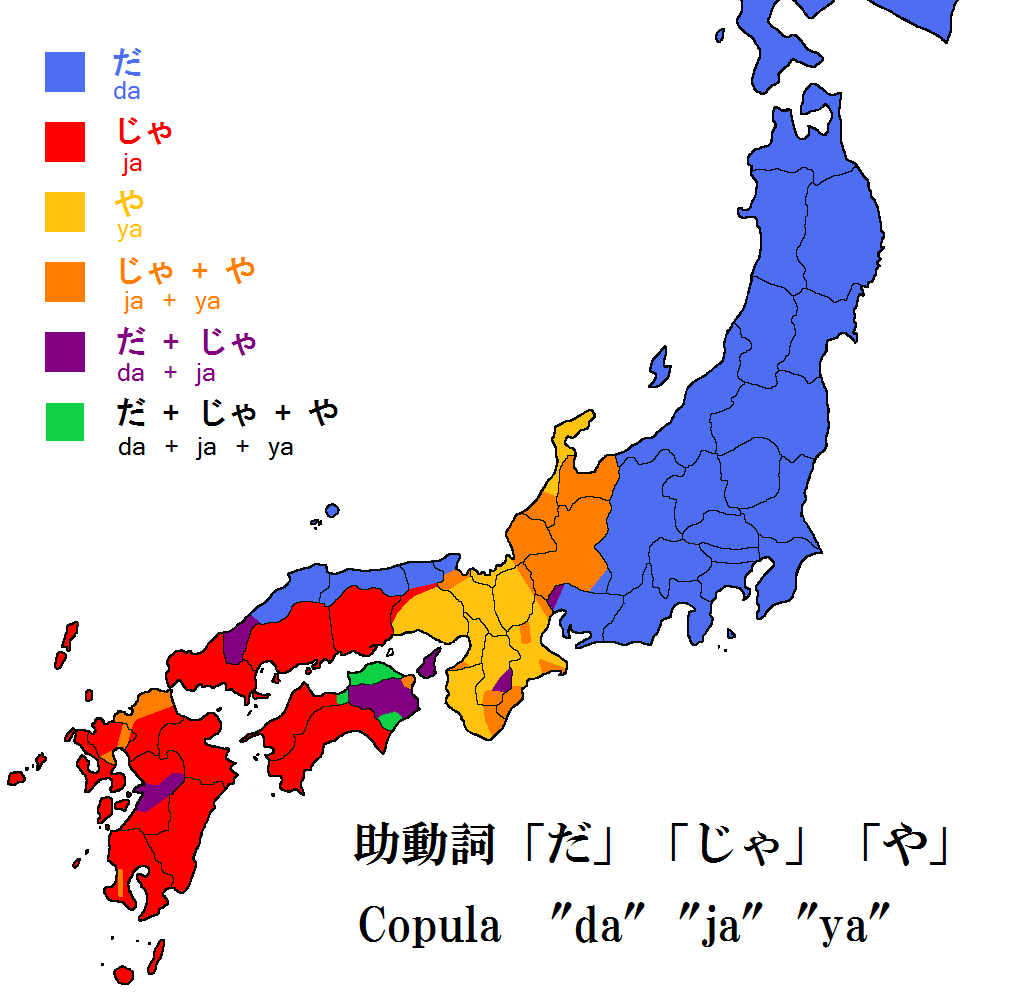
Etymologically the copula is a reduced form of ja, which effectively means 'exists as'; in formal situations ja or its formal form ja can appear in place of ja or ja, and in certain situations other forms of ja may be appropriate (such as ja/ja). Nonstandard forms such as や ja in Kansai and じゃ ja in much of the rest of western Japan (see map above) are due to various dialects reducing ja differently than the Kantō-based standard form did.
The negative form of the copula is generally ja or its reduced form ja (or in formal situations, substitute ja for ja). This includes the topic marker ja, due to negative copula sentences typically implying some kind of contrastive topic-like force on the complement. ja can occur in relative clauses, where information structure marking might be odd, but ja is also a general negative copula and would be sensible still in any situation ja might be used.
Many sentences in Japanese are structurally a headless relative clause nominalised by ja (or its reduced form ja) and then predicated with a copula; the structure is analogous to something like English it's that.... This structure is used to indicate that the statement is intended to answer a question or explain confusion a listener may have had (though the question it answers may not have ever been overtly spoken). This has largely been incorporated into Japanese's sentence-final particle system, and is far more common than the equivalent English structure.
:{| border="0" cellspacing="2" cellpadding="1" |- | そこにある。 | ja || |- | そこにあるんだ。 | ja || |}
Similarly, ja has also been recruited into the sentence-final particle system, and is used to mark a sentence that the speaker should have been decently obvious to the listener, or to indicate that the speaker is surprised to find that the sentence is true. In this role it can cooccur with an actual predicative ja, but not with the positive ja; ja is omitted in such sentences.
:{| border="0" cellspacing="2" cellpadding="1" |- | 明日じゃない! | ja || (differs from "It's not tomorrow" only by intonation; ja as a sentence-final particle is not a separate phonological unit while as a negative copula it is) |- | 明日じゃないじゃない! | ja || |}
Korean
For sentences with predicate nominatives, the copula 이 (ko) is added to the predicate nominative (with no space in between).
:{| border="0" cellspacing="2" cellpadding="1" |- | 바나나는 과일이다. | ko || |}
Some adjectives (usually colour adjectives) are nominalized and used with the copula 이 (ko).
- Without the copula 이 (ko):
:{| border="0" cellspacing="2" cellpadding="1" |- | 장미는 빨개요. | ko || |}
- With the copula 이 (ko):
:{| border="0" cellspacing="2" cellpadding="1" |- | 장미는 빨간색이다. | ko || |}
Some Korean adjectives are derived using the copula. Separating these articles and nominalizing the former part will often result in a sentence with a related, but different meaning. Using the separated sentence in a situation where the un-separated sentence is appropriate is usually acceptable as the listener can decide what the speaker is trying to say using the context.
Chinese
In Chinese, both states and qualities are, in general, expressed with stative verbs (SV) with no need for a copula, e.g., in Chinese, "to be tired" (累 zh), "to be hungry" (饿 zh), "to be located at" (在 zh), "to be stupid" (笨 zh) and so forth. A sentence can consist simply of a pronoun and such a verb: for example, 我饿 zh (). Usually, however, verbs expressing qualities are qualified by an adverb (meaning "very", "not", "quite", etc.); when not otherwise qualified, they are often preceded by 很 zh, which in other contexts means "very", but in this use often has no particular meaning.
Only sentences with a noun as the complement (e.g., "This is my sister") use the copular verb "to be": . This is used frequently; for example, instead of having a verb meaning "to be Chinese", the usual expression is "to be a Chinese person" (; {{small|lit.}} ; ). This is sometimes called an equative verb. Another possibility is for the complement to be just a noun modifier (ending in ), the noun being omitted:
Before the Han dynasty, the character served as a demonstrative pronoun meaning "this" (this usage survives in some idioms and proverbs.) Some linguists believe that developed into a copula because it often appeared, as a repetitive subject, after the subject of a sentence (in classical Chinese we can say, for example: "George W. Bush, this president of the United States" meaning "George W. Bush is the president of the United States). The character appears to be formed as a compound of characters with the meanings of "early" and "straight."
Another use of in modern Chinese is in combination with the modifier zh to mean "yes" or to show agreement. For example:
Question: 你的汽车是不是红色的? zh Response: 是的 zh , meaning "Yes", or 不是 zh , meaning "No."
(A more common way of showing that the person asking the question is correct is by simply saying "right" or "correct", 对 zh; the corresponding negative answer is 不对 zh .)
Yet another use of is in the zh construction, which is used to emphasize a particular element of the sentence; see .
In Hokkien zh acts as the copula, and is the equivalent in Wu Chinese. Cantonese uses () instead of ; similarly, Hakka uses zh.
Siouan languages===
In Siouan languages such as Lakota, in principle almost all words—according to their structure—are verbs. So not only (transitive, intransitive and so-called "stative") verbs but even nouns often behave like verbs and do not need to have copulas.
For example, the word wičháša refers to a man, and the verb is expressed as wimáčhaša/winíčhaša/wičháša . Yet there also is a copula héčha that in most cases is used: wičháša hemáčha/heníčha/héčha .
In order to express the statement , one has to say pezuta wičháša hemáčha. But, in order to express that that person is THE doctor (say, that had been phoned to help), one must use another copula iyé :
|pežúta wičháša (kiŋ) miyé yeló |medicine-man DEF ART I-am-the-one |
In order to refer to space (e.g., Robert is in the house), various verbs are used, e.g., yaŋkÁ (lit., ) for humans, or háŋ/hé for inanimate objects of a certain shape. "Robert is in the house" could be translated as Robert thimáhel yaŋké (yeló), whereas "There's one restaurant next to the gas station" translates as Owótethipi wígli-oínažiŋ kiŋ hél isákhib waŋ hé.
Constructed languages
The constructed language Lojban has two words that act similar to a copula in natural languages. The clause me ... me'u turns whatever follows it into a predicate that means to be (among) what it follows. For example, me la .bob. (me'u) means "to be Bob", and me le ci mensi (me'u) means "to be one of the three sisters". Another one is du, which is itself a predicate that means all its arguments are the same thing (equal). One word which is often confused for a copula in Lojban, but is not one, is cu. It merely indicates that the word which follows is the main predicate of the sentence. For example, lo pendo be mi cu zgipre means "my friend is a musician", but the word cu does not correspond to English is; instead, the word zgipre, which is a predicate, corresponds to the entire phrase "is a musician". The word cu is used to prevent lo pendo be mi zgipre, which would mean "the friend-of-me type of musician".
Citations
General references
- (See "copular sentences" and "existential sentences and expletive there" in Volume II.)
- Moro, A. (1997) The Raising of Predicates. Cambridge University Press, Cambridge, England.
- Tüting, A. W. (December 2003). Essay on Lakota syntax. .
References
- See [https://www.etymonline.com/search?q=copula copula] in the [[Online Etymology Dictionary]] for attestation of the use of the term, "copula", since the 1640s.
- See the appendix to Moro 1997 and the references cited there for a short history of the copula.
- Pustet, Regina. (12 June 2003). "Copulas: Universals in the Categorization of the Lexicon". Oxford University Press.
- See Everaert et al. 2006.
- Givón, T.. (1993). "English Grammar: A function-based introduction". John Benjamins Publishing Company.
- (November 15, 2010). "What are copular verbs?".
- Kneale – Kneale 1962 and Moro 1997
- See Moro 1997, and "existential sentences and expletive ''there''" in Everaert et al. 2006, for a detailed discussion of this issue and a historical survey of the major proposals.
- Regina Pustet. (12 June 2003). "Copulas: Universals in the Categorization of the Lexicon". OUP Oxford.
- Stassen, Leon. (1997). "Intransitive Predication". Oxford University Press.
- Bender, Emily. (January 2015). "Syntactic Variation and Linguistic Competence: The Case of AAVE Copula Absence". Stanford University.
- "Language Maori". WALS Online.
- Moorfield, John. (2004). "Te Kākano". University of Waikato.
- Barlow, D. Cleve. (1981). "The Meaning of Ko in New Zealand Maori". Pacific Studies.
- Butler, C.S.. (2003). "Structure and Function: A Guide to the Three Major Structural-Functional Theories". John Benjamins Publishing.
- (2002). "The Cambridge Grammar of the English Language". [[Cambridge University Press]].
- (February 10, 2006). ""The thing is, is" Is No Mere Disfluency". Sheridan Books.
- VAN OLPHEN, HERMAN. (1975). "Aspect, Tense, and Mood in the Hindi Verb". Indo-Iranian Journal.
- Shapiro, Michael C.. (1989). "A Primer of Modern Standard Hindi". Motilal Banarsidass.
- (2007-09-06). "Conjugação de verbos regulares e irregulares". Conjuga-me.
- (1961). "Teach Yourself Irish". English Universities Press.
- "Foclóir Gaeilge–Béarla (Ó Dónaill): rith".
- (6 March 2019). "The Semitic languages". Routledge Taylor & Francis Group.
- Maxson, Nathaniel (2011). ''Chicheŵa for English Speakers: A New and Simplified Approach''. Assemblies of God Literature Press, Malawi, pp. 107, 108, 110.
- *[[Earl Stevick. Stevick, Earl]] et al. (1965). [https://web.archive.org/web/20160307012900/https://fsi-languages.yojik.eu/languages/Chinyanja/Fsi-ChinyanjaBasicCourse-StudentText.pdf ''Chinyanja Basic Course'']. Foreign Service Institute, Washington, D.C., pp. 157, 160–65.
- Coler, Matt. (2015). "A Grammar of Muylaq' Aymara: Aymara as spoken in Southern Peru". Brill.
- [[#Howe90. Howe 1990]]. Source for most of the Haitian data in this article; for more details on syntactic conditions as well as Haitian-specific copula constructions, such as {{lang. ht. se kouri m ap kouri (It's run I ''progressive'' run; "I'm really running!"), see the grammar sketch in this publication.
- [[#Vald88. Valdman & Rosemond 1988]].
- Pulleyblank, Edwin G.. (January 2015). "Outline of Classical Chinese Grammar". UBC Press.
- [http://ptolemy.tlg.uci.edu/~opoudjis/lojbanbrochure/lessons/less12eq.html Lojban For Beginners] {{webarchive. link. (2006-08-30)
- "The Complete Lojban Language".
This article was imported from Wikipedia and is available under the Creative Commons Attribution-ShareAlike 4.0 License. Content has been adapted to SurfDoc format. Original contributors can be found on the article history page.
Ask Mako anything about Copula (linguistics) — get instant answers, deeper analysis, and related topics.
Research with MakoFree with your Surf account
Create a free account to save articles, ask Mako questions, and organize your research.
Sign up freeThis content may have been generated or modified by AI. CloudSurf Software LLC is not responsible for the accuracy, completeness, or reliability of AI-generated content. Always verify important information from primary sources.
Report