From Surf Wiki (app.surf) — the open knowledge base
Coptic cross
Cross associated with Coptic Christians
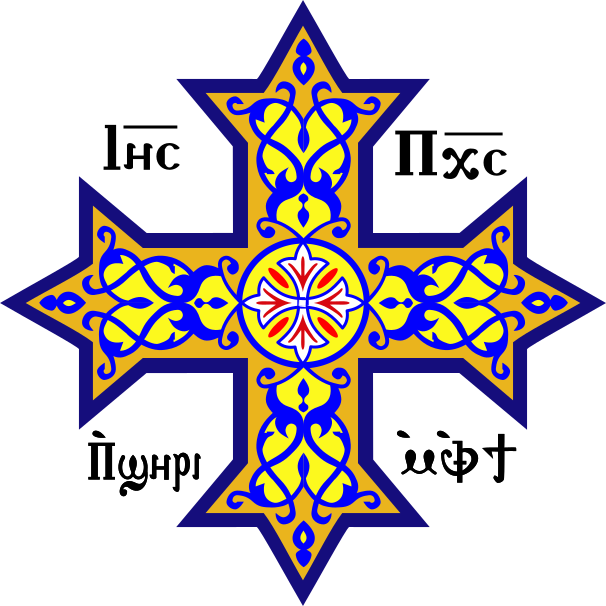
Cross associated with Coptic Christians
The Coptic cross is any of a number of Christian cross variants associated in some way with Coptic Christians.
Typical form
The typical form of the "Coptic cross" used in the Coptic Church is made up of two bold lines of equal length that intersect at the middle at right angles. Each line terminates in three points, representing the Trinity of the Father, the Son, and the Holy Spirit. Altogether, the cross has 12 points symbolizing the Apostles, whose mission was to spread the Gospel message throughout the world. The cross most commonly used in Coptic churches is the Trefoil Cross (also known as Coptic Cross), which was a developed locally from the short Greek cross. The Coptic crosses often have a circle at the center representing God's eternal and everlasting love, demonstrated through the crucifixion of Christ, Christ's halo, and resurrection.
Bertran de la Farge dates it to the 4th century and cites it as a predecessor of the Occitan cross.
In 1984, a modern variant of the Coptic cross composed of three bars intersecting at right angles in three dimensions was given as a gift by the Coptic Orthodox Church and mounted on the top of the All Africa Conference of Churches building since the Coptic Church is considered to be the mother church in Africa.
Popular culture
Many Copts have the cross tattooed as a sign of faith on the inside of their right arm at the wrist.
Gallery
|File:Codex Glazier 2.JPG|Illuminated early form of Coptic cross at the end of the 4th–5th century Coptic Codex Glazier |File:Coptic Relief.jpg|5th-century liturgical Coptic relief featuring the Coptic crux ansata |File:Painting of a Cross, Kellia.jpg|Wall painting of a jewelled cross (Kellia, Egypt, late 6th century) |File:Philae Temple of Isis coptic cross 1.JPG|Coptic cross from the Ancient Egyptian Temple of Philae |File:Coptic-Cross.svg|Basic abstract equal-armed cross design with circle at center and surrounded by 4 nails. Called a "Coptic" cross by Rudolf Koch in his The Book of Signs (Dover); may not be prominent in Coptic Christian symbolism in this form. |File:Brooklyn Museum 2000.123.1 Processional Cross.jpg|Ethiopian Orthodox Processional cross from the Amhara Region (mid-20th century) |File:0019 Coptic Christian hand held blessing cross, Cairo 2010.JPG|Coptic priest holding a hand-held blessing cross (Cairo, 2010)
References
References
- (13 April 2014). "Patriarcato Copto Cattolico – Home".
- (2004). "Symbols: Encyclopedia of Western Signs and Ideograms". Ionfox AB.
- Goldman, Ari L.. (1989-10-10). "Coptic Pope's Visit Cheers Faithful – The". New York Times.
- Ramzy, Nelly. (2014). "Symbolism in Coptic Architecture: The Power of ‘Meaning’ in Architectural Expression". International Journal of Architecture and Infrastructure Planning.
- (n.d.). "La croix occitane, dossier réalisé par O.Lamarque et C.Pujol, d'après un texte de Bertran de la Farge".
- "Coptic Africa".
- (2022-03-03). "The Story Behind the Coptic Cross Tattoo". Coptic Solidarity.
This article was imported from Wikipedia and is available under the Creative Commons Attribution-ShareAlike 4.0 License. Content has been adapted to SurfDoc format. Original contributors can be found on the article history page.
Ask Mako anything about Coptic cross — get instant answers, deeper analysis, and related topics.
Research with MakoFree with your Surf account
Create a free account to save articles, ask Mako questions, and organize your research.
Sign up freeThis content may have been generated or modified by AI. CloudSurf Software LLC is not responsible for the accuracy, completeness, or reliability of AI-generated content. Always verify important information from primary sources.
Report