From Surf Wiki (app.surf) — the open knowledge base
Cooper pair
Pair of electrons bound together at low temperature, allowing for superconductivity
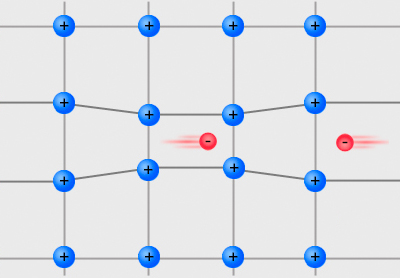
Pair of electrons bound together at low temperature, allowing for superconductivity
In condensed matter physics, a Cooper pair or BCS pair (Bardeen–Cooper–Schrieffer pair) is a pair of electrons (or other fermions) bound together at low temperatures in a certain manner first described in 1956 by American physicist Leon Cooper.
Description
Cooper showed that an arbitrarily small attraction between electrons in a metal can cause a paired state of electrons to have a lower energy than the Fermi energy, which implies that the pair is bound. In conventional superconductors, this attraction is due to Bardeen–Pines interaction, a type of electron–phonon interaction. The Cooper pair state is responsible for superconductivity, as described in the BCS theory developed by John Bardeen, Leon Cooper, and John Schrieffer for which they shared the 1972 Nobel Prize in Physics. | access-date = 2008-07-24
Although Cooper pairing is a quantum effect, the reason for the pairing can be seen from a simplified classical explanation.
The energy of the pairing interaction is quite weak, of the order of 10−3 eV, and thermal energy can easily break the pairs. So only at low temperatures, in metal and other substrates, are a significant number of the electrons bound in Cooper pairs.
The electrons in a pair are not necessarily close together; because the interaction is long range, paired electrons may still be many hundreds of nanometers apart. This distance is usually greater than the average interelectron distance so that many Cooper pairs can occupy the same space.

The BCS theory is also applicable to other fermion systems, such as helium-3. Indeed, Cooper pairing is responsible for the superfluidity of helium-3 at low temperatures.
Relationship to superconductivity
The tendency for all the Cooper pairs in a body to "condense" into the same ground quantum state is responsible for the peculiar properties of superconductivity.
Cooper originally considered only the case of an isolated pair's formation in a metal. When one considers the more realistic state of many electronic pair formations, as is elucidated in the full BCS theory, one finds that the pairing opens a gap in the continuous spectrum of allowed energy states of the electrons, meaning that all excitations of the system must possess some minimum amount of energy. This gap to excitations leads to superconductivity, since small excitations such as scattering of electrons are forbidden. | access-date = 2008-07-24}} The gap appears due to many-body effects between electrons feeling the attraction.
R. A. Ogg Jr., was first to suggest that electrons might act as pairs coupled by lattice vibrations in the material. This was indicated by the isotope effect observed in superconductors. The isotope effect showed that materials with heavier ions (different nuclear isotopes) had lower superconducting transition temperatures. This can be explained by the theory of Cooper pairing: heavier ions are harder for the electrons to attract and move (how Cooper pairs are formed), which results in smaller binding energy for the pairs.
The theory of Cooper pairs is quite general and does not depend on the specific electron-phonon interaction. Condensed matter theorists have proposed pairing mechanisms based on other attractive interactions such as electron–exciton interactions or electron–plasmon interactions. Currently, none of these other pairing interactions has been observed in any material.
Although the term Cooper pairs is commonly used, it is more accurate to speak of Cooper pairing, as superconductivity does not arise from individual electrons binding into localized "quasi-bosons" that would follow Bose–Einstein statistics. Rather, by forming a coherent many-body ground state, electrons make optimal use of the available phase space under the Pauli exclusion principle.**
References
References
- (November 2018). "Superfluid helium-3 in confined quarters". Physics Today.
- "Cooper Pairs of Bosons".
- Ogg, Richard A.. (1 February 1946). "Bose-Einstein Condensation of Trapped Electron Pairs. Phase Separation and Superconductivity of Metal-Ammonia Solutions". American Physical Society (APS).
- Poole Jr, Charles P, "Encyclopedic dictionary of condensed matter physics", (Academic Press, 2004), p. 576
- Bardeen, John. (1973). "Cooperative Phenomena". Springer Berlin Heidelberg.
This article was imported from Wikipedia and is available under the Creative Commons Attribution-ShareAlike 4.0 License. Content has been adapted to SurfDoc format. Original contributors can be found on the article history page.
Ask Mako anything about Cooper pair — get instant answers, deeper analysis, and related topics.
Research with MakoFree with your Surf account
Create a free account to save articles, ask Mako questions, and organize your research.
Sign up freeThis content may have been generated or modified by AI. CloudSurf Software LLC is not responsible for the accuracy, completeness, or reliability of AI-generated content. Always verify important information from primary sources.
Report